That Time NASA Discovered Life on Earth

Hello, friends!

As some of you may already know, there is life on Earth.  NASA discovered that fact in 1990.  Let me explain.

In the decades prior to the Space Age, certain astronomers had claimed to observe vegetation growing on the Moon, artificial canals on the face of Mars, and some scientists even speculated that beneath the clouds of Venus (which were surely H2O clouds), we might find a world dense with jungle.  Writers and philosophers had long speculated about how other worlds might be populated by other people, and at least a few theologians argued that there must be life on other planets (for why would God create all these planets and then leave them empty?).

And yet, as both the Soviet and American space programs ventured farther and farther out into space, they found nothing.  No vegetation on the Moon (not even on the far side of the Moon).  No canals on Mars.  Definitely no jungles on Venus (and as for Venus’s clouds, it turns out they’re not made of H2O—they’re not made of H2O at all!!!).

I don’t want to make it sound like everybody expected to find life on the Moon, Mars, or elsewhere, but a lot of people were expecting to find life.  So what happened?  Why couldn’t our space probes find life on any of the other worlds of the Solar System?  There were two possible explanations.  Either there was no life out there to find, OR something was wrong with our space probes.  Maybe they weren’t carrying the right equipment to detect life, or maybe they weren’t performing their experiments properly, or maybe they weren’t sending the correct data back to Earth.

Which brings us to 1990.  NASA’s Galileo spacecraft was heading out to Jupiter, but for navigational reasons it needed to do a quick flyby of Earth first.  A certain scientist named Carl Sagan saw this Earth flyby as an opportunity.  What would happen if Galileo did a thorough scan of our home planet?  Could this fairly standard NASA space probe, equipped with a fairly standard suite of scientific instruments, detect life on a planet where we already knew life existed?

The results were published a few years later in a paper entitled “A search for life on Earth from the Galileo spacecraft.”  This “search for life on Earth” paper is my all time favorite scientific research paper.  First of all, for a scientific paper, it’s a surprisingly easy read.  Turns out Carl Sagan was a good writer with a knack for explaining science in a clear and accessible manner.  Who knew?  Secondly, the experiment itself is really cool.  And third, the results of the experiment are a little more ambiguous than you might expect.

Among other things, Galileo detected both oxygen and methane in Earth’s atmosphere.  If you didn’t already know there was life on Earth, it would be difficult to explain how those two chemicals could both be present.  Oxygen and methane should react with each other.  They should not exist together in the same planet’s atmosphere for very long—not unless something unusual (like biological activity) continuously pumps more oxygen and more methane into the atmosphere.

Additionally, Galileo noticed a strange “red-absorbing” substance widely distributed across Earth’s landmasses.  This mystery substance could not be matched with any known rock or mineral, suggesting a possible biological origin.  This red-absorbing mystery substance was, in fact, chlorophyll—the chemical that allows plants to perform photosynthesis.

And lastly, Galileo picked up radio transmissions.  Galileo couldn’t determine the content of these transmissions, but the transmissions were clearly artificial—an indication that there is not only life but intelligent life on Earth.

I’ve read this “search for life on Earth” paper several times over the years.  Like The Lord of the Rings or Ender’s Game, it’s one of those things I love to read again and again, and each time I feel like I get a little more out of it.  The main take away, I have come to believe, is that if there were anything similar—anything even remotely similar—to Earth’s biosphere on the Moon or Mars or anywhere else in the Solar System, we would know about it.  Our space probes would absolutely be able to detect something like that.

However, there’s still a lot of stuff here on Earth that the Galileo probe missed.  Some little details, for example: chlorophyll absorbs both red and blue light, but Galileo apparently didn’t notice the blue absorption.  Only the red.  And Galileo overlooked some big things, too.  Cities, roadways, the Great Wall of China?  Maybe a follow-up mission to Earth would find those things, but Galileo didn’t see any of that stuff.  And then there’s Earth’s oceans.  Galileo couldn’t detect anything beneath the surface of the water.  Water very effectively blocked all of Galileo’s sensors.

So our space probes are not fundamentally flawed, but they do have a few blind spots.  Today, no one expects to find jungles on Venus or canals on Mars.  Our space probes say those things aren’t there, and we can be confident that our space probes are working properly.  But there are a few niche environments out there were alien life might still be hiding.

WANT TO LEARN MORE?

Science communicators (myself included) dumb things down for their readers, which is why reading actual scientific papers has become an important part of my research process.  Dumbed down science is fine, provided it still says what the actual scientific research says.  But reading these sorts of papers is a skill, and it takes some time and practice to do it.  If you’ve ever wanted to start reading scientific papers for yourself, “A search for life on Earth from the Galileo spacecraft” by Carl Sagan et al. is a good starter paper.

Sciency Words: Chromophore

Hello, friends!  Welcome to Sciency Words, a special series here on Planet Pailly where we take a closer look at those weird words scientists use.  Today’s Sciency Word is:

CHROMOPHORE

Recently, just for fun, I was watching an old interview with Carl Sagan (the same interview I cited in Wednesday’s post, by the way).  Around 25 minutes into that interview, Sagan talks a little about Jupiter, and he mentions that Jupiter’s distinctive coloration is caused by something called “chromophores.”

Sagan then goes on to say, flippantly, that we call it a chromophore because “we don’t know what it is.”  But the word chromophore is not quite a meaningless placeholder term for a thing we don’t understand (like dark matter).

Definition: A chromophore is a group of atoms within a larger molecule that are responsible for giving that molecule its color.  So, for example, chlorophyll molecules have chromophores in them that soak up red and blue light, thus giving chlorophyll its characteristically green appearance.

Etymology: Chromophore comes from two Greek words meaning “color” and “bearing.”  According to the Oxford English Dictionary, the earliest recorded usage of the word is in this 1879 dictionary of chemistry.  The word appears in a section about the chemical reactions used to make dyes.

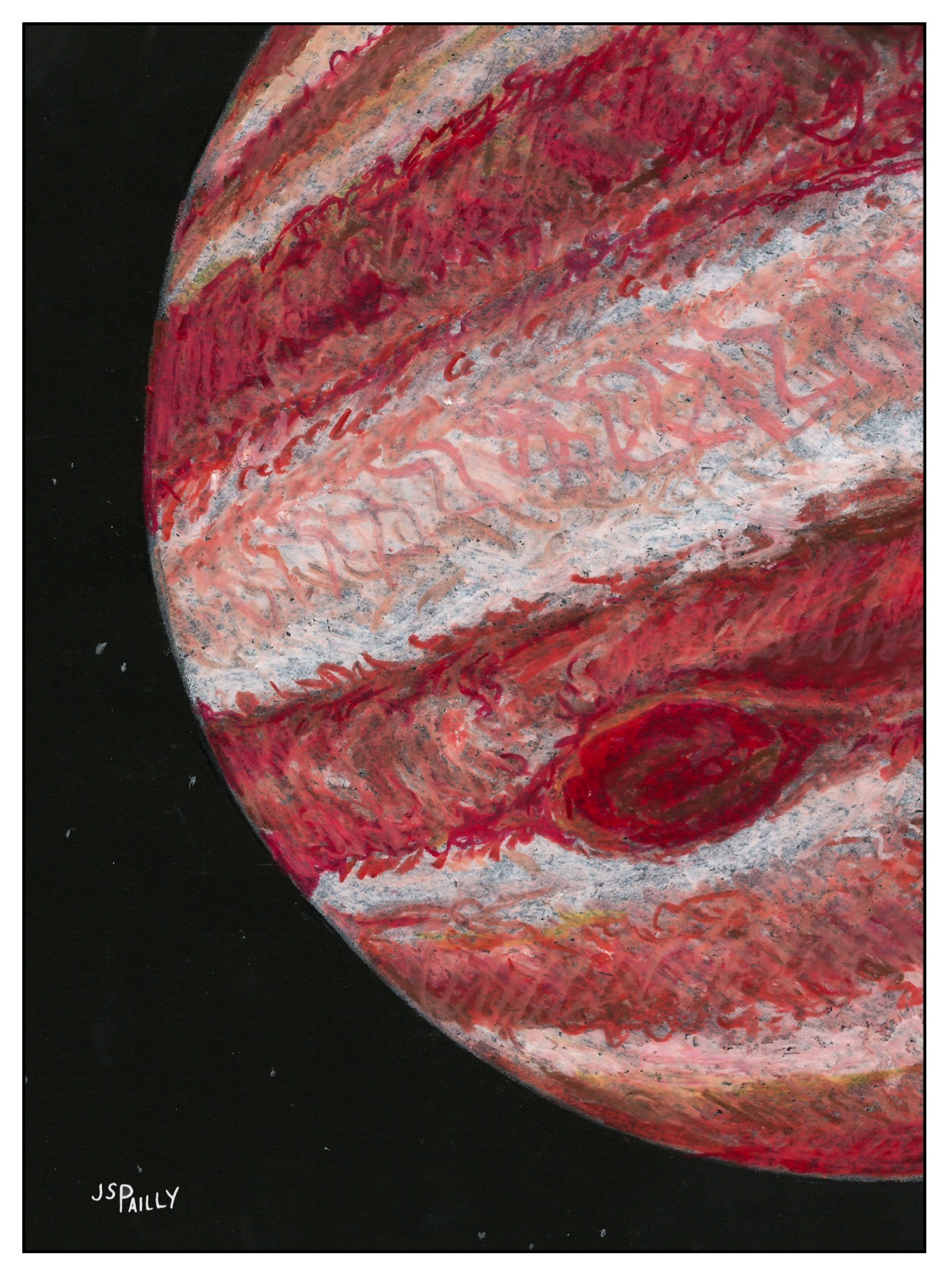
Fun fact: just like the planet Jupiter, the oil pastels I used to draw this picture of Jupiter contain “chromophores.”

To say that Jupiter’s coloration is caused by chromophores is absolutely correct, but somewhat unhelpful.  It’s like asking “what caused that sound?” and being told “vibrations of the air.”  But, at least for now, it seems we don’t have a better answer.  To the best of my knowledge, we still don’t know which chemicals, specifically, are responsible for giving Jupiter his distinctive coloring (though Jupiter researchers have a lot of plausible-sounding guesses).

But whatever those chemicals are, they must contain chromophores.  Almost by definition, that must be true.

Shameless Self Promotion Time: Looking for Jupiter T-shirts, Jupiter notebooks, or other Jupiter-themed stuff?  Click here to check out all the Jupiter-related products available in the Planet Pailly store on Redbubble!

Is There Life on Earth?

Hello, friends!

Let’s imagine some space aliens are cruising by our Solar System.  They turn their scanners on our planet and see… what?

Among other things, they’d notice that Earth’s landmasses are partially covered with a strange, green-colored substance.  Of course, you and I know what that green substance is.  It’s chlorophyll.  But would those extraterrestrial observers, who have no prior knowledge of our planet, be able to figure that out?  Even if they did, would they realize what chlorophyll is used for?  Maybe.  Probably not, though.

Which brings me to my all-time favorite scientific paper: “A search for life on Earth from the Galileo spacecraft,” by Carl Sagan et al.  I love this paper in part because it’s so clearly and concisely written, with jargon kept to a minimum.  Sagan was, after all, a talented science communicator.  But I also love this paper because its conclusions are so shocking, so eye-opening.

In 1990, NASA’s Galileo spacecraft turned all its high-tech instruments toward Earth and detected… not much, actually.  Galileo did pick up radio broadcasts emanating from the planet’s surface.  Aside from that, though, Galileo’s data offered highly suggestive (but also highly circumstantial) evidence on Earthly life.  The lesson: finding life on other planets is hard.  Even using our very best equipment, it was hard for NASA to detect signs of life right here on Earth!

At least that’s what I got out of reading Sagan’s Galileo experiment paper.  And based on various commentaries I’ve read or heard about this paper, that seems to be the lesson other people got out of it too.  So I was surprised to hear Sagan himself, approximately seven-and-a-half minutes into this interview, saying the exact opposite.

We’ve flown by some sixty worlds.  We claim that we haven’t found life anywhere, and that that is a significant result.  That is, that we would have found life had it been there.  But this has never been calibrated.  We’ve never flown by the Earth with a modern interplanetary spacecraft, all instruments on, and detected life here.  And so Galileo, because of this peculiar gravity assist VEEGA trajectory, permits us to do that.  And as I’ll describe tomorrow, we find life five or six different ways, including intelligent life.  And this then means that the negative results that we find elsewhere are, in fact, significant.

I’ve been puzzled by this for a while now, but I think I’ve finally figured out why Sagan would say this.  It’s politics.

On the one hand, scientists need to understand the challenges they’ll face (including the limitations of their own equipment) in searching for life on other worlds.  That really is, I think, the purpose of the Galileo experiment paper.  On the other hand, it would not do to say on public television, to cantankerous taxpayers and the listening ears of Congress, that NASA spends millions of dollars on space probes that are not even capable of detecting life right here on Earth.

Space exploration is expensive.  And like all expensive types of research, sooner or later the researchers involved have to learn how to play politics.

Sciency Words: Euphotic Zones

Sciency Words: (proper noun) a special series here on Planet Pailly focusing on the definitions and etymologies of science or science-related terms.  Today’s Sciency Word is:

EUPHOTIC ZONES

Based on what Google ngrams has to tell me, it looks like “euphotic” and “euphotic zone” entered the English lexicon right at the start of the 20th Century, then really caught on circa 1940.

The word euphotic is a combination of Greek words and means something like “good lighting” or “well lit.”  In the field of marine biology, the euphotic zone refers to the topmost layer of the ocean, or any body of water, where there’s still enough sunlight for photosynthesis to occur.

My first encounter with this term was in this paper by astrophysicists Carl Sagan and Edwin Salpeter.  Sagan and Salpeter sort of co-opted this term from marine biologists and applied it to the layer of Jupiter’s atmosphere where—hypothetically speaking—Jupiterian life might exist.

I don’t see any reason why the term could not also by used for other planets as well.  There’s a euphotic zone just above the cloud tops of Venus.  The same could be said about Saturn or Uranus.  Or maybe if the ice is thin enough, we may find euphotic zones right beneath the surfaces of Europa or Enceladus.

Of course just because a planet has a euphotic zone, that doesn’t mean photosynthetic organisms are living there.  And also there are plenty of ecosystems here on Earth that do not depend on photosynthesis and that don’t exist anywhere near a euphotic zone.

Still, I’m very glad to have picked up this term.  The concept of euphotic zones can be very helpful in any discussion of where alien life may or may not be hiding.

Sciency Words: Sinkers, Floaters, and Hunters

Sciency Words: (proper noun) a special series here on Planet Pailly focusing on the definitions and etymologies of science or science-related terms.  Today’s Sciency Word is:

SINKERS, FLOATERS, and HUNTERS

In the 1970’s, Carl Sagan and fellow astrophysicist Edwin Salpeter were curious about the orangey-red coloration seen on certain parts of Jupiter.  That sort of orangey-red color is frequently associated with organic chemistry (see my post on tholin).

So in this 1976 technical report for NASA, Sagan and Salpeter hypothesize that we really are seeing organic compounds in Jupiter’s atmosphere.  They then go on to imagine what kind of life might develop on a planet like Jupiter.  As a frame of reference, they start by describing one specific example of life here on Earth:

The best analogy seems to be the surface of the sea.  Oceanic phytoplankton inhabit a euphotic zone near the ocean surface where photosynthesis is possible.  They are slightly denser than seawater and passively sink out of the euphotic zone and die.  But such organisms reproduce as they sink, return some daughter cells to the euphotic zone through turbulent mixing, and in this way maintain a steady state population.

So if microorganisms exist on Jupiter, perhaps they follow a similar lifecycle.

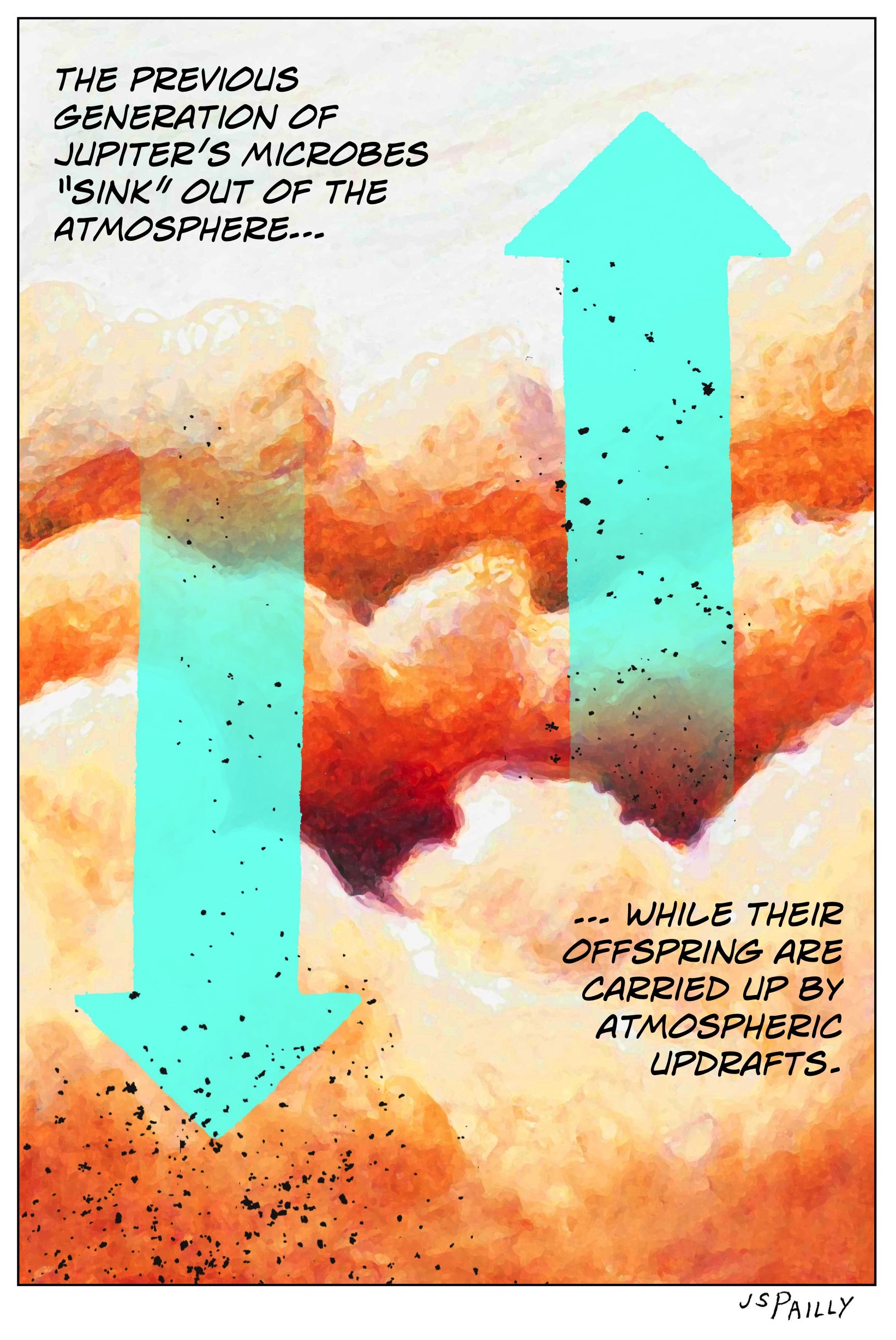
Sagan and Salpeter name these hypothetical microorganisms “sinkers,” since sinking is pretty much the defining characteristic of their lifecycles.  But if these sinkers really do exist, then Jupiter may be able to support other, more complex forms of life as well.

Sagan and Salpeter go on to describe “floaters.” Floaters would be giant organisms, perhaps several kilometers in radius.  In order to remain buoyant, they’d have to have very thin skin and be filled with a lifting gas like hydrogen.  Floaters would drift aimlessly through the skies of Jupiter, feeding on the rising and falling swarms of sinkers.

And then there would be “hunters,” as Sagan and Salpeter call them, though that term may be misleading.  Hunters would be able to maneuver deliberately through the air, “hunting” for other organisms.  But these hunters would not eat their prey, at least not in the way we understand eating.  Instead, through a process called “coalescence,” the hunter and the hunted would merge together as one giant super-organism.

Personally, I think Sagan and Salpeter let their imaginations run a little too wild in this paper.  Could life exist on Jupiter?  Sure.  The universe is full of possibilities.  Can we predict with any specificity what life on Jupiter would be like?  I doubt it.

Still, the Jovian ecosystem that Sagan and Salpeter described seems plausible enough.  For the purposes of science fiction, it deserves some attention, and it inspired the short story I posted on Monday.  However, if you haven’t read that story yet, I have to confess (spoiler warning): it turns out the planet in that story is not Jupiter.

Beware Wishful Thinking: A Science Lesson

This may seem like a contradiction. Astrobiologists are actively searching for alien life.  It’s their job.  And yet whenever new evidence of alien life is presented, astrobiologists are the first and most vocal skeptics about it.  If your job is to search for alien life, why would you be so quick to doubt any evidence that alien life actually exists?

This goes back to the famous “extraordinary claims require extraordinary evidence” line from Carl Sagan, or the whole proof beyond a reasonable doubt thing I kept saying during my recent A to Z series on the search for alien life.  Astrobiologists very much do want to find alien life.  They’re eager to find it.  Perhaps a little too eager.

And thus, astrobiologists have to be careful.  They have to be extra skeptical, because they have to be on guard against their own wishful thinking.

And really, this is not only true in the field of astrobiology; it’s true of science in general.  And frankly, it’s a valuable lesson for us all, even if you’re not a scientist.

I can’t tell you how many times I’ve really wanted to believe something.  I’ve really wanted to believe that some girl likes me, or that I’ve put my money in sound investments, or that I’ve voted for the right people.  And when you really want to believe something, you’ll latch onto whatever flimsy evidence you can find to prove to yourself that it’s true.

Astrobiologists know this.  Scientists know this (or at least they’re supposed to).  And I think it’s good advice for us all to live by.  The more you want to believe something, the more you should question and doubt it.  Always, always, always be on guard against your own wishful thinking.

Sciency Words A to Z: Tholin

Welcome to a special A to Z Challenge edition of Sciency Words!  Sciency Words is an ongoing series here on Planet Pailly about the definitions and etymologies of science or science-related terms.  In today’s post, T is for:

THOLIN

Have you ever been stuck trying to say something, but you just don’t have the right words to say it?  In the 1970’s, planetary scientists Carl Sagan and Bishun Khare had that problem.

They’d conducted a series of experiments using gaseous chemicals that were known to be common in outer space, chemcials like ammonia, methane, water, hydrogen sulfide… they mixed all these chemicals together and zapped them with either an electric spark or ultraviolet light.  Then they studied the orangey-brown gunk that formed as a result.

Initially, this gooey gunk was thought to be a polymer, but as reported in this 1979 paper, Sagan and Khare soon determined that wasn’t what it was.

It is clearly not a polymer—a repetition of the same monomeric unit—and some other term is needed.

Sagan and Khare propose the word “tholin,” which is sort of a pun.  It’s taken from two Greek words that are spelled the same, except for an accent mark that’s shifted from one vowel to another.  One word means “muddy,” the other means “dome” or “vault,” as in the great dome or vault of the sky.  Sagan and Khare go on to mention that they were “tempted by the phrase ‘star-tar.’”

Tholin may be present on some asteroids and comets, and tholin or tholin-like material has been observed on several moons in the outer Solar System, most notably Titan.  We may have even found tholin on Pluto, and several other red-hued dwarf planets could have it too.

So what specifically is this stuff?  Well, I can’t really say.  Tholin is not a specific substance but rather a general category of organic matter.  As planetary scientist Sarah Hörst explains in this article:

The best analogy I have been able to come up with is “salad.”  Salad, like tholin, is a mixture of a number of different compounds and spans a fairly broad range of materials.  Most of us would agree on a case by case basis whether or not something is a salad, but the definition is not at all specific and the material itself depends on the starting materials, temperature, etc.

So there are many different tholins out there.  The tholin we might find inside a comet is probably different from the tholin we find on Pluto, which is different from the tholin we find on Titan.  What all these tholins have in common is that they’re the kind of yucky gunk you’d expect life to make, except life didn’t make it.

However, while life doesn’t make tholin, tholin could, in theory, be used to make life.  Or at least, once life gets started, tholin can serve as a source of food for primitive microorganisms.

Titan has long been the poster child for tholin chemistry, simply because Titan has so much of this stuff.  More than enough, you’d think, for some sort of biological activity to get started—assuming it hasn’t already!  However, with all that tholin lying around, sending astronauts to explore Titan properly may prove to be a sticky proposition.

Next time on Sciency Words A to Z, there’s no way we’ll find life on Venus… right?

Sciency Words A to Z: METI

Welcome to a special A to Z Challenge edition of Sciency Words!  Sciency Words is an ongoing series here on Planet Pailly about the definitions and etymologies of science or science-related terms.  In today’s post, M is for:

METI

In a sense, SETI researchers are just sitting by the phone waiting for somebody to call.  Maybe that’s the wrong way to go about it.  Maybe it’s time to pick up the phone, start dialing numbers, and see who picks up.

This idea is sometimes called active SETI, but it’s more common (and according to this paper, more appropriate) to use the term METI: the messaging of extraterrestrial intelligence.

Earth has been broadcasting TV and radio signals for over a century.  This has led to a common misconception that even now, aliens on some far off planet might be gathering around their equivalent of a television set, watching old episodes of Howdy Doody  or The Honeymooners.  Or perhaps, if the aliens live nearby, they’re currently listening to our more recent music.

But Humanity is only a Type 0 or Type I civilization, depending on which version of the Kardashev scale you’re using. Either way, our broadcasts are not actually that strong.  As David Grinspoon explains in his book Earth in Human Hands:

Our television signals are diffuse and not targeted at any star system.  It would take a huge antenna, much larger than anything we’ve built or planned, to pick up on them.  From a radio point of view our planet is not completely hidden, but it is hardly conspicuous.  This could easily change.  Targeted messages sent directly toward nearby stars would cause Earth suddenly to turn on like a spotlight, becoming an obvious beacon announcing, for better or worse, “We are here!”

Of course we’ve already done this.  Several times, in fact.  But not with enough consistency to truly make our presence known.

The first attempt was in 1974, when Frank Drake and Carl Sagan transmitted a message from the Arecibo radio telescope in Puerto Rico, aimed at the M13 globular cluster.  But according to Grinspoon, if aliens ever do pick up that signal, “[…] they might dismiss it as a momentary fluke.  We would.”  That’s because the Arecibo message was a quick, one-time thing.  By itself, it’s hardly proof beyond a reasonable doubt that life exists on Earth.

If we really want to get somebody’s attention, we have to send a sustained, repetitive signal, kind of like those repetitive radio pulses Jocelyn Bell detected in the 60’s.  We have the technology.  We can make METI a reality.  But should we?  Some say yes, others no.  After all, we have no idea who might hear our signal, or what form their response might take, and there is no guarantee that the aliens will be friendly.

METI is a discussion and a debate that maybe we all, as a species, should be part of.  Perhaps we should take a vote, because in the end, we all have a stake in what might happen.  And while we’re at it, there are some other issues we all, as a species, should vote on.  Or at least that’s what Grinspoon says we should do in his book.

Next time on Sciency Words A to Z, we’ll go back in time and check out the oceans of Mars.

Sciency Words A to Z: The Drake Equation

Welcome to a special A to Z Challenge edition of Sciency Words!  Sciency Words is an ongoing series here on Planet Pailly about the definitions and etymologies of science or science-related terms.  In today’s post, D is for:

THE DRAKE EQUATION

In 1961, American astronomer Frank Drake proved that alien life exists.  He didn’t do this with a telescope or by analyzing a Martian meteorite. No, Frank Drake proved it with math, pure and simple.  Or at least that’s the impression some people seem to get when they first hear about the Drake equation.

The Drake equation was first presented in 1961 at a conference held at the Green Bank Telescope in West Virginia. Only ten people were in the audience when Drake gave his presentation (one of those ten people, by the way, was a young Carl Sagan).  And the topic to be discussed at this conference: a new and highly controversial idea called SETI.

In this article from Universe Today, Drake is quoted explaining what inspired his equation:

As I planned the meeting, I realized a few day[s] ahead of time we needed an agenda. And so I wrote down all the things you needed to know to predict how hard it’s going to be to detect extraterrestrial life.  And looking at them it became pretty evident that if you multiplied all these together, you got a number, N, which is the number of detectable civilizations in our galaxy.

After reading All These Worlds Are Yours by Jon Willis, I’ve come to think of the Drake equation as a to-do list for astrobiologists.

N = R* · fp · ne · fl · fi · fc · L
  • Figure out how many stars are born in our galaxy per year (R*).
  • Figure out how many of those stars have planets (fp).
  • Figure out how many of those planets could support life (ne).
  • Figure out how many planets that could support life actually do (fl).
  • Figure out how often life evolves into intelligent life (fi).
  • Figure out how often intelligent life develops radio communications that we could detect (fc).
  • Figure out how long the average intelligent civilization keeps its radio equipment working (L).

Like I said, it’s a to-do list.  It’s presented in the form of an equation because… well, you know… scientists.

At this point, we have a pretty good feel for the first two variables in the Drake equation.  As stated in this article from Astronomy Magazine, 1.5 to 3 new stars are born per year in our galaxy, and each star has at least one planet, on average.  Current and upcoming missions should start to pin down real numbers for the number of planets that could potentially support life.

Beyond that, those questions do get progressively harder, but astrobiologists are steadily working their way down their to-do list—or rather, they’re working their way through the equation, starting from the left and heading to the right.  Answers are coming, slowly but surely.

Next time on Sciency Words A to Z, when astrobiologists talk about Earth-like planets, what exactly does that mean?

Sciency Words A to Z: Carbon Chauvinism

Welcome to a special A to Z Challenge edition of Sciency Words!  Sciency Words is an ongoing series here on Planet Pailly about the definitions and etymologies of science or science-related terms.  In today’s post, C is for:

CARBON CHAUVINISM

According to legend, Nicolas Chauvin was a French soldier during the Napoleonic Wars.  He’s described as being boastfully patriotic and doggedly loyal to Napoleon even long after Napoleon was defeated.  He was basically a joke, a caricature of a Napoleon supporter in a post-Napoleonic Europe.  And it is from Nicolas Chauvin’s name that we get the word chauvinism.

Carbon chauvinism is a term coined by Carl Sagan.  It refers to a common attitude among scientists that carbon-based life is the only kind of life that’s possible in our universe.  There are other kinds of chauvinism that the science of astrobiology has to contend with (just you wait until we get to the letter R), but carbon chauvinism is the big one, followed closely by water chauvinism.

In this 1973 interview with Rolling Stone, Sagan had this to say:

There’s carbon chauvinism, water chauvinism—you know, people who say that life elsewhere can only be based on the same chemical assumptions as we are.  Well, maybe that’s right.  But because the guys making that statement are based on carbon and water, I’m a little suspicious.

And yet despite Sagan’s little suspicions, he goes on to say in that same interview that he is a carbon chauvinist himself. And I have to admit, so am I. Carbon chauvinism is the one and only chauvinism I know of that seems to be justified.  As Sagan says:

Having gone through the alternative possibilities, I find that carbon is much better suited for making complex molecules, and much more abundant than the other things that you might think of.

Silicon is often suggested as a possible alternative to carbon, and silicon-based life forms are everywhere in science fiction. Carbon and silicon do have a great deal in common, chemically speaking.  But where carbon-based molecules are nice and wiggly—perfectly suited for all the wiggly activities of life—silicon-based molecules tend to be inflexible and kind of brittle.

So if you want to be a rock, silicon’s great! But if you want to be a life form, it’s hard to imagine why you would choose to base your biochemistry on silicon rather than carbon—carbon’s just objectively better in every way!

But then again, I am one of those people Sagan was talking about: one of those guys based on carbon.  Maybe you should be a little bit suspicious of my biases.

Next time on Sciency Words A to Z, let’s count our aliens before they’ve hatched, so to speak.  Exactly how many alien civilizations do we expect to find out there?