This weekend, BioWare launched a copy of their new video game, Mass Effect 3, into space via weather balloon. Whoever found it when it landed, wherever it landed, could keep it. My friend Jim and I spent Saturday chasing this weather balloon, tracking its GPS signal, and were within 10 miles of its landing site when someone else claimed it.
 Fun publicity stunts aside, Mass Effect is a good game for those of us who enjoy the science part of science fiction. Much of the story revolves around the discovery of a new element on the periodic table, an element with an atomic number of zero. The strange qualities of “element zero” make all kinds of things possible, from artificial gravity to faster than light travel, as well as a few pretty cool guns.
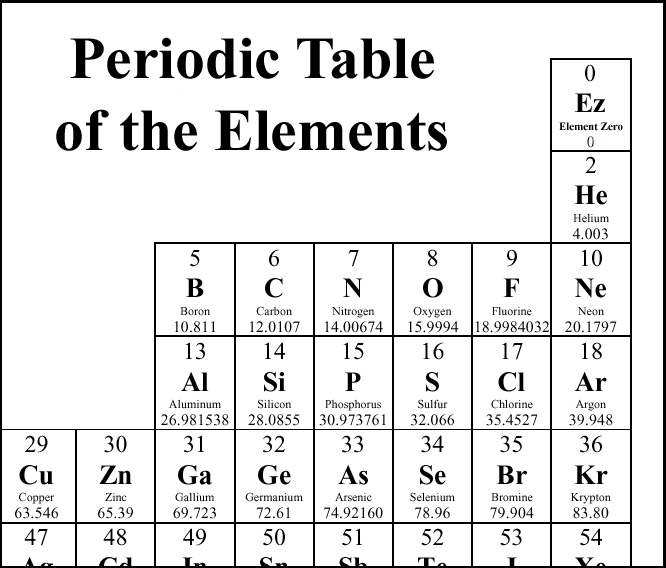 Thing is, scientists once thought to include an element zero in the real periodic table. They called it neutronium. As you may remember from high school science, most atoms are made from protons, neutrons, and electrons, with the number of protons determining the atomic number. A neutronium atom has no protons; it is a single, free-floating neutron.
Scientists today don’t generally consider free-floating neutrons to be atoms in their own right, and so neutronium is not listed in the periodic table. However, the term has been used in science fiction many times, usually to refer to incredibly strong substances produced in the heart of neutron stars.
Obviously, Mass Effect’s element zero is different than neutronium (unless you want to consider neutronium an element zero isotope). But if a massless, atomic numberless element really did exist, it would definitely have some strange properties. Maybe even the properties predicted by the game.
 Planet Pailly