Sciency Words: Space Adaptation Syndrome

Sciency Words MATH

Today’s post is part of a special series here on Planet Pailly called Sciency Words. Each week, we take a closer look at an interesting science or science-related term to help us all expand our scientific vocabularies together. Today’s term is:

SPACE ADAPTATION SYNDROME

Yeah, we could just call it “space sickness,” but this is Sciency Words, so we have to call it “space adaptation syndrome.” Because NASA has a rule that all space related terms must be turned into acronyms, we can also call it “S.A.S.”

Most astronauts experience space adaptation syndrome at some point, usually during training or during their first few days in space. Relapses are also known to happen. As you can imagine, NASA really wants to figure out what causes S.A.S. and how to prevent it. This is one of the reasons they recently left an astronaut in space for almost a full year.

Mr11 Year in Space
This is totally how the year in space mission happened.

At present, S.A.S. seems to be similar to motion sickness. It is also sort of the exact opposite of motion sickness. Think of it this way:

  • Motion sickness: your inner ear senses motion, but your eyes do not (because you’re playing with your phone in a moving car, for example). In this case, your eyes are feeding your brain false information.
  • Space adaptation syndrome: your eyes see that you’re moving (or not moving), but in the absence of gravity, your inner ear hasn’t got a clue what’s going on. So in this case, your eyes are trustworthy; it’s your inner ear feeding false information to your brain.

The good news is that we humans can adapt. Our brains learn to rely less on our inner ears, allowing the business of human space exploration to continue.

The bad news is that once we humans adapt to space, returning to Earth becomes a problem. I’m not talking about bone loss or muscle atrophy. I’m talking about balance. All of a sudden, your inner ear is working again, and your brain has to relearn how to do this balancing and walking stuff.

There is also a concern—and I’m not sure how seriously to take this concern—that the human body might adapt too well to space. You might spend so much time up there, becoming so acclimated to zero-G, that your brain and inner ear will never function properly together again. You’ll never walk again. You’ll never be able to come home. You’ll be stuck in space for the rest of your life.

That would suck.

Or maybe it wouldn’t. To be honest, if I ever get to go to space, I probably won’t want to come back anyway.

P.S.: Here’s a bonus Sciency Word: lead-head. Lead-head is what astronauts call immunity from space adaptation syndrome.

Still Glad I’m Not a Spider

A while back, I wrote a post about the mating behavior of spiders. As you may or may not be aware, female spiders typically kill and eat any males foolish enough to approach them. That post included one of my earliest and all time favorite illustrations.

Spider Cold Feet

However, you shouldn’t feel too sorry for male spiders. I recently discovered that in at least some spider species, males have evolved longer legs, making them more nimble when approaching females. They’ve also developed the ability to produce extra silk, enabling them to tie up potential mates.

Survival of the fittest is not the only evolutionary pressure on a species. The challenge of securing a mate can be just as important—sometimes more important. Evolutionary biologists call that sexual selection. It’s a concept I had some fun with in an article for Sci-Fi Ideas about the evolution of unicorns.

In the case of spiders, perhaps we’re seeing a little bit of sexual selection and survival of the fittest all rolled into one. A quick-moving, silk slinging male spider is better able to grab a female, tie her up, and… umm… you get the idea. In the end, the male spider escapes uneaten, living on the mate again and spread its genes still further.

In summary, I’m still glad I’m not a spider. Of either gender.


Molecular Monday: Meet Glycine

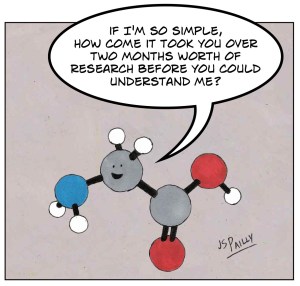
Friends, I’ve told you before: chemistry is hard. But I think I’ve learned enough to be able to introduce you to our first amino acid. This is glycine, the simplest amino acid.

Mr09 Glycine

By my count, amino acids have four key components. They are (in no particular order):

  • An amino group: the part that gives amino acids their name.
  • A carboxyl group: the part that includes a loosely attached hydrogen atom, which makes an amino acid an acid.
  • An alpha carbon: provides structural stability by separating the amino and carboxyl groups. In the highly technical diagram above, the atom with the smiley face is the alpha carbon.
  • The side chain: a group of atoms that attaches to one of the alpha carbon’s two extra bonding sites. An additional hydrogen atom caps whichever bonding site isn’t used for the side chain.

It’s these side chains which really distinguish one amino acid from another. Depending on which side the side chain attaches to, we’ll either have a right-handed or left-handed amino acid.

It’s important to be aware of the “handedness” of amino acids (of the “chirality” of amino acids, to use the technical term). Human DNA and the DNA of all life on Earth only codes for left-handed amino acids. In theory, there could be life forms on other planets that rely on the right-handed kind.

But glycine is a special case. Glycine’s side chain, if we can justifiably call it a side chain, is one single hydrogen atom. This is why glycine is considered the simplest amino acid: you can’t get much simpler than one hydrogen.

Also, this single hydrogen “chain” is indistinguishable from the single hydrogen used to cap the alpha carbon’s other free bonding site. This means glycine is non-chiral. It can be either right-handed or left-handed. I supposed you could say glycine is ambidextrous.

Because glycine is non-chiral and because it is the simplest amino acid, I have a feeling glycine could play a special role in astrobiology. Maybe… just maybe… glycine is universal to all life in the cosmos.

Or maybe not. This is just a pet theory I came up with based on what I’ve learned so far.  I’m sure I’ll have more to say about this as we get to know some of the other amino acids.

* * *

Today’s post is part of a special series here on Planet Pailly called Molecular Mondays. Every other Monday, I struggle valiantly to understand and explain some concept in the field of chemistry. Please note: I suck at chemistry, but I’m trying to learn. If I made a mistake, please, please, please let me know so I can get better.

Sciency Words: Chirality

Sciency Words BIO copy

Today’s post is part of a special series here on Planet Pailly called Sciency Words. Each week, we take a closer look at an interesting science or science-related term to help us all expand our scientific vocabularies together. Today’s term is:

CHIRALITY

Imagine that we’ve finally placed a lander on the surface of Europa. The lander takes samples and detects amino acids, an essential ingredient for life. That raises a few eyebrows, but amino acids are not exactly uncommon in space. Then scientists realize that Europa’s amino acids all share the same chirality.

That’s the part where everybody freaks out.

Chirality, which is a noun, and chiral, which is an adjective, come from a Greek word meaning hand. You’ll see why in a moment.

Amino acids are made of several parts. By definition, they must include an amino group (one nitrogen atom and two hydrogens).

Mr08 Amino Group

By definition, they must also include a carboxyl group (two oxygens, a carbon, and a hydrogen).

Mr08 Carboxyl Group

They also need to have at least one carbon atom positioned between them, for structural purposes.

Mr08 Alpha Carbon

An amino acid with only one carbon separating the amino and carboxyl groups is called an alpha amino acid. If there were two carbons, it would be a beta amino acid, and so on.

But notice: that central carbon atom still has two available bonding sites.

Mr08 Missing Side Chain 1

So amino acids have one more crucial component called a side chain. It’s these side chains that give each type of amino acid its unique flavor (literally—amino acids taste different from one another, or so I’m told).

But which side do we attach the side chain to?

Mr08 Missing Side Chain 2

Left side it is! And we’ll attach a single hydrogen atom to the right.

Very early in the development of life on Earth, organisms started manufacturing amino acids out of simpler chemicals, and they always made the “left-handed” kind. Why? Coin toss. It could just have easily gone the other way, as far as we know.

To this day, our DNA continues to code for left-handed amino-acids only. As a result, there are more left-handed than right-handed amino acids present on Earth. If we ever find a similar disparity elsewhere in the universe—whether left or right-handed—that would be compelling evidence for the existence of alien life.

By the way: there’s a common misconception about chirality that you sometimes find in science fiction. Supposedly, humans cannot eat foods made from right-handed amino acids, and aliens with right-handed biochemistries cannot eat our left-handed foods. This is not necessarily true. In fact, humans do consume right-handed amino acids. Some of them are useful to our bodies, just not in the construction of proteins, and they’re not coded for by our DNA.

Of course, there are plenty of other reasons humans and aliens probably shouldn’t share food.

Mr08 Alien Food

So the chirality of amino acids might not be your top concern.

Earth Germs on Mars: What Might Happen?

Warning: the word “might” will appear a lot in today’s post.

When the Curiosity rover left Earth, it might have been contaminated with several different strains of Earthly bacteria. This was a big oops for NASA, especially for NASA’s Office of Planetary Protection, which is supposed to make sure we don’t spread our germs to other planets.

But how bad could the damage really be? Curiosity was headed for Mars. It’s not like Mars has water.

Then we found out Mars does have water. Droplets and trickles of water. Modestly sized puddles of the stuff. Now, even though Curiosity is currently located near actively trickling water, the rover is not allowed to go investigate. It might contaminate the water. It might endanger any ecosystem that might exist in the slightly damp Martian soil.

I wrote previously that we should take the risk anyway. Let Curiosity approach the water. Let Curiosity take a sample. Let Curiosity be curious. What are the odds that microorganisms from cushy, life-friendly Earth could survive on Mars? What are the odds that they could outcompete native life forms that are perfectly adapted to the harsh Martian environment?

That’s how I felt, until last week when I learned about bacterial conjugation.

Mr04 Bacteria of Mars

According to the panspermia hypothesis, life on Earth and Mars might (there’s that word again) share a common ancestor. If so, Martian microbes might be genetically compatible with bacteria from Earth. Through bacterial conjugation, they might be able to share DNA.

They might.

Mr04 Martian Earthling Hybrid

Or they might not.

Finding out that bacteria on Earth and Mars are genetically compatible would be a huge discovery, assuming we knew it was happening. But Curiosity is not equipped to test for that sort of thing. Curiosity isn’t equipped to study biological activity of any kind. So the rover’s presence in and around Martian water flows might trigger changes to the local ecosystem without our knowledge.

So grudgingly, I’ll agree. Let’s keep Curiosity away from the Martian wetlands. It might not worth the risk.

Sciency Words: Bacterial Conjugation

Sciency Words BIO copy

Today’s post is part of a special series here on Planet Pailly called Sciency Words. Each week, we take a closer look at an interesting science or science-related term to help us all expand our scientific vocabularies together. Today’s term is:

BACTERIAL CONJUGATION

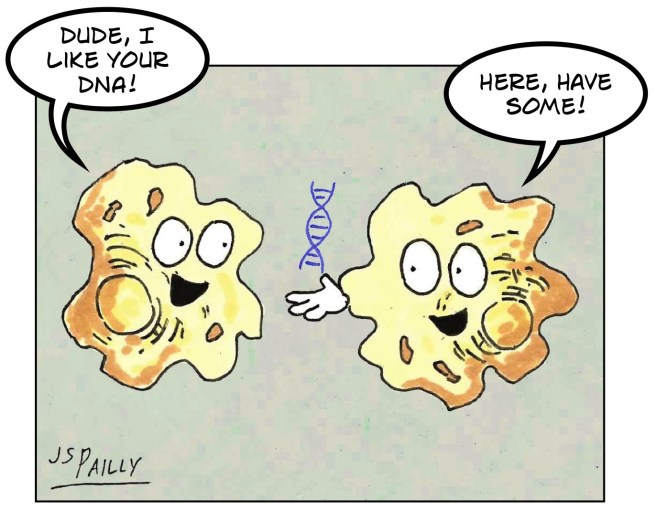
Bacteria aren’t like us. They’re not stuck with the DNA they’re born with.

Mr02 Bacterial Conjugation

Through a process called bacterial conjugation, one bacterium can donate some of its genes to another. In some cases, this even works between bacteria of different species.

The process begins with something called an “F plasmoid” or “F factor.” Bacterial conjugation has a few things in common with sexual reproduction, so I’m sure you can guess what the F stands for. It stands for fertility. Obviously.

This F plasmoid is actually a strand of DNA looped into a circle. A bacterium that has an F plasmoid is called an F+ cell. A bacterium that doesn’t have it is an F- cell. And when an F+ cell and an F- cell meet, the real fun begins.

  • Step One: The F+ cell grows a hair-like protrusion called a pilus (plural pili).
  • Step Two: The pilus attaches to the F- cell, and a connection is formed. You could think of the pilus as a tiny straw linking one bacterial cell to the other.
  • Step Three: Within the F+ cell, the F plasmoid splits apart right down the center of its double helix structure, like a zipper unzipping. One half is fed through the pilus, and the other half stays put.
  • Step Four: Using the half-strand of DNA as a guide, the F- cell creates a complimentary strand of DNA and zips the two back together. The F+ cell does the same thing with the half-strand that it kept. Now both bacteria have a full copy of the F plasmoid, meaning both are F+ cells, and both can go spread the F plasmoid to other bacteria.

This ability has proven to be really useful for bacteria. It is, for example, one of the mechanisms that spreads immunity to our anti-bacterial drugs.

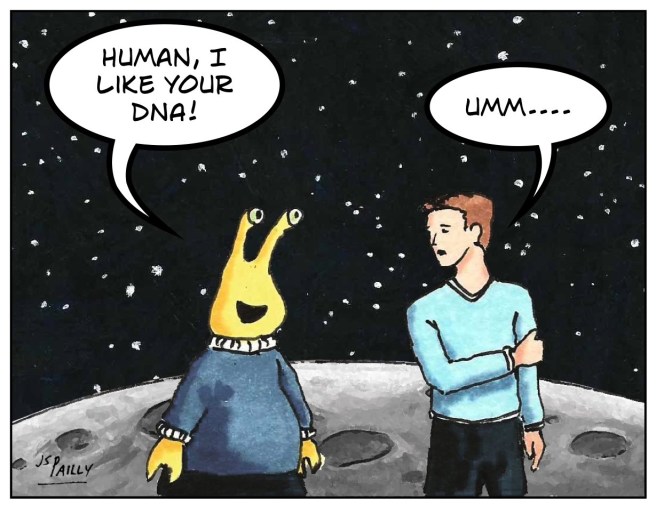
It’s too bad humans can’t do this, but transferring DNA between multicellular organisms would be a far more complicated matter (though come to think of it, sperm and egg cells do an okay job). But perhaps on some distant alien world, multicellular conjugation is possible. Perhaps it is common even between different species. Maybe some day we’ll meet these conjugating life forms, and awkward conversations will ensue.

Mr02 Multicellular Conjugation