
Today’s post is part of a special series here on Planet Pailly called Sciency Words. Each week, we take a closer look at an interesting science or science-related term to help us expand our scientific vocabularies together. Today’s term is:
STOCHASTIC
At first glance, stochastic appears to have a pretty easy definition. Basically, it means random. A stochastic event can be defined, quite simply, as a random event. So why do scientists need this weird term? Why can’t they just say random if they mean random?
I’ve seen this word now in a surprisingly wide range of scientific fields, most recently in relation to the population dynamics of endangered species and then in relation to the magnetic field of Jupiter. The thing is that in actual usage, stochastic and random aren’t quite synonyms. A better definition for stochastic might be “seemingly random.”
The word originates from a Greek word meaning “to aim at” or “to shoot at.” So it’s an archery term, but the Greeks also used it to mean “to guess at.” I like this linguistic metaphor because a guess really is like aiming for the truth; whether or not you hit the mark is another matter.
Anyway, the word seems to have migrated from Greek to German to English, and in its modern scientific sense it refers to something that might be predictable in theory but appears to be random in practice. As an example, you may have heard that the flapping of a butterfly’s wings could set in motion a chain of events ultimately leading to a devastating hurricane.
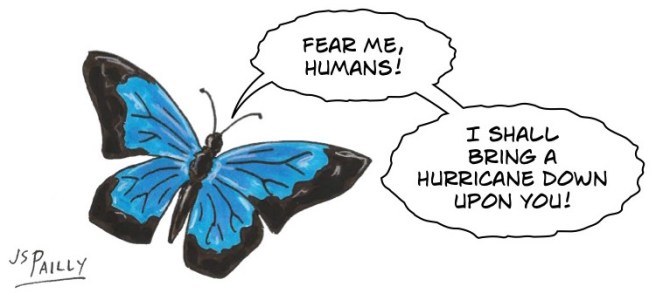
In theory, these butterfly-initiated hurricanes could be predicted, if only we knew the exact locations and flapping behaviors of every single butterfly on Earth (along with a million and one other factors). But in practice, since we can’t gather all the necessary data, we can only make educated guesses about when and where the next hurricane will hit.
In other words, hurricanes are stochastic events. They seem random, even though they’re not.













 Planet Pailly