Hello, friends! For this year’s A to Z Challenge, I decided to talk about the planet Mercury. I wasn’t sure at first if I’d be able to do a whole alphabet’s worth of posts about this one planet, but at this point, I think I just might pull it off! In today’s post, Y is for:
YEAR OF MERCURY WATCHING
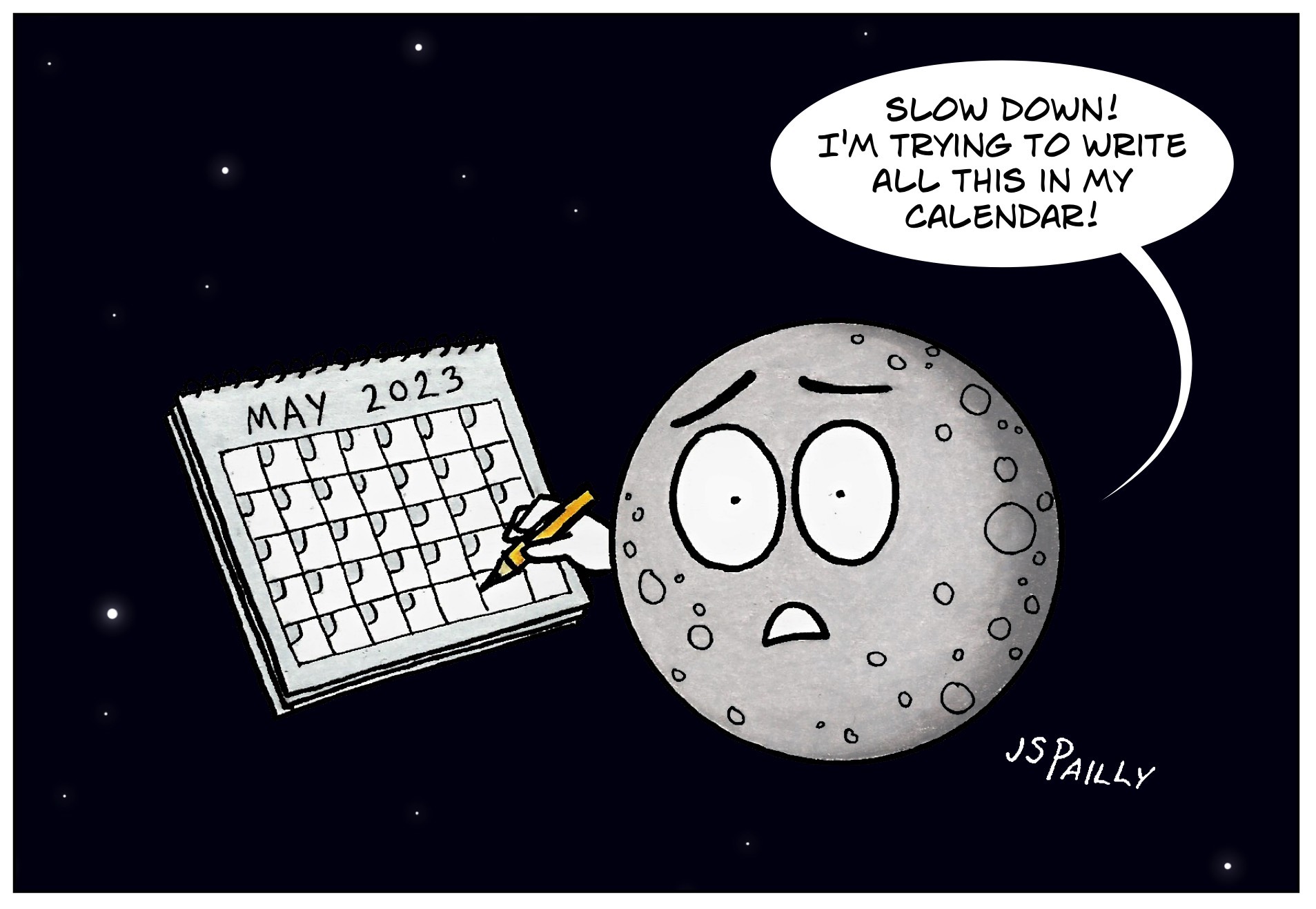
My original plan for this post was to talk about Mercury’s year. It’s 88 Earth days long, which (oddly enough) is only half the length of Mercury’s solar day. That’s because of a spin-orbit resonance, sidereal rotation, yada yada… we’ve already talked about this stuff. So instead, today I want to talk about the rest of this year here on Earth and tell you when the best opportunities to see Mercury will be.
The best time to see Mercury is during an “elongation,” which is when Mercury (as viewed from Earth) is as far away from the Sun as he can get. To say that another way, if you drew an imaginary line between Mercury and the Sun, elongation is when that line would be at its longest.
Some elongations end up being a little higher (or should I say longer?) than others. This is because of Mercury’s highly elliptical (non-circular) orbit. The highest elongation of Mercury this year occurred on April 11. I wish I’d known that earlier this month, because I definitely would have mentioned it. Anyway, the next elongation will occur in the morning on May 29, 2023. After that, there will be an elongation in the evening on August 10. Another elongation will occur on the morning of September 22, and another will be on December 4.
Don’t worry too much about the specific dates. You’ll still get a pretty good view of Mercury a few days before and after an elongation occurs.
I have only seen Mercury two times in my life that I know of. I recently learned, however, that Mercury is known to twinkle like a star, so I may have seen him many times without recognizing him as a planet. After all the Mercury research, Mercury writing, and Mercury artwork I’ve done for this year’s A to Z Challenge, I am very eager to get out there and see Mercury again (even if it means getting up before sunrise on or around May 29).
WANT TO LEARN MORE?
I found the dates for upcoming elongations of Mercury in this article from EarthSky.org. The article also goes into a little more detail about how elongations work.
Hello, friends! Welcome back to the A to Z Challenge. For this year’s challenge, my theme is the planet Mercury, and in today’s post U is for:
UPLANDS
Science Fiction
The year is 2059. With the benefit of newly invented gravity manipulation technology, NASA has determined that they can safely and economically place a small rover on the surface of Mercury. The first ever Mercury rover will land in a region just south of Mercury’s equator, part of the so-called “uplands” of Mercury.
Science Fact
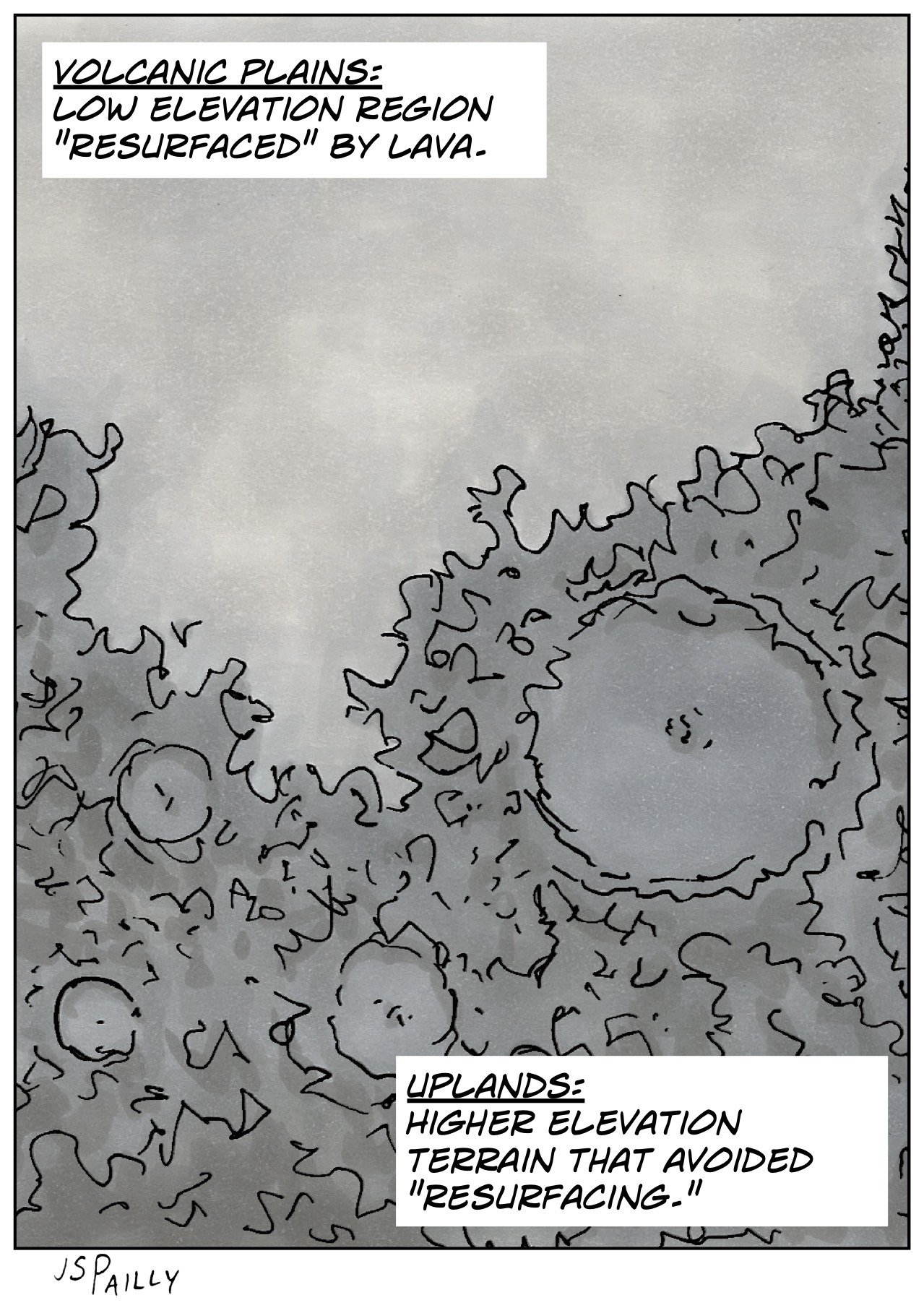
There are generally two types of terrain on Mercury: the smoother, flatter volcanic plains regions, which are mostly found in the northern hemisphere, and the rougher, craggier, more heavily cratered “uplands,” which are found in Mercury’s equatorial regions and extend into the southern hemisphere.
Those smoother, flatter regions formed through a process planetary scientists call “resurfacing,” which is one of my favorite scientific euphemisms. Resurfacing sounds like something you do to a parking lot. What resurfacing actually means, in reference to planets, is that some sort of extreme volcanic activity covered part of a planet’s surface in lava. The lava cooled and hardened, creating a smooth new surface and covering up whatever surface topography may have been present in the past.
Mercury is not a volcanically active world today, but it must have been at some point. Most likely, the partial resurfacing of Mercury happened shortly after the end of the late heavy bombardment, a critical period in the history of our Solar System when the inner planets got pelted with asteroids. Lava pooled in low elevation regions of Mercury, either filling in or totally covering up craters left by the late heavy bombardment. But higher elevation regions—the uplands, in other words—were spared from resurfacing.
Similar upland terrain can be found on the Moon, and studying the lunar uplands has told scientists much about what the Solar System was like during the late heavy bombardment. Comparing and contrasting the uplands of the Moon with the uplands of Mercury may give us an even clearer and more detailed picture of what that era of the Solar System’s history was like. For this reason, a mission to explore the uplands of Mercury could be very interesting and exciting for scientists.
Science Fiction
NASA apparently failed to learn their lesson after the public naming contest for their mission to Uranus and proceeded to hold another public naming contest for the Mercury Uplands Rover. And that is how NASA’s Up-Dog Mission officially came to be.
WANT TO LEARN MORE?
Here is a 2016 article from NASA announcing the first complete topographic map of the surface of Mercury.
And here is an article from Space.com about the Moon and Mercury and the things we might learn by comparing and contrasting the two.
P.S.: If you don’t understand the up-dog reference, feel free to ask me “What is up-dog?” in the comments below.
Hello, friends! We’re in the final week of this year’s A to Z Challenge! If you don’t know what the A to Z Challenge is, it’s a monthlong blogging event where participants write a full alphabet’s worth of blog posts about a topic of their choice. My topic this year is the planet Mercury, and in today’s post T is for:
THE TWINKLING PLANET
When you look up in the nighttime sky, stars twinkle, and planets don’t. This is probably the first astronomy lesson most people learn. It’s one of those basic facts almost everybody seems to know. However, like most super basic facts that everybody seems to know, there are exceptions to the rule. Mercury is a planet, and yet Mercury twinkles.
Stars twinkle because they’re very far away, and their starlight is relatively faint. So when starlight hits Earth’s atmosphere, the atmosphere distorts the light, causing a twinkling effect. But planets are much closer, and sunlight reflecting off a nearby planet is much brighter and more intense than the light emitted by distant stars. Earth’s atmosphere still distorts the light reflecting off planets, but the distortion is nowhere near as noticeable. Usually.
Two factors make Mercury different. First, Mercury is much smaller than the other planets, so he doesn’t reflect as much sunlight our way as, say, Venus or Jupiter. It’s probably worth mentioning that Mercury is also a darker colored planet, with much of his surface covered in graphite. Second, because Mercury is so close to the Sun, we Earthlings usually can’t see him except just after dusk or just before dawn. This means that whenever we see Mercury, Mercury’s light has to pass through Earth’s atmosphere at an angle. In other words, Mercury’s light has to travel through more of Earth’s atmosphere in order to reach our eyes.
Less light plus more atmospheric distortion equals a twinkling planet. As William Sheehan notes in his book Mercury (for the Kosmos series), “[Mercury] is more often seen, no doubt, than recognized.”
I love star gazing. I love looking for planets in the sky, and I love the moment of realization when I recognize one of them. I only know for certain that I’ve seen Mercury two times in my life, and I needed help from an astronomy app both times. However, I may have seen Mercury many times than I know and just assumed he was another star, twinkling near the horizon.
The real lesson here is that there are those basic facts that everyone knows, basic facts like stars twinkle and planets don’t. But once you learn the basic facts about something, start learning about the exceptions to the rule. You may miss out on some really neat experiences in life if you ignore the exceptions and stick to knowing only the basic facts.
WANT TO LEARN MORE?
Here’s an article from EarthSky.org about why stars twinkle and planets (usually) don’t. It’s one of the rare articles I’ve seen that notes how, under the right circumstances, planets can twinkle, too.
And also, I’m going to once again recommend Mercury by William Sheehan. Chapter One of that book is about how Mercury twinkles, or rather how Mercury “scintillates,” to use a more scientific term.
Hello, friends! Welcome to Sciency Words, a special series here on Planet Pailly where we talk about the definitions and etymologies of scientific terms. In today’s Sciency Words post, we’re talking about the word:
ANTITAIL
Did you see the comet? Pretty much everyone I know has been asking me that question lately. Comet C/2022 E3 (ZTF) had a wild ride these last few weeks. First, she started glowing a lot brighter and a lot greener than expected, leading to some people calling her “the green comet.” Then, due to some intense solar activity, a gap formed in one of the green comet’s two tails. Shortly thereafter, almost as if the comet were trying to compensate for the damage to one tail, an apparent third tail became visible to observers here on Earth. This apparent third tail is what astronomers call an antitail.
Definition of antitail: Comets typically have two tails: a dust tail and an ion tail. These tails are supposed to point away from the Sun. They’re caused by the solar wind sweeping gas, dust, and other lightweight material away from the comet and off into space. An antitail is an apparent third tail pointing toward the Sun. At least antitails look like they’re pointing toward the Sun, but this is actually an optical illusion.
Etymology of antitail: The prefix “anti-” can mean several things. In this context, it means “opposite,” because antitails point (or look like they point) in a direction opposite to the direction cometary tails are supposed to point. Based on my research, I believe this term was first introduced in the late 1950’s, following the appearance of comet Arend-Roland.
Okay, I’m going out on a bit of a limb claiming that the term was introduced in the 1950’s. I cannot find any sources explicitly stating that, but almost every source I looked at seems to agree that Comet Arend-Roland had the most famous and noteworthy antitail in the history of antitails. In 1957, Arend-Roland developed a large and protruding “sunward spike.” In photos (like this one or this one), the comet reminds me a little of a narwhal.
Arend-Roland cannot possibly be the first comet ever observed to have an antitail, but it does seem to be the most spectacular and most widely studied antitail in recorded history. Crucially, I was unable to find any sources mentioning cometary antitails prior to 1957. Ergo, I think I’m right that the term was first introduced around that time, in reference to that particular comet. But I could be wrong, and if anyone knows more about this topic than I do, please do share in the comments below.
Regardless of how much of a first Arend-Roland’s antitail really was to the scientific community at the time, it was not much of a mystery. Within a matter of months, scientists were able to offer explanations, like this explanation published in Nature:
No extraordinary physical theory appears necessary to account for the growth of the sunward tail […] The sunward tail must almost certainly have resulted from the concentration of cometary debris over an area in the orbital plane. Seen at moderate angels to the plane, the material possessed too low a surface brightness to be easily observed, but seen edge-on it presented a concentrated line of considerable intensity.
So several things have to happen in order for us Earth-based observers to see an antitail. First, a comet needs to shed some debris that’s too big and heavy to be swept off by the solar wind. This extra debris will accumulate along the comet’s orbital path, rather than billowing off in a direction pointing away from the Sun. Second, Earth has to be in just the right place at just the right time to see this debris field “edge-on.” Otherwise, the light reflecting off the debris will be too diffuse for us to see. And third, this has to happen at a time when the comet’s tails don’t overlap with the debris field (i.e., the debris and the tails have to be pointing in opposite directions, as seen from Earth). Otherwise, the glow of the tails will obscure the light reflecting off the debris.
Last week, I was lucky enough to see the comet, but I didn’t see her bright green color (she was a hazy grey in my telescope), and I certainly didn’t get a chance to see the antitail. I’m pretty sure I was a few days too late for that, and besides, there’s too much light pollution where I live to see faint details like that.
Still, I consider it a great joy and privilege that I got to see as much of the comet as I did. And for all the cool sciency stuff I couldn’t see for myself, I can always turn to my research if I want to learn more.
WANT TO LEARN MORE?
Here’s the 1957 report from Nature that I quoted above, explaining what “must almost certainly” have caused Arend-Roland’s “sunward tail.”
I read somewhere once that every writer has a “thing”—something that they’re desperately trying to say. It’s something that’s hard to put into words, a feeling or an idea that defies the conventional use of language. If this “thing” could be said in a simple and straightforward way, we writers would just say it and move on rather than spend the bulk of our lives writing.
What is that “thing” for me? I wish I could tell you! It would be so much easier if I could just tell you the “thing” that keeps poking at my mind, but of course I can’t. All I can say is that my thing has something to do with the stars. It has something to do with the slow and stately motion of the planets. It has something to do with that feeling I get whenever I look up at the nighttime sky.
Is it curiosity? A sense of wonder at the vastness of the cosmos? I guess that’s part of it, but those words feel wholly inadequate. Wonder and curiosity are nice, but there’s something more. There’s so much more! The planets and stars inspire something in me that simply must be said—something that must be put into words, no matter what—it must be!
But no words ever seem to express this “thing” well enough. So I keep trying. I keep writing, in the hope that maybe someday I’ll find a way to say the thing I don’t know how to say, and maybe somebody else will read my words and understand what I’m talking about.
So, friends, do you have a “thing” that you’re trying to say through your writing? Care to give us a clue (if you can) about what your “thing” might be?
Hello, friends! Welcome to another episode of Sciency Words, a special series here on Planet Pailly that’s all about those weird words scientists use. Today on Sciency Words, we’re talking about:
METAL
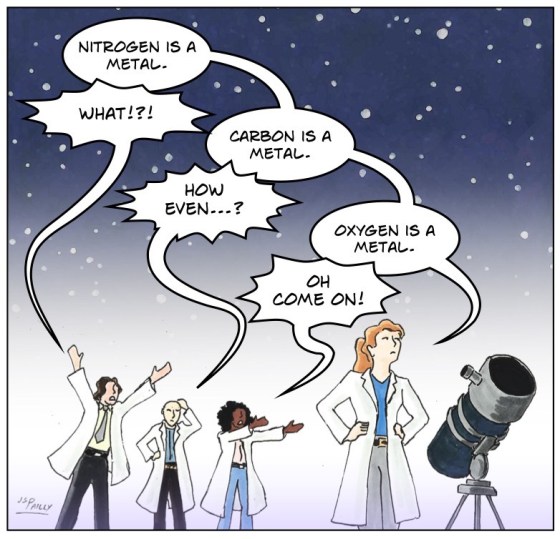
Yes, scientists use some very strange words. You know the kind of words I mean. Words that are hard to pronounce. Words with definitions that only make sense if you understand differential calculus. But you know what’s even weirder? When scientists take words you already know and redefine them. That’s what astronomers and astrophysicists have done to the word “metal.”
Approximately 75% of the matter in the universe is hydrogen. 24% of it is helium. And the remaining 1%? Ask an astrophysicist, and they’ll tell you the remaining 1% is all “metal.” If that seems weird to you, don’t worry. All the other scientists think it’s weird too.
For years now, I’ve been trying to figure out how this started. Who gets credit (or blame) for first messing up the definition of metal?
I don’t know, but I do have a pet theory. Perhaps certain chemical elements (like nickel or iron) are easier to detect in outer space than others. And if you’re trying to study that 1% of the material universe that isn’t hydrogen or helium, perhaps those easier-to-detect elements (which happen to be metals) serve as a convenient proxy for everything else—including nonmetals like nitrogen, carbon, and oxygen.
According to the Oxford English Dictionary Online, the earliest documented usage of either “metal” or “metallicity” (in the astronomy sense of those words) is this 1969 paper on the molecular composition of stars. Now I won’t pretend to have read the whole paper (it’s over 60 pages long), but based on what I did read, I can say this much: this cannot be the true first usage of the word metal (in the astronomy sense).
At one point, the authors, two astronomers from U.C. Berkley, categorize nitrogen as a metal. No explanation is offered. Clearly the authors expect their readers (i.e. other astronomers) to understand why nitrogen would be considered a metal, which suggests to me that most astronomers in 1969 already understood “metal” to mean “matter that isn’t hydrogen or helium.”
However, I can also say this: I think this paper supports my pet theory. The paper describes a new technique for determining the molecular composition of stars. In explaining this new technique, the authors focus on the spectroscopic signatures of three specific elements: sodium, magnesium, and calcium. Those three elements are then used as a proxy for all the other non-hydrogen and non-helium elements that might be found inside a star.
Sodium, magnesium, and calcium are all—wait, let me double check the periodic table—yes, all three of those elements lie on the metal side of the metalloid line. And thus through a process linguists call semantic generalization, the word metal is generalized to mean something more than it originally meant.
Next time on Planet Pailly, someone really wanted to pick a fight with me about life on Mars.







 Planet Pailly