
Today’s post is part of a special series here on Planet Pailly called Sciency Words. Each week, we take a closer look at an interesting science or science-related term to help us expand our scientific vocabularies together. Today’s term is:
THE ZERO-ONE-INFINITY RULE
I came across this term in Time’s special edition on Scott Kelly’s year in space, which I reviewed on Wednesday. The term was used in an article about astrobiology, but it actually originates in the field of computer science.
Zero-One-Infinity in Computer Science
The zero-one-infinity rule is sort of a rule of thumb. It’s credited to Dutch computer scientist Willem Louis Van Der Poel. According to this rule, a computer program should either never allow a certain event (zero), or it should allow it only once (one), or it should allow it an unlimited number of times (infinity).
The logic here is that it makes sense to not allow something to happen. It also might make sense to allow something to happen only once, perhaps as an exception. But programmers shouldn’t create arbitrary limits (according to this rule) on what a program can do. If you’re willing to allow something to happen twice, why not three times? Or four? Or thirty-eight? Or as many times as the user wants (computer memory space permitting)?
I don’t have a whole lot of coding experience, but the zero-one-infinity rule makes sense to me. It seems like a good rule, although I could probably think up more than one exception to the rule if I really wanted to.
Zero-One-Infinity in Astrobiology
Applying the zero-one-infinity rule to the search for alien life is, in my opinion, brilliant. How many locations in the universe can support life? There are really only three answers:
- Life cannot exist anywhere in the universe (zero).
- Life can exist only on Earth; Earth is a very special exception in a universe where life is otherwise not allowed (one).
- Life can exist in an unlimited number of locations in the universe (infinity).
We already know the zero proposition is false.
There was a time (I remember it well) when many a scientist argued that Earth must be an exception: the one and only place in the universe where life could exist. Occasionally, I still hear people try to argue this.
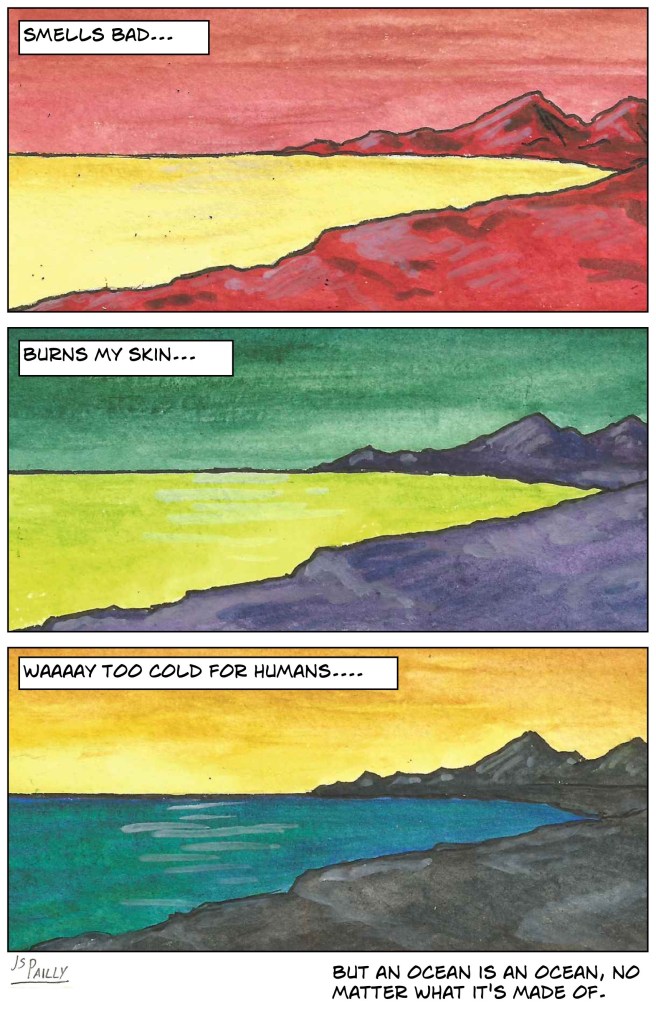
All it would take is to find a second life-bearing world to prove the one proposition wrong (I’m looking at you, Europa). Because once we know about two living worlds, how could anyone argue that there can’t be three? Or four? Or thirty-eight? Or however many the universe feels like having?
Links
Zero-One-Infinity Rule from The Jargon File.
Willem Louis Van Der Poel from Wiki Wiki Web.



 Planet Pailly