Artsy Science: Einstein and the Secret of the Imagination

Artsy ScienceToday’s post is the first in a collection of posts on the artistic side of science.  Through both art and science, we humans try to make sense of the world around us, and the two fields have a lot more in common than you might expect.

* * *

For this initial post in Artsy Science, I want to share some quotes from one of the 20th Century’s most famous musicians: Albert Einstein.  You may not have known that Einstein was a dedicated violinist.  He never traveled anywhere without his most beloved instrument.  He also played the piano, and there are many apocryphal stories about him solving complex mathematical puzzles while practicing his music.  To Einstein, art and science were merely two separate branches of the same tree.

Here is what Einstein had to say about art and science:

  • Music does not influence research work, but both are nourished by the same sort of longing, and they complement each other in the release they offer.
  • I am enough of an artist to draw freely upon my imagination. Imagination is more important than knowledge. Knowledge is limited. Imagination encircles the world.
  • The most beautiful experience we can experience is the mysterious. It is the source of all true art and science.

Most of Einstein’s discoveries were not made in a lab but in his own mind.  After reading about vexing mysteries uncovered by other scientists, Einstein would sit back and try to picture these mysterious phenomena from new perspectives, and then later attempt to describe in scientific terms what he had imagined.  Einstein called these “thought experiments.”

In an age when our society has become rigidly fact oriented, often intolerant of daydreamers, free spirits, and other such time wasters, we should remember Albert Einstein’s work and what it reveals about the power of the human imagination.  And maybe we should all take a few moments to pause, close our eyes, and engage in a few “thought experiments” of our own.

P.S.: If your thought experiments lead you to any important discoveries, please share them in the comments below!

Sciency Words: The Theory of Invariance

Sciency Words Logo

Today’s post is part of a special series here on Planet Pailly called Sciency Words.  Every Friday, we take a look at a new and interesting scientific term to help us all expand our scientific vocabularies together.  Today’s word is:

THE THEORY OF INVARIANCE

Albert Einstein made many important contributions to science, but one of his most controversial was the theory of relativity.  Not that it was controversial among scientists.  Proof of relativity came fairly rapidly after its initial publication, and experiment after experiment have continued confirming its validity ever since.  No, the controversy was among the general public, some of whom perceived, for some reason, that relativity in physics led to relativity in morality.

This confusion upset Einstein so much that, later in life, he pushed to have his theory renamed “the theory of invariance.”  Where the term relativity applied to the relative frames of reference of different observers, the term invariance refers to the invariant speed of light, which is just as essential to the theory as the relativity part.  It would also reassure people that no, morality is not relative.

However, by that time the name relativity had already been around for several decades.  The names of scientific principles are not easily changed once they’re established, so for better or worse, the theory of relativity is here to stay.

So what do you think?  Do you like relativity, or do you think we should have renamed it invariance as Einstein suggested?

Einstein’s Old Envelopes

The other day, I came across an amusing story about Albert Einstein. He and his wife were visiting the Mount Wilson Observatory in Southern California, and several of the astronomers there were bragging about how powerful their telescope was. They said it could reveal the secret workings of the universe. Elsa, Einstein’s wife, laughed and said, “My husband does that on the back of an old envelope.”

Today, we think of scientists working in big laboratories with lots of expensive equipment. To make any meaningful scientific discoveries, we assume you first need a large budget, subsidized either by the Federal Government or a major corporation like Lockheed Martin or Kaiser Permanente. And yet Einstein required none of that. All his greatest contributions to science were made using nothing more than his mind—and apparently some old envelopes.

Einstein Time

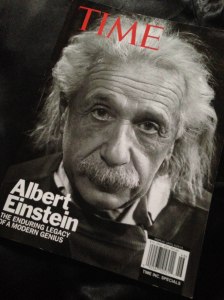
P.S.: I found this anecdote in a recent special edition of Time Magazine profiling Einstein. I highly recommend reading it. Einstein is a far more fascinating and complicated historical figure than popular culture has portrayed him to be.

IWSG: The Perils of Word Counts

InsecureWritersSupportGroupToday’s post is part of the Insecure Writer’s Support Group, a blog hop hosted by Alex J. Cavanaugh.  It’s a way for insecure writers like myself give each other advice and encouragement.  Click here to see a full list of participating blogs.

* * *

Here’s a piece of advice attributed to one of my role models: “Not everything that counts can be counted, and not everything that can be counted counts.”  These words are often attributed to Albert Einstein, although there is some scholarly debate as to whether or not Einstein actually said this.  But that’s not important right now.  The words themselves have weighed heavily on my mind of late, regardless of their historical origin.

I’m the kind of writer who keeps scrupulous records of everything: deadlines, word counts, the number of hours I spend writing…  I even make pie charts about this stuff.  In short, I do a lot of counting, and that usually serves me well.  Counting keeps me on schedule and forces me to work a little harder to get that extra thousand words done.  Also, because of my scrupulous record keeping, I can flip back through old calendars and see how my writing discipline has increased over the years.  Where once I struggled to complete 3,000 words in a week, I now routinely write that much in a day.

The down side is that on days when I don’t write, or for reasons beyond my control I can’t write, I see this unmarked day in my records, and that makes me feel like a failure.  It’s exponentially worse when I see a series of unmarked days in a row.

Due to a recent family emergency, I now have over a week of zero writing.  Despite the circumstances, I feel guilty.  Yes, a close relative was hospitalized, and yes, I had to travel a long distance to see her, and yes, my presence seemed to make a difference, BUT WHAT ABOUT MY WRITING QUOTA!!!

It’s only because of that quote from Einstein (or whoever) that I am able to keep things in perspective and remember that some things are more important than word counts.