Space Fairies: When Astronauts “See Things” in Space

Tinkerbelle has been up to some mischief in space. Ever since the Apollo Missions, astronauts have reported seeing strange flashes of white or bluish white light. Astronaut Don Pettit once described them as “luminous dancing fairies.” Sadly, these fairies aren’t magic. They’re a sign of something rather dangerous.

In space, you can expect to see these fairies at any time. They’ll appear to flicker and flutter all around the interior and exterior of your spacecraft, but they’ll be most visible in the dark. And if you really want to get a good look at them, you should close your eyes.

You read that right. Close your eyes. This phenomenon is easiest to observe with your eyes closed… a fact which gives a pretty big hint about what’s really going on.

Cosmic radiation is ubiquitous. In space, cosmic rays are constantly passing through your body, steadily raising your cancer risk. Every once in a while, a cosmic ray will pass through your eye. When it does, it may trigger the rods and cones of your retina, or it may even hit your optic nerve directly. And that’s when you start seeing pretty lights.

So the next time you’re in space…

Aa01 Come to Space

… close your eyes for a few minutes and count how many flashes you see. That’ll give you some sense of how much radiation you’re soaking up.

P.S.: According to this article from Universe Today, Apollo Mission astronauts saw on average one “fairy” every 2.9 minutes.

Enceladus: Too Young for Life?

Does life exist on Enceladus? Maybe. I don’t know. It depends.

Ap05 Enceladian Jellyfish 1

Calm down, Enceladian jellyfish thing. We’re still trying to figure this out.

Astronomers recently determined that Enceladus has a decoupled crust, meaning there is a global ocean of liquid water hidden beneath this tiny moon’s surface. Just the kind of environment that could support alien life. But there’s a problem.

A recent scientific paper, entitled “Dynamical Evidence for a Late Formation of Saturn’s Moons,” suggests that Enceladus may be too young for life to have evolved there. (Please note: I typically try to read these sorts of papers in their entirety, but this one is 50 pages long. I think I got the gist of it, but I cannot honestly say I read the whole thing).

After examining tidal forces, orbital resonances, and orbital inclinations within the Saturnian system, the paper reaches two possible conclusions:

  • Either the Saturnian system changes at an oddly slow rate…
  • Or Saturn’s rings and many of its moons—including Enceladus—formed very, very recently.

If you were a dinosaur, specifically a dinosaur who knew how to use a telescope, you may have been able to watch as a previous generation of Saturn’s moons were destroyed. Perhaps these moons collided with each other. Perhaps they were torn asunder by Saturn’s gravity. Perhaps you would have wondered, with your walnut-sized dinosaur brain, if anything like that could ever happen to Earth.

Anyway, the destruction of Saturn’s old moons left a whole lot of debris, forming a disk of icy and rocky material around the planet. Much of that debris is still there in the rings, but some of it accreted together, forming new moons like Enceladus.

All of this happened, according to this “Dynamical Evidence” paper, about 100 million years ago. That doesn’t give life a whole lot of time to evolve, which is bad news for out Enceladian jellyfish friend.

Ap05 Enceladian Jellyfish 2

Sorry, buddy.

Sciency Words: Decouple

Sciency Words BIO copy

Today’s post is part of a special series here on Planet Pailly called Sciency Words. Each week, we take a closer look at an interesting science or science-related term to help us all expand our scientific vocabularies together. Today’s term is:

DECOUPLE

After years of speculation, last September we finally learned the truth. Enceladus, one of Saturn’s moons, has a decoupled crust.

Ap04 Enceladus Decoupled

Sorry, Enceladus. I meant no offense. In fact, having a decoupled crust might be a good thing.

We’ve known for some time now that there is liquid water somewhere beneath Enceladus’s surface. Some of that water periodically spurts out of geysers located near the moon’s south pole. You can see this happening in the totally legit Hubble image of Enceladus above.

The big question: how much liquid water is there? Are we talking about a modest subsurface lake near the south pole…

Ap04 Enceladus Subsurface Lake

… or does Enceladus have a vast global ocean hidden beneath its surface? You know, the kind of environment that might support life.

Ap04 Enceladus Subsurface Ocean

By carefully observing Enceladus as it orbits Saturn, astronomers noticed that the moon appears to wobble more than it should. The best explanation for this: the moon’s crust is not attached to anything solid. It floats freely atop a layer of liquid. Enceladus’s crust is—to use the technical term—decoupled from the moon’s rocky interior.

That’s pretty compelling evidence for a global subsurface ocean, and while it doesn’t prove that Enceladus supports life, it does make the possibility a whole lot more likely.

Or does it? Let me check on that for Monday’s post.

* * *

Alternative definition of decouple: to remove any couples from a party or similar social event, leaving all the single gents and ladies free to mingle.

IWSG: I’ll Get By with a Little Help from My Friends

I believe I have reached a major turning point in my life as a writer. I’m better organized than ever. I’m making rapid progress toward my goals. I’m doing things with my writing (and my art) that I never imagined I might do, and by the end of this year, I may have some pretty exciting news.

But that is not what I want to talk about today. Instead, I want to thank some people. I want to thank them for knowing not to spare my feelings in their criticism, for holding me accountable whenever I get lazy, and for giving me space and time when I need it (also, for tolerating all my sciency puns).

Most importantly, I want to thank them for believing in me even when I didn’t believe in myself. Without their help and encouragement, I would have given up on my dreams a long time ago.

So to all my dearest friends—especially Jen, April, Lee, and Dave—thank you.

It is often said that writing is an inherently lone06ly activity, but I have learned that it doesn’t need to be. In fact, it shouldn’t be. As a writer, you can do a lot more and go a whole lot further with a little help from your friends.

* * *

Insecure Writers Support Group Badge

Today’s post is part of the Insecure Writer’s Support Group, a bloghop hosted by Alex J. Cavanaugh and co-hosted this month by Megan Morgan, Chris Votey, Viola Fury, Christine Rains, Madeline Mora-Summonte, L.G. Keltner, Rachna Chhabria, and Patricia Lynne (Wow, there are a lot of co-hosts this month!). Click here to find out more about this amazing group and see a full list of participating blogs.

Molecular Monday: Those Zany Zwitterions

Molecules are supposed to be nice and stable, with all the bonding sites on each of their atoms used up… no more and no less. At least, that’s how I was taught to picture them in school, and that’s how I’ve been drawing them on my blog. But in the case of amino acids, it turns out this is wrong (sort of).

Take our new friend glycine, the simplest amino acid. I’ve been drawing glycine like this:

Ap02 Glycine

This is a perfectly acceptable depiction of a glycine molecule. Glycine does sometimes look like this, but not usually in biological processes. In biological processes, it tends to look more like this:

Ap02 Zwitterionic Glycine

One proton (a.k.a. one hydrogen ion) was shed from glycine’s carboxyl group. The two oxygen atoms (portrayed in red) kept that hydrogen’s electron. The dashed lines indicate that the oxygen atoms and the nearby carbon atom now share this electron, and the minus sign shows that there’s now a negative electrical charge in that region of the molecule.

So where did that rogue proton go? Through an intramolecular acid-base reaction, it moved to the nitrogen atom (portrayed in blue) of the amino group. Nitrogen is now bonded to four other atoms, despite the fact that it’s only supposed to have three bonding sites. Also, the area around the nitrogen now has a positive electrical charge, indicated by the plus sign.

A molecule like this with localized regions of differing electrical charge is called a zwitterion (which is such a cool term—it comes from the German word zwitter, meaning hybrid). It’s not hard for me to imagine that zwitterions like glycine are a lot more versatile in chemical reactions than “normal” molecules with all their bonding sites properly accounted for.

Going forward, I’m going to draw amino acids in their zwitterionic forms, not just because I love the word but because I think they’re more relevant to the biochemical stuff I’m currently researching.

P.S.: Spell check is weird. While writing today’s post, I was stunned to find that spell check had no issue with the word zwitterions (the plural) but it flags zwitterion (the singular) as a mistake.

* * *

Today’s post is part of a special series here on Planet Pailly called Molecular Mondays. Every other Monday, I struggle valiantly to understand and explain some concept in the field of chemistry. Please note: I suck at chemistry, but I’m trying to learn. If I made a mistake, please, please, please let me know so I can get better.

Sciency Words: Dark Side of the Moon

Sciency Words PHYS copy

Today’s post is part of a special series here on Planet Pailly called Sciency Words. Each week, we take a closer look at an interesting science or science-related term to help us all expand our scientific vocabularies together. Today’s term is:

THE DARK SIDE OF THE MOON

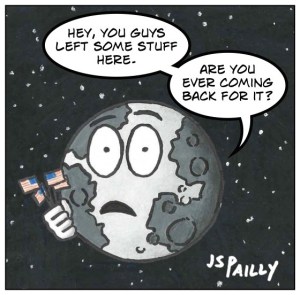
As the Moon orbits the Earth, the same side of the Moon is always facing toward us. It’s like the Moon is staring at us, unblinking, perhaps with some awkward question it’s been meaning to ask.

My06 Stuff on the Moon

But what’s on the other side? What’s on the side facing away from us? Scientists call that the “dark side” of the Moon. Scientists love making Star Wars references, and this one really fits. The dark side of the Moon is cloaked in perpetual darkness, because it is not only turned away from Earth but also away from the Sun.

As a result, we don’t really know much about the dark side of the Moon. There have been rumors that the Apollo Missions, while in lunar orbit, observed secret alien bases in the Moon’s dark region. This is obvious nonsense. The dark side of the Moon is too dark to observe anything!

Maybe some day when humanity finally chooses to return to the Moon, we’ll get some answers. Just so long as we remember to bring a flashlight.

P.S.: Happy April 1st! No, there is no such thing as a “dark side of the Moon.” The side of the Moon facing away from Earth is properly called the “far side of the Moon,” and it gets just as much sunlight as the side facing us.

Voting for the American Space Program

Let’s say you really care about the American space program. You want the United States to return to the Moon, go to Mars, and maybe capture an asteroid. You hope we might put a submarine in Europa’s subsurface ocean or possibly deploy aerostats above Venus’s acid clouds. Oh, and don’t forget about the James Webb Space Telescope!

Let’s say space exploration is a top priority for you. In fact, let’s say it is your #1 political issue. So how should you vote?

On Monday, I made the argument that Republicans are generally more pro-NASA than Democrats. But that doesn’t mean we, as space enthusiasts, have to vote Republican (thank goodness, especially this year). In fact, Republicans tend to set goals for NASA that sound exciting but are perhaps a little too ambitious; you could argue that Republicans just set NASA up to fail. Meanwhile Democrats don’t seem to object to space exploration, but they’d prefer to spend federal dollars elsewhere.

This puts us space policy voters in an awkward position. What do you do when you care about a political issue but that issue doesn’t fit neatly into either the Republican or Democratic camps?

One option is to join an advocacy group (also known as a special interest group). Here are three influential organizations that lobby Congress in support of space exploration:

  • The Mars Society: The Mars Society is focused on one and only one goal: colonizing Mars. Specifically, they advocate for the Mars Direct plan developed by Robert Zubrin. Under that plan, either NASA or a partnership between NASA and foreign space agencies would establish a small outpost on Mars within ten years. Subsequent missions would then expand that outpost into a full-fledged colony. Click here for more on the Mars Society.
  • The National Space Society: The National Space Society, or N.S.S., supports human settlement all across the Solar System, not just on Mars. Their plans include the Moon, Mars, orbital space stations, the asteroid belt… basically they want humans to set up shop wherever possible. Click here for more on the N.S.S.
  • The Planetary Society: The Planetary Society has some pretty big names behind it. It was founded by Carl Sagan and is currently headed by Bill Nye the Science Guy. They’re more focused on robotic space exploration than human space flight, and they’ve done a pretty respectable job convincing Congress to not slash NASA’s planetary science budget (or at least not slash it by too much). Click here for more about the Planetary Society.

Obviously joining any of these groups costs money, but you don’t have to spend zillions of dollars. Small contributions can make a surprisingly big difference for these kinds of organizations.

I just recently rejoined the Planetary Society after letting my membership lapse for a few years. I don’t have much money to spare, but I care enough about space exploration that I want to support it where I can. Also, their quarterly magazine is pretty informative.

I think many people get frustrated with American politics because some issues (like space policy) just don’t seem to fit into the two-party system. So if there’s a political cause you care about, especially if it’s not clearly identifiable as a Democrat issue or a Republican issue, consider joining an advocacy group. Voting is not the only way you can make your voice heard.

Red Planets and Blue Planets: The Politics of Space Exploration

It’s an election year here in the United States. As a blogger, I’m pretty sure I am legally obligated to rant about politics during an election year. Also, as I continue my research about space, I am becoming increasingly aware of how American politics and space exploration are intertwined.

First off, our Solar System is divided between red planets and blue planets.

Mr12 Red Planets and Blue Planets

The partisan divide on space exploration might surprise you. Republicans, famous for wanting to reduce spending everywhere possible, tend to support NASA; Democrats, who generally support more government spending, usually try to cut NASA’s budget.

As an example, you may recall that Newt Gingrich, former Republican Speaker of the House, not only wanted America to return to the Moon but also wanted to make the Moon America’s 51st state. Meanwhile, President Barack Obama put and end to the space shuttle program.

I want to be fair here. When the Obama Administration canceled the space shuttle program, I was disappointed, but that decision paved the way for private companies like SpaceX to get into the space exploration game, which will probably be a good thing in the long run. And as much as I do want America to return to the Moon, that whole 51st state idea was a bit kooky.

Still, Republicans are generally more supportive of NASA than Democrats (except when NASA is doing climate change research). Please do not assume that this makes me a Republican. I have strong opinions about a number of other political issues. Space exploration actually ranks pretty low on my list of priorities when I vote in federal elections.

Fortunately, you don’t have to vote Republican to show your support for space exploration. There are other options, which I’ll review in greater detail on Wednesday.

Sciency Words: Space Adaptation Syndrome

Sciency Words MATH

Today’s post is part of a special series here on Planet Pailly called Sciency Words. Each week, we take a closer look at an interesting science or science-related term to help us all expand our scientific vocabularies together. Today’s term is:

SPACE ADAPTATION SYNDROME

Yeah, we could just call it “space sickness,” but this is Sciency Words, so we have to call it “space adaptation syndrome.” Because NASA has a rule that all space related terms must be turned into acronyms, we can also call it “S.A.S.”

Most astronauts experience space adaptation syndrome at some point, usually during training or during their first few days in space. Relapses are also known to happen. As you can imagine, NASA really wants to figure out what causes S.A.S. and how to prevent it. This is one of the reasons they recently left an astronaut in space for almost a full year.

Mr11 Year in Space
This is totally how the year in space mission happened.

At present, S.A.S. seems to be similar to motion sickness. It is also sort of the exact opposite of motion sickness. Think of it this way:

  • Motion sickness: your inner ear senses motion, but your eyes do not (because you’re playing with your phone in a moving car, for example). In this case, your eyes are feeding your brain false information.
  • Space adaptation syndrome: your eyes see that you’re moving (or not moving), but in the absence of gravity, your inner ear hasn’t got a clue what’s going on. So in this case, your eyes are trustworthy; it’s your inner ear feeding false information to your brain.

The good news is that we humans can adapt. Our brains learn to rely less on our inner ears, allowing the business of human space exploration to continue.

The bad news is that once we humans adapt to space, returning to Earth becomes a problem. I’m not talking about bone loss or muscle atrophy. I’m talking about balance. All of a sudden, your inner ear is working again, and your brain has to relearn how to do this balancing and walking stuff.

There is also a concern—and I’m not sure how seriously to take this concern—that the human body might adapt too well to space. You might spend so much time up there, becoming so acclimated to zero-G, that your brain and inner ear will never function properly together again. You’ll never walk again. You’ll never be able to come home. You’ll be stuck in space for the rest of your life.

That would suck.

Or maybe it wouldn’t. To be honest, if I ever get to go to space, I probably won’t want to come back anyway.

P.S.: Here’s a bonus Sciency Word: lead-head. Lead-head is what astronauts call immunity from space adaptation syndrome.

Still Glad I’m Not a Spider

A while back, I wrote a post about the mating behavior of spiders. As you may or may not be aware, female spiders typically kill and eat any males foolish enough to approach them. That post included one of my earliest and all time favorite illustrations.

Spider Cold Feet

However, you shouldn’t feel too sorry for male spiders. I recently discovered that in at least some spider species, males have evolved longer legs, making them more nimble when approaching females. They’ve also developed the ability to produce extra silk, enabling them to tie up potential mates.

Survival of the fittest is not the only evolutionary pressure on a species. The challenge of securing a mate can be just as important—sometimes more important. Evolutionary biologists call that sexual selection. It’s a concept I had some fun with in an article for Sci-Fi Ideas about the evolution of unicorns.

In the case of spiders, perhaps we’re seeing a little bit of sexual selection and survival of the fittest all rolled into one. A quick-moving, silk slinging male spider is better able to grab a female, tie her up, and… umm… you get the idea. In the end, the male spider escapes uneaten, living on the mate again and spread its genes still further.

In summary, I’m still glad I’m not a spider. Of either gender.