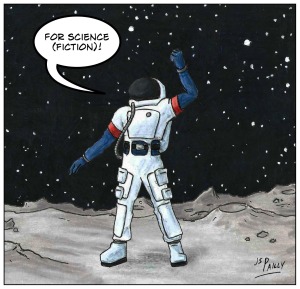
In writing this blog, I’m trying to teach myself science. Real science. At least, enough real science to be able to write competent science fiction.
Since most news articles about science are embarrassingly unreliable (damn those shruggies!), I end up reading a lot of scientific papers. And there’s something I’ve noticed. It’s like there’s a pattern to how scientific papers are written (at least, the legitimate ones).
Science Done Right
Taken as a whole, scientific papers sort of read like this:
Hey, I (or we) just noticed this weird thing which might have implications for how we think about other things. Here’s my (or our) best guess about what’s going on here, and here’s all the details so you can check this weird thing out for yourself. Hopefully we (the scientific community) can get to the bottom of this mystery.
A recent paper on the Planet Nine hypothesis is a great example (click here). In the paper, researchers explain that they’ve noticed something odd happening in the scattered disk region of our Solar System.
The researchers’ best guess is that an as-yet-undetected planet is perturbing the scattered disk. They then present all their data. All of it. Not just the parts that support their hypothesis. This shows that the researchers didn’t cherry-pick data to suit their idea. And in the end, the paper suggests new lines of research that could help prove or disprove this whole Planet Nine thing.
Doing Science Wrong
I’ve also encountered another kind of paper, a paper that reads more like this:
I (or we) hereby proclaim a new discovery which proves (or disproves) this other thing. End of discussion.
Sometimes these papers will also say things like:
We did an experiment. You can trust that we did it right. Here is some of our data; just the stuff that we believe is relevant.
And often, these papers will end with a line like:
Why, oh why, is the scientific community conspiring against me (or us) to hide the truth?
Real Science vs. Fake Science
In order to understand how real science works, you have to also learn a little about fake science so that you can tell the difference.
Fortunately, fake science is fairly easy to identify. There are so many red flags: bold proclamations, lack of detail concerning experimental methods, withholding experimental data that is deemed “irrelevant.” The whole “conspiracy to hide the truth” thing comes up a lot too. According to fake scientists:
Anyone who disputes my brilliant theory must be part of the conspiracy!
Meanwhile, real scientific papers tend to feel like a conversation. Mind you, it’s not always a polite conversation. One paper might be an opening argument, the next a rebuttal, and so forth. Scientific egos bruise easily, it seems, but eventually some sort of consensus is achieved.
At least until someone notices another weird thing which might have implications for whatever the consensus opinion turned out to be.





 Planet Pailly
