I’ve been feeling a bit discouraged lately. I’ve gotten a little off track with writing these past few weeks, and I have a lot of catching up to do. But I recently saw this short film, and it inspires me to keep going.
There are those who would say that science has taken all the magic out of life and all the magic out of the world. I don’t see things that way, and clearly these intrepid young space adventurers don’t see things that way either.
Sciency Words: (proper noun) a special series here on Planet Pailly focusing on the definitions and etymologies of science or science-related terms. Today’s Sciency Word is:
THE 90-DAY REPORT
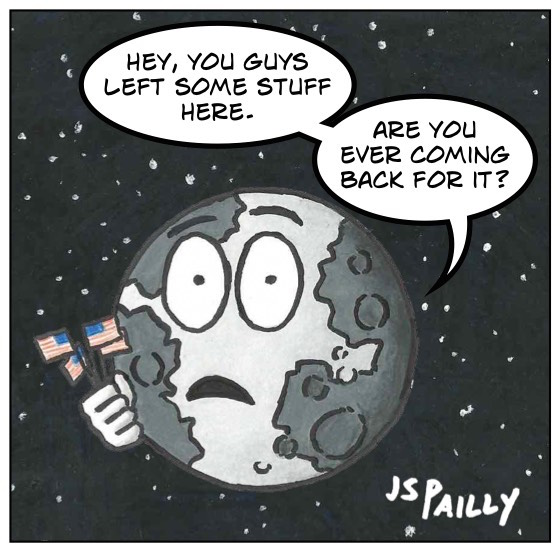
We recently celebrated the 50th anniversary of the Moon Landing. There’s been a lot of talk lately about the old Apollo Program, and also a lot of talk about the new Artemis Program, NASA’s next manned (and womanned) mission to the Moon.
But this is not a Sciency Words post about Artemis (I’m saving that for next week). Instead, this is a post about the 90-Day Report and how it effectively killed NASA’s plans to return to the Moon in the 1990’s. I think the story of the 90-Day Report provides some context for what may or may not happen with Artemis.
It was July 20, 1989—the 20th anniversary of the Moon Landing—when President George H.W. Bush announced America’s intention to return to the Moon and establish a permanent presence there. This would be part of a strategy for America to push onward to Mars. Following the President’s announcement, a special committee was formed to figure out how to make it all happen. The committee’s findings were released in a document titled “Report on the 90-Day Study on Human Exploration of the Moon and Mars,” a.k.a. the 90-Day Report.
According to the 90-Day Report, NASA would need to build a huge amount of infrastructure in space. If you’ve seen Stanley Kubrick’s 2001: A Space Odyssey, that’s basically what the 90-Day Report described: giant space stations, a multitude of space shuttles taxiing equipment and personnel to Earth orbit, and enormous interplanetary space cruisers to transport astronauts to the Moon or Mars.
And how much would this cost? The 90-Day Report conspicuously didn’t say, but the most commonly cited estimate was $450 billion. To put that in some context, NASA’s budget at the time was just over $11 billion (according to Wikipedia, numbers not adjusted for inflation). As Robert Zubrin explains in his book The Case for Mars:
It is doubtful that any kind of program could have survived that price tag. Given its long timelines and limited set of advertised accomplishments on the road to colonizing space, which did little to arouse the enthusiasm of the space-interested public, the 90-Day Report proposal certainly could not. Unless that $450 billion number could be radically reduced, the [Space Exploration Initiative] was as good as dead, a fact made clear in the ensuing months and years as Congress proceeded to zero out every SEI appropriation bill that crossed its desks.
A lot of people ask why we haven’t returned to the Moon since the days of the Apollo Program. The 90-Day Report is a prime example of why. “Too many cooks in the kitchen,” as a dear friend of mine likes to say. Where President Kennedy set a singular, clearly defined goal for the American space program, President Bush handed the space program over to a committee, which came up with a very complicated, very costly list of ideas, which Congress was unsurprisingly unwilling in paying for.
To be fair, at least one idea from the 90-Day Report did come to fruition. We did get a giant space station. But that only happened as a result of an international partnership, which is (in my opinion) a model for how all future space missions should be done.
So with the memory of the 90-Day report in mind, next week we’ll talk about the Artemis Program.
We choose to go to the Moon! We choose to go to the Moon…. We choose to go to the Moon in this decade and do the other things, not because they are easy, but because they are hard; because the goal will serve to organize and measure the best of our energies and skills, because that challenge is one that we are willing to accept, one we are unwilling to postpone, and one we intend to win, and the others, too.
J.F.K., 1962
This weekend, we celebrated the 50th anniversary of the Moon Landing. Much has already been written about this anniversary: about what the Apollo Program meant to the United States and to the world, about why the space program has struggled in the five decades since, about future missions that may or may not be happening.
I’m going to approach this from a different perspective, because as passionate as I am about space, there’s one thing I’m even more passionate about: writing.
I’ve blogged about this before: being a writer is a lot like running the space program. For a writer, every small step forward feels like a giant leap. But much like NASA scientists, writers have a tough time setting realistic budgets and deadlines for themselves. And most significantly, there will always been doubters and naysayers who want to tell you what you’re doing isn’t pragmatic. You’re wasting time and money. Aren’t there other problems you should deal with first? Writing can wait.
So today, if I may borrow the words of President Kennedy, I’d like to say this:
I choose to write my stories! I choose to write my stories and do the other things (like marketing, blogging, etc), not because they are easy, but because they are hard; because that goal will serve to organize and measure the best of my energies and skills, because that challenge is one I am willing to accept, one I’m unwilling to postpone, and one I intend to win.
– J.S.P., 2019
Now that I’m thinking about it, you could plug just about any goal you set for yourself into J.F.K.’s Moon speech, and it’ll probably still work. So in the spirit of President Kennedy and the Apollo Program, what do you choose to do?
Sciency Words: (proper noun) a special series here on Planet Pailly focusing on the definitions and etymologies of science or science-related terms. Today’s Sciency Word is:
THE SILURIAN HYPOTHESIS
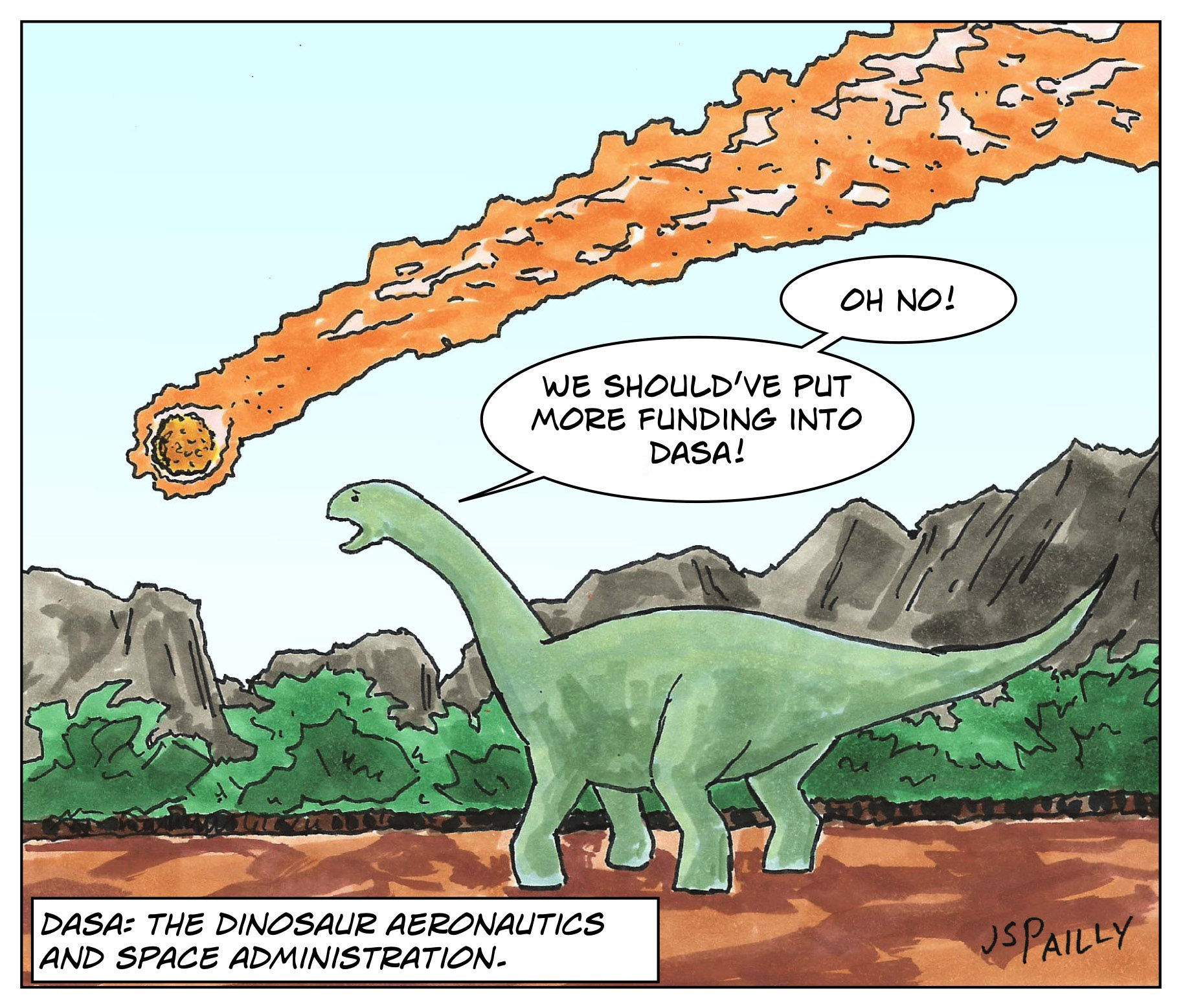
I’ve heard several variations on this joke. Why did the dinosaurs go extinct? Because they didn’t put enough money into their space program.
But what if that isn’t a joke? What if the dinosaurs (or some other prehistoric creatures) did establish an advanced civilization right here on Earth millions of years before we came along? Could such a civilization come and go without leaving any trace for us modern humans to find? Or could the traces be there for us to see, and we just haven’t recognized them yet?
In 2018, NASA astrobiologists Gavin Schmidt and Adam Frank presented this idea in a formal scientific paper titled “The Silurian Hypothesis: Would it be possible to detect an industrial civilization in the geological record?” As Schmidt and Frank explain in a footnote:
We name the hypothesis after a 1970 episode of the British science fiction TV series Doctor Who where a long buried race of intelligent reptiles “Silurians” are awakened by an experimental nuclear reactor. We are not however suggesting that intelligent reptiles actually existed in the Silurian age, nor that experimental nuclear physics is liable to wake them from hibernation.
Schmidt and Frank go on to examine some of the ways human industrial activities have changed this planet, and how those changes are being recorded geologically. They also examine a few of the oddities and anomalies in the geological record as we currently know it.
To be clear, there is absolutely no definitive evidence that another advanced civilization existed on Earth before our own. Schmidt and Frank go to great pains to emphasize that they don’t actually believe their own hypothesis to be true.
The Silurian Hypothesis is intended to be more of a thought experiment than anything else. It’s meant to help us better understand how human civilization is changing this planet, and also (remember Schmidt and Frank are NASA astrobiologists) how alien civilizations might be changing their own worlds.
P.S.: The Silurian Hypothesis is also a wonderful example of how science fiction can inspire real life science.
Lately, I’ve been trying to learn as much as I can about the planet Uranus and its moons. It’s been a real challenge. Only one spacecraft has ever visited the Uranian System, and that was back in 1986.
When I do research on most other objects in the Solar System, I usually find plenty of good, highly detailed information to work with. Geology, chemistry, meteorology (sometimes), seismology (sometimes), astrobiology (more often than you’d think)…. But when it comes to the moons of Uranus… well, we know what color they are!
Today, I’d like to introduce you to Umbriel. She’s sort of dark grey. All the moons of Uranus are grey, but Umbriel is the darkest shade of grey out of them all. In fact, that’s basically what the name Umbriel means: darkness.
According to this paper, Umbriel’s dark grey color might be caused by carbon compounds. Imagine there’s coal or charcoal dust sprinkled all over Umbriel’s surface. That’s basically what we think we’re looking at, except unlike coal or charcoal, Umbriel’s carbon compounds probably formed due to the photolysis and/or radiolysis of carbon dioxide, not because of biological activity.
But that dark coloration appears to be only skin-deep. Near the equator, Umbriel has a lighter, icier-looking surface feature. It’s believed to be the result of a relatively recent asteroid or comet impact. The color change probably means we’re seeing subsurface material that hasn’t undergone photolysis yet. Officially, that surface feature is known as Wunda Crater. Unofficially, it’s called the fluorescent Cheerio. Seriously, I’m not making that up.
Sending a spacecraft to Uranus is a costly and technologically challenging endeavor. That’s why we’ve only done it once. But if/when another Uranus mission does get off the ground, investigating that fluorescent Cheerio should be a top priority. Anything that can tell us what lies beneath the surface of an icy moon like Umbriel is worth a closer look.
Star Trek: The Motion Picture is not exactly the most beloved film in the Star Trek franchise. It’s slow-paced. It feels kind of sterile. The uniforms look just awful. But I recently found out about the director’s cut, and I have to say it’s a huge improvement.
Granted, the movie still has its problems. Among other things, those uniforms still look awful. But at least I felt like I was watching Star Trek and not a bad rip-off of 2001: A Space Odyssey. And the movie was thought-provoking in the way that Star Trek—and in fact all of science fiction—ought to be.
The movie’s antagonist is a vast, near-unknowable alien intelligence, an intelligence which has come in search of its Creator, and which is threatening to wipe out all life on Earth if the Creator’s identity is not revealed. Speaking of this vast, alien intelligence, Mr. Spock explains:
It only knows that it needs, Commander. But like so many of us, it does not know what.
If I may get a little personal for a moment, I’ve been feeling a bit discouraged lately. Discouraged about what? My writing journey? My career? My personal relationships? Take your pick! I just feel like something is missing. I need something, and frustratingly I don’t even know what that something is.
But after watching the director’s cut of Star Trek: The Motion Picture, I’ve decided that’s okay. That’s part of life. We all go through this at some point or another. This need for something—and the frustration of not even knowing what it is we need—is such a universal experience that even the most alien of alien intelligences may feel the same way sometimes. I don’t know about you, but I find that to be a comforting thought.
P.S.: Well, it’s a comforting thought until some alien intelligence decides to take out its frustration on us Earthlings.
Sciency Words: (proper noun) a special series here on Planet Pailly focusing on the definitions and etymologies of science or science-related terms. Today’s Sciency Word is:
STAGNANT LID
Here on Earth, we have earthquakes. Lots and lots of earthquakes. And that’s very odd.
Maybe we should be thankful for all those earthquakes. Our planet’s system of plate tectonics is unique in the Solar System. Frequent earthquakes are a sign that Earth’s tectonic plates are still moving, that our planet is still geologically healthy. The alternative would be stagnant lid tectonics, and that’s something we Earthlings probably don’t want.
In this 1996 paper, planetary scientists V.S. Solomatov and L.N. Moresi coined the term “stagnant lid” to describe what was happening on Venus—or rather what was not happening. Venus doesn’t have active plate tectonics. Maybe she did once, long ago. If so, Venus’s plates somehow got stuck together, forming a rigid, inflexible shell.
The term stagnant lid has since been applied to almost every other planetary body in the Solar System, with the obvious exceptions of the four gas giants, and the possible exceptions of two of Jupiter’s moons: Europa and Ganymede.
According to this paper from Geoscience Frontiers, neither Europa nor Ganymede have truly Earth-like plate tectonics, but something similar may be happening. The authors of that paper refer to the situation on Europa and Ganymede as “fragmented lid tectonics” or “ice floe tectonics.” The upcoming Europa Clipper and JUICE missions should tell us more about how similar or different this is to Earth’s plate tectonics.
A stagnant lid does not necessarily mean that a planet or moon is geologically dead. Venus and Io both have active volcanoes, for example, and it was recently confirmed that Mars has marsquakes. But none of these stagnant lid worlds seem to be as lively as Earth—and I mean that in more ways than one.
If you buy into the Rare Earth Hypothesis, plate tectonics is one of those features that makes Earth so rare. Plate tectonics is something Earth has that other planets don’t, and thus it may be an important factor in why Earth can support life when so many other worlds can’t.
I have a friend who’s obsessed with The Little Mermaid. So if I’m going to write a post about Ariel, one of the moons of Uranus, it would be a real shame if I couldn’t make some sort of Little Mermaid reference.
Unfortunately, we know precious little about Ariel, or any of Uranus’s moons, for that matter. Only one spacecraft has ever visited: NASA’s Voyager 2, way back in 1986. And the data Voyager 2 sent back gives us a frustratingly incomplete picture.
What I can tell you is that Ariel’s surface is made of ice, specifically water ice and carbon dioxide ice. One hemisphere appears to have more carbon dioxide than the other, according to this paper from Icarus. And according to this profile piece from NASA, Ariel is the shiniest of Uranus’s moons–it reflects more sunlight than the others. Oh, and Ariel’s surface appears to be younger than the surfaces of those other moons as well. That might be important!
[The Voyagers 2] flyby revealed Ariel to be relatively smooth, as if its surface was being continually renewed by activity deep within. It is currently believed to be the only ocean world in the Uranian system.
A word of caution: that Scientific American article says a lot of highly speculative, highly conjectural stuff. Take it with a grain of sodium chloride.
However, in the absence of better, more detailed information about Uranus and its moons, it sounds like Ariel could maybe possibly be Uranus’s version of Europa or Enceladus. It could possibly be a moon with an icy crust floating atop an ocean of liquid water. It might even be the kind of environment that could support life. There might even be….
But no, I shouldn’t make a claim like that. It would be irresponsible of me as a science blogger. Voyager 2’s data was too limited, and subsequent observations by Hubble or other Earth-based telescopes can only tell us so much. Until our next mission to Uranus (whenever that might be), we really can’t say what might be hiding beneath the icy crust of Ariel.
Sciency Words: (proper noun) a special series here on Planet Pailly focusing on the definitions and etymologies of science or science-related terms. Today’s Sciency Word is:
DREADNOUGHT
Okay, this isn’t really a scientific term. It’s more of a science fiction thing. This week, I ended up watching a video on YouTube about how science fiction borrows and sometimes misuses terminology from the navy. If you’re a Sci-Fi fan, and especially if you’re a Sci-Fi creator, I think this video is worth your time.
For me, the most interesting of these terms was dreadnought, a word that literally means “I fear nothing.” In Sci-Fi, dreadnoughts tend to be the biggest, scariest, most overpowered spaceships out there. If you’re going into battle against a dreadnought, well… I guess it was nice knowing you.
In real life, the term dreadnought comes from the H.M.S. Dreadnought, a massively oversized, massively over-armed battleship that first went out to sea in 1906. The idea for this ship was championed by Admiral Sir John Fisher, later known as Baron Fisher.
I couldn’t resist showing you Baron Fisher’s coat of arms. Note the family motto on the bottom. Image courtesy of Burke’s Peerage.
Admiral Fisher wanted an all-big-guns ship. No small guns. No middling-sized guns. Only the largest guns available at the time would be large enough for the H.M.S. Dreadnaught. According to this article, the Dreadnought triggered something of an arms race between Britain and Germany, with each country trying to out-dreadnought the Dreadnought, so to speak.
Thus we have a case of what linguists call semantic generalization. The specific name of one vessel became a generalized term for all the ships that followed a similar design philosophy. And now the term has been adopted by the Star Trek and Star Wars universes, and many other Sci-Fi universes besides.
Personally, I think dreadnoughts in science fiction have become a bit cliché. They’re the biggest, baddest ships in the galaxy, and yet somehow the good guys always find a way to blow them up. But now that I know the history of the term, I kind of want to fit some dreadnoughts into my own Sci-Fi universe—probably in some clever, punny way that honors Admiral Fisher and the original H.M.S. Dreadnought.
Welcome to the Insecure Writer’s Support Group! If you’re a writer, and if you feel in any way insecure about your writing life, click here to learn more about this awesome group!
Since last month’s meeting of the Insecure Writer’s Support Group, I’ve been getting out more, doing new things, meeting new people. It’s not like I took the “your life is soooo boring” thing seriously. I didn’t plan this or anything. It just sort of happened.
Anyway, if I’m going to be meeting new people, having more of a social life, and all that stuff, then I think it’s time to revisit one of my older IWSG posts. So here, once again, is an open letter to anyone who’s had a conversation with me.
* * *
This is an open letter to anyone who’s ever had a conversation with me. You may or may not have been aware of this at the time, but I’m a writer. That means there’s something you should know: while we were talking, I was taking mental notes about you.
Okay, there’s no need to panic. I’m not in the habit of taking people I know or people I’ve met and just dropping them into my stories. Yes, some writers do that, but that’s not how my process works.
So I promise I will not create a character just like you; however, the things you said—especially the way you said them—may inform my character development process at some point in the future. Well, maybe not in the future. To be honest, I’m probably already using you as a source of inspiration.
If you used some particularly interesting turn of phrase of displayed some unique or striking mannerism while we were interacting, I may have actually written that down to ensure I wouldn’t forget. I wouldn’t have done this in front of you. That would’ve been rude. But be aware that I probably did this behind your back, and I probably added you to a file folder when I got home.
I hope this doesn’t make you feel self-conscious or uncomfortable. It’s important to me that you behave naturally. Or rather, I want you and need you to behave authentically, because authentic speech and behavior are precisely that I’m trying to replicate in my storytelling.
Thank you for your time. I just thought you ought to know what you’re getting yourself into when you talk to a writer like me.


 Planet Pailly