Wait, What Do You Mean There’s No “Life” on Mars?

Hello, friends!

The other day, someone wanted to pick a fight with me.  This person said to me in a forceful, almost rude tone, that there is absolutely no chance we will ever discover life on Mars.  If you know me at all, you must surely know: them’s fightin’ words!

Except before this conversation could escalate into a full blown argument, it became apparent (to me, at least) that we were not actually talking about the same thing.  You see when I talk about life on Mars, I mean life of any kind, including microorganisms—especially microorganisms.  This other person was using the word “life” to mean, specifically and exclusively, intelligent life.

No, I do not expect we’ll find intelligent life on Mars.  There are no canals, no cities—none of that stuff Percival Lowell once imagined he saw in his telescope.  Nor do I expect to find non-intelligent animals or any kind of plant life.

The best we can hope for is that there might be Martian microorganisms hiding under a glacier, subsisting off a trickle of meltwater.  And to be honest, I’m not overly optimistic about finding even that much life on Mars.  But to say it is absolutely impossible?  No, I cannot agree with that.

And after explaining what I mean when I talk about life on Mars and what my expectations actually are, this person conceded (grudgingly, perhaps) that I might have a point.  Thus what could have been a bitter and fruitless argument turned into an opportunity to educate someone about the science of astrobiology.  Why?  Because I asked the question “Wait, what do you mean by life?”

Language is not as precise a tool as we often imagine.  People sometimes use the same words to mean very different things, leading to misunderstandings, hurt feelings, and unproductive arguments.  I think a lot of those arguments, both big and small, could be avoided if more people would stop and ask: “Wait, what do you mean by (fill in the blank)?”

Next time on Planet Pailly, am I too judgmental?  We’ll find out in this month’s posting of the Insecure Writer’s Support Group.
Sciency Words: Metal

Hello, friends!  Welcome to another episode of Sciency Words, a special series here on Planet Pailly that’s all about those weird words scientists use.  Today on Sciency Words, we’re talking about:

METAL

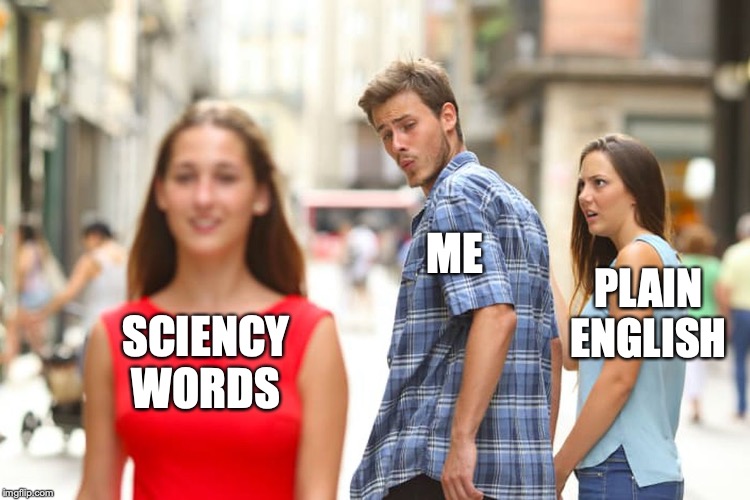
Yes, scientists use some very strange words.  You know the kind of words I mean.  Words that are hard to pronounce.  Words with definitions that only make sense if you understand differential calculus.  But you know what’s even weirder?  When scientists take words you already know and redefine them.  That’s what astronomers and astrophysicists have done to the word “metal.”

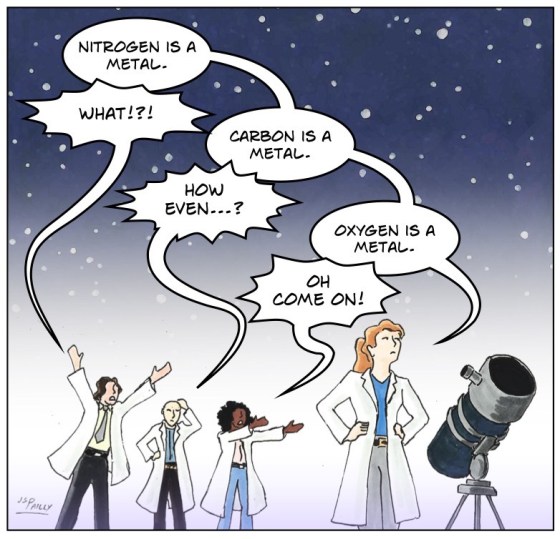
Approximately 75% of the matter in the universe is hydrogen.  24% of it is helium.  And the remaining 1%?  Ask an astrophysicist, and they’ll tell you the remaining 1% is all “metal.”  If that seems weird to you, don’t worry.  All the other scientists think it’s weird too.

For years now, I’ve been trying to figure out how this started.  Who gets credit (or blame) for first messing up the definition of metal?

I don’t know, but I do have a pet theory.  Perhaps certain chemical elements (like nickel or iron) are easier to detect in outer space than others.  And if you’re trying to study that 1% of the material universe that isn’t hydrogen or helium, perhaps those easier-to-detect elements (which happen to be metals) serve as a convenient proxy for everything else—including nonmetals like nitrogen, carbon, and oxygen.

According to the Oxford English Dictionary Online, the earliest documented usage of either “metal” or “metallicity” (in the astronomy sense of those words) is this 1969 paper on the molecular composition of stars.  Now I won’t pretend to have read the whole paper (it’s over 60 pages long), but based on what I did read, I can say this much: this cannot be the true first usage of the word metal (in the astronomy sense).

At one point, the authors, two astronomers from U.C. Berkley, categorize nitrogen as a metal.  No explanation is offered.  Clearly the authors expect their readers (i.e. other astronomers) to understand why nitrogen would be considered a metal, which suggests to me that most astronomers in 1969 already understood “metal” to mean “matter that isn’t hydrogen or helium.”

However, I can also say this: I think this paper supports my pet theory.  The paper describes a new technique for determining the molecular composition of stars.  In explaining this new technique, the authors focus on the spectroscopic signatures of three specific elements: sodium, magnesium, and calcium.  Those three elements are then used as a proxy for all the other non-hydrogen and non-helium elements that might be found inside a star.

Sodium, magnesium, and calcium are all—wait, let me double check the periodic table—yes, all three of those elements lie on the metal side of the metalloid line.  And thus through a process linguists call semantic generalization, the word metal is generalized to mean something more than it originally meant.

Next time on Planet Pailly, someone really wanted to pick a fight with me about life on Mars.

I’m Escaping from Prison. Want to Join Me?

Hello, friends!

For this first blog post of 2020, I’d like to share a quote from one of the greatest authors of all time.  As you know, lots of people take a pretty dim view of fantasy and science fiction, and they take an even dimmer view of those of us who enjoy those genres.  J.R.R. Tolkien had the perfect response for those people:

Why should a man be scorned if, finding himself in prison, he tries to get out and go home?  Or if, when he cannot do so, he thinks and talks about other topics than jailers and prison-walls?

J.R.R. Tolkien

Of course Tolkien found his escape in a world of Hobbits and magical rings.  Me?  I find my escape in outer space.  Here on Earth, we humans have created a world of money and politics, of materialism and egotism and self-centered posturing, of winning and losing and grinding each other into the dust.

Okay, maybe it’s not all bad.  There are pleasant things about this world we humans have made for ourselves too.  But still, can you really blame me if, from time to time, I choose to think about or talk about or write about what it would be like to get the heck off this planet?

I know some people will still judge me for my love of science fiction and my obsession with space exploration.  They’ll call me foolish or childish.  That’s fine.  People can say what they like.  I intend to keep dreaming and keep wondering and keep exploring the universe in my own semi-imaginative way.

And friends, you are welcome to join me on this adventure, if you want.  All you have to do is click the subscribe button!

Next time on Planet Pailly: why can’t scientists agree on what the word metal means?

Final Post of 2019

So this is going to be my last post for 2019.  There are several reasons for this.  First off, I’ve been feeling a bit under the weather.  Secondly, it’s Christmas season, and that is always a bit distracting.  And thirdly, I have big plans for 2020, so as soon as I’m feeling better, and once all the presents are wrapped, I want to get straight to work on stuff for next year.

Seriously, I am so excited for next year.  Some of you can probably guess why!

In the meantime, here are some pictures of my Christmas tree, fully decorated with Star Wars action figures, as has been my custom for many years now.  Because Christmas is about love and family and stuff… sure.  But we all know it’s really all about the toys.

And I’ll see you all on January 1st for the first Insecure Writer’s Support Group of 2020!

Correction: January’s I.W.S.G. has been postponed until January 8th, so I’ll have something else for you on January 1st!

Sciency Words: Meme

Sciency Words: (proper noun) a special series here on Planet Pailly focusing on the definitions and etymologies of science or science-related terms.  Today’s Sciency Word is:

MEME

I don’t know about you, but when people talk about memes, I’m not always 100% sure what they mean.  However, it turns out that meme is, in fact, a scientific term, or at least it started out as one.  And you know how I am about scientific terms!

British evolutionary biologist Richard Dawkins gets credit for coining the word meme.  In his 1976 book The Selfish Gene, Dawkins posits that culture develops, changes, and spreads when humans beings imitate the behavior of other human beings.  Explaining the origin of his new word, Dawkins writes that he wanted:

[…] a noun that conveys the idea of a unit of cultural transmission, or a unit of imitation.  “Mimeme” comes from a suitable Greek root, but I want a monosyllable that sounds a bit like “gene.”  I hope my classicist friends will forgive me if I abbreviate mimeme to meme.  If it is any consolation, it could alternatively be thought of as being related to “memory,” or to the French word même.  It should be pronounced to rhyme with “cream.”

In the decades that followed Dawkins’ book, a whole new field of research began to emerge.  The science of memetics would take the analogy between genes and memes to an extreme by applying the core concepts of Darwinian evolution.  To quote from this 2015 article:

Memes are naturally selected and adapted by human beings based on “competition” within our consciousness.  The fittest and best adapted memes will have a better diffusion than the ones which do not fit into the cultural systems they are competing within.

Now if you’re like me and you’re still not 100% sure what, exactly, a meme is, don’t worry.  We’re not alone.  As that same article goes on to explain, the field of memetics seems to have fallen into decline in the late 1990’s/early 2000’s.  The problem: no one, not even the memeticists, could agree on what the word meme means, specifically.

Personally, I think this is a case of an analogy being taken one step too far.  Memes are supposed to be like genes.  Okay.  But genes are tangible things.  They exist within your cells.  It is possible to test for the presence of a gene in an organism’s D.N.A., and you can link genes to the traits that organisms do or do not have.  But memes?  This “unit of imitation” thing is intriguing, but it’s also a rather abstract concept.  How do you study, in a scientific manner, an abstract concept?  How do you test for the presence of an abstract concept?

If we’re talking about the survival of the fittest, perhaps meme is not fit enough for the ecosystem of scientific terms.  However, through the process of linguistic evolution, the word seems to have found a different ecological niche to fill.  According to the Oxford English Dictionary, the first recorded reference to an Internet meme (or rather a “net meme”) was in 1998, around the same time that the science of memetics was in its heyday.  The term was used in a news report about this video clip:

Sciency Words: The X17 Particle

Sciency Words: (proper noun) a special series here on Planet Pailly focusing on the definitions and etymologies of science or science-related terms.  Today’s Sciency Word is:

THE X17 PARTICLE

If you want to know everything there is to know about particle physics, there are only four things you need to understand:

  • Gravity
  • Electromagnetism
  • The weak nuclear force
  • The strong nuclear force

See?  Particle physics is easy!

Okay, maybe particle physics is not so easy.  Even the professionals will tell you they don’t understand those four fundamental forces nearly well enough.  And now, to make matters worse, we may have to add a fifth fundamental force to the list, thanks to the newly discovered X17 particle.

The story of the X17 particle begins with this 2015 paper published in Physical Review Letters.  A team of researchers in Hungary were studying a radioactive isotope of beryllium when they noticed something odd.  Click here if you’re interested in more details about what the Hungarians noticed and what was so odd about it; but for our purposes here on Sciency Words, I think it’s enough to say that this odd thing implied the existence of a previously unknown subatomic particle.

After doing some calculations, the Hungarians determined that this unknown particle (or X particle) must have a mass just shy of 17 megaelectronvolts (hence the name X17 particle).  Follow up research at the University of California, Irvine, strengthened the case that this new particle is real, and furthermore the Irvine team argued that X17 might even be a force carrying particle—meaning we might have discovered a fifth fundamental force of nature!

The latest update is that the same team of Hungarian researchers have noticed something odd happening with another radioactive isotope, this time an isotope of helium.  And according to this prerelease paper, we are once again dealing with an unknown particle with a mass just shy of 17 megaelectronvolts.

This could be a huge breakthrough in the field of particle physics, and according to the Irvine team the X17 particle might even shed some light on the mystery of dark matter.  However, as reported in this article from Quanta Magazine, this particular team of researchers in Hungary have a history of discovering “new” particles that turn out to be errors in their data.  Furthermore, there’s some suspicion that the Hungarians are withholding some of their experimental data regarding X17.  As I’ve written before, withholding data is a huge red flag.

That being said, both professional physicists and the popular press seem to be abuzz with rumors about X17, and I can’t tell you how many people have been asking me about this whole “fifth force” thing.  So I definitely think it is worth knowing about the X17 particle (and now you can impress your friends at parties by explaining what the name means!).

However, do not be surprised if, in another few years, the X17 particle gets thoroughly discredited and debunked.

#IWSG: Write, Rest, Repeat

Welcome to the Insecure Writer’s Support Group!  If you’re a writer, and if you feel in any way insecure about your writing life, click here to learn more about this awesome group!

For today’s episode of the Insecure Writer’s Support Group, I’m going to turn things over to my muse.  She has something to say, and maybe it’s something your muse needs to hear.

My fellow muses, I’m sure you all remember what they taught us during muse training: writers are weak-willed and lazy.  They’ll invent all sorts of excuses to avoid writing.  So it’s up to us to use whatever deception, manipulation, or coercion we can in order to force our writers to do their writing!

But after spending so much time out in the real world working with a real life writer, I’ve discovered that what they told us in training isn’t quite true.  Writers want to write.  They really, really do.  The problem is that they set their expectations too high and then feel disappointed and discouraged when they fall short of their goals.

My own writer is obsessed with tracking his daily and weekly word counts.  He’s also started keeping a tally of the total number of words he writes per year.  Word counts can be a great way for writers to measure their own progress.  However…

I know many of you have been dealing with similar problems.  Maybe your writer just “lost” NaNoWriMo, or worse… maybe your writer “won” and is now stuck with a total mess of a manuscript.  Either way, your writer may be feeling a bit frustrated, a bit discouraged—even a little bit (dare I say it?) insecure right now.

Challenges like NaNoWriMo can test your writer’s limits and help them grow.  However—and this is the part I wish they’d teach us in muse training—writers also need recovery time.  This past year, I have allowed my writer to settle into a rhythm of intense writing days followed by periods of slower, more relaxed writing.

My writer didn’t like this new rhythm at first.  He thought I was being too easy on him.  Truth be told, I was a bit nervous about this myself because, as I said, this really isn’t what they taught us in muse training.  But then my writer noticed that, while his daily word counts were all over the place, his weekly word counts were steadily going up.  He stopped complaining, and I stopped worrying.

Write, rest, and repeat!  That’s our writing mantra now.  So if you’re having trouble with your writer, don’t presume they’re being lazy.  Don’t be too hard on your writer, and don’t let your writer be too hard on him/herself.  Let your writer rest.  Give your writer a chance to recover.  Then move on to the next writing challenge!

The Great Red Spot: More Than Skin Deep?

You and I may think of the Great Red Spot as Jupiter’s defining characteristic, but Jupiter himself is rather embarrassed about his spot.  He’s been trying for some time now to get rid of it.

The Great Red Spot (or G.R.S., as all the cool kids call it) has been shrinking for decades now, and the rate of shrinkage has been accelerating.  Just this year, long streams of red stuff seemed to break free, as it the G.R.S. were “unspooling.”

So why has the G.R.S. gone into decline?  Well, a better question might be why did it last so long in the first place?  Apparently, according to most fluid dynamics models, the G.R.S. should have only lasted a few years.  Instead, it’s been going strong for centuries.  Astronomers first noticed it as early as 1664.

In 2013, physicists Philip Marcus of U.C. Berkley and Pedram Hassanzadeh of Harvard gave us a partial answer.  According to this article from phys.org, they were the first to model the G.R.S. not as a 2D surface feature but as a 3D structure, with a vortex extending into the depths of Jupiter’s atmosphere.

Marcus and Hassanzadeh found that vertical flow (hot and cold air moving up and down inside the G.R.S.) was doing a lot to help keep the storm system going.  As Hassanzadeh explains in that same phys.org article:

In the past, researchers either ignored the vertical flow because they thought it was not important, or they used simpler equations because it was too difficult to model.

Late last month, Marcus and Hassanzadeh gave a presentation at the annual meeting of the American Physical Society, and according to that presentation, fans of the Great Red Spot have nothing to worry about.

As Marcus explains in this article for Astronomy Magazine, we can monitor the vortex beneath the G.R.S. by observing the behavior of other nearby storm systems.  And based on those observations, Marcus says, “[…] there is no evidence that that vortex itself has changed its size or intensity.”

Personally, I think Marcus and Hassanzadeh make a pretty compelling case that the G.R.S. is as strong as ever, even if it appears, superficially, to be shrinking.  But I still don’t really understand what’s caused that superficial shrinkage, and I’m left wondering how long it will be before the visible part of the G.R.S. starts to expand again.  Surely it will start expanding again, right?

I guess there’s always more to learn.

Sciency Words: Artificial Intelligence

Sciency Words: (proper noun) a special series here on Planet Pailly focusing on the definitions and etymologies of science or science-related terms.  Today’s Sciency Word is:

ARTIFICIAL INTELLIGENCE

In 1955, American cognitive scientists John McCarthy and Marvin Minsky sent out an extraordinary proposal:

We propose that a 2 month, 10 man study of artificial intelligence be carried out during the summer of 1956 at Dartmouth College in Hanover, New Hampshire.  The study is to proceed on the basis of the conjecture that every aspect of learning or any other feature of intelligence can in principle be so precisely described that a machine can be made to simulate it.

McCarthy and Minsky go on to write that that machines can be made to learn, solve problems for themselves, and “improve themselves.”  They also claim that “significant advancement” can be made toward these goals if a group of experts were to “work on it together for a summer.”

Ah, such optimism!

That 1955 proposal is the first documented usage of the term “artificial intelligence.”  Apparently McCarthy initially wanted to use the term “automata studies,” but even among scientists and engineers, “automata studies” didn’t sound sexy enough.  So McCarthy coined the term “artificial intelligence” and ran with that instead.

According to this article from the Science History Institute: “The name implied that human consciousness could be defined and replicated in a computer program […].”  Whether of not that’s true—whether or not computers really can reproduce human-style consciousness—is a topic of ongoing debate.  Regardless, McCarthy’s new term got the attention he wanted, and the 1956 conference at Dartmouth was a success.

However, it turns out it would take more than “a summer” to trigger the robot apocalypse.  Still, the 1956 Dartmouth Conference started something important, and today, we are living with the consequences!

Oh No! It’s the Internet!

Here in the U.S., we’re about to celebrate my favorite holiday: Thanksgiving.  It’s a holiday all about good food and spending time with good friends, and… that’s basically it.  And that’s why I love it.  No need to agonize over finding just the right gift, or anything like that.  Just relax and enjoy being human.

This year, I am most thankful for the Internet.  Now you might be thinking how could anyone be thankful for the Internet?  There’s so much online harassment going on.  Political disinformation campaigns are plentiful.  People are being cheated and scammed, and faceless corporations are collecting personal data on each and every one of us.

Yes, the Internet can be a scary place.  Without a doubt, some bad things have happened to me online, and I know far worse things have happened to other people.  But as a wise woman once told me: nothing good in life comes without risk or without sacrifice.  And at least in my personal experience, the good stuff on the Internet far outweighs the bad.

The Internet has fed my passion for writing and art.  It’s fed my passion for science and space exploration.  It’s given me access to so many resources, and I’ve read so much original research (unfiltered by the popular press) thanks to the Internet.  I’ve learned so much, and I’ve been exposed to perspectives and worldviews that I, as someone living in one specific region of the United States, never would have encountered otherwise.  And the Internet has left me with an awareness that, despite all this knowledge I’ve gained, I still have so much more to learn.

And most importantly of all, I’ve made new friends here on the Internet.  I may not have met you in person, but I love you all the same!  I know some people would take a dim view of me for claiming my online friends count as “real” friends, but it’s true.  I really do consider many of you to be good friends.  For that, I am very thankful.

Okay wait… do I really want to share that in a blog post…?