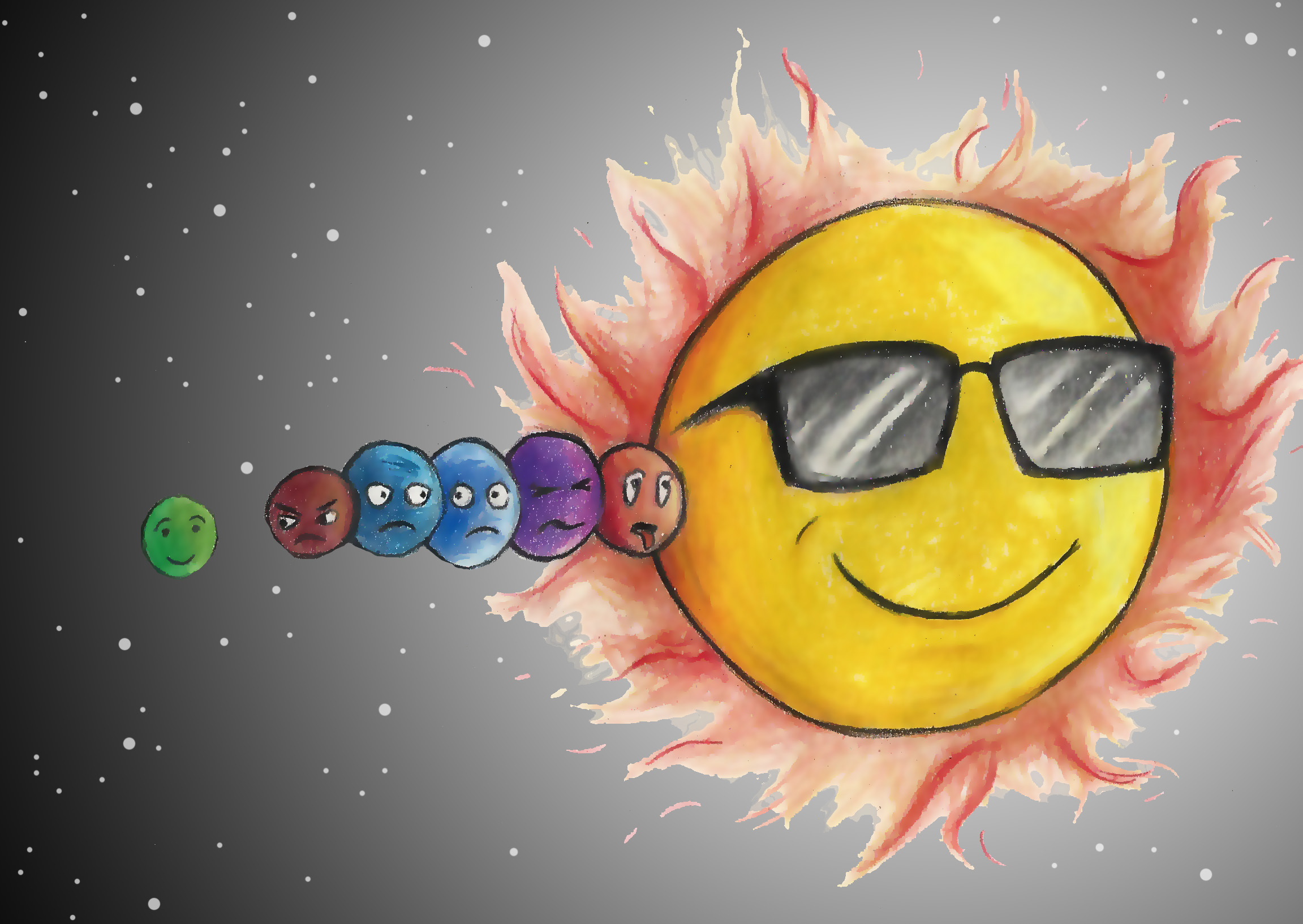
Good News and Bad News

Okay.  Here’s the good news.  Kids like to read.  I know; it’s shocking.  Things were never like this when I was growing up, but thanks to books like Harry Potter and Twilight reading has become “popular.”  Just look at the success of young adult literature.

Now the bad news.  American students don’t understand science.  Apparently they even struggle to explain how heat moves from one place to another.  There are a lot of reasons why this may have happened: schools are cutting their budgets, class sizes are too large, teachers avoid important but controversial subjects like evolution.  I won’t go into all that right now (click here or here if you want to read more).

I’ve always felt that scientific accuracy makes better science fiction.  Obviously the story comes first, and sometimes that means bending the Laws of Thermodynamics a little, but science fact makes science fiction more believable.  A book like Dune wouldn’t be the same without the research Frank Herbert did on ecology.  Ender’s Game wouldn’t work without Newton’s Laws of Motion or Einstien’s Theory of Relativity, which are seamlessly incorporated into military strategy in space.

But maybe scientific accuracy matters for another reason as well.  Young readers might learn something.  For the first time, a fourth grader named Johnny might find science interesting, and he might go ask his science teacher if this Relativity stuff is really true.  Maybe, with the help of science fiction, American students like Johnny will start to understand science again.

What do you think?

Second-hand Biology

Over the last two years, I’ve caught swine flu, whooping cough, and a mysterious neurological condition.  Now I also have an ear infection.  As one illness piles on top of another, it’s become difficult to keep up with my writing.  Several times, I’ve considered giving it up entirely (my neurological issues make it hard to concentrate).

However, I’ve decided all my visits to doctor’s offices and hospitals are good for my writing (when I can do it).  I write science fiction.  Biology is a part of science, and I’m surrounded by experts in applied biology.  This is a research opportunity!

My own situation could be a sci-fi story.  Why are all these diseases picking on me?  What if they’re working together—coordinating their attacks?

Okay, maybe it wouldn’t be a good sci-fi story.  But if I ever have to create my own Dr. Beverly Crusher, I can base her on the real doctors I’ve met.  Real doctors aren’t like the ones on Grey’s Anatomy (sadly, they aren’t like the ones on Star Trek either).  Based on what I’ve seen, there are three kinds of doctor.

  • The kind who doesn’t care.  Your pain and suffering is just another day at the office to this guy.
  • The kind who try to convince you you’re sicker than you really are so they can get more money from your insurance company.
  • The good kind, who answer your questions, check up on your progress, and help you decide for yourself how to treat your condition.  I don’t know how common these good doctors are; I’ve only met one so far.

What I’m trying to say is this: for a writer, nothing is a bad experience.  No matter what you may be going through, it’s an opportunity to learn something.  Thanks to my illnesses, I know a little more about health care (and after two MRIs, I envy Star Trek’s medical tricorder for good reasons).

What bad experiences have helped you as a writer?

P.S.: Thanks to my ear infection, I now know what the Eustachian tube is.

Book Review: In Search of Schrodinger’s Cat

Most of physics can be explained using billiard balls on a pool table.  Quantum mechanics is a game of pool where the 8 ball can turn itself into a 3 ball and a 5 ball, which go their separate ways, for no apparent reason.  Or where a 1 ball can appear out of thin air, so long as it’s accompanied by a -1 ball, and then vanish—again for no apparent reason.  Sometimes a ball in one of the pockets can pop back out, and sometimes two balls that should have collided will pass right through each other.

In Search of Schrödinger’s Cat by John Gribbin attempts to explain the quantum world to us humans living in the “real” world.  The book begins by making it clear that common sense does not apply to quantum reality.  Atoms and photons and various fermions and bosons follow their own secret rules, and we humans have to accept that strange things do happen without ever knowing why.

By approaching quantum mechanics from a historical point of view, Gribbin shows how one discovery led to another, increasing the amount of evidence for “quantum weirdness” even as scientists worked harder and harder to prove subatomic particles made logical sense until finally they threw up their hands and gave up.  Some of the very people who created quantum mechanics, such as Erwin Schrödinger himself, were the most incredulous about it.

The book was published in the 1980’s, and since then we have built larger and larger particle accelerators, and there have been new developments in quantum science.  But the essential mysteries are still mysteries, and In Search of Schrödinger’s Cat is a good introduction to the subject.  Equations are kept to a minimum, but there are a few.  Some prior familiarity with time travel and alternate universes as presented in science fiction would help as well.

Pessimism: The Next Generation

In my opinion, some of the best science fiction published today is in the young adult section.  Uglies by Scott Westerfeld and The Hunger Games by Suzanne Collins are two of my favorites, and I just ordered a book called Matched by Allie Condie, which I’m eager to read.

All three books could be classified as a specific kind of sci-fi: dystopia.  They all present a future gone horribly wrong.  Uglies is about compulsory plastic surgery; in The Hunger Games, children fight to the death as a form of entertainment; Matched, according to its description on Amazon, is about a world where the state determines who you can marry.  It reminds me most of the original utopia, the perfect society advocated by Plato over 2000 years ago, which also included a government run breading program.

And these books are meant for kids, age 13 and up.

I grew up watching Star Trek, one of the most optimistic sci-fi series ever created.  It presents a future without poverty, racism, or war (except occasional wars against Klingons, Romulans, or the Dominion).  It shows technology making our lives better.  It shows a government that respects the rights of its citizens and noncitizens alike.  It boldly tells us that no matter how bad the world is today, there’s always hope for tomorrow.

Star Trek’s message shaped the person I am today.  Although I would never discourage children from reading books—any books—they’re interested in, I have to wonder what impact all these dystopias have on young minds.  Are we making a generation of pessimists?

* * *

It’s two weeks since I originally posted this, and I can safely say Matched by Allie Condie is an excellent book.  These are all excellent books.  My only concern is that a steady diet of dystopias might make kids afraid of the future… afraid that we can’t solve our problems without Big Brother style government.

With that said, dystopia for young adults is nowhere near as pessimistic as the classic dystopias, like Geroge Orwell’s 1984 or Aldous Huxley’s Brave New World.  No matter how bad things get in Uglies, Hunger Games, or Matched, there is still hope for a better world.  Even hope for a real utopia.

Ajax (Off Topic)

Oh! Brave and noble Ajax
Who fought before the walls of Troy
None could repel your attacks
Many warriors you did destroy

Your name would live forever
That was your comrades’ hope
I see it still whenever
I buy orange scented dish soap.


The Fall of Zeus

You may or may not be a fan of alternate histories, but don’t you wonder how ancient Greek mythology would have developed if people still believed it today?  I think the modern pantheon would look very different.

There was a prophecy that one day the son of Zeus and Metis, one of Zeus’s many mistresses, would overthrow his father.  A complicated and somewhat disturbing story follows (Metis turns into a fly, and Zeus eats her), but in the end they have a daughter.  Zeus isn’t concerned because, of course, no woman could overthrow the king of the gods!

That daughter was Athena, goddess of wisdom, logic, justice, democracy… she has a long résumé.  It seems to me that here in the 21st Century we’ve come to depend a great deal on the things Athena represented.  Zeus, god of lightning, couldn’t be so important.  Lightning isn’t a mystery.  It’s caused by a static charge forming between dust or water particles in the air.

Furthermore, scientists in the Abu Dhabi Desert recently created rain for 52 days.  By generating ionized particles, they forced what little moisture was in the air to condense and fall as raindrops.  If we continue developing technology to control the weather, it’ll be the death of any weather deity.

Greek mythology was about personifying the various forces at work in people’s lives.  If those stories had continued into the modern world, a world where science has overcome many old superstitions (let’s not mention creation theory right now), then Athena has become queen of the gods.

* * *

The picture above is of a Roman plate depicting Minerva, a.k.a. Athena, from circa 1st Century BC.  Courtesy of wpclipart.com.

For more information on artificial rain in the Abu Dhabi Desert, click here.

* * *

I’m curious to hear what you think.  If the Greek gods were still around, who would be in the modern pantheon?  What new gods would we have created?

A Planet By Any Other Name…

Dr. Scientist: Did you know GJ 1214 b is almost seven times as massive as Earth, and it orbits its parent star in less than two Earth days?  Or that the planets HD 200964 b and HD 200964 c are in a state of orbital resonance, meaning their orbital times can be expressed as a ratio of 4:3? And that the planet MOA-2007-BLG-192Lb…

James: Wait, what was the first one?

Dr. Scientist: PSR 1257 b.

James: No, the one you were talking about.

Dr. Scientist: Oh, you mean GJ 1214 b.

James: … I guess.

Dr. Scientist: I got confused.  I thought you meant what was the first exoplanet ever discovered.  That one’s called PSR 1257 b, and there’s another planet in the same system called PSR 1257 c.

James: Okay, that’s enough.  Why the [expletive deleted] don’t any of these planets have names?  Can’t someone at least make up nicknames?  Are we waiting for first contact with the people from HD 149026 b so we can ask them what they call HD 149026 b?

Dr. Scientist: It’s very unlikely anything lives on HD 149026 b.  The surface temperature is more than 2000 degrees Celsius.

James: How would I know that?  I don’t know the difference between HD 149026 b and HD 217107 b!  Look, what if, just for the sake of convenience, we all agreed to call HD 149026 b “Snooki,” and HD 217107 b “The Situation?”

Dr. Scientist: I’m not sure those names are scientifically accurate.

James: I don’t care!  It’s hard to have a conversation about exoplanets when they’re all named things like HD 802701 b!

Dr. Scientist: (chuckling) HD 802701 b?  There’s no planet by that name.

James: … I’m not talking to you anymore.

* * *

The International Astronomy Union, which is in charge of naming celestial objects, has not yet agreed on how planets outside the Solar System should be named.  At the moment, most exoplanets are named after the star they orbit followed by a lower case letter (b for the first planet found, c for the next one, and so on).  Some are named after the telescope used to detect them (the COROT Mission or the Kepler Mission, for example).

Sadly, this system often produces boring names for what is otherwise an exciting area of science.

P.S.: There are hundreds of known planets in our galaxy, and the list is growing.  What do you think we should call them?  Personally, I think Planet Pailly has a nice ring to it.

Do You Know Your Neighbors?

If you’re a fan of Star Trek, you probably know Earth is somewhere in the Alpha Quadrant, and you might know the planet Vulcan, Spock’s home world, is about 16 light-years away.  But what else is in our neighborhood?  Earth is in the Solar System (that is the proper name, since the Sun’s name is “Sol”).  The Solar System is in the Orion Arm of the Milky Way Galaxy, which is part of the Virgo Super Cluster.

Comet-like Filaments Along the Inner Rim of the Helix Nebula
Source: Hubblesite.org
As a resource for science fiction writers, I thought it would be nice to compile a list of other things that are, in astronomical terms, near us.

  • The nearest star (other than Sol) is Proxima Centauri, a red dwarf star that may be part of the Alpha Centauri star system.  The next closest star (after Alpha Centauri) is Barnard’s Star, another red dwarf, followed by Wolf 359, which is well known to Trekkies.
  • The nearest star cluster is the Hyades, an open cluster about 150 light-years away.  There are three hundred to four hundred stars within a 33 light-year radius, most of them near the center.  The better-known Pleiades Star Cluster is about 450 light-years away.
  • The nearest planetary nebula is the Helix Nebula (pictured above), also known as the “Eye of God.”  In my opinion, it’s one of the most beautiful things in the sky, and it’s a mere 700 light-years away.
  • The nearest star-forming region is the Orion Nebula, a little more than 1,300 light-years from Earth.  It’s large enough and bright enough to see with the naked eye.  On a clear night with relatively low light pollution, look for Orion’s Belt; the nebula is a fuzzy blob below the middle star.  Much of what we know about star and planet formation we learned from the Orion Nebula.
  • Contrary to popular belief, Andromeda is not the nearest galaxy.  That honor goes to the Canis Major Dwarf Galaxy.  In fact, there are a lot of dwarf galaxies, including the Large and Small Magellanic Clouds, orbiting the Milky Way, and more orbiting Andromeda.
  • Andromeda is the nearest spiral galaxy.  It’s 2.5 million light-years away… and closing.  Five billion years into the future, the Milky Way and Andromeda are expected to collide.  The Pinwheel Galaxy (a.k.a. the Triangulum Galaxy) is also nearby… only 3 million light-years away.

You probably already knew about some off these “nearby” objects.  Alpha Centauri and Andromeda are fairly well known to anyone who follows science fiction, but I for one had never heard of the Canis Major Dwarf Galaxy before.  Hopefully, we’ve all learned something about the neighborhood we live in.

P.S.: The planet Vulcan orbits a star named 40 Eridani A, which is about 16 light years away.  At warp 9, we could be there next week!

P.P.S.: Warp velocity is determined by the equation v = w3c where v is velocity, w is the warp factor, and c is the speed of light.  I got the equation from Wikipedia.

Improbable Planets

A lot of people want to tell us what is or is not possible.  Okay, I admit traveling faster than the speed of light is impossible.  Knowing a subatomic particle’s exact position and momentum at any given time—that’s impossible.  But most other things in science fiction are merely improbable.

The Kepler Space Telescope recently sighted six new planets orbiting a yellow dwarf star.  The Kepler Mission, discussed in a previous post (click here), is looking for planets in a region near the constellation Cygnus.  The discovery of six planets is good progress.  The discovery of six planets in one star system is exciting.  The discovery of planets orbiting so close together is impossible improbable.

Kepler 11 and its planets (sizes and distances not to scale).

As illustrated in the cartoon above, five of these newly found planets are uncomfortably close together.  And they’re orbiting way too close to their parent star—closer than Mercury is to our Sun.  Only the sixth planet is traveling in what we’d call a normal orbit.  So much for the Titius-Bode Law.

Of course in science, everything must be checked and double checked, and then as we develop better technology and learn more about the universe, we’ll have to check our data yet again.  These six planets may not be as close together as we currently believe… or they may be closer.

The point is in science there are too many things we don’t know.  Even things we think we know might be wrong.  Science fiction writers have a duty to remind us that in this complex, beautiful universe anything is possible.  Except traveling faster than light.

For more information on Kepler 11 and its planets (and a more “accurate” illustration of the Kepler 11 star system), click here.

P.S.: What do you think is impossible improbable?

A Star Named Molly

Generally, research makes a story better.  Sometimes, however, it destroys a story completely.  For a long time, I’ve wanted to write an epic space opera that takes place in a star system named Molly.  Somewhere between gratuitous space battles, someone asks why it’s called that, and the answer turns out to be that hundreds of years earlier someone paid to name a star after his girlfriend.

We’ve all heard of those star naming services, but according to my research they’re all frauds.  Only the International Astronomical Union (IAU) has the authority to name a star, and they usually assign names based on a star’s position and apparent brightness.  Some stars have names, like Sirius or Betelgeuse, but that’s because they were well known long before the IAU came along.

I don’t believe in facts getting in the way of a good story­—otherwise I would have given up on science fiction a long time ago—but this one bothers me so much I don’t want to use it.  I still think the idea of an epic space opera in the Molly System is funny, but I don’t want to legitimize the star naming scam.

If you want to read more about the IAU and their stance on buying star names, click here.

P.S.: I apologize to Molly.  I’m sure your boyfriend had the best of intentions.