Welcome to the World of Tomorrow

Okay, so we don’t have flying cars or jet packs, but we do have electronic books, and we can play Angry Birds on our phones.  So we’re making progress.  It’s the 21st Century, and things are starting to feel a little like science fiction.

The biggest thing we haven’t done yet is, of course, space travel.  It should be affordable by now, or at least reasonably common.  Instead, NASA is shutting down the space shuttle program, and we’re left with little more than recreational trips into the upper atmosphere—reserved for the rich.

But there’s hope.  As I discussed in last week’s post, the United States is interested in sending missions to nearby asteroids.  Some private companies are also interested in mining those asteroids for resources, and China has announced plans to build a base on the moon for its own mining purposes.
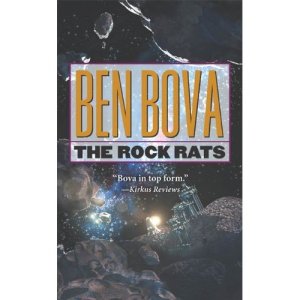
If all this really happens, if the economies of two major superpowers become dependent on space travel, then we’ll definitely be living in a science fiction world similar to Ben Bova’s Asteroid Wars series.  We may see a day when men not only live on the Moon but are fighting for their independence, and when prospectors in the Asteroid Belt are killing each other to claim their own lumps of rock.

I’m not sure I want to live in the Asteroid Wars novels.  I’d much prefer living in the Star Trek universe, where things are relatively peaceful (and maybe we can play Angry Birds on the holodeck).  But the real future is a science fiction novel yet to be written.  It’s up to us to decide what it should be like.
Vampires in Space

Have you noticed the occasional astronomy references in the Twilight novels?  They’re one of my favorite things about them.  Even the titles (Twilight, New Moon, Eclipse, and Breaking Dawn) are related to astronomy terms, and the movie soundtracks include songs like “Supermassive Black Hole” and “Neutron Star Collision.”

I’ve often felt that, as a society increasingly dependent on science, scientific language should somehow seep into our literature.  And not just science fiction literature.  So in that spirit, here are some suggestions for future Twilight novels:

Twilight: Syzygy

“Oh Edward,” Bella said, “don’t you see?  You, me, and Jacob… our lives are perfectly aligned, like three planets in a state of syzygy.”

Twilight: Perihelion

“Sometimes,” Edward admitted, “Bella does things that drive us apart, but I am like a planet and she is the sun, and no matter how far away my orbit takes me, I always turn back.  I always return to be as close to her as possible, at the point of perihelion.”

Twilight: Oort Cloud

“Listen, bloodsucker,” Jacob snarled at Edward, “I don’t want to see you anywhere near Bella.  You should be as far away as possible, like a comet in the Oort Cloud.”

Sci Friday

Here’s this week’s Sci Friday links.  Enjoy!

Who Owns the Moon?

The most recent Transformers movie gives us a look back at the Moon landing.  This at a time when the future of human space flight, or at least American space flight, is in question.  The last space shuttle mission is currently on its way home, and our astronauts will have to book future trips to the International Space Station with the Russians.

The general idea in the United States is that the private sector will now take over space flight.  In fact, a company called SpaceX (which sounds like something from a 1950’s Sci-Fi movie) is very close to launching its first mission to the ISS.  In December, they hope to send a remote-guided capsule there and return it safely to Earth.

If they succeed, SpaceX wants to put people in its capsules next.  That would allow NASA to at least book flights with an American company rather than outsourcing to Russia.  If everything goes according to plan, it could happen as early as 2014.

In the meantime, China is moving ahead with its own space program.  Their three-step agenda will lead to construction of a moon base, and then China intends to mine the Moon for its resources, believed to include iron, titanium, and helium-3 (needed to build nuclear fusion reactors).  According to Ouyang Ziyuan, chief scientist of the Chinese Lunar Exploration Program, China will do this “for the benefit of humanity.”

The United States has expressed some interest in chasing Near Earth Objects, asteroids and comets that come close—sometimes dangerously close—to our planet.  Many of these asteroids contain valuable resources as well, such as platinum group metals, and some groups in the US advocate asteroid mining as a way to solve America’s ongoing economic crisis.

It’s not hard to imagine, if moon bases and asteroid chasing become profitable, that the US, China, and any other country involved in space flight, will come into conflict.  Helium-3 could become the new oil, and the Moon the new Middle East.

Links

For more on SpaceX, click here.

For more on China’s plans to go to the Moon, click here.

For more on the Moon’s valuable resources, click here.

For more on asteroid mining, click here.

Sci Friday

The final Harry Potter movie is out today.  I’ll go see it later today (I’ll be the weird guy crying in the fourth row).  Now I know Harry Potter isn’t science fiction, but it turns out there is some science related to it.  Here’s a few links.

And here are some links that have absolutely nothing to do with Harry Potter.

Lastly, there is a book called The Science of Harry Potter.  I’ve never read it and can’t say if it’s worth reading, but I know I was very confused when I first heard about it.

Do You Believe in Spider-Man?

For years, science know-it-alls laughed at Spider-Man because, of course, real spiders produce silk in their abdomens, not their hands.  Most insects and arachnids use tiny hooks or sticky pads on their feet to climb walls; they don’t cling to things using silk.  At least, that’s what we used to think.

Now studies are showing that tarantulas, being too big to hold themselves to walls with tiny claws alone, actually do produce silk in the tips of their feet.  A small amount of silk keeps them secure, even if the surface they’re climbing begins to shake, and traces of that silk remain after they’ve moved on.

I’m surprised we went so long without discovering this.  It’s not like tarantulas are some exotic, new creature just discovered in the depths of the rainforest; people have kept them as pets for decades!  Apparently those traces of silk were found earlier, but scientists at the time assumed the tarantula produced them in its abdomen and attached the material to its feet as it climbed.  Another example of the danger in making assumptions.

Of course science fiction often predicts major discoveries well before actual science has a clue.  Spider-Man is now entirely plausible.  Well, the radioactive spider bite is still kinda silly, but at least science backs up some of his powers.

For more information on tarantula’s and their amazing feet, click here.  There is also conflicting evidence, which may prove tarantulas don’t produce silk from their feet after all.  For that, click here.

Why Should You Read Science Fiction?

Someone once told me that people who read romance novels are better lovers.  Supposedly there’s a study to prove this.  Also, people who read mysteries have a stronger sense of right and wrong.  I suppose that makes sense.  We learn a lot from what we read.  So what does science fiction teach us?

Most people have a stereotype in their heads about Sci-Fi fans.  We’re supposed to be a bunch of overweight, pimply nerds living in our parents’ basements.  We have poor social skills, we can’t get girlfriends, and naturally, we all wear thick glasses.  Why would anyone read science fiction when it turns you into that?

Well, I say it’s a risk worth taking.

For one thing, science fiction gives us a sense of wonder.  The universe is huge and complicated, and really anything is possible.  Even right here on Earth there are so many things we don’t understand.  And with that wonder comes a sense of respect for nature, from the tiniest atom to the largest galactic cluster, and every organism in between.

Science fiction also teaches us to be optimistic.  Almost every story insists that, no matter how bad things are today (and sometimes things today do seem pretty bad), the human race does have a future.  Somehow or other, we’re going to make it, and we might get flying cars!

So go read a science fiction book.  Yeah, you might have to move into your parents’ basement, but at least you’ll know the universe is really interesting.

P.S. I said we can’t get girlfriends because, obviously, girls don’t like science fiction.  Click here if you believe that.

Sci Friday

Here are this week’s sciency links.
STS-135: Final Launch of the Space Shuttle Program from NASA on YouTube. This is the video of the final launch of Space Shuttle Atlantis.
Pitching Plastic for Good from CNN. New technology could allow us to recycle 100% of our plastic.
An Alien Encounter 20 Years Away? From Big Think.
Space X’s Next Launch Will Carry NASA Solar Sail Experiment from Wired Science.
Dawn of a New Age: The First Person to Reach 150 is Already Alive… And Soon We’ll Live to be a THOUSAND, Claims Scientist from The Daily Mail.
The Four Ways We Kill Ourselves from Living to 150.

Book Review: Atom: Journey Across the Subatomic Cosmos

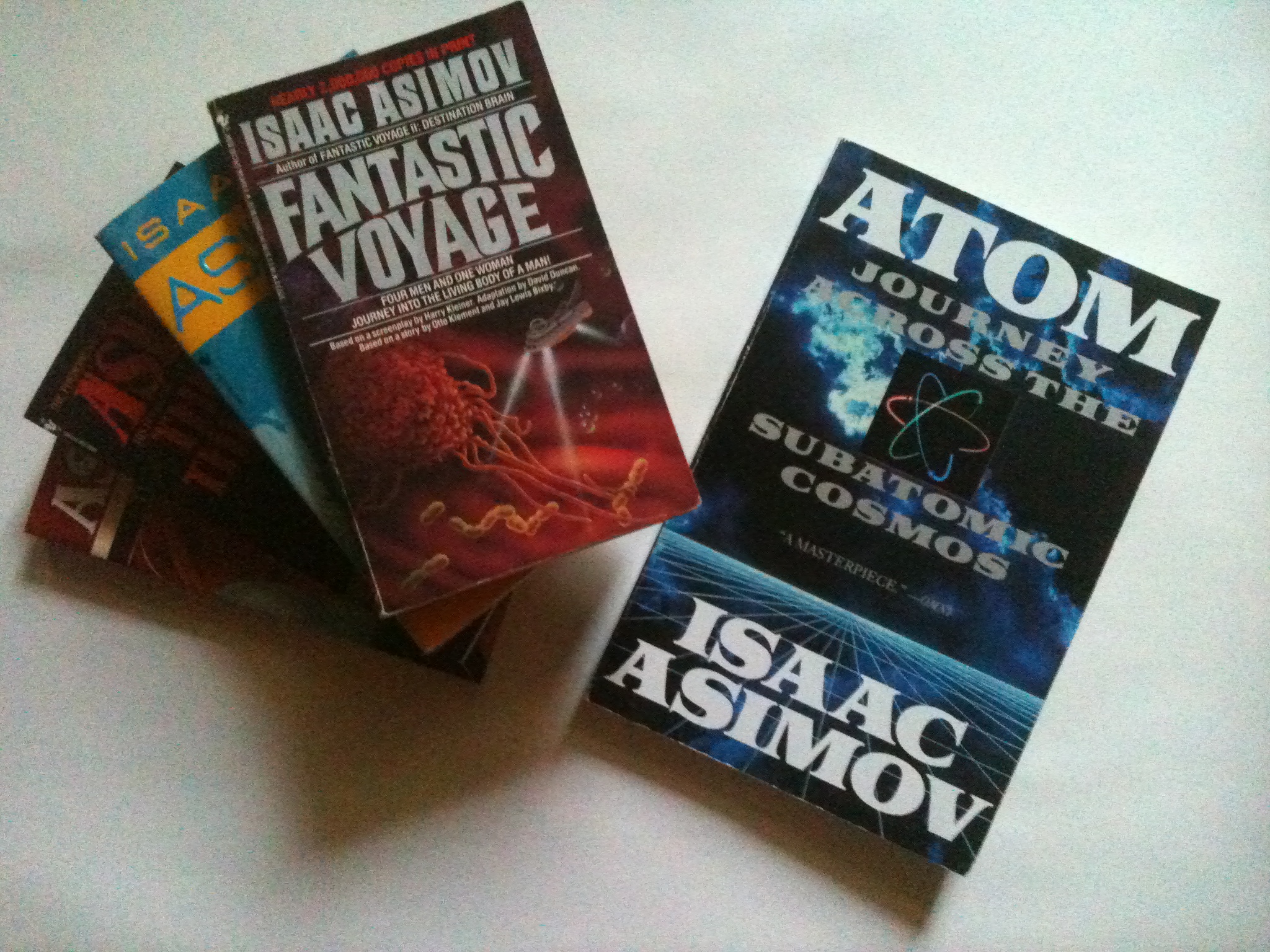
If you’re like me, you took some science courses in high school or college because you had to but didn’t learn much.  But you like science fiction, or maybe you just like those sciency documentaries on the Discovery Channel, and you feel a little overwhelmed by how complicated science really is.  If so, Isaac Asimov’s Atom: Journey Across the Subatomic Cosmos is the book for you.

Isaac Asimov is better known amongst us Sci Fi folk for writing I, Robot, Fantastic Voyage, and the Foundation novels.  But he also wrote many books on science (without fiction).  Originally published in 1992, Atom lays out the history of atomic theory starting with the ancient Greeks and quickly moving on to the late 19th and early 20th Centuries, when most of the critical theories about atoms were made.

I always like science presented as history because it shows how one discovery leads to another, giving the reader a much clearer understanding of why science is the way it is today.  There were two basic discoveries: first, the discovery that matter is made of small, indivisible particles called atoms, and second that those indivisible particles are actually divisible.  They’re made of protons and neutrons with a cloud of electrons around them, all held together by tremendous amounts of energy.  And those protons and neutrons—they can be broken into smaller particles too, which is where things get weird.

Some of this stuff will seem familiar, coming from half-remembered science classes.  Some will be entirely new to you, but Asimov has a way of making complicated concepts easy to understand (even the weirdness).  It’s a gift he probably learned writing so many great science fiction stories and novels.

This book gave me a better understanding what atoms are and how they work.  Because of Asimov’s clear writing style, it helped me understand the difference between nuclear fission and fusion, why antimatter exists, and what the Pauli exclusion principal is and why it’s important.  Understanding atoms makes a lot of things easier to understand; after all, everything is made of them.

One warning: Asimov makes some interesting predictions about future discoveries.  For example, he says elements 110 and 114, which had not yet been discovered in 1992, might be stable.  They are not.  Most of his predictions turned out to be incorrect, so don’t rely on them.  Otherwise this is a great way to start the science education you didn’t get in school, and after reading it you’ll find you understand a lot more of what they’re talking about on those sciency Discovery Channel shows.

Click here to see this book on Amazon!