Our Place in Space: The Far Side of the Moon

Hello, friends!  Welcome to Our Place in Space: A to Z!  For this year’s A to Z Challenge, I’ll be taking you on a partly imaginative and highly optimistic tour of humanity’s future in outer space.  If you don’t know what the A to Z Challenge is, click here to learn more.  In today’s post, F is for…

THE FAR SIDE OF THE MOON

The James Webb Space Telescope has been getting a lot of press lately.  It’s the biggest and best telescope we humans have ever put into space.  But today, we’re going to imagine an even bigger and (potentially) an even better telescope.  We’re not going to put this telescope in space, though.  We’re going to build it on the surface of the Moon.

The far side of the Moon is the perfect location to build a radio telescope.  We’ve certainly built radio telescopes here on Earth, but those Earth-based radio telescopes keep running into the same two problems.  First, Earth’s atmosphere (especially the ionosphere) blocks certain cosmic radio wave frequencies from reaching us here on the ground.  And second, there’s a whole lot of terrestrial radio chatter happening here on the ground.  That chatter can interfere with any radio signals that do make it through from outer space.

But on the far side of the Moon, those problems don’t exist.  There’s no atmosphere, and certainly no ionosphere.  And since this is the far side of the Moon we’re talking about—i.e., the side of the Moon that always faces away from the Earth—all that terrestrial radio noise is gone.  The Moon itself would block those signals from ever interfering with our radio telescope.

The telescope itself would be absolutely enormous.  It would be built inside of a crater, with a dish approximately one kilometer wide.  NASA has already approved funding to research this idea; please note, they have not approved funding to build it yet!  Only to research the idea, to see if it’s actually feasible using current technology.  If it turns out that it is feasible, though, building a radio telescope on the far side of the Moon might end up being part of NASA’s new Artemis Program.

What would we do with our new lunar telescope?  Well for one thing, we could “look back in time” to see what the ancient universe was like.  Specifically, we could study a period of time known as the “cosmic Dark Ages.”  This would have been a time after the Big Bang but before the formation of the first stars—literally, the cosmic Dark Ages, like I said.  The hydrogen gas permeating the universe in that era would have emitted some amount of electromagnetic radiation, which we can still detect today in certain radio wave frequencies (or we could detect it, if Earth’s stupid atmosphere would stop getting in the way!).

In addition to looking for these naturally-occurring radio signals, our lunar radio telescope could also watch for radio signals that do not appear to be natural in origin.  Radio transmissions from aliens, in other words.

Searching for aliens would definitely not be the main reason to build a radio telescope on the Moon.  The stuff I said about the cosmic Dark Ages—that’s the main reason to do this.  The aliens thing would just be a side benefit.

For this “Our Place in Space” series, I’ve mostly focused on projects that I think could happen in the distant future.  But this lunar radio telescope project is something that probably needs to happen sooner rather than later.  The far side of the Moon is the perfect location for a radio telescope right now, but as humans start spreading out across the Solar System, things may change.  The far side of the Moon may get a whole lot noisier, in terms of radio chatter.

So in the distant future, rather than building a radio telescope on the Moon, we might prefer to build our radio telescopes farther out.  Places like Pluto, Orcus, Eris, or Quaoar—all those little dwarf planets beyond the orbit of Neptune—may end up being super useful for future radio astronomers.

Want to Learn More?

Check out this article from NASA’s Jet Propulsion Laboratory: “Lunar Crater Radio Telescope: Illuminating the Cosmic Dark Ages.”

Also, here’s an article from Universe Today: “The Moon is the Perfect Spot for SETI.”

#IWSG: How Long Will This Take?

Hello, friends!  Welcome to April’s meeting of the Insecure Writer’s Support Group, a blog hop created by Alex J. Cavanaugh and co-hosted this month by Joylene Nowell Butler, Jemima Pett, Patricia Josephine, Louise – Fundy Blue, and Kim Lajevardi.  If you’re a writer and if you feel in any way insecure about your writing life, click here to learn more about this amazingly supportive group!

So right now, I’m participating yet again in the A to Z Challenge, a month long blogging challenge where you have to write twenty-six posts (one for each letter of the alphabet) over the course of April.  My theme for this year’s challenge is “Our Place in Space.”  For this theme, I’ve been researching a lot and writing a lot about human space exploration in the distant future.  And there’s something I’ve noticed, a lesson that’s relevant both to space exploration and to writing: every project takes longer than initially expected.

Already this month, I’ve covered proposed missions to send astronauts to the moons of Jupiter and robotic probes all the way out to the nearest star.  In today’s A to Z post, we’re talking about building an elevator to space as a way to save money on rocket fuel.  And in upcoming posts, we’ll visit a methane lake on Titan, build floating cities in the atmosphere of Venus, and go digging for fossils on Mars.

I always do my research for these posts, and I always get super excited about the things I learn.  All these things are possible!  We humans could really do all this stuff someday!  But then I get to the part of whatever article I’m reading where it says “in the next fifteen to twenty years…”  I always roll my eyes when I get to that part.  Yes, we can do these things.  Some of these things may even be within our reach using existing technologies.  But space exploration is, and always will be, really hard work.  We need to have realistic expectations for how long this stuff will take.

I understand that.  And yet, when it comes to writing, I keep telling myself, “Oh yeah, that’ll be easy.  I can write that in like an hour.”  And then I’m always surprised when I spend all day writing that supposedly easy thing and still can’t finish it.

When will I learn?

Our Place in Space: An Elevator to Space

Hello, friends!  Welcome to Our Place in Space: A to Z!  For this year’s A to Z Challenge, I’ll be taking you on a partly imaginative and highly optimistic tour of humanity’s future in outer space.  If you don’t know what the A to Z Challenge is, click here to learn more.  In today’s post, E is for…

AN ELEVATOR TO SPACE

It takes a lot of fuel to get to space.  We’ve talked about this before, and we’re going to talk about it again (and again and again).  In order for the human race to take our rightful place in space, we’re going to have to dream up some clever and crafty ways to reduce the fuel costs of space travel.  One idea—an idea so crazy it might work—would be to build an elevator to space.

So how would we build a space elevator?  Here’s one method: the first step would be to place a space station in geostationary orbit.  Next, our space station would lower a cable all the way down to Earth’s surface.  For the purposes of gravitational stability, the space station would also have to extend a second cable straight out into space, to serve as a counterweight to the weight of the first cable.

Once both cables are fully extended, an elevator carriage could be attached to the cable here on the ground.  Then just press a button, and the elevator takes you to space!

This whole space elevator system would still require an enormous amount of energy.  Also, a ride on the space elevator would take a really long time.  Some sources I’ve looked at say reaching the “top floor” would take several days; others say it would be more like several weeks.  And safety concerns should not be overlooked, because if that elevator cable ever broke, it could become a big problem all around the world (or at least all the way around Earth’s equator, if you catch my meaning).

Still, compared to launching rockets, this would be a far more cost effective and fuel efficient way to transport people and materials from the ground up into space.  As for the safety concerns, we just have to be sure we make that cable out of some really, really, really, really, really, really, really strong material, to ensure that it never breaks!  One problem: no such material is known to exist yet.  Carbon nanotubes and other experimental nano-materials might be strong enough, or they might fall a bit short of being strong enough.  It’s hard to say at this point.

So this is definitely not a thing we can build right now, but maybe someday in the distant future, going space will be as easy as riding an elevator.  I just hope they come up with better elevator music by then.

Want to Learn More?

I’m going to recommend this short video from Kurzgesagt (In a Nutshell) on space elevators.

I’m also going to recommend this slightly longer and slightly more technical video from Real Engineering.

Our Place in Space: The DART Mission

Hello, friends!  Welcome to Our Place in Space: A to Z!  For this year’s A to Z Challenge, I’ll be taking you on a partly imaginative and highly optimistic tour of humanity’s future in outer space.  If you don’t know what the A to Z Challenge is, click here to learn more.  In today’s post, D is for…

THE DART MISSION

So far this month, I’ve been telling you about things that I think will happen (or plausibly could happen) at some point in the distant future.  But today, I’m going to talk about something that’ll happen in the not-so-distant future.  Something that will happen in the very near future, actually.  Later this year, in fact!  In late September or early October of 2022, a NASA space probe named DART will deliberately crash into an asteroid named Dimorphos.

Dimorphos is a relatively small asteroid orbiting a much larger asteroid named Didymos.  Basically, Dimorphos is Didymos’s moon.  These two asteroids will be passing fairly close to Earth later this year.  Now I want to be 100% clear about this: neither Didymos nor Dimorphos are going to collide with our planet.  We are in no danger.  But these asteroids will be coming close enough that we could do a little experiment—an experiment to see just how well we could defend our planet from a dangerous, mass-extinction-causing asteroid, should such an asteroid ever come our way.

DART stands for Double Asteroid Redirection Test.  As you can see in the highly technical diagram below, the plan is for the DART spacecraft to have a head-on collision with Dimorphos.

This head-on collision should cause Dimorphos to lose some orbital momentum, which should alter Dimorphos’s orbit around Didymos.  How different will Dimorphos’s new orbit be?  Hard to say.  The exact angle of impact… the astroid’s mineral composition… the amount of debris produced by the collision… all of these things may factor into what Dimorphos’s new orbit looks like.

Astronomers can do all the computer simulations they like, but until we throw a real life projectile at a real life asteroid, we won’t really know what will happen.  Not with any kind of precision.  Ergo, we need to do this experiment.

Looking once more into the distant future, I believe that humanity is going to spread out across space.  Large numbers of people will eventually be living on the Moon and Mars, as well as on other planets and moons of our Solar System.  But I also believe these humans in the distant future will take good care of the Earth.  Among other things, they will know how to defend Earth from incoming asteroids and comets, so that what happened to the dinosaurs never has to happen again.  And that capability—the capability to keep Earth safe from killer asteroids and comets—begins with a little NASA experiment scheduled to occur later this year.

Want to Learn More?

Here are a few papers that I’ve been reading about the upcoming DART Mission.  This is where I got most of the information for today’s post:

Our Place in Space: Callisto

Hello, friends!  Welcome to Our Place in Space: A to Z!  For this year’s A to Z Challenge, I’ll be taking you on a partly imaginative and highly optimistic tour of humanity’s future in outer space.  If you don’t know what the A to Z Challenge is, click here to learn more.  In today’s post, C is for…

CALLISTO

The major moons of Jupiter are Io, Europa, Ganymede, and Callisto.  In science fiction, Europa and Ganymede seem to get the most attention.  Sci-Fi writers often end up putting human colonists (or at least a handful of plucky human scientists) on the surfaces of one or both of these icy moons.  But today, I’m going to argue that Callisto would be a far more suitable home for future humans.

First off, and most importantly, there’s the issue of radiation.  The space around Jupiter is one of the most dangerous radiation environments in the entire Solar System.  As you can see in the highly technical diagram below, the radiation is most intense in the vicinity of Io.  The radiation levels get better in the vicinity of Europa and continue to taper off when you reach Ganymede.  You’re still soaking up a lot of radiation, though!  Callisto’s radiation levels, however, are fairly low.  You might even describe the radiation levels on Callisto as “survivable.”

Furthermore, planetary protection laws in the future may mean that both Europa and Ganymede are off limits to human settlers.  Scientists today are 99.99% sure that Europa has a vast ocean of liquid water beneath her surface, and (as you know) wherever there’s water, there may also be life.  There’s evidence suggesting Ganymede may have a subsurface ocean, too.  Europa is often said to be the #1 most likely place where we might find alien life here in the Solar System.  While the odds of finding life on Ganymede are considerably lower, the possibility of Ganymedean life shouldn’t be ignored.

There are already international agreements in place regarding extraterrestrial life.  Space agencies like NASA, the E.S.A., and others are legally obligated to do everything they can to protect suspected alien biospheres from our Earth germs (and also to protect Earth’s biosphere from any germs we might find in outer space).  For obvious reasons, these international agreements haven’t exactly been tested in court, and it’s a little unclear how they would be enforced.

But in a future where human civilization is spreading out across the Solar System, I’d imagine bio-contamination laws would become stronger, not weaker.  Europa would almost certainly be declared off-limits to humans, unless it is proven beyond a shadow of a doubt that no aliens currently live there.  Ganymede may end up being off-limits, too, for the same reason.

Meanwhile, we have Callisto.  Scientists who want to study possible biospheres on Europa and Ganymede could set up a research station on Callisto.  From there, they could keep a close eye on the other moons of Jupiter.  They could operate remote-controlled probes to explore Europa and Ganymede without risking contamination, or they could go on brief excursions to Europa and Ganymede themselves (taking proper safety precautions, of course).  While they’re at it, these scientist could also explore Io.  Io is the most volcanically active object in the Solar System.  There is virtually no chance that we’ll find life there, but studying Io’s volcanoes would still be interesting.

I’d be remiss if I didn’t mention this: Callisto might have liquid water beneath her surface, too.  Not as much liquid water as Ganymede, and nowhere near as much as Europa, but still… it’s possible.  Which means there’s a slim possibility that there could be life on Callisto.  But in Callisto’s case, it is a very slim possibility.  Based on what we currently know about Jupiter’s moons, Callisto still seems like the best place for humans to live.  The radiation levels are much lower, the risk of bio-contamination is negligible…  Yeah, if I were a science fiction writer, I’d put my human colonists on Callisto.

Want to Learn More?

In 2003, NASA published a plan to send astronauts to Callisto, with the intention of using Callisto as a base of operations to explore the other Jovian moons.  Click here to read that plan.  Some of the information is out of date, of course, but it’s still got some interesting ideas.  Maybe someday, something like this plan could work!

I’d also recommend this article on Planetary Protection Policy, covering some of the rules that are already in place to protect planets and moons where we might find alien life.


P.S.: If I were a science fiction writer…?  Wait a minute, I am a science fiction writer!  Click here if you want to buy my first book.  It’s not set on Callisto, unfortunately, but it’s still a fun story.

Our Place in Space: Breakthrough Starshot

Hello, friends!  Welcome to Our Place in Space: A to Z!  For this year’s A to Z Challenge, I’ll be taking you on a partly imaginative and highly optimistic tour of humanity’s future in outer space.  If you don’t know what the A to Z Challenge is, click here to learn more.  In today’s post, B is for…

BREAKTHROUGH STARSHOT

So it’s several hundred years into the future.  Human civilization has spread out across the Solar System.  Large numbers of people are living on the Moon and Mars.  We even have successful colonies on Venus and Mercury (more on that later this month) and a few smaller settlements on the various moons of the outer Solar System.  Does this mean we’re done exploring space?  Heck no!  There’s still plenty more outer space stuff to explore!

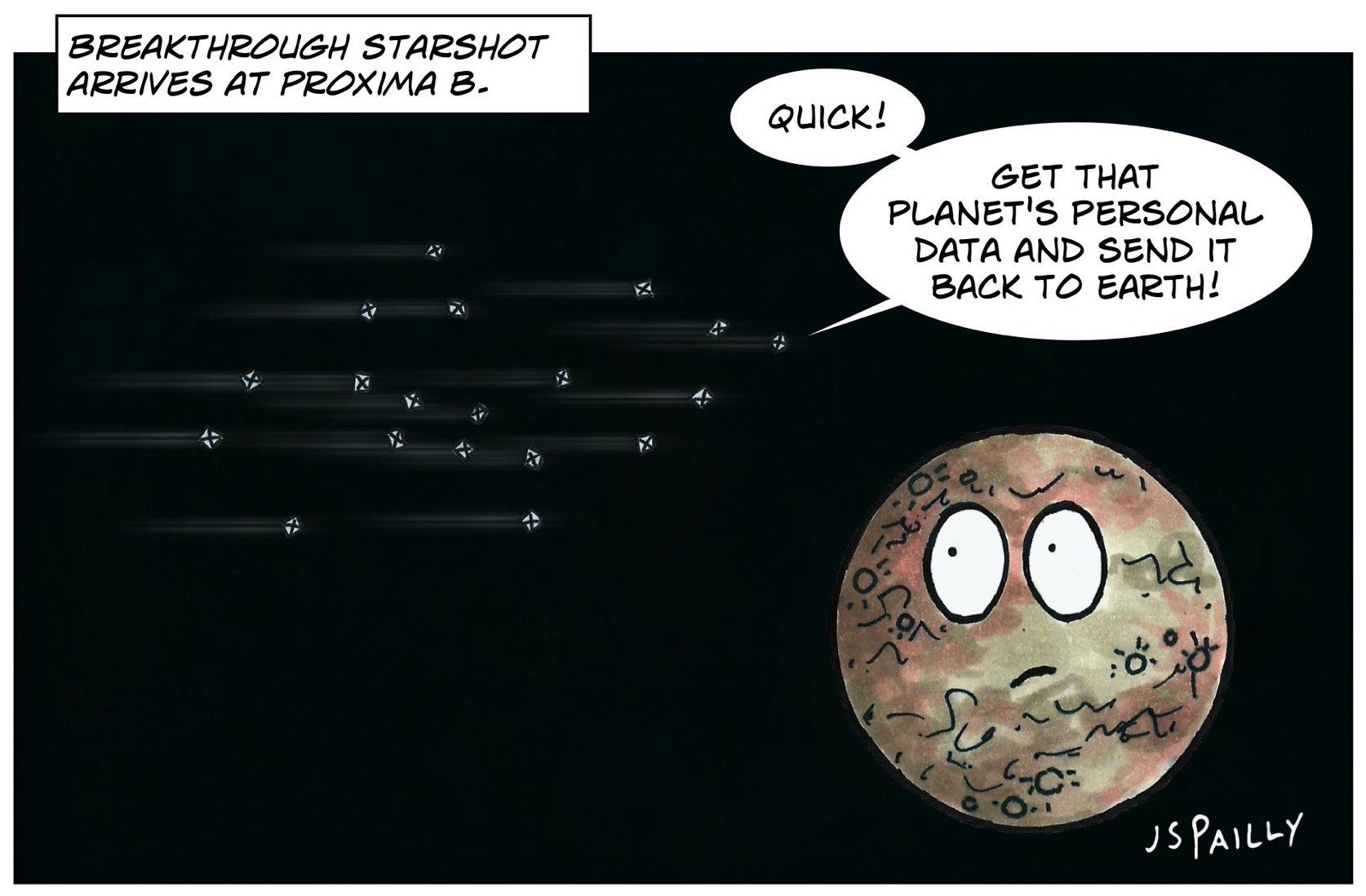
Just as NASA scientists here in the 21st Century send robotic space probes to our neighboring planets, scientists in the future will be keen to send robotic probes out to neighboring star systems.  And the model for a robotic mission to another star system already exists.  In 2016, venture capitalist Yuri Milner, theoretical physicist Stephen Hawking, and Facebook C.E.O. Mark Zuckerberg announced funding for a new research project called Breakthrough Starshot.

The idea is to build a swarm of teeny-tiny space probes, use high energy laser pulses to accelerate these probes straight out of the Solar System, and then sit back and wait for our probe swarm to transmit data back from another star system.  Specifically, Breakthrough Starshot wants to visit Proxima Centauri, the nearest star system to our own.  Proxima Centauri is known to have at least one planet, an Earth-sized world known as Proxima b.

Get it?  Because the C.E.O. of Facebook is involved in this project!

Could we actually build space probes that small?  Well, computer chips are pretty gosh darn small at this point, and they keep getting smaller.  So do cameras and other advanced electronic devices.  So yeah, this part of Breakthrough Starshot’s plan seems plausible enough.

What about that whole high energy laser pulse thing?  That part does seem more speculative to me, but experiments in Earth orbit have shown that light sail technology does work.  Just as the sail on a sailboat catches the wind, a light sail can catch light and use that light-pressure to propel a spacecraft through space.  A high energy laser aimed at a light-sail-equipped space probe… yeah, that sounds plausible to me, too.

Of course, a lot could go wrong with a space probe traveling through interstellar space.  That’s why we’d send a swarm of these things, rather than just one.  Most of the probes probably won’t make it to Proxima b, but the few that do survive the trip will send us some spectacular images and data.

Personally, I don’t like seeing headlines predicting that Breakthrough Starshot will be launching by such and such date (typically, a date in the late 2020’s or early 2030’s).  Breakthrough Starshot does seem to be founded on good science.  It’s the kind of program that really could work, someday.  But is it going to happen in the next ten to fifteen years?  No, I don’t think so.  That seems overoptimistic, in my opinion.

In the more distant future, however, Breakthrough Starshot (or a program very much like it) absolutely could happen.  This sort of thing could definitely work.  And looking ever further into the future, to a time when humans have thoroughly explored our own Solar System, the idea of sending swarms of microchip space probes to neighboring star systems might become routine.

Want to Learn More?

Click here to visit Breakthrough Starshot’s website.  They’ve got lots of information and videos explaining how they intend to get to Proxima b.

I’d also recommend clicking here to see a list of challenges that the Breakthrough Starshot team know they will need to overcome in order to make their plan work.

And for those of you who are looking for some heavier reading, click here to read “A Roadmap to Interstellar Flight,” a scientific paper that essentially serves as Breakthrough Starshot’s founding document.

Our Place in Space: The Aldrin Cycler

Hello, friends!  Welcome to Our Place in Space: A to Z!  For this year’s A to Z Challenge, I’ll be taking you on a partly imaginative and highly optimistic tour of humanity’s future in outer space.  If you don’t know what the A to Z Challenge is, click here to learn more.  In today’s post, A is for…

THE ALDRIN CYCLER

Even in the future, space travel will be expensive.  True, new technologies should make it less expensive than it is today, but there’s one problem that will never go away, no matter how advanced our technology gets: gravity.

Anywhere you want to go in space, you’re going to have to fight against gravity to get there: Earth’s gravity, the Sun’s gravity, the gravity of other planets and moons—at some point on your journey, you’re going to have to fight against any or all of these gravitational forces.  And fighting gravity uses up fuel.  Lots and lots and lots of fuel.

And yet, despite the unforgiving and unrelenting force of gravity, human civilization will eventually spread out across the Solar System.  I’m not going to tell you it will happen in the next twenty years.  I won’t tell you it will happen in the next century, even.  But someday, it will happen.  I’m sure of it!  And so today, I want to talk a little about what the future transportation infrastructure of the Solar System might be like.

American astronaut Buzz Aldrin is, of course, most famous for being the second person to set foot on the Moon.  Aldrin is also a highly accomplished scientist and engineer.  In 1985, he did some math and discovered a very special orbital trajectory that would make traveling from Earth to Mars (and also from Mars back to Earth) far more fuel efficient.

The term “Aldrin cycler” refers to that very special orbital trajectory Aldrin discovered.  The term can also be used to describe a spacecraft traveling along that special orbital trajectory.  The initial investment to build an Aldrin cycler (the spacecraft, I mean) would be really high.  We’d probably want to build a rather large spacecraft for this, and once it’s built, maneuvering the thing into the proper trajectory would require a stupendous amount of fuel.

However, once we’ve done all that, the cycler will cycle back and forth between Earth and Mars, over and over again, pretty much forever.  Traveling to Mars would be a little like catching a train.

I was going to have the Aldrin cycler make a “choo-choo” sound, like I train, but then I realized that would be silly.  Things don’t make sounds in outer space.

Passengers would board the cycler as it flew past Earth; about five months later, they’d disembark and head down to the surface of Mars.  The cycler would then take a long journey (about twenty months) looping around the Sun before flying past Earth once more; then the “cycle” would begin again.

The trip from Earth up to the cycler would still require some amount of fuel.  So would the trip from the cycler down to the surface of Mars.   The cycler itself would also require a little bit of fuel for maneuvering thrusters; otherwise, over time, the ship could start to drift ever so slightly off course.

Obviously this is not a cost-free form of space travel, but I’m sure you can see how this could help keep the cost of space travel down.  And so I imagine in the distant future, the Aldrin cycler (or something very much like it) will be a key part of the Solar System’s infrastructure, just as trains are an important part of our modern day infrastructure here on Earth.

Want to Learn More?

Click here to see a short animation of the Aldrin cycler orbital trajectory, showing several cycles worth of Earth-to-Mars and Mars-to-Earth journeys.

I’d also recommend Buzz Aldrin’s book Mission to Mars: My Vision for Space Exploration, where Aldrin describes the Aldrin cycler (and other cool Mars related things) in more detail. Click here to see the book’s listing on Amazon.

A to Z Theme Reveal: Our Place in Space!

Hello, friends!  April is almost here, which means it’s almost time for the A to Z Challenge!  If you haven’t heard of the A to Z Challenge before, click here to learn more.  It’s a cool thing, with lots of blogs participating, covering all sorts of fun and interesting themes.  Here on Planet Pailly, the theme for this year’s A to Z Challenge will be:

OUR PLACE IN SPACE!!!

This will be a mostly imaginative tour of the future, with a little bit of actual, factual science mixed in.  We’ll see how future human colonists are faring on the Moon and Mars, we’ll visit scientific research stations in the outer Solar System, and perhaps we’ll witness humanity’s first tentative steps toward interstellar travel.  We’ll also check in on Earth and see how our home planet is doing.

I can also promise you that this will be an optimistic view of the future.  I am, and always have been, optimistic about the future of humanity.  People have told me before that my optimism is foolish and naive.  People have told me to “look at the direction things are going” and that I should “get ready for what’s coming.”  Maybe those people have a point, but when I talk about the future, I’m not quite as foolish and naive as I may seem.

I know the world is a scary place right now.  There’s a really nasty war going on.  There’s a pandemic going on (still).  Around the world, liberal democracies are under threat, and climate change is transitioning from being a theoretical concern to a very real and very immediate problem.  The gap between the rich and poor is growing wider, our population growth is unsustainable, et cetera, et cetera… I know.  Believe me, I know.  And yet despite all of that, I still have hope for our planet and our species.

Mother Earth (as pictured above) is right.  We can do better than this.  The first step is to believe in ourselves, to believe that a better and brighter future is still possible.  I admit that hope alone will not guarantee us a better or brighter future, but I also know from personal experience that hopelessness is a self-fulfilling prophecy.  Those who still have hope still have a chance while those who give up hope have doomed themselves.  Let us not, as a species, give up hope in ourselves.

So in the coming month, I invite you to join me in imagining a future where kindness has prevailed, a future where we have not destroyed ourselves or our planet, and where we, as a species united in peace, have gone on to claim our rightful place in space.

#IWSG: How to Talk Business with Your Muse

Hello, friends!  Welcome to this month’s meeting of the Insecure Writer’s Support Group.  Are you a writer?  Do you feel insecure about your writing?  If so, then this is the support group for you!  Click here to learn more!

So I promised myself that I wouldn’t talk business here on the blog, but today I’m going to talk business here on the blog.  You see, I’m in the process of developing a new business plan for both my writing and my art.  Last weekend, I had a meeting with my editor.  I’ve also been doing a bit of research about S.E.O.  I’m starting to put together an outline of goals and strategies.  I feel good about all this stuff I’m doing.  I feel confident.  My muse, on the other hand, is getting very nervous.

As you know, muses come from a land of pure imagination, and (for obvious reasons) nobody needs money in a land of pure imagination.  My muse has heard of money before, but she doesn’t fully understand what money is or how it works.  She’s never used it for anything except as a plot device.

And when it comes to businesses and business plans, my muse has only the vaguest of notions about what all that means (I only have vague notions about it, too, but I’m learning).  Don’t be wasteful, don’t be inefficient, do be competitive and aggressive, do cut costs anywhere and everywhere you can, do ramp up production and increase your sales, always deliver value to your customers (whatever that means), never forget about the bottom line—that’s what businesses do, right?  But that sort of super strategic, super economical mindset—that is totally anathema to how muses operate.

The creative process is inherently inefficient.  It’s inherently messy, chaotic, and unpredictable.  A muse and her writer/artist must feel free to make mistakes; they must be able to experiment and take creative risks; they must allow themselves to waste a whole bunch of time and energy on ideas that almost certainly will not work out.

The last two years were something of a wake up call for me.  I really do need to take the business side of writing and art more seriously.  But as I go about putting together my new business plan, I know I must also keep my muse happy.  In fact, I’ve decided that keeping my muse happy should be job #1 in this new business plan of mine.  Even if it means missing the occasional deadline, even if it results in earning less money, even if it does not seem (at first) to be good for the bottom line, allowances must be made for the “wastefulness” and “inefficiency” of the creative process, because if I cannot make those allowances, well… then maybe this is not the right “business” for me after all.

Arguing with Myself: The Search for Alien Life

Hello, friends!

So a certain argument has been playing out in the back of my mind for a long, long time now.  Whenever I write, there are really two different versions of me who do my writing.  On the one hand, there’s science enthusiast me.  On the other, there’s Sci-Fi author me.  And these two versions of me view science, space exploration, and the universe at large in dramatically different ways.  One of the biggest ongoing disagreements I have with myself involves alien life.

Science enthusiast me believes that extraterrestrial microorganisms are pretty common in the universe.  Science enthusiast me thinks we will find evidence of extraterrestrial microbes in the very near future, perhaps hiding under the ice on Mars or swimming around in the oceans of Europa, Enceladus, or even Titan.  (I almost wrote unambiguous evidence there, but science enthusiast me also expects that confirming the discovery of extraterrestrial microbes will be tricky—just ask the researchers who found (or thought they found) microfossils inside a Martian meteorite back in 1996).

As for complex multicellular life—plants and animals, or whatever the extraterrestrial equivalent of plants and animals might be—science enthusiast me is far less optimistic.  While microorganisms have proven again and again that they can survive almost anything, even direct exposure to the vacuum of space, multicellular organisms seem to be far more fragile, far less resilient.  Earth may be one of the very few worlds where complex, multicellular organisms like us are able to survive and thrive over cosmic timescales.

And intelligent life?  Science enthusiast me believes intelligent life must exist elsewhere in the universe—surely it must!  But the universe is an awfully big place.  Our nearest intelligent and communicative neighbors could be many galaxies away.  Humanity is not alone in the universe, according to science enthusiast me, but we may as well be.

Sci-Fi author me, however, sees things from a different perspective.

Sci-Fi author me wants to write stories where encounters with alien life are commonplace, almost routine—stories where the aliens are sometimes friendly and sometimes not so friendly—stories where all sorts of weird and wacky interspecies adventures are possible!  And Sci-Fi author me takes a particular and peculiar pleasure in handwaving away all the concerns and objections science enthusiast me might have, not just regarding alien life but also in relation to faster-than-light travel, time machines, cybernetics, et cetera, et cetera.  Part of the fun, for Sci-Fi author me, is thinking up clever excuses for why impossible things are now possible (in the context of the story world, at least).

So there is this ongoing argument happening in the back of my mind.  This argument is never going to end, and I’ve decided that that’s okay.  Not every argument needs to have a winner and a loser, nor do arguments necessarily need to end in compromises.  Sometimes a house divided can stand after all.  Science enthusiast me believes the universe is like this; Sci-Fi author me would prefer (for story reasons) if the universe were more like that.  And the tension between these two different versions of myself drives my creativity, both as a science blogger and a science fiction writer.

P.S.: For those of you who might be interested, both the “I Heart Science” and “I Heart Sci-Fi” designs in this post are available in my RedBubble store.  Click here if you heart science, or click here if you heart Sci-Fi.  And remember: nobody’s stopping you from clicking both if you heart both!