Tentacle Monsters

Aliens with tentacles are so common in science fiction they’ve become a stereotype, but you don’t have to go to space to find intelligent tentacle monsters.  Right here on Earth, we have the octopus.  It may be slimy and it may have a funny name, but the octopus is surprisingly smart.

In this first video, we see that octopi are not trapped in the ocean.  They can—and often do—walk on land.  This may be one way they escape predators in the water.  So long as their skin is still moist, they can breathe.

In the next video, we see an octopus open a jar to get food.

Finally, the octopus in this video picks up the broken halves of a coconut shell, hides inside them, and rolls itself down a slope.  The coconut shells provide both defense and transportation (it’s probably fun too), and this is one of the rare examples of non-primates using tools.

For humans, opposable thumbs were a key part of our evolution.  The ability to grasp objects and manipulate them with such dexterity encouraged our ancestors to use their minds.  They began to make tools, to build stuff, and eventually they invented cars and computers and smartphones.  Tentacles are just as useful as opposable thumbs, and now octopi are learning to use their minds too.  In a few million years, they may become as smart as us.  On some other planet, maybe they already have.
What is Science Fiction?

Although we’ve all seen science fiction movies or read science fiction books, although we all know about Darth Vader, the USS Enterprise, and the number 42, no one seems entirely sure what science fiction is.  What’s the definition?  What determines that this story is Sci-Fi and this one is not?

Some say science fiction must have some scientific fact at its core.  If you take that fact out and the story falls apart, then it’s science fiction.  However, this definition might include many stories we don’t think of as Sci-Fi.  Many action thrillers involve nuclear weapons, many mysteries use forensic science, and you could even argue most romances depend heavily on biology.

Another definition says science fiction is no different than fantasy except in science fiction the “magic” must have a scientific explanation.  However, this runs into problems when the scientific explanation is not consistent with real science.  Many Sci-Fi purists argue that Star Trek, Star Wars, Doctor Who, The Hitchhiker’s Guide to the Galaxy, and so forth are not science fiction because of alleged inaccuracies.  They say these stories belong in a new category called “science fantasy.”

I prefer to describe science fiction as anything that depends on a fictional science.  It’s pithy, but it works.  Star Trek has the fictional sciences of warp drive and transporter beams.  Dune has the fictional science of planetology.  The Hitchhiker’s Guide has the fictional science of the number 42.  Nuclear weapons, forensics, and biology are all real sciences, so thrillers, mysteries, and romances can’t sneak into the Sci-Fi section under my definition, and we don’t have to create a whole new genre for the less-than-perfect depictions of science in Star Trek and Star Wars.

Obviously this ongoing debate doesn’t end here.  What do you think science fiction is?  Do you like any of the definitions here, or is there another you prefer?

Tattoos of the Future

Tattoos have a long and distinguished history among humans.  In ancient times, they represented power or spiritual authority.  Today they have special significance to the people who wear them.  But in the future, a tattoo may be more than just body art.  It could also serve a practical purpose.

Nokia recently patented a special magnetic material that can be “tattooed” onto your skin.  This material would vibrate when you get a call on your cell phone.  This could be especially helpful in a future where tiny cell phones might be implanted in our ears.  It could also be the first step in turning the human race into cyborgs.  For more on Nokia’s cell phone tattoo, click here.

Even if you don’t want cybernetic tattoos, your doctor might give you a prescription for one.  Researchers have developed a medical tattoo that can monitor glucose levels as they rise and fall.  For people with diabetes, it certainly sounds better to get a glucose monitoring tattoo than having to stick yourself with a needle multiple times per day.  For more on medical tattoos, click here.

No one said tattoos have to be on your skin.  You can also tattoo your teeth, and with a sophisticated dental tattoo made from graphene, your tooth tattoo can monitor the bacterial levels in your mouth.  Graphene is a carbon structure similar to graphite, but much stronger and capable of some unusual electrical properties.  At the moment, it’s ridiculously expensive, but as graphene production gets cheaper you can expect your dentist to offer this product in the future.  However, I doubt I’d ever get one.  Something about combining tattooing with dentistry is just too scary.  For more information, click here.

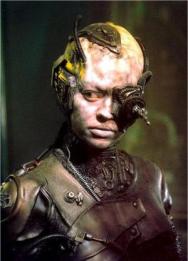
Cybernetics is an uncomfortable topic.  No one wants to end up like the Borg from Star Trek, with complex, artificial limbs and weird devices stuck to our heads.  But the cyborg revolution might be a little more stylish with the help of a few good tattoo artists.  Maybe you could have your glucose monitor in the shape of a butterfly and your cell phone vibrator could be a Celtic cross.

The State of Science and Science Fiction

This blog is usually about the future: the distant future where we’re flying off to Mars for our vacations and we have robots to do our laundry for us.  But the more immediate future is important as well.  Given the global economic problems of the last few years, the way we do science and the way we get our science fiction is changing.  I recently found two articles that give us a hint about how different these things will be.

First, Hollywood director James Cameron recently voyaged into the depths of the Marianas Trench.  As far as I know, he did not discover any secret alien civilizations while he was down there.  As the government cuts funding for scientific research, more and more private companies and wealthy individuals are stepping in to take the government’s place.  This article from Deep Sea News suggests that the near future of science may depend on people like James Cameron.

Second, with the rise of the Kindle, the Nook, and other ebook readers, the way science fiction books are published is changing.  In fact, the entire publishing industry is in upheaval.  While many publishing professionals are screaming in terror, some unknown authors are getting a chance to be read for the first time.  This article from Auxiliary Memory looks at the top 100 science fiction ebooks sold on Amazon and how the changing science fiction market may bring us some really good, really strange, new Sci-Fi ideas.

For those of you who care about science and science fiction, please read these articles.  We’re living in the 21st Century, that magical age when science fiction is supposed to become science fact.  The world really is changing, and both science and science fiction are changing with it.

Robots in the Taco Business

Robotic quadcopters are pretty cool, and as you can see in the video above they make decent musicians.  Now a startup company in San Francisco says they’ll deliver your tacos using a quadcopter (click here to visit TacoCopter.com).  All you have to do is place your order on your smartphone and let the robots do their magic.  As science fiction predicted, robots are becoming part of our daily lives.

Of course TacoCopters aren’t our only robotic servants.  We have robots for disarming bombs, predator drones that fly around killing terrorists, and there is serious talk of making cars that drive themselves.  With this growing community of robots around us, we should seriously consider what we’ll do if they rise up against us and try to take over.

This is why science fiction writer Isaac Asimov proposed his Three Laws of Robotics, fundamental laws to be programmed into every robot.

  1. Robots may not harm a human being or through inaction allow a human to be harmed.
  2. Robots must obey any order given by a human unless that order would violate the First Law.
  3. Robots must protect their own existence so long as that does not conflict with the First or Second Laws.

At this point in time, robots are not intelligent and cannot threaten humanity.  At this point in time, I’m not even convinced TacoCopters.com is a serious website created by a serious company.  According to Popular Science, the person who created it has a history of hoaxes (click here for that).  However, the day will come when robots live among us.  Hopefully some version of Asimov’s Three Laws will be enacted before the robot wars begin.

Health Care of Tomorrow

Nobody likes going to the doctor’s office.  It would be better if it were more like Dr. McCoy’s sickbay from Star Trek.  No complicated tests, no needles, no peeing in a cup.  The doctor would just scan you with a flashy-light thingie and give you a hypospray for whatever’s bothering you.  Sadly, that kind of technology is a long way away, but medical research is making progress.

The flashy-light thingie is already a reality.  A stylish, new wristwatch called the Basis band uses LED light reflected off your wrist to take your pulse and check other vital signs.  The data this watch collects could help you improve your fitness routine or provide doctors more information when diagnosing a problem.  For more information on this and similar health gadgets (including one actually called a Tricorder) click here.

When a personal health monitoring watch isn’t enough, your doctor might make you a personalized immune mouse.  Doctors of the future will graft your tissue onto a specialized mouse, turning the mouse into a perfect analog of you.  They can then test various treatments on the mouse without putting you at risk.  Researchers at Columbia University Medical Center are already creating these mice, and experts say this method could be particularly helpful for treating autoimmune diseases like type I diabetes.  For more information, click here.

Of course Dr. McCoy doesn’t only treat ordinary illnesses like diabetes.  He also deals with problems specific to life in space, an area we don’t know much about right now.  A recent experiment in Russia tested the physiological and psychological effects of being confined in a small spacecraft for over 500 days, the duration of a trip to Mars.  The Russian Space Agency now wants to repeat the experiment on the International Space Station.  Only on the ISS can they test the effects of prolonged weightlessness and exposure to cosmic radiation.  For more on this, click here.

No one can predict the future.  We do not yet know what will happen to the President’s health care reform law, but we do know technology keeps improving.  Computers get smaller, and sensors become more sensitive.  Someday, while you’re on your trip to Mars, a doctor might flash a light-thingie at you and, with the help of your personalized mouse, treat you for space sickness.

Slower Than Light

Last year, a group of scientists said they’d measured neutrinos traveling faster than the speed of light.  This caused a huge uproar.  If true, it would contradict Einstein’s Theory of Relativity.   All of modern physics would be in doubt.  Everything we thought we knew about gravity, black holes, and nuclear power would be called into question.  Pigs would start flying, dogs would stop chasing cats, and the world as we know it would come to an end!

A neutrino outruns a photon.

But now everyone can calm down.  Researchers found a problem with the original experiment.  There was a faulty cable somewhere which may have created an inaccurate measurement.  Also, the experiment has been repeated, and the new test results show neutrinos travel at the speed of light, not faster than light.  The Theory of Relativity is saved!

Personally, I never believed the original experiment would hold up.  Relativity works too well and explains too many weird things in the universe.  It’s hard to imagine it being so fundamentally flawed.  But I wanted to believe, because the discovery of a faster-than-light particle would begin an exciting new era in science, one that might even allow faster-than-light travel.

For more on the second neutrino experiment, click here.

Neutrino Cell Phones

We all love cell phones.  We all hate when they lose signal.  If you’re inside a building, underground, or underwater, it’s too difficult for radio waves to escape and carry your message to whoever you’re talking to.  That’s why scientists are working on communications by neutrinos.

A neutrino is a massless, chargeless particle that doesn’t interact with ordinary matter.  Every day, countless neutrinos pass right through the planet without stopping and continue on through space.  They leave almost no trace of their presence, and it takes massive and complicated technology to detect even a small handful of them.

Researchers at North Carolina State University and the University of Rochester have found a way to encode binary information into neutrinos and transmit it through solid rock to a detector.  They managed to send a single word: “Neutrino.”  Not very creative, but it still proves their point.  Neutrinos can be used for communications.

At the moment, this is not exactly practical, but given time I’m sure neutrino detectors can be simplified and shrunk down to the size of a cell phone.  Then all your phone calls from the bottom of the ocean will come through loud and clear.

As cool as neutrino cell phones would be, this development raises an even bigger issue.  If neutrinos can be used for communications, surely some alien society would have already done so.  Maybe SETI should spend less time listening to radio waves coming from space and more investigating all those countless neutrinos passing through our planet.  There might be binary information encoded in them.

For more information on this neutrino experiment, click here.

The Latest Research on Warp Engines

Warp drive is so deeply associated with Star Trek that other science fiction series can’t really use it.  They either have to invent some other faster-than-light technology or think of a clever, new name for the same thing.  That’s unfortunate because warp drive does make some scientific sense.  However, new research suggests it is more dangerous than we previously thought.

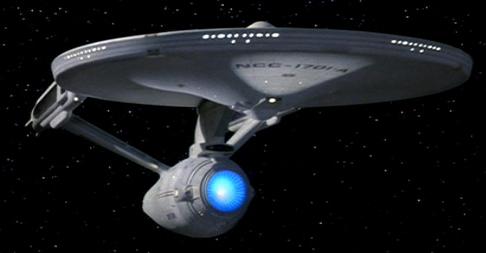
The starship Enterprise does not actually travel faster than light.  It generates a “warp bubble,” distorting space around it.  Space in front becomes compressed, and the space behind expands.  This warping of space shrinks the distance between the Enterprise and its destination, so the Enterprise doesn’t have to travel faster than light to get there.

Science says this is possible, although it requires a lot more energy than current technology can generate.  Still, it’s possible.  That’s the important thing, and researchers at the University of Sydney recently did a theoretical experiment to see what would happen if someone built a real warp engine.  The results raise some serious safety concerns.

As you may recall from a previous post, space is dirty.  There are so many particles of dirt floating in space that they block light from many of the stars in our own galaxy.  The researchers found this dirt would accumulate in the compressed space in front of the Enterprise, and when the ship comes to a stop all that dirt would be released as an enormous shockwave.  According to the researchers, this shockwave has enough force to destroy a planet.

It’s hard to explore strange, new worlds when your warp drive keeps destroying them when you arrive.  Either the crew of the Enterprise is very careful when dropping out of warp or they have some technology to correct for this problem.

The important thing is that right now, here in 2012, scientists are doing research on warp drives.  I have no doubt we’ll solve this problem by 2063, when Zefram Cochrane invents Earth’s first real warp drive.

For more information on the research done at the University of Sydney, click here.