
Baby Galaxies, Part 4 of 4

Dr. Eric McKenzie

It is my pleasure to introduce Dr. Eric McKenzie, associate director for the department of astronomy at the University of Maryland.  He received his Ph.D. from the University of Florida, and his research has focused on galaxy evolution at specific wavelengths of redshifted light.  He also helped me get some of my facts straight for the Tomorrow News Network story “The Orion War.”

This week, he has answered some questions about galaxy evolution and what the early universe was like.  Today is the final installment of his interview.

James Pailly: If you could go back in time to visit a planet in one of these young galaxies, what do you think you’d find there?  Any chance you might meet an alien life form?

Dr. McKenzie: I’m no astrobiologist, so I’m speaking a little off-the-cuff, but here are some thoughts.

As mentioned earlier, there were fewer heavy elements in the early universe.  With hydrogen predominating, the population of planets would presumably favor gas giants like Jupiter rather than terrestrial planets like Earth.  Water would be relatively uncommon due to the need for oxygen atoms.  It’s a good guess that life would be carbon-based, like Earth’s. (Scientists have speculated that silicon-based life forms may be possible, but silicon would be quite rare in the early universe.)  Technology could be a challenge for early alien civilizations, since on average they would have smaller quantities of useful materials to work with.  Consider the conflicts that have been fought on Earth over scarce natural minerals – the problem would be exacerbated!

Early civilizations would also face the threat of an increased likelihood of supernovae.  With the early universe’s higher star formation rate, many stars were being born, but the largest ones were only living a few million years and dying in supernova explosions.  This wouldn’t be very healthy for civilizations living in nearby star systems, nor for emerging life which might one day result in a civilization.

Baby Galaxies, Part 3 of 4

Dr. Eric McKenzie

It is my pleasure to introduce Dr. Eric McKenzie, associate director for the department of astronomy at the University of Maryland.  He received his Ph.D. from the University of Florida, and his research has focused on galaxy evolution at specific wavelengths of redshifted light.  He also helped me get some of my facts straight for the Tomorrow News Network story “The Orion War.”

This week, he will be answering questions about galaxy evolution and what the early universe was like.

James Pailly: What are quasars, how did they form, and what role did they play in galaxy evolution?

Dr. McKenzie: Quasars are the bright centers of galaxies where hot gas is swirling into giant black holes.  We believe that nearly all galaxies have massive black holes at their center; the Milky Way certainly does.  In most cases, these black holes are quiescent.  They’re not actively absorbing much material because the galaxy’s gas and stars are orbiting around the black hole without falling in.  However, a small fraction of galaxies have active black holes, where material is continuously spiraling inward.  The gas is moving very quickly in tight orbits and heating up due to friction between the gas particles.  The net result is a powerful blaze of energy – a quasar.  When the clump of gas is eventually consumed, the quasar will turn off again.

Quasars are a feature of the early universe – we don’t generally see them in nearby galaxies.  This may be because, at our present stage in the universe’s history, the massive black holes at the centers of galaxies have already cleaned out all of the ‘easy pickings’ of gas clouds.

The effects of quasars are potentially powerful enough to affect the evolution of their host galaxies.  As most of the nearby gas swirls into the black hole, angular momemtum effects cause a small fraction to be flung outward instead.  This outflow may push away other gas which is farther from the galaxy’s center, perhaps eventually cutting off the quasar’s food source.  On a larger scale, it may even reduce the galaxy’s ability to concentrate gas to form new stars.  This is a very active area of current research!

Baby Galaxies, Part 2 of 4

Dr. Eric McKenzie

It is my pleasure to introduce Dr. Eric McKenzie, associate director for the department of astronomy at the University of Maryland.  He received his Ph.D. from the University of Florida, and his research has focused on galaxy evolution at specific wavelengths of redshifted light.  He also helped me get some of my facts straight for the Tomorrow News Network story “The Orion War.”

This week, he will be answering questions about galaxy evolution and what the early universe was like.

James Pailly: Were galaxies in the early universe different than the ones we see around us today?

Dr. McKenzie: Quite a bit!  They were generally smaller, for starters.  Because the universe was denser, they also collided with each other more frequently.  The larger galaxies that we see nowadays, including our own Milky Way, appear to have built up over time through mergers of smaller galaxies.  Modern galaxies often have orderly spiral or elliptical shapes, but it’s rare to see such galaxies in the early universe.

Early galaxies formed stars more quickly than modern galaxies do. The ‘global star formation rate’ has been steadily slowing over the past 5 billion years or so as the available gas gets converted into stars.  Some of the galaxy collisions caused massive waves of star formation because the galaxies’ gas got compressed by gravitational interactions; these galaxies are called ‘starbursting galaxies’.

Early galaxies also had fewer ‘metals,’ which in astronomy jargon means all the elements beyond the simplest ones, hydrogen and helium. The universe formed with essentially no heavy elements, including carbon, nitrogen, oxygen, iron, gold, uranium, and so on.  These were produced later by fusion within stars or during the violent supernova explosions that occur when the largest stars die.  (Pretty much all of the non-hydrogen atoms in our bodies originally came from stars.  The stars cast this material into space as their lives came to an end, and the atoms came to rest in the cloud of gas that later coalesced into our solar system.  I think that this is one of the most extraordinary discoveries of astronomy.)

Baby Galaxies, Part 1 of 4

Dr. Eric McKenzie

It is my pleasure to introduce Dr. Eric McKenzie, associate director for the department of astronomy at the University of Maryland.  He received his Ph.D. from the University of Florida, and his research has focused on galaxy evolution at specific wavelengths of redshifted light.  He also helped me get some of my facts straight for the Tomorrow News Network story “The Orion War.”

This week, he will be answering questions about galaxy evolution and what the early universe was like.

James Pailly: Using redshifted light, you’ve peered back in time to see the formation and evolution of galaxies.  What is redshifted light, and how are we able to see so far into the distant past?

Dr. McKenzie: The wavelengths of light that we see from a moving object get shifted to the bluer or redder end of the spectrum because of the motion. The color shift depends on whether the motion is toward us or away from us.  Thus, stars and galaxies look bluer if they are moving toward us and redder if they are moving away from us.

This works just like the wavelengths of sound from a moving object.  Think of the sound when cars, trains, ambulances, etc. go past you.  When they come toward you, the sound is high in pitch (short wavelengths, high frequency).  When they pass you and are moving away, the sound quickly switches to low pitch.  If a car were driving past us at a significant fraction of the speed of light, we would see the visual color shift, as well: it would look first bluer, then redder!

Our universe is expanding: nearly all of the galaxies are moving away from us, and so their light is redshifted.  When we see the most distant galaxies, they are the reddest, because they are moving away the fastest.

By studying galaxies which are billions of light years away, we see what the universe was like at a younger time.  Because light travels at a finite speed, we never see anything as it looks ‘right now’.  The moon is 1 1/4 light seconds away, and so we see it as it was 1 1/4 seconds ago.  The sun is 8 light minutes away, and so we see it as it was 8 minutes ago.  (This leads to the slightly disconcerting thought that, if the sun winked out of existence right now, we would be happily oblivious for 8 minutes while the light rays continued to travel to us.)  Looking at distant galaxies gives us a picture of the early universe.  We can study how galaxy ‘demographics’ have been changing over time, such as their sizes, shapes, colors, and star/gas/dust content.

Tomorrow’s News Today

For the last five months, I’ve been writing a series of short stories called The Tomorrow News Network.  They’re all posted on a website (click here).  The plan was to publish ten stories this year, one per month until October.

I’ve now reached the halfway point.  The fifth story is called “Tomorrow’s News Today” and is about the bizarre murder of a 25th Century scientist.  If you like time travel, you should read this story.  If you like murder mysteries, you should read this story.  If you like both, definitely read this story!  Click here.

Plans for the next five stories include the assassination of Earth’s first president, dinosaurs wrecking havoc in space, and some cowboys who find something strange in the Wild West.  I hope you’ll join me for the Tomorrow News Network’s next crazy adventure.

Why Newt Gingrich’s Moon Base Still Matters

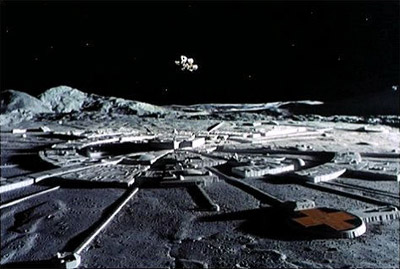
Moon Base Alpha as seen in Space: 1999.

So Newt Gingrich isn’t running for president anymore, and we’re probably better off for that.  Early in his campaign, he promised that if he were elected he would build a Moon Base by 2020 and give America’s lunar colony the opportunity to become a state.  Of course, this sounded ridiculous and probably contributed to Gingrich’s ultimate defeat in the Republican Primary.  However, returning to the Moon and establishing a Moon Base is still a good idea, and it might still happen regardless of who’s president.

Here are five reasons why a Moon Base is a good idea.

  1. The Hubble Space Telescope has provided scientists a great opportunity to study the universe, but soon it will go into retirement.  NASA is building an even more powerful telescope to replace it, but someday that too will go into retirement.  Establishing an observatory on the Moon could provide all the benefits of space telescopes without the hassle of periodically replacing them.  It could also be more cost efficient.  Click here for more on that.
  2. The Moon has an abundance of natural resources, some of which are extremely rare on Earth.  Helium-3, an isotope of helium, is one of them and could be used one day as a carbon-free, radiation-free fuel source.  Click here for more on how to get the Moon’s helium-3.
  3. The Moon can be used as a launch point for further exploration of the Solar System.  The Moon’s gravity is one-sixth that of Earth’s, so launching from the Moon is about six times easier and cheaper than launching from Earth.  A spacecraft could be built using the Moon’s own resources and sent to Mars, Jupiter, or wherever for a fraction of the cost.
  4. Newt Gingrich wanted his Moon Base to become America’s 51st State, but lunar colonization shouldn’t be for Americans only.  The Russian Space Agency has already approached the European Space Agency and NASA to form a Moon Base partnership.  If their proposal works, the next time human beings walk on the Moon it won’t be about one nation competing with another but many nations working together.  That kind of cooperation would not only advance science but change the way we see our own planet.  Click here for more on Russia’s proposal.
  5. This is the most important reason to build a Moon Base, at least in my opinion: the Moon would make an awesome vacation spot!  Hopefully, I’ll see you there at the low gravity tennis court.

Disclaimer: This is not a political blog, and I am not a Newt Gingrich supporter.  It would have been nice, though, to see a serious debate about space policy in our presidential politics, and maybe someday we will.

Corporate Greed: The Final Frontier

Some people look into the night sky and see stars or try to identify planets.  Others look up there and see dollar signs.  Lots of dollar signs.  Enough to change the economics of our whole planet.

According to a report from Gizmodo (click here to read it), a group of wealthy investors have teamed up to start a new company called Planetary Resources.  Their goal is to build spaceships, fly them into Earth orbit, and grab some passing asteroids.

We generally think of asteroids as big space potatoes.  In the famous asteroid field scene in The Empire Strikes Back, some of those asteroids actually are potatoes.  Every once in awhile, we hear about one coming dangerously close to Earth, and we know from Armageddon that a large enough asteroids could wipe out all life on this planet.

What we don’t generally talk about are the material resources asteroids contain.  A company that successfully captures an asteroid could harvest it for metals that are rare on Earth but essential for our fancy electronic devices.  According to Gizmodo, a single asteroid could be worth billions of dollars.

In these times of economic trouble, it’s hard to justify the expense of space travel.  It costs millions to send people into space, but that doesn’t sound so bad when you expect billions in profits.  And adding all those extra resources to the global economy could end this recession for good.

Science fiction has already anticipated this situation.  Ben Bova’s Asteroid Wars series, which is part of his larger, Grand Tour of the Solar System series, tells the story of greedy corporations fighting over control of the Solar System’s resources.  While catching and mining asteroids is exciting and could save our economy, hopefully we won’t let things turn as violent as Ben Bova’s novels predict.

Let’s Go to Alpha Centauri

If you haven’t read Across the Universe by Beth Revis, you should.  It’s got science, political intrigue, and a healthy dose of human nature—everything a science fiction novel should have.  It’s set on a space ship carrying colonists to a new planet in Alpha Centauri, the nearest star to our own Solar System.  Until recently, scientists assumed Alpha Centauri couldn’t have planets, but new discoveries have called that into question.

Alpha Centauri is a binary star, meaning it is actually two stars orbiting each other.  A third star, Proxima Centauri, may also be part of the Alpha Centauri system, or it may simply be passing nearby.  It seemed impossible for planets to form and survive with the gravity of all these stars pulling in so many different directions, yet scientists recently found a planet orbiting another binary star, Kepler-16.

Right now, the Planetary Society is gathering funding to take a closer look at Alpha Centauri.  The Planetary Society is a nonprofit organization started by Carl Sagan, among others, and currently headed by Bill Nye the Science Guy.  They plan to rent time at an observatory in Chile to watch Alpha Centauri for twenty nights straight, hoping a planet will reveal itself during that time.

If you want to help, click here to donate to the Planetary Society’s Alpha Centari project (select Finds Exo-earths on the drop down menu where is says “direct my gift to”).  Just think how cool it will be if they do find a planet and you can say you helped!  By the way, I am a member of the Planetary Society.  It doesn’t cost much to join, and your membership fees will help this and other research on space and space travel.  If you’re interested in joining, click here.

According to some experts, the discovery of a planet—especially a habitable one—in Alpha Centauri would lead to immediate planning for an unmanned mission to check it out.  Later, we might decide to send human colonists, just like in Across the Universe.  The folks at SpaceRip.com have put together an excellent documentary on what it will take to reach Alpha Centauri.  Click here to see it.

Also, Centauri Dreams recently posted an interesting analysis of Proxima Centauri.  It’s extremely unlikely Proxima has any planets, but not impossible.  Click here to find out why.

The Magic of Space Travel

In the last few years, we’ve heard a lot of bad news about NASA.  Every federal agency has suffered budget cuts, and NASA is no exception.  The Space Shuttle program has ended, the ExoMars mission has been canceled, and the cost of the James Webb Space Telescope has skyrocketed so much it sucks up most of whatever money NASA has left.

But yesterday the Space Shuttle Discovery, perched atop a modified 747, flew over Washington D.C.  It was something of a victory lap before the veteran spacecraft went into retirement as a museum piece at the Smithsonian.  People skipped work and pulled their kids out of school to see it.  Politicians snapped photos from their office windows and tweeted about it.  The FAA reportedly broke its own rules to allow the shuttle to fly so low over so many government buildings.

Despite all the money and despite the fact that the shuttle program never lived up to expectations, people cheered for Discovery.  Some cried.  There is something magical about space travel, something that transcends recessions, political squabbles, and even science itself.

In a few years, private companies will take over where the space shuttles left off, taxiing astronauts to the International Space Station and conducting experiments in Earth orbit for businesses, universities, and the government.  For a mere $200,000, they’ll even take you into space (rumor has it that the price will drop significantly as space travel becomes more common).

A new space race is beginning, with China talking about building a Moon base to mine the Moon’s resources.  The United States wants to visit an asteroid; asteroids could also be a source of valuable resources.  One expert described the future as a game of “Solar System Monopoly” with various countries competing over economic interests in space.

No matter what the future brings, no matter what economic interests are involved, human beings will never lose their romantic love of space.  Our true destiny is out there among the stars.  The Space Shuttle Discovery brought us one step closer to getting there.

Videos courtesy of NASA Television.

Robot Artists

As an artist, one of the most important things I had to learn was what NOT to include in a drawing.  For example, to make a portrait look right, you can’t draw every individual hair or every fine wrinkle or every tiny freckle on the tip of the nose.  You have to focus on the parts of the face that define that face, that reveal the subject’s personality, and ignore most of the small details.

This is a skill unique to humans, or at least it used to be.  New robots have emerged with special programming to help them decide what should or should not be included in a drawing.  With a camera, they observe a human face, and their robotic hand picks up a pencil and starts drawing a portrait.

Aside from the fact that robots are now encroaching on even more people’s jobs, what are the philosophical implications for art?  When a robot draws something, who’s the artists: the robot or the person who programmed the robot?  Also, if robots learn to understand and appreciate art on their own, how much closer does that bring them to being just like us?

This month’s short story for The Tomorrow News Network explores how machines and the arts might mix together in the future.  Click here to start reading “The Opera of Machines.”  For more information on robotic portrait artists, click here.