How Will Religion Evolve?

The stereotypical Sci-Fi writer is either an atheist or an agnostic.  I’ve read more than a few science fiction novels that glowingly predicted the day when humanity “outgrows” religion.  Somehow, I doubt that day will ever come.  For better or worse, religion is here to stay, and I would find it far more interesting to read a science fiction novel about how religion might evolve and adapt to the science, technology, and cultural values of a futuristic society.

Today, I want to share a few links that relate somewhat to the future of religion.  First, we have an interview with an anonymous woman who is in what she calls a “polyamorous” marriage, meaning a marriage of more than two people.  Now, I’m a pretty open-minded guy, but even I am struggling to accept some of the things this woman has to say.  It’s easy to imagine a future where our religious leaders come into conflict with the polyamorous community.  Click here to read “A Love Bigger Than Two” by John Shore.

Next, we have an article on free will courtesy of Self Aware Patterns.  The author takes a look at whether or not we human beings can be held morally responsible for our actions.  From a scientific perspective, maybe it’s all a matter of genes and environment.  Even the non-deterministic physics of quantum mechanics, often sighted as proof that free will exists, might not prove anything of the sort.  Click here to read “Free Will?  Free of What?” by Michael Smith.

Finally, in a surprisingly candid interview with the atheist editor of an Italian newspaper, Pope Francis discusses his vision for the future of the Roman Catholic Church.  In Pope Francis’s typically enigmatic fashion, it’s hard to tell what exactly he plans to do, but it sounds like big changes are coming.  Click here to read “The Pope: How the Church will Change” by Eugenio Scalfari.

Please note that I do not necessarily agree with or endorse the views presented in any of these articles.  I offer them merely as food for thought and hopefully as a springboard for further conversation on how religious beliefs might evolve in the future.

Sciency Words: Weird Phobias

Sciency Words Logo

Today’s post is part of a special series here on Planet Pailly called Sciency Words.  Every Friday, I bring you a new and interesting scientific word to help us all expand our scientific vocabularies.  Today’s word is:

PHOBIA

I think we all have our own little, irrational fears.  I’m terrified of blood.  I once fainted in a biology class because we were talking about blood.  I think it was something about blood cells squeezing through capillaries in single file that set me off.

I recently spent some time researching various phobias for a writing project and learned that the technical term for my irrational fear is hemophobia.  Here are a few other interesting phobias.

  • Pupaphobia: the fear of puppets.
  • Aibohphobia: the fear of palindromes (it’s funny because aibohphobia is itself a palindrome).
  • Omphalophobia: the fear of belly buttons.
  • Hellenologophobia: fear of the ancient Latin and Greek languages, or fear of scientific terminology (if you are hellenologophobic, you probably shouldn’t be reading this blog).
  • Sesquipedalophobia: fear of long words.
  • Hexakosioihexekontahexaphobia: fear of the number 666.

So what’s your biggest phobia?  Do they have a technical term for it?  Have you ever managed to overcome your fear?  Please share in the comments below.

I Don’t Want to be George Lucas

InsecureWritersSupportGroupToday’s post is part of the Insecure Writer’s Support Group, a blog hop hosted by Alex J. Cavanaugh.  It’s a way for insecure writers like myself give each other advice and encouragement.  Click here to see a full list of participating blogs.

IndieLife7Today’s post is also part of Indie Life, a blog hop for independent authors hosted by the Indelibles.  Click here to see a list of participating blogs.

These two blog hops don’t normally overlap like this, but Insecure Writer’s Support Group was pushed back a week by New Year’s Day.

* * *

I’m in the middle of revising my short story series so it can be re-released on Kindle, and in the process I’m making a lot of changes.  In some cases, pretty major changes.  My beta readers tell me these changes are a huge improvement, but I’m starting to worry because I don’t want to become George Lucas.

The original Star Wars films are among the greatest Sci-Fi movies of all time.  Then in the 1990’s, Lucas went back and “improved” them by adding a bunch of CGI robots and monsters.  Then with the DVD release, he added some more stuff, and he did it again when the movies came out on Blu-ray.  All these so-called improvements supposedly bring the movies closer to Lucas’s original artistic vision.

Of course we can all fall into this trap, revising our work over and over, adding new material where we think it’s needed, and tinkering with small details that don’t really matter to the story.  The only difference between George Lucas and the rest of us is that he does this with all his fans watching and cringing, many of us wondering what was wrong with the original movies in the first place.

I started writing my Tomorrow News Network series over two years ago, and I’ve grown a lot as a writer since then.  I use a much broader vocabulary, I have a stronger grasp on the science behind my fiction, and I’ve learned the difference between showing and telling.  I believe the changes I’m making to my stories are necessary… but then again, so did George Lucas.  I can only hope I’m making genuine improvements and not just adding extra CGI monsters.

So my question today is at what point do you say, “Enough”?  At what point do you know you’re done making meaningful revisions and your work is ready for publication?

Sciency Words: Xylophone

Sciency Words Logo

Today’s post is part of a special series here on Planet Pailly called Sciency Words.  Every Friday, I bring you a new and interesting scientific word to help us all expand our scientific vocabularies.  Today’s word is:

XYLOPHONE

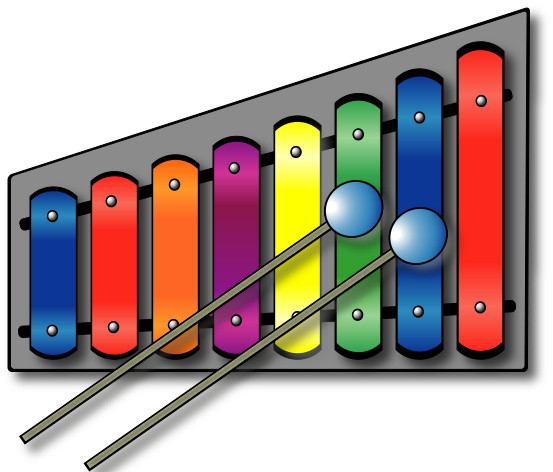
Okay, xylophone isn’t really a sciency word, but it has a sciency word contained within it.  “Phone,” of course, means sound, but what about the “xylo-” part?  That comes from the Greek word “xylon,” which means wood, and there are lots of scientific terms that use “xylon” as a root, especially in the study of plants.

You might remember the words “xylem and phloem” from your 5th grade science class.  They’re sort of like the arteries and veins of plant biology, helping to transport water and other nutrients from the ground up to the treetops.

There’s also the term “xylophagous,” an adjective describing something that eats wood.  Termites, for example, are xylophagous insects.  “Xylitol” is a kind of sugar mainly found in birch tree sap, and it has the unusual property of being a sugar that is good for your teeth.  We also have the term “xylophobia,” the fear of forests or of objects made of wood.

“Xylene” is a category of petrochemicals originally discovered in wood tar, hence its name.  We now use it in solvents, paint thinners, and gasoline.  Some car enthusiasts add extra xylene to regular gas to create a higher octane.  I’ve read enough articles about how this can go horribly wrong, since xylene is a toxic and flammable chemical, so please don’t try this at home.

Picture courtesy of wpclipart.com

So the next time you hear a word with the prefix “xylo-” you’ll know what it means.  It’s fairly easy to remember too, given that we’re all familiar with the humble xylophone.  The only sad part is that the xylophone I had as a kid was made entirely out of plastic and therefore was not a xylophone at all.

P.S.: “Xylon” would make a great name for a race of wooden robots.  They could be the low-tech counterparts to Battlestar Galactica’s Cylons.

Welcome to the World of Tomorrow

Ladies and gentlemen, we have traveled another year into the future!  It looks like we still don’t have flying cars or robotic butlers, and we still haven’t made contact with any alien civilizations, but the 21st Century is young.  Just look at some of the advances in science and technology we saw in 2013, and you’ll know awesome things are around the corner.

In early 2013, scientists confirmed the discovery of the Higgs Boson, a critical missing piece in the standard model of quantum physics.  As a science fiction writer, I found this to be rather disappointing.  Science fiction depends on those unknown elements of science, and failure to find the Higgs would have created a lot of fresh unknowns.  Still, there is one question that remains unanswered: now that we’ve discovered this powerful and elusive particle, what are we going to do with it?

Science fiction got a big boost last year from the Curiosity rover on Mars.  For decades, astronomers assumed Mars was totally barren, severely limiting our story telling options.  Now it seems the Red Planet might be able to support life after all.  Curiosity has discovered the basic chemical components necessary for life.  It also discovered trace amounts of liquid water.  Scientists now believe water is everywhere, scattered across the Martian surface by sandstorms.  Two questions remain: did Mars support life at some point in its past, and might there be something living there today?

Lastly, Amazon got a lot of attention by suggesting it might offer an aerial delivery service using robotic drones.  Drones are becoming increasingly common in our skies.  Hobbyists use them for fun, the military uses them to spy on enemy combatants, and the NSA uses them (probably) to spy on everyone else.  The media is starting to use them as well, sending “journalistic drones” where no journalist has gone before.  The big question is do we want all these drones zipping around overhead?  I suspect either Congress or the FAA will address that question soon, probably by the end of 2014.

On a personal note, I had a lot of bad luck in 2013 and fell way behind on my writing schedule.  That’s not to say 2013 was a complete disaster, but now that it’s over I say good riddance and look forward to a happier and more productive 2014.  With all these unanswered sciency questions, I’m sure I’ll have plenty of material to write about.

What are you looking forward to in 2014?

Sciency Words: What Comes After Yottabyte?

I recently saw an old Sci-Fi movie where one character uses the word “terabyte” as though this is some enormously large quantity of data.  And, of course, it is, at least here in 2013.  But the movie was set several centuries from now.  By that time, I doubt a whole terabyte would impress anyone.

Terabyte comes from a Greek word meaning “monster,” as in a terabyte is a monstrous amount of information.  It’s equal to one trillion bytes.  After terabyte comes petabyte, exabyte, zettabyte, and finally yottabyte.  The prefix “yotta-” comes from the Italian word for eight and means 1,0008, so a yottabyte equals one septillion or 1,000,000,000,000,000,000,000,000 bytes.

And yet centuries from now, even a yottabyte might not seem like a lot.  It’s rumored that the NSA has already collected several yottabytes of data for its surveillance programs.  I suspect this is a slight exaggeration (emphasis on slight) but it does prove that the term yottabyte is already becoming part of our vocabularies.

So what comes after a yottabyte?  According to my research, yottabyte is currently the largest amount of data that we have an official term for, but some people have already proposed the word brontobyte for the next level.  I presume a brontobyte is so much data that it’s as big as a brontosaurus.


IMG_1097

The Perfect Gift for Your Frenemy

It’s the day before Christmas, and there’s that one person on your list who you can barely tolerate, a person you loathe and yet you can’t just skip over them.  A mother-in-law, perhaps.  Or that guy at work (you know… that guy).  Or that so-called friend who keeps stabbing you in the back.  What makes the perfect gift for the people in your life you absolutely hate?

A display of uranium glass from a thrift store.  Photo credit: Nerd
A display of uranium glass from a thrift store. Photo credit: Nerdtalker via Wikimedia Commons.

How about uranium glass?  It’s glass with just a tiny bit of uranium mixed in.  Decades ago, before the dangers of uranium were well understood, people made glassware out of this stuff, and you can still find it in antique stores or on eBay.  It’s quite beautiful, with a distinctive yellowish green color, and under certain lighting conditions it will even glow.

But of course it’s radioactive.  The radioactivity is fairly low and generally considered safe, but it’s still radioactive, making it the perfect gift for the special someone who you wish would just die.

Sciency Words: Mathematical Theorem

Sciency Words Logo

Sometimes stuff happens, and so I missed yesterday’s Sciency Words post.  Sciency Words is a series here on Planet Pailly where we take a look at some interesting scientific term and try to expand our sciency vocabularies together.  I usually post this series on Fridays, but this week I fell behind schedule, so I’m a day off.

So for the first ever Saturday edition of Sciency Words, our word today is:

MATHEMATICAL THEOREM

Last week, we talked about the difference between a scientific theory and a scientific law, or rather the lack of any real difference between them.  Neither one can ever be taken as 100% certain, but that doesn’t mean that one day a theory (like say evolution) will be discarded completely.  New theories seek to refine the old ones, not replace them outright.

Some degree of uncertainty is inherent in science, but that’s not true of mathematics.  Two plus two equals four.  The sum of the angles of an equilateral triangle equals 180 degrees.  Two parallel lines on a flat surface will never intersect.  These are incontrovertible facts.  Where scientists struggle with their imprecise theories and laws, mathematicians enjoy full confidence in what they call “theorems.”

You’re probably familiar with the Pythagorean Theorem, which states that a2 +b2 = c2 when we’re dealing with the sides of a right triangle.  This theorem was first discovered by an ancient Greek philosopher named Pythagoras and has remained unchanged and unchallenged for over 2,500 years.  There are literally hundreds of ways to prove the Pythagorean Theorem (click here to see 99 of them), but that’s not really necessary.  Where in science we must perform the same experiment hundreds or even thousands of times and still have doubts, mathematics only requires us to prove something once.

So mathematical theorems are 100% certain in a way no scientific theory or law can ever be; however, we must keep in mind that these theorems apply only to our abstract concept of geometry and numbers.  Here in the real world, there are no perfect circles, no angles that are exactly 90 degrees, and no two lines that are perfectly parallel.  The real world is messy and imprecise, and so science remains our best tool for the study of the universe we actually live in.

Scientific Theory vs Scientific Law

Sciency Words Logo

Today’s post is part of a special series here on Planet Pailly called Sciency Words.  Every Friday, I bring you a new and interesting scientific word to help us all expand our scientific vocabularies.  Today, I want to do something a little different and take a look at two terms that we all probably know but are too often misunderstood.

SCIENTIFIC THEORY vs. SCIENTIFIC LAW

You may hear someone say, “Well, evolution is just a theory,” as though that means it’s a trivial thing, little more than guesswork.  A common misconception is that, if we really knew for sure, if there truly were no doubts, we’d call it a scientific law.  So since there is no “Law of Evolution,” that must mean the matter is still suspect.  Perhaps the whole evolution idea may one day turn out to be wrong.

I was taught in school that there are three levels of scientific certainty.  First comes the hypothesis, an untested idea based on scientific observations alone.  Next comes the theory, a hypothesis that has survived all the experiments we’ve tried thus far but is still “just a theory.”  Lastly, we have scientific laws, which are theories that have been proven beyond all possible doubt, that cannot be challenged or overturned, that are absolute, scientific Facts (with a capital F).

That’s a convenient hierarchy, one that was easy for my twelve-year-old self to understand, but it’s not actually the way things work.  There are several different definitions for scientific theories and scientific laws.  The distinction sometimes involves whether or not the theory/law uses mathematics.  Sometimes it’s a question of whether or not the theory/law describes some specific phenomenon or a more generalized view of nature.  And some experts will tell you there is no difference between them whatsoever.

The view I have come to accept is that the difference has more to do with the fashion of the time than anything else.  In the 17th and 18th Centuries, scientists generally called their discoveries laws (for example, Newton’s Law of Gravity or Kepler’s Laws of Planetary Motion).  Scientists in more modern times, such as Darwin (19th Century) or Einstein (20th Century), prefer to call their discoveries theories.  This may reflect a changing attitude among scientists who had come to realize that nothing in science is ever 100% certain.

So what happens when a law or theory is “disproven,” and what would happen if a new discovery seriously challenged the Theory of Evolution?  Well, when Einstein’s Theory of Relativity “disproved” Newton’s Law of Gravity, that did not mean that gravity suddenly went away.  We still use Newton’s law today because it’s a close approximation of the truth, at least until you approach a black hole or try accelerating to the speed of light.  Under those conditions, Newton can’t help you, mainly because he had no idea such things were even possible.

One day, we may learn that Darwin’s Theory of Evolution is only an approximation of the truth.  In fact, that’s already happened thanks in part to the discovery of DNA, something that Darwin didn’t know existed.  The result was not the end of evolution but the development of a new, more sophisticated theory, one that adds greater precision and detail to its predecessor.  We might call this the Theory of Genetic Evolution in order to distinguish it from Darwin’s original idea, but the basic concept remains the intact.

In science, nothing is proven beyond all possible doubt, but that doesn’t mean new theories completely replace the old ones.  One theory builds upon another and upon another.  Einstein built upon the work of Newton, Newton upon the work of Galileo, and so forth all the way back to the natural philosophers of Ancient Greece.  Science continuously makes new discoveries and refines its understanding of nature.  Whether we call these discoveries theories or laws doesn’t matter.  What matters is that science keeps evolving.

P.S.: Special thanks to Mark Ball for suggesting scientific theory as the subject for today’s post.  Please check out Mark’s website, Sci-Fi Ideas.  It’s a great place for both science fiction fans and science enthusiasts to muse over the many possibilities of our universe.

P.P.S.: The great science fiction writer Isaac Asimov once wrote an essay entitled “The Relativity of Wrong.”  Click here to read it.  It’s one of my favorite pieces on science, and it was a real eye-opener for me back when I still believed in that silly hierarchy of scientific certainty I’d learned in school.

What I’ve Learned from Indie Life

IndieLife7

Today’s post is part of Indie Life, a blog hop for independent authors hosted by the Indelibles.  Click here to see a list of participating blogs.
* * *

A few months ago, I took a leap of faith, quitting my full time job in favor of a part time position.  My goal was to spend more time writing and start to become a true career author.  I still have a long way to go on this journey, but here are some of the things I’ve learned so far:

  • This is my destiny.  I had my doubts at first.  Some well-meaning people tried to convince me not to do this, and I shared their concerns.  But I am now convinced that this is what I am meant to be doing, and though I still have some big obstacles ahead of me, I have faith that somehow things are going to work.
  • The double rule: a fellow writer, someone much farther along this journey than I, once told me that whatever amount of time you think it will take you to write something, it will actually take twice as long.  He was right, and I now call this the double rule.
  • The excuses rule: you can always find an excuse not to write.  Something’s happening with the family.  Something’s wrong with the dog, cat, or goldfish.  All the food in the refrigerator needs to be arranged in alphabetical order.  The excuses rule is that, no matter what emergency (or so-called emergency) is going on, I have to keep writing.  In other words, there are no excuses.
  • You can’t do this without some financial preparedness.  I did not abruptly storm into my boss’s office one day and quit.  I created a savings account, built it up over the course of several years until I had enough money to live on for roughly 18 months.  Then I quit my job.  Having that money set aside gives me the confidence to keep writing and keep dreaming, knowing that I will not end up homeless and destitute, begging for scraps of food outside the local McDonald’s.
  • Anyone can find a way to follow their dreams.  Regardless of your situation, you can find a way to make this work.  It just takes time, discipline, and perhaps a little creative thinking.
  • Hire a professional editor.  This part frightened me, putting my beautiful manuscript into the hands of an editor and getting it back covered in red ink, but I didn’t need to be afraid.  An editor’s job isn’t merely to point out your mistakes but to help you tell the best story you can.  When I finally started working with an editor, it was the first time that I didn’t feel like I was all alone on this journey.
  • The education rule: I once believed that I shouldn’t take this step until I’m “ready,” until I “know everything I need to know.”  That’s ridiculous.  The life of the writer, indie or otherwise, is all about asking questions and learning more.  The most important thing I’ve learned is that I still have a lot to learn, and I always will.

So, my fellow Indie Lifers, what have you learned since going Indie?