Sciency Words: Triple Alpha Process

Sciency Words Logo

Today’s post is part of a special series here on Planet Pailly called Sciency Words. Every Friday, we take a look at a new and interesting scientific term to help us all expand our scientific vocabularies together. Today’s word is:

TRIPLE ALPHA PROCESS

Earlier this week, we took a look at the puzzle game Fe [26], in which you fuse atomic nuclei together and try to produce the isotope iron 56. Today, I’m going to teach you one of the basic moves you’ll have to learn in order to win this game. It’s called the triple alpha process.
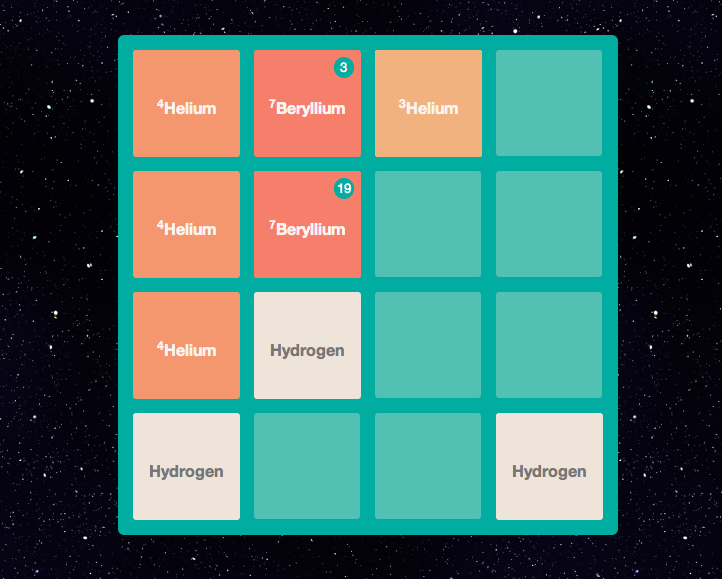
Triple Alpha Step One

First, you’ll have to create three helium nuclei, specifically the isotope labeled helium 4. Helium 4 plays a special role in nuclear physics where it is often called the “alpha particle.” If it didn’t have that “alpha” name, I guess we’d be talking about the triple helium process today.
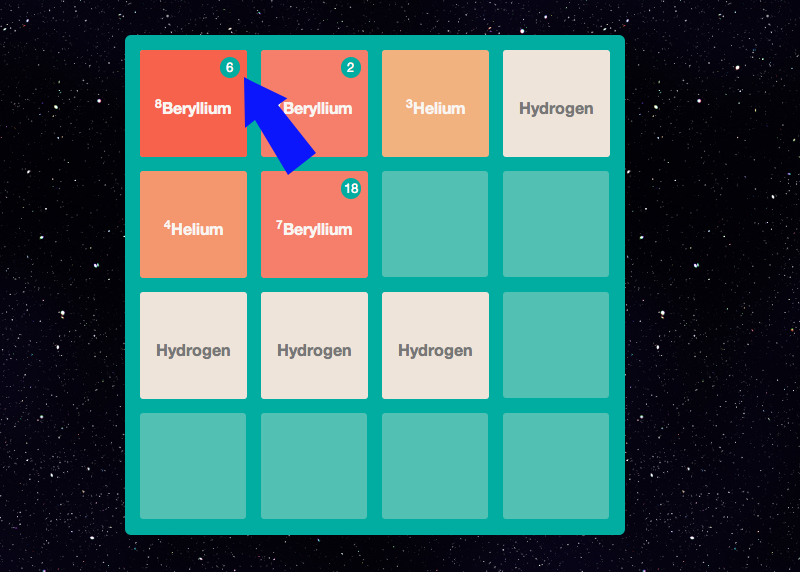
Triple Alpha Step Two

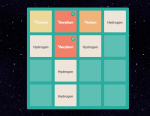
Once you’ve created your helium, fuse two of them together to make beryllium 8. You’ll notice that beryllium 8 is marked with a little, green number. That number indicates that you’ve created an unstable isotope. You have only six turns before it undergoes radioactive decay and turns back into helium.

Triple Alpha Step Three.

Before your beryllium decays, quickly fuse it with your third helium 4 nucleus. This will produce carbon 12. You can relax now. Carbon 12 is stable, and you have plenty of time to figure out what you’re supposed to do with it. You’re now well on your way toward winning Fe [26].

Click here to start playing Fe [26]. Click here to learn about other sciency video games profiled this month here on Planet Pailly.

P.S.: This is the way carbon is actually made in the hearts of stars. Two helium nuclei (or alpha particles) fuse together to make beryllium 8. If a third helium nucleus shows up quickly enough, it can turn that beryllium into carbon; if not, the beryllium will rapidly disintegrate.

P.P.S.: See, Mom, I told you video games can be educational!

Sciency Games: Fe [26]

Today’s post is part of a series of posts profiling sciency video games.  These are educational games, most available for free online, that can really help you gain a deeper understanding of science.  Click here to find out more about this series.

* * *

After several failed attempts, I've finally made carbon in the game Fe [26].
After several failed attempts, I’ve finally made carbon in the game Fe [26].
If you have not yet played Threes or the conceptually similar 2048, turn back now.  These games are highly addictive!  However, if it’s already too late for you, then maybe you should try Fe [26].  It functions much like 2048, but instead of adding numbered tiles together, you “fuse” atomic nuclei in the heart of a star.

In 2048, the game progresses thusly: 2 + 2 = 4, 4 + 4 = 8, 8 + 8 = 16, etc.  That’s fairly easy to understand, but in Fe [26] things get more interesting.  Hydrogen + hydrogen = deuterium (or deuteron as it’s called in this game).  Deuterium + hydrogen = helium 3.  Helium 3 + hydrogen = helium 4.  Helium 4 + helium 4 + helium 4 = carbon 12.  What could be simpler?

You win the game if you create iron 56, one of the most stable isotopes of any chemical element.
You win if you manage to create iron, specifically iron 56, one of the most stable isotopes of any chemical element known to exist.  I’ve only pulled it off a few times now, and only with the help of the cheat sheet at the bottom of the Fe [26] webpage.
What excites me about this game is that, even though it’s frustrating at first, eventually you start to see patterns.  You start to learn which combinations of atoms work and which ones do not.  After checking with Wikipedia, I discovered that the knowledge I acquired from this game is fairly close to reality.

So if you write science fiction or have more than a passing interest in science, I recommend giving this game a try.  It might help you learn something about what really goes on inside stars.  Best of all, the game is free!

Click here to start playing Fe [26].

P.S.: In addition to teaching me a little nuclear physics, Fe [26] has also taught me to hate beryllium 7.  I keep making it by mistake, though I don’t hate it nearly as much as magnesium 24.  Accidentally creating magnesium 24 is the worst!

Let the Sciency Games Commence!

I started this blog as a way to force myself, as a science fiction writer, to do the kind of research that I and so many other aspiring Sci-Fi authors neglect to do. I’ve learned a lot since Planet Pailly began, and I hope you’ve learned something too. Today, I want to share a few tools that have helped make learning a little easier.

I say tools, but what I really mean are video games. It’s amazing how much you can learn from a game when that game is scientifically accurate (or at least accurate-ish). Here are three examples:

  • Fe [26]: Atoms are important, but where do they come from? In Fe [26], which is modeled on the popular smart phone game 2048, you control the fusion reactions that occur inside a star. The real fun is figuring out which combinations of particles work and which ones don’t. Click here to play Fe [26].
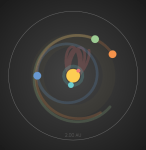
  • Super Planet Crash: The planets in our Solar System exist in a delicate balance. Subtle changes in gravity or momentum can have disastrous consequences… which is what Super Planet Crash is all about! Your goal is to create a stable star system. You score points based on how long your planets stay in orbit around their parent star. Click here to play Super Planet Crash.
  • Kerbal Space Program: The people of Kerbin are cute, squishy green guys who are hyper excited about space exploration, and for some reason they’ve put you in charge of their space program. This game simulates not only the physics of space flight but also the logistics of running a NASA-esque organization. Of all the games on this list, this is the only one that isn’t free, but if you’re interested, click here to check out the demo version of the game.


The important thing about all these games is that you learn by doing. That makes them far more effective teaching tools than any lecture, book, or sciency blog post.

For the rest of this month, I’ll be taking a closer look at each of these games. Here is the itinerary for those upcoming reviews as well as special editions of Sciency Words featuring words I learned because of these games.

Wednesday, May 14: Review of Fe [26]

Friday, May 16: Sciency Words: Triple Alpha Process

Wednesday, May 21: Review of Super Planet Crash

Friday, May 23: Sciency Words: Eccentricity

Wednesday, May 28: Review of Kerbal Space Program

Friday, May 30: Sciency Words: Orbital Vocabulary

Sciency Words: Ouroboros

Sciency Words Logo

Today’s post is part of a special series here on Planet Pailly called Sciency Words. Every Friday, we take a look at a new and interesting scientific term to help us all expand our scientific vocabularies together. Today’s word is:

OUROBOROS

Ouroboros is not a word I ever thought of as a sciency word until I saw this:

Please note: I recommend watching the video with the audio muted. While the video does have educational value, whoever filmed it seems to find a little too much humor in the suffering of animals.

Ouroboros is an ancient symbol depicting a snake or sometimes a dragon curled into a circle, biting its own tail. The image has a lot of historical and mythological significance and has been referenced by many famous philosophers. It usually symbolizes stuff like eternity, rebirth, or the endless circle of life.

After seeing a real-life ouroboros, I think we can guess that the symbol probably originates in something ancient people observed in nature. I can’t imagine snakes commonly try to eat themselves, but if one animal engaged in this self-destructive behavior, surely others have done so as well.

But why would a snake do this to itself in the first place? According to an article from I Fucking Love Science (an awesome name for a website, by the way), this behavior may be the result of stress or perhaps overheating. Snakes are cold blooded and cannot regulate their blood temperature the way mammals do. For the snake in this video, the ouroboros does not represent the circle of life or anything of the sort; it is probably the unfortunate result of someone leaving the heat lamp on for too long.

IWSG: Research Rant

InsecureWritersSupportGroupToday’s post is part of the Insecure Writer’s Support Group, a blog hop hosted by Alex J. Cavanaugh. It’s a way for insecure writers like myself give each other advice and encouragement. Click here to see a full list of participating blogs.

* * *

A few years ago, I was at a party with some fellow writers. A certain someone who wrote historical fiction made a comment about how important it is for writers to do their research, to make sure they get all their facts straight, “unless you write science fiction, of course,” he added with slight nod toward me.

I’ve heard this assumption before, and I’ve heard it since. I’ve heard it in writing seminars, I’ve read it on blogs, and I’ve encountered it in many casual conversations with other writers. Writers must do their research, but fantasy and science fiction writers get a pass. After all, they write about stuff that’s totally made up!

I mean, fantasy writers obviously have no need for research. They don’t need to know about different kinds of swords or armor. They certainly don’t need to know anything about farming, horseback riding, or medieval architecture, and I can’t think of any reason why they’d need to study military strategy. No, fantasy writers have it easy. No research required whatsoever.

As for science fiction writers like myself, why we have it even easier! Outer space is a land of pure imagination. Space travel requires zero understanding of Newton’s laws. As a Sci-Fi writer, I will never… not even once… need to know the difference between hydrogen and helium, between dark matter and dark energy, or between special and general relativity. Nope. Science fiction is 100% research free. It’s a good thing too because that relativity stuff is complicated. Have you seen all the math involved?

This historical fiction guy went on to explain that “world building” is what fantasy and science fiction writers do instead of research. “Listen, jerk,” I said, “that’s something I do on top of my research, not instead of it.” Okay, I didn’t actually have the nerve to say that, but I wanted to. I really wanted to.

So please, fellow writers, please do not belittle us fantasy and science fiction authors. We have to do research just as much as anyone else.

End rant.

When Humvees Fly

A few weeks ago, I told you about Terrafugia, a company that’s on the verge of putting the first ever flying car on the market. Of course, their car is not a true flying car à la the Jetsons; it’s more like an airplane with retractable wings, making it street legal. It’s the kind of vehicle that would still require you to earn a pilot’s license, so I doubt it will become the common man’s vehicle of choice.

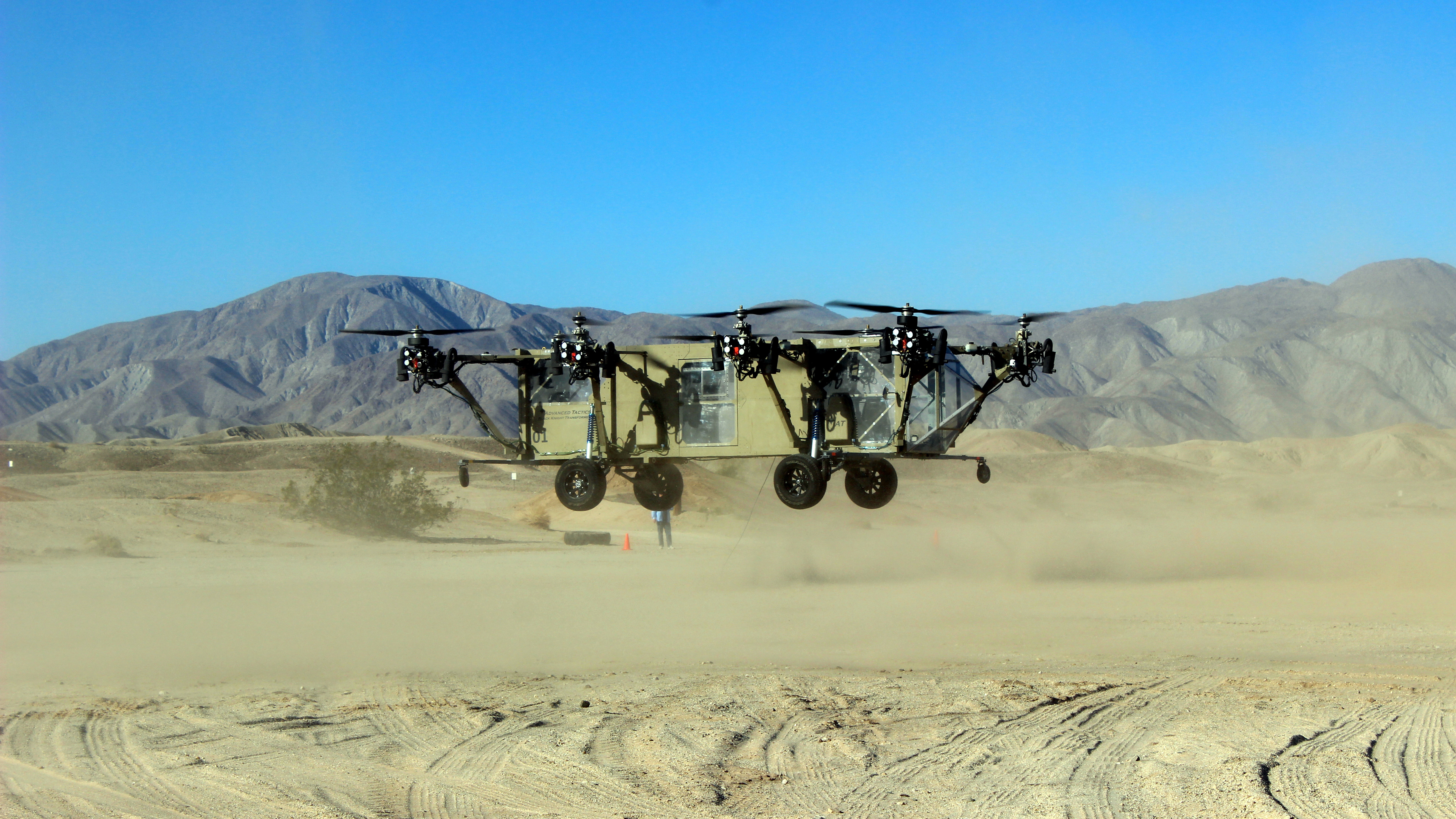
Well, there’s another company working on flying car designs. Advanced Tactics Inc., a California based aerospace company, is reporting the first successful test flight of their Black Knight Transformer. The technology appears to be similar to those little, toy quadcopters you’ve probably seen, but on a much larger scale. It has big rotors and big blades, big enough to lift a small truck off the ground.

According to the company’s website, the Black Knight Transformer will be used primarily by the military for quick extraction of casualties and for cargo resupply missions. The advantages of this vehicle on (or above) the battlefield are obvious. When you need to cross hazardous terrain, you can just fly over it. When flying makes you an easy target, you can drive.

Best of all, the Black Knight apparently has an autopilot feature. Articles from Singularity Hub and Scientific American suggest that means a pilot’s license isn’t necessary, leaving only one question unanswered: how soon can I buy one?

Sciency Words: The Theory of Invariance

Sciency Words Logo

Today’s post is part of a special series here on Planet Pailly called Sciency Words.  Every Friday, we take a look at a new and interesting scientific term to help us all expand our scientific vocabularies together.  Today’s word is:

THE THEORY OF INVARIANCE

Albert Einstein made many important contributions to science, but one of his most controversial was the theory of relativity.  Not that it was controversial among scientists.  Proof of relativity came fairly rapidly after its initial publication, and experiment after experiment have continued confirming its validity ever since.  No, the controversy was among the general public, some of whom perceived, for some reason, that relativity in physics led to relativity in morality.

This confusion upset Einstein so much that, later in life, he pushed to have his theory renamed “the theory of invariance.”  Where the term relativity applied to the relative frames of reference of different observers, the term invariance refers to the invariant speed of light, which is just as essential to the theory as the relativity part.  It would also reassure people that no, morality is not relative.

However, by that time the name relativity had already been around for several decades.  The names of scientific principles are not easily changed once they’re established, so for better or worse, the theory of relativity is here to stay.

So what do you think?  Do you like relativity, or do you think we should have renamed it invariance as Einstein suggested?

Photons and Ice Cream

How can light be a particle and a wave?  I have no freaking idea.  This has perplexed scientists for generations now, but experiment after experiment have proven it is true.  Somehow, the individual photons that make up light are particles sometimes and waves others, depending on how you look at them.  Even weirder, sometimes photons seem to have the properties of both particles and waves at the same time.

Asimov

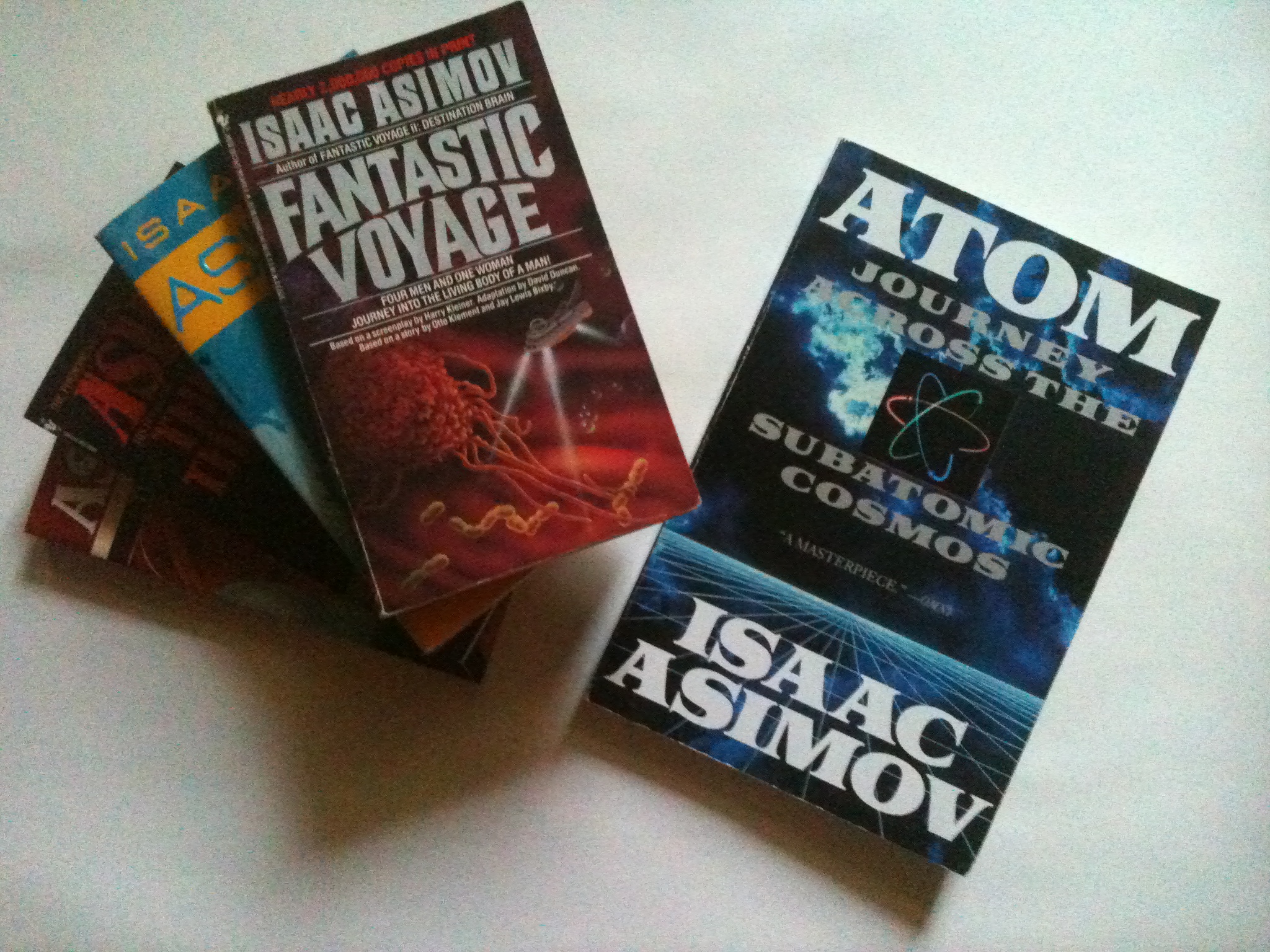
A few years ago, I read a simple analogy that makes particle-wave duality a little easier to understand.  This comes to us courtesy of Isaac Asimov’s book Atom: Journey Across the Subatomic Cosmos.

Asimov asks us how we might describe an empty ice cream cone (other than disappointing).  Is it a triangle or a circle?  Somehow, it appears to be both.  When observed from one perspective, it’s clearly a triangle; from another, it’s obviously circular.  And sometimes, if viewed under certain special circumstances, the ice cream cone appears to exhibit properties of both a triangle and a circle at the same time!

I had planned to include a picture of an ice cream cone here, but it mysteriously disappeared. Such strange things are known to happen in quantum physics.

Of course, light’s dual nature is far more complicated than that of an ice cream cone.  Our limited, human minds may never learn how to visualize photons doing their quantum voodoo particle-wave thing, but the ice cream analogy might make this bizarre concept a little easier to digest.

P.S.: A few years ago, I wrote a review of Atom: Journey Across the Subatomic Cosmos.  If you have any interest in learning about science, this book is a must read.  I cannot emphasize enough that it is the best book on science I have ever encountered.

Sciency Words: Muscle Memory

Sciency Words Logo

Today’s post is part of a special series here on Planet Pailly called Sciency Words.  Every Friday, we take a look at a new and interesting scientific term to help us all expand our scientific vocabularies together.  Today’s word is:

MUSCLE MEMORY

Do you remember learning to walk?  Of course you do!  Who could forget struggling to figure out how to move one leg, maintaining your balance while doing so, bending the knee at just the right angle, then placing your foot squarely on the ground before attempting to move the other leg?  Literally hundreds of individual muscles are involved.  It’s complicated stuff.  If you’re anything like me, you probably fell down a lot while trying to get this right.

But now, walking requires hardly any concentration at all.  That’s because of muscle memory, your brain’s ability to memorize which combinations of muscle movements are required to perform basic, everyday tasks.  The more you practice doing something (swimming, riding a bicycle, dancing the tango…) the easier it will become because your brain learns to perform all the necessary motions automatically.

There’s a good chance you’ve already heard about muscle memory and already know exactly what it means.  I hate sharing stuff most of my readers already know (which is why I have yet to write a blog post defining photosynthesis), but I decided to do this as today’s Sciency Word anyway because for a long time, I misunderstood the meaning of this term.

I assumed muscle memory had more to do with weight training, as in muscles become stronger and better suited to a specific activity, “remembering” in a metaphorical sense how that activity is done.  I didn’t know it had anything to do with memory in the literal sense, as in memory stored in the brain.

I figure if I made this erroneous assumption, perhaps some of my readers did as well.  Hopefully we will all keep expanding our scientific vocabularies together!

Wisdom of Dune

The sequels to Dune are not, perhaps, great works of science fiction.  They don’t even come close to the literary masterpiece that is the original Dune.  However, these books do offer a few kernels of wisdom.  Here are three of my favorites:

One cannot have a single thing without its opposite.

– Children of Dune

It is possible to know so much about a subject that you become totally ignorant.

– Chapterhouse: Dune

Silence is often the best thing to say.

– Chapterhouse: Dune

Take these quotes as you will.  I have found them to be true, sometimes frustratingly so.

What are some of your favorite quotes from science fiction?