Sci Friday

Here are this week’s sciency links.

The Robots are Coming

Well, we all knew this day would come: robots are stealing our jobs.  The video above is an advertisement for FRIDA, a human sized robot capable of performing a multitude of tasks in a factory setting.  Although the video says the robot is meant to work along side humans, most likely the robot will replace us.

Again, we knew this was coming, and I’m sorry if you end up losing your job to FRIDA or WALL-E or Apple’s inevitable iEmployee.  I don’t mean to be insensitive, but we also have to think about kind of robots we allow to replace us.  It’s fortunate that science fiction has warned us over and over again about robot revolutions.  It seems Freda’s programming has safety in mind (see the part of the video about 40 seconds in).

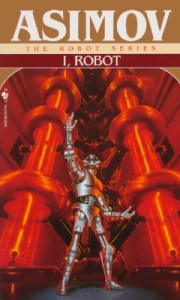
The robot has a directive not to harm humans, and this directive is more important than its instructions to do whatever it’s doing with its hands.  Although relatively simplistic, it reminds me of the Laws of Robotics proposed in several Isaac Asimov novels.  The first law says, “A robot may not harm a human being, or, through inaction, allow a human being to come to harm.”

Robots cannot break this law, and it’s such a fundamental part of their programming that a human can’t remove it without making the robot entirely useless.  So even as robot society grows and expands, the robots always remain peaceful and altruistic.  It’s a completely different vision than that of, for example, the Terminator movies.

A company in Taiwan has already started buying FRIDA robots for its factories.  No doubt, people will lose their jobs.  As I’ve said, we knew this day would come.  But at least we can design robots to be safe and friendly, not heartless killers.

Sci Friday

It’s been a big week for science.  Once upon a time, Earth may have had two moons, and Mars might have liquid water right now (Doctor Who fans should be worried).  Here are this week’s sciency links.

Eat Your Chlorine!

Chlorine is bad for you.  Don’t eat it.  Don’t drink it (i.e., don’t drink bleach).  If you happen to see a cloud of yellow-green gas floating nearby, walk away and don’t breathe it.  But new research may show that some organisms can thrive in a chlorine-rich environment.  They might even come to depend on this deadly poison for survival.

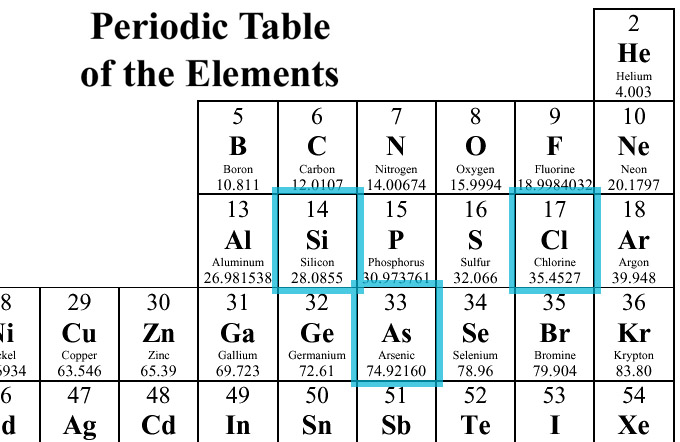
Alternative biochemistries may incorporate silicon, chlorine, or even arsenic.

Science fiction often speculates about alternative biochemistries, most notably silicon based life.  Up until recently, we’ve only been able to study carbon based life, where carbon is used as the primary building block for organic molecules.  Since silicon is similar to carbon, Sci-Fi says it might be possible for some alien creature to substitute silicon for carbon.

In December of last year, NASA scientists announced the discovery of bacteria which could replace their phosphorus with arsenic.  This research is still in dispute (sometimes the arguments get a little personal), but it seems researchers generally agree arsenic based life could exist somewhere, if not on Earth.  (See my previous posts on arsenic eating bacteria, “Eat Your Arsenic” and “Don’t Eat That Arsenic!”)

Now researchers in Germany claim they’ve engineered new E. coli bacteria which substitute a chlorine compound for part of the bacteria’s DNA.  As far as I can tell, this discovery is not in dispute… yet.  But again, it shows that real scientists believe an alternative biochemistry is possible.

Please note that while people use terms like arsenic based and chlorine based life, these examples are still carbon based.  Carbon can do things that no other element can, not even silicon.  It can form strong, lightweight chains of atoms, which are extremely useful for making things like DNA (see “Carbon vs. Silicon” for more).  Swapping silicon for carbon makes those chains fall apart.  If a silicon based life form exists, like the one pictured below, its biochemistry has to be completely different from ours and not just a one-for-one substitution.

As astronomers discover more and more planets outside our solar system, those alternative biochemistries become very important.  When they examine these planets, looking for telltale clues of oxygen-nitrogen atmospheres and other signs of life-as-we-know-it, they also have to remain open to the possibility of life-as-we-don’t-know-it.  Maybe even the highly unlikely silicon based life of science fiction.

Click here for more on chlorine based life.

P.S.: No word yet on any Sci-Fi thrillers where bleach-immune E. coli escape from the lab to wreak havoc of innocent humans’ digestive systems.

Sci Friday

Here are this week’s sciency links.  I strongly recommend reading the second one before checking out the new Planet of the Apes movie.

Welcome to the World of Tomorrow

Okay, so we don’t have flying cars or jet packs, but we do have electronic books, and we can play Angry Birds on our phones.  So we’re making progress.  It’s the 21st Century, and things are starting to feel a little like science fiction.

The biggest thing we haven’t done yet is, of course, space travel.  It should be affordable by now, or at least reasonably common.  Instead, NASA is shutting down the space shuttle program, and we’re left with little more than recreational trips into the upper atmosphere—reserved for the rich.

But there’s hope.  As I discussed in last week’s post, the United States is interested in sending missions to nearby asteroids.  Some private companies are also interested in mining those asteroids for resources, and China has announced plans to build a base on the moon for its own mining purposes.

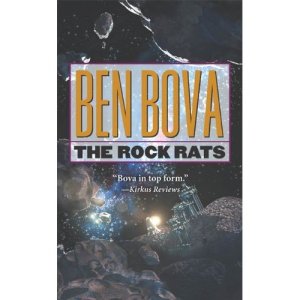
If all this really happens, if the economies of two major superpowers become dependent on space travel, then we’ll definitely be living in a science fiction world similar to Ben Bova’s Asteroid Wars series.  We may see a day when men not only live on the Moon but are fighting for their independence, and when prospectors in the Asteroid Belt are killing each other to claim their own lumps of rock.

I’m not sure I want to live in the Asteroid Wars novels.  I’d much prefer living in the Star Trek universe, where things are relatively peaceful (and maybe we can play Angry Birds on the holodeck).  But the real future is a science fiction novel yet to be written.  It’s up to us to decide what it should be like.

Sci Friday

Here’s this week’s Sci Friday links.  Enjoy!

Who Owns the Moon?

The most recent Transformers movie gives us a look back at the Moon landing.  This at a time when the future of human space flight, or at least American space flight, is in question.  The last space shuttle mission is currently on its way home, and our astronauts will have to book future trips to the International Space Station with the Russians.

The general idea in the United States is that the private sector will now take over space flight.  In fact, a company called SpaceX (which sounds like something from a 1950’s Sci-Fi movie) is very close to launching its first mission to the ISS.  In December, they hope to send a remote-guided capsule there and return it safely to Earth.

If they succeed, SpaceX wants to put people in its capsules next.  That would allow NASA to at least book flights with an American company rather than outsourcing to Russia.  If everything goes according to plan, it could happen as early as 2014.

In the meantime, China is moving ahead with its own space program.  Their three-step agenda will lead to construction of a moon base, and then China intends to mine the Moon for its resources, believed to include iron, titanium, and helium-3 (needed to build nuclear fusion reactors).  According to Ouyang Ziyuan, chief scientist of the Chinese Lunar Exploration Program, China will do this “for the benefit of humanity.”

The United States has expressed some interest in chasing Near Earth Objects, asteroids and comets that come close—sometimes dangerously close—to our planet.  Many of these asteroids contain valuable resources as well, such as platinum group metals, and some groups in the US advocate asteroid mining as a way to solve America’s ongoing economic crisis.

It’s not hard to imagine, if moon bases and asteroid chasing become profitable, that the US, China, and any other country involved in space flight, will come into conflict.  Helium-3 could become the new oil, and the Moon the new Middle East.

Links

For more on SpaceX, click here.

For more on China’s plans to go to the Moon, click here.

For more on the Moon’s valuable resources, click here.

For more on asteroid mining, click here.
Sci Friday

The final Harry Potter movie is out today.  I’ll go see it later today (I’ll be the weird guy crying in the fourth row).  Now I know Harry Potter isn’t science fiction, but it turns out there is some science related to it.  Here’s a few links.

And here are some links that have absolutely nothing to do with Harry Potter.

Lastly, there is a book called The Science of Harry Potter.  I’ve never read it and can’t say if it’s worth reading, but I know I was very confused when I first heard about it.