A Stranger Comes to Town

Leo Tolstoy once said, “All great literature is one of two stories: a man goes on a journey or a stranger comes to town.”  In the latest edition of Tomorrow News Network, we have a story that is a little of both.

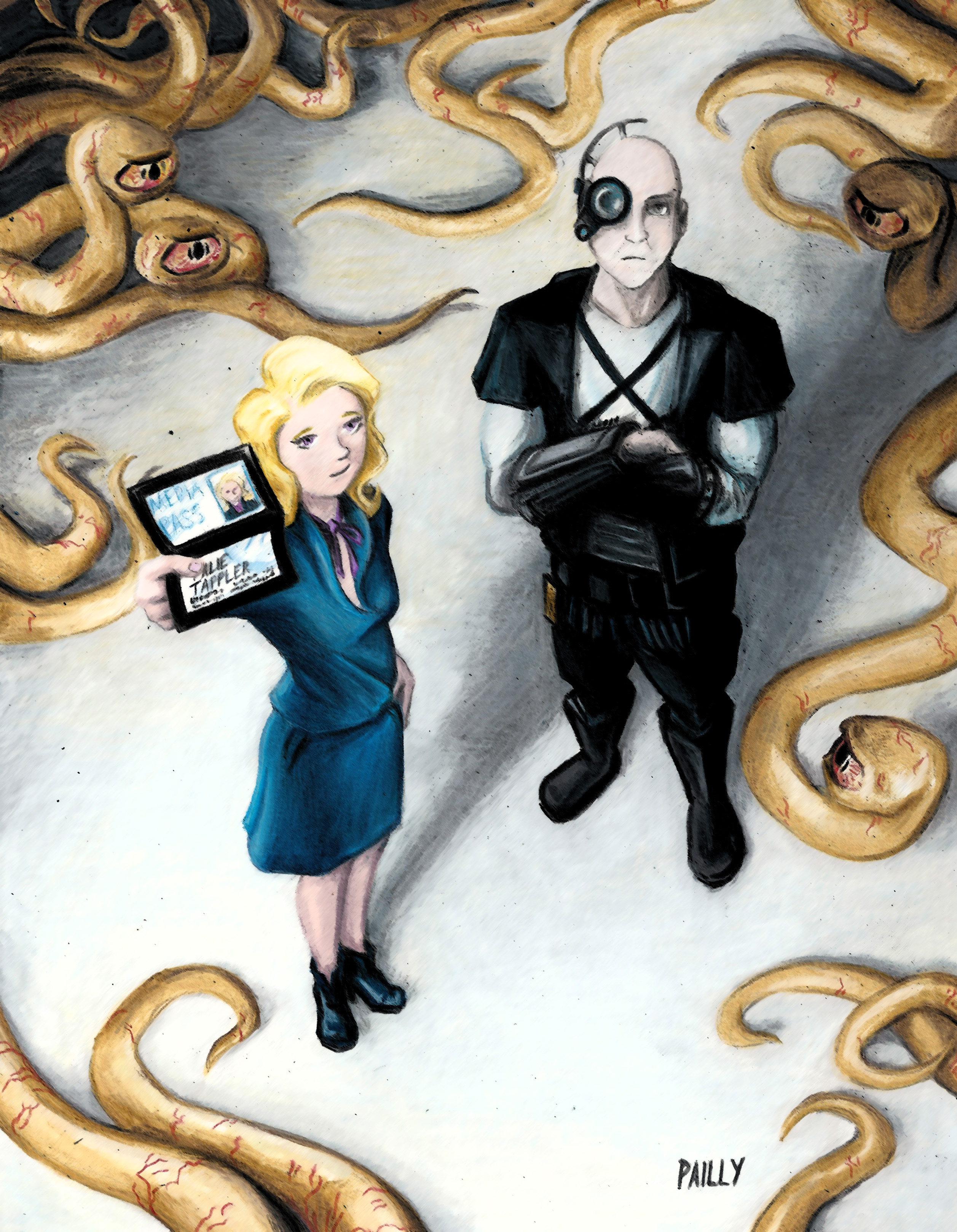
Charlotte is a young girl who wants to be a journalist when she grows up.  Unfortunately, she lives in a small town in the Wild West of the 19th Century, a place and time when women didn’t have so many career opportunities.  All that changes when a stranger comes to town, a woman from the future named Talie Tappler.  Charlotte will then have to go on a journey to find out the truth about the town she lives in.  It’ll be the biggest news story of her life.

Click here to start reading “A Stranger Comes to Town.”

New Story: Mr. Cognis Goes on Vacation

Mr. Cognis may be a cyborg and he may not have any emotions (except the ones he downloads), but he is also one of the Tomorrow News Network’s hardest working employees.  He deserves a vacation.

Cognis and his cyborg girlfriend have chosen to travel to the planet Bliss, a popular vacation resort in the Triangulum Galaxy.  Unfortunately, Bliss has a dangerous secret… a secret which could threaten the entire universe.

Click here to read the latest adventure in the Tomorrow News Network series, “Mr. Cognis Goes on Vacation.”

Final (Regular) Post

I’ve enjoyed writing this blog.  I’ve learned a lot and met a lot of cool people.  I am sorry to bring this to an end, but the reality is I have too muck work to do for the Tomorrow News Network series and I just don’t have the time to keep up with both projects.

At the beginning of this year, I promised to write ten short stories featuring time traveling journalist Talie Tappler.  The first seven are complete, and you can read them for free at the Tomorrow News Network website (click here).

The final three will bring this year’s series to an epic conclusion, and one of Talie’s most closely guarded secrets will be revealed.  They will also set the stage for another set of stories next year.

In addition to that, content for the Tomorrow News Network website is expanding.  I’ll be writing a lot more posts profiling aliens, technology, and time travel.  And yes, I’ll still write about the science behind science fiction­­­­–just on the TNN site rather than this one.

So I hope you’ll join me for Talie’s next time travel adventure.  If nothing else, it’s bound to be sciency.

Update: This blog will remain active after all.  I just won’t be updating it as regularly.

My Trip to Mars

A new Tomorrow News Network story comes out tomorrow, and this one’s set on Mars.  To prepare for writing this story, I had to make a quick trip to Mars to familiarize myself with the place, and thanks to Google Earth that is possible.

For those of you who already have Google Earth on your computers, you know how cool it is.  For those of you who don’t have it, click here.  It’s free, and it’s awesome.  Not only do you get a complete map of Earth, but also Mars, the Moon, and the constellations.  Furthermore, using topographical information, Google Earth can create virtual simulations of Terran, Martian, or Lunar landscapes.

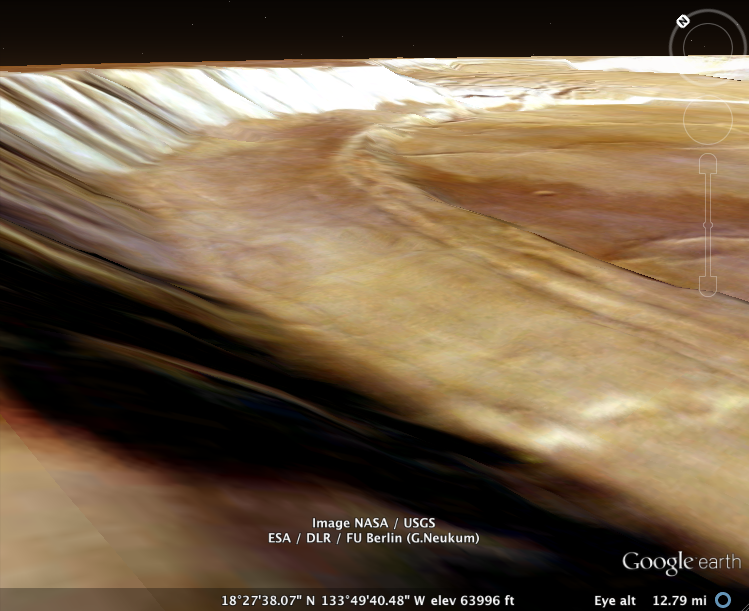
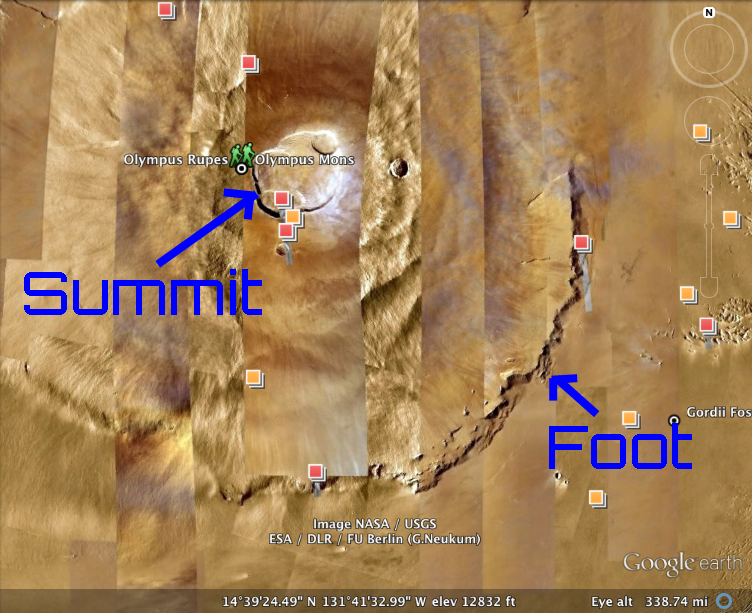
Most of this month’s Tomorrow News Network is set in a colony near Olympus Mons, the largest mountain on Mars.  In fact, it’s the largest mountain in the Solar System.  So my first stop was the summit of the mountain.

Olympus Mons is actually a volcano. What you see here is part of the crater.

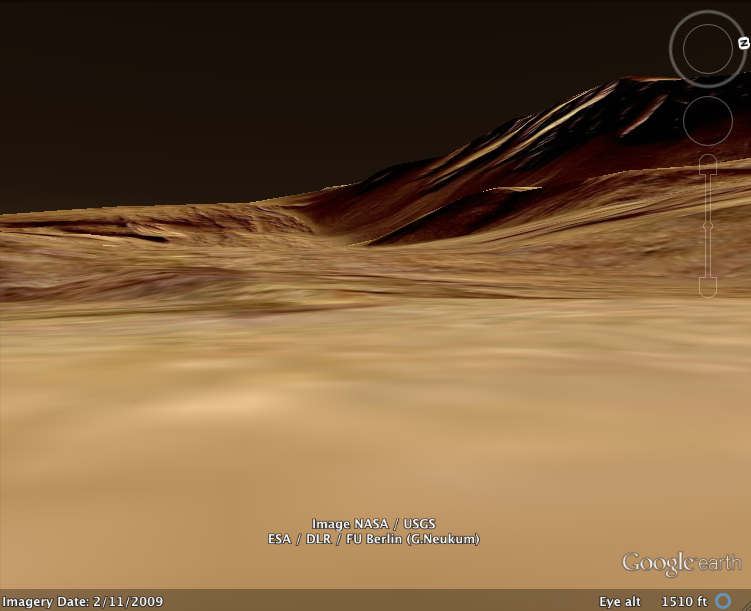
Next I went to the foot of the mountain.  It’s hard to see just how huge Olympus Mons is in these screenshots.  The mountain is so big it wraps around the curvature of the planet, so from the bottom you can’t see the top because the top is beyond your horizon line.

This is a steep slope near the foot of the mountain. The rest of the mountain is too big to see from ground level.

I don’t spend a lot of time talking about Olympus Mons in the story coming out tomorrow.  We have too many other things to talk about, but as a writer I like to know as much as possible about the places I write about.  Google Earth is a surprisingly good way to do that.  I used it to explore Roswell Army Air Field for another story (much of the original base is still there and still in use), and now I’ve used it to explore Mars.

The view from above.

So thank you, Google.  You guys have made one science fiction writer’s job a little bit easier.

All images in this post are © 2012 Google.

Update: The Tomorrow News Network story for June is now posted.  Click here to start reading “Death to History.”

Tomorrow’s News Today

For the last five months, I’ve been writing a series of short stories called The Tomorrow News Network.  They’re all posted on a website (click here).  The plan was to publish ten stories this year, one per month until October.

I’ve now reached the halfway point.  The fifth story is called “Tomorrow’s News Today” and is about the bizarre murder of a 25th Century scientist.  If you like time travel, you should read this story.  If you like murder mysteries, you should read this story.  If you like both, definitely read this story!  Click here.

Plans for the next five stories include the assassination of Earth’s first president, dinosaurs wrecking havoc in space, and some cowboys who find something strange in the Wild West.  I hope you’ll join me for the Tomorrow News Network’s next crazy adventure.

Robot Artists

As an artist, one of the most important things I had to learn was what NOT to include in a drawing.  For example, to make a portrait look right, you can’t draw every individual hair or every fine wrinkle or every tiny freckle on the tip of the nose.  You have to focus on the parts of the face that define that face, that reveal the subject’s personality, and ignore most of the small details.

This is a skill unique to humans, or at least it used to be.  New robots have emerged with special programming to help them decide what should or should not be included in a drawing.  With a camera, they observe a human face, and their robotic hand picks up a pencil and starts drawing a portrait.

Aside from the fact that robots are now encroaching on even more people’s jobs, what are the philosophical implications for art?  When a robot draws something, who’s the artists: the robot or the person who programmed the robot?  Also, if robots learn to understand and appreciate art on their own, how much closer does that bring them to being just like us?

This month’s short story for The Tomorrow News Network explores how machines and the arts might mix together in the future.  Click here to start reading “The Opera of Machines.”  For more information on robotic portrait artists, click here.

The Orion War

In the distant future, religion is illegal. Commodore Isaac Matheson leads a fleet of exiled Christians to find a new home in the far off Orion Nebula, a swirling cloud of gas and dust where brand new stars and planets are forming. But when the fleet is attacked, the search transforms into a long, bitter crusade.
HubbleSource: Hubblesite.org

Time traveling journalist Talie Tappler comes to interview Isaac. She’s not supposed to interfere with history. She’s not supposed to do anything to change it. And yet she drops subtle hints, warning Isaac that he will have to do something terrible to bring this holy war to an end.

Click here to read “The Orion War” at the Tomorrow News Network website.

The Future of Cameras

Mr. Cognis from The Tomorrow News Network is not just a regular cameraman.  He’s a cybernetic cameraman with his camera surgically attached to his head.  Of course, cybernetic cameras haven’t been invented yet, so we’ll have to make due with the technology we have.  Fortunately, camera makers have developed some pretty cool new ways to use what we have, and cameras are doing things no one would have expected just a few years ago.

Researchers at Stanford University have been working on an open source camera, nicknamed “Frankencamera.”  Most digital cameras are closed source, meaning you cannot alter the programming inside them.  An open source camera like Frankencamera allows clever computer people to change the way the camera works, potentially inventing new photography methods no one would have thought of otherwise.  The source code for Frankencamera has been released and is in use on Nokia’s N900 smart phone.

Another new camera technology on the market is called Lytro.  This is the camera for anyone who’s ever taken a photograph only to discover it was blurry afterwards.  The Lytro camera has an extra set of lenses inside, allowing it to capture more information than a traditional camera.  Using that additional information, you can go back later and change the focus so that your picture isn’t blurry anymore.  Click here to go to the Lytro website, and check out the photo gallery where you can try changing the focus of various sample images.

The Pelican Imaging Corporaion, headquartered in California, has developed technology even cooler than Lytro.  Not only can their camera allow you to refocus an image after you take it, but it can see through obstacles like fence posts or the branches of a tree (click here to see a video of how they do this).  Pelican’s camera is actually an array of 25 teeny, tiny cameras all working together.  Just like Lytro’s extra lenses, these extra cameras supply additional information so that images can be refocused or adjusted later.  Best of all, this array of cameras is small enough to fit inside a smart phone.

Digital cameras are changing rapidly.  Other tricks include seeing around corners and picking out images from the reflections in people’s eyes.  Click here for the full article on all the cameras I’ve mentioned and more from Science News.  Of course, no computer processes visual information as well as the human brain, an advantage cyborgs like Mr. Cognis still have over the rest of us.

How Much of “99 White Balloons” is True?

February’s edition of The Tomorrow News Network is posted.  This month, time traveling journalist Talie Tappler goes back to July 4th, 1947, the day a spaceship crashed near Roswell, New Mexico.  Turns out the weather balloon story wasn’t a complete lie.  Click here to read “99 White Balloons.”

So how much of “99 White Balloons” is true?  Probably not much.  I’ve never done a historical piece before, and in the course of my research on Roswell… well… let’s just say I’ve been to some pretty strange places on the Internet lately.

However, there are a few somewhat credible sources on Roswell.  In 1995, Congressman Steve Schiff of New Mexico launched an investigation into what really happened and forced the release of many documents concerning the recovery of what was described as a “flying disk.”

Two important terms uncovered in Congressman Schiff’s investigation were “Project Mogul” and “Majestic Twelve,” both of which appear in “99 White Balloons.”  The meaning of these terms—in fact, the authenticity of their existence—is open to debate.

According to the government, Project Mogul was a top secret experiment in the late 1940’s which used weather balloons to listen for the sound of Russian nuclear tests.  Scientists supposedly believed sound waves might become trapped in the upper atmosphere the way they sometimes become trapped in thermal layers of the deep ocean.  We now know that is not true.  In fact, the idea is a little silly when you think about it (air in the upper atmosphere is too thin to transmit sound well), which is why conspiracy theorists say Project Mogul was invented after the fact to cover up the truth about the UFO crash.

The Majestic Twelve (sometimes referred to as MJ 12) is an even more mysterious term, and people have interpreted it in many different ways.  In “99 White Balloons,” I have chosen to present it as a group of twelve experts on extra terrestrial affairs who arrive at Roswell Army Air Field shortly after the crash.  They serve as the stereotypical men in black characters.

The rest of my research focused on the US military of the late 1940’s.  1947 was the year the Army Air Force transitioned into the modern Air Force.  Much of Roswell Army Air Field, the base where the UFO wreckage was supposedly taken, is still there.  It was renamed Walker Air Force Base and remained in use until 1967.  It is now an industrial airport.

Personally, I’m not a big fan of UFO conspiracy theories.  I’m a science enthusiast, and very few UFO sightings come with hard, scientific evidence; however, I know people who say they’ve seen spaceships in the sky and are pretty adamant about it.  Whether any of these stories are true or not, I’ve enjoyed studying them and writing about them.  I hope you’ll enjoy reading my interpretation of the Roswell Incident over at tomorrownewsnetwork.com.