Uranus and Planet Nine: Exploring Two Planets for the Price of One

Hello, friends!

I don’t like to go out shopping.  My time is valuable.  Traffic is frustrating.  Fuel is expensive.  So if I do need to go out for some reason, I plan my route carefully and try to combine multiple errands into one trip.  Believe it or not, this is a lifeskill that I learned from NASA.  When NASA plans missions into outer space, they too plan carefully and try to double, triple, or quadruple up science objectives for a single mission.

In April of 2022, the U.S. National Academy of Sciences advised NASA to send a mission to the planet Uranus, with a launch date in the early 2030’s.  This mission has not been officially approved yet, nor has it officially been named.  As a placeholder name, it’s often called the Uranus Orbiter and Probe mission, or U.O.P.  As this placeholder name implies, the mission would include two spacecraft: an orbiter, to orbit Uranus, and a probe, which would be dropped into the atmosphere to probe Uranus’s interior.

No spacecraft from Earth has visited Uranus since the 1980’s, so a mission like this is long overdue.  The orbiter will spend four to five years orbiting the planet, studying the planet’s rings, measuring the planet’s weird and wonky magnetic field, and visiting all of the planet’s major moons—several of which may contain subsurface oceans of liquid water.  Oh, and if NASA does launch in the early 2030’s, U.O.P. should arrive in time to observe the changing of seasons on Uranus (something which only happens once ever 42 years).

As for the atmospheric probe, it will spend maybe an hour or so plummeting through the planet’s atmosphere before being crushed by the increasing atmospheric pressure.  Right now, scientists can only make educated guesses about Uranus’s interior structure and chemical composition.  The uppermost layer of the Uranian atmosphere is an opaque haze of hydrocarbons.  Neither ground-based nor space-based telescopes can see through that haze, so an atmospheric probe is the only way to find out what the deeper layers of Uranus’s atmosphere are really like.

But as I said at the beginning of this post, NASA likes to double, triple, and quadruple up science objectives whenever they can, and I just read about a really interesting and exciting side quest U.O.P. may be able to complete while on route to Uranus.  For about a decade now, scientists have suspected that we might have nine planets in our Solar System after all.

According to the Planet Nine hypothesis, something very massive—massive enough to be a large planet or, perhaps, a small black hole—is lurking in the outer reaches of the Solar System, somewhere far beyond the orbit of Neptune.  You see, the orbits of many of trans-Neptunian objects (comets, dwarf planets, etc.) seem to be clustered together in a rather peculiar way.  It’s almost as if a very big, very massive something has been pushing all those trans-Neptunian objects around, corralling them together with the power of its gravity.

As of yet, no one has been able to pinpoint the exact location of the mysterious Planet Nine.  But U.O.P. may be able to help!  Remember that Uranus is very, very far away.  The flight from Earth to Uranus will take a very, very long time.  During that long journey through space, U.O.P. will feel the gravitational influence of all the planets in the Solar System—including the gravitational influence of any planets we don’t currently know about.  So by keeping close tabs on U.O.P.’s exact location in space, astronomers should be able to notice any unexpected gravitational forces that may start tugging on U.O.P.

Even a slight gravitational tug should, over the course of the long journey to Uranus, be enough to point us in the direction of Planet Nine, or at least help us zero in on Planet Nine’s most probable location.

WANT TO LEARN MORE?

Here’s a write-up from the Planetary Society about NASA’s most recent “decadal survey” for planetary science, which includes (among other recommendations) the proposed Uranus Orbiter and Probe Mission.

And here’s the research paper I read pitching the idea of using U.O.P. to help search for Planet Nine.

And lastly, here’s an article from Inverse explaining the above mentioned research paper in layperson’s terms.


That Time NASA Discovered Life on Earth

Hello, friends!

As some of you may already know, there is life on Earth.  NASA discovered that fact in 1990.  Let me explain.

In the decades prior to the Space Age, certain astronomers had claimed to observe vegetation growing on the Moon, artificial canals on the face of Mars, and some scientists even speculated that beneath the clouds of Venus (which were surely H2O clouds), we might find a world dense with jungle.  Writers and philosophers had long speculated about how other worlds might be populated by other people, and at least a few theologians argued that there must be life on other planets (for why would God create all these planets and then leave them empty?).

And yet, as both the Soviet and American space programs ventured farther and farther out into space, they found nothing.  No vegetation on the Moon (not even on the far side of the Moon).  No canals on Mars.  Definitely no jungles on Venus (and as for Venus’s clouds, it turns out they’re not made of H2O—they’re not made of H2O at all!!!).

I don’t want to make it sound like everybody expected to find life on the Moon, Mars, or elsewhere, but a lot of people were expecting to find life.  So what happened?  Why couldn’t our space probes find life on any of the other worlds of the Solar System?  There were two possible explanations.  Either there was no life out there to find, OR something was wrong with our space probes.  Maybe they weren’t carrying the right equipment to detect life, or maybe they weren’t performing their experiments properly, or maybe they weren’t sending the correct data back to Earth.

Which brings us to 1990.  NASA’s Galileo spacecraft was heading out to Jupiter, but for navigational reasons it needed to do a quick flyby of Earth first.  A certain scientist named Carl Sagan saw this Earth flyby as an opportunity.  What would happen if Galileo did a thorough scan of our home planet?  Could this fairly standard NASA space probe, equipped with a fairly standard suite of scientific instruments, detect life on a planet where we already knew life existed?

The results were published a few years later in a paper entitled “A search for life on Earth from the Galileo spacecraft.”  This “search for life on Earth” paper is my all time favorite scientific research paper.  First of all, for a scientific paper, it’s a surprisingly easy read.  Turns out Carl Sagan was a good writer with a knack for explaining science in a clear and accessible manner.  Who knew?  Secondly, the experiment itself is really cool.  And third, the results of the experiment are a little more ambiguous than you might expect.

Among other things, Galileo detected both oxygen and methane in Earth’s atmosphere.  If you didn’t already know there was life on Earth, it would be difficult to explain how those two chemicals could both be present.  Oxygen and methane should react with each other.  They should not exist together in the same planet’s atmosphere for very long—not unless something unusual (like biological activity) continuously pumps more oxygen and more methane into the atmosphere.

Additionally, Galileo noticed a strange “red-absorbing” substance widely distributed across Earth’s landmasses.  This mystery substance could not be matched with any known rock or mineral, suggesting a possible biological origin.  This red-absorbing mystery substance was, in fact, chlorophyll—the chemical that allows plants to perform photosynthesis.

And lastly, Galileo picked up radio transmissions.  Galileo couldn’t determine the content of these transmissions, but the transmissions were clearly artificial—an indication that there is not only life but intelligent life on Earth.

I’ve read this “search for life on Earth” paper several times over the years.  Like The Lord of the Rings or Ender’s Game, it’s one of those things I love to read again and again, and each time I feel like I get a little more out of it.  The main take away, I have come to believe, is that if there were anything similar—anything even remotely similar—to Earth’s biosphere on the Moon or Mars or anywhere else in the Solar System, we would know about it.  Our space probes would absolutely be able to detect something like that.

However, there’s still a lot of stuff here on Earth that the Galileo probe missed.  Some little details, for example: chlorophyll absorbs both red and blue light, but Galileo apparently didn’t notice the blue absorption.  Only the red.  And Galileo overlooked some big things, too.  Cities, roadways, the Great Wall of China?  Maybe a follow-up mission to Earth would find those things, but Galileo didn’t see any of that stuff.  And then there’s Earth’s oceans.  Galileo couldn’t detect anything beneath the surface of the water.  Water very effectively blocked all of Galileo’s sensors.

So our space probes are not fundamentally flawed, but they do have a few blind spots.  Today, no one expects to find jungles on Venus or canals on Mars.  Our space probes say those things aren’t there, and we can be confident that our space probes are working properly.  But there are a few niche environments out there were alien life might still be hiding.

WANT TO LEARN MORE?

Science communicators (myself included) dumb things down for their readers, which is why reading actual scientific papers has become an important part of my research process.  Dumbed down science is fine, provided it still says what the actual scientific research says.  But reading these sorts of papers is a skill, and it takes some time and practice to do it.  If you’ve ever wanted to start reading scientific papers for yourself, “A search for life on Earth from the Galileo spacecraft” by Carl Sagan et al. is a good starter paper.

NASA’s DART Mission: Rest in Peace

Hello, friends!

As you probably know, NASA’s DART spacecraft deliberately rammed itself into an asteroid on Monday.  This was a test.  It was only a test.  The asteroid in question (named Dimorphos) was never a threat to us.  Someday, though, another asteroid may come along… an asteroid that does threaten us… an asteroid that could end life as we know it.  The DART Mission was intended to test out ability to defend ourselves, should a large and genuinely threatening asteroid ever show up on our doorstep.

I spent Monday night watching NASA TV’s livestream of the DART Mission.  Those final images from DART’s navigational camera were amazing!  I never really thought about what it would look like to crash into the surface of an asteroid.  Now I know exactly what that would look like.

Anyway, today I thought I’d share a few things that I learned—things that I did not know before—while watching NASA’s livestream, as well as the press conference that was held after the mission was over.

The Space Force: So I knew DART launched almost a year ago, but I didn’t know it had launched from Vandenberg Space Force Base (I also didn’t know Vandenberg Air Force Base had been renamed).  I still think the whole Space Force thing is cringy, but at least the Space Force did help do something to actually defend our planet.  So that’s cool!
DART’s Solar Panels: In addition to testing our planetary defense capabilities, the DART spacecraft also tested a few new space technologies.  Most notably, DART was using a new, experimental solar panel design.  DART launched with its solar panels rolled up into cylinders, then the solar panels unrolled once the spacecraft was in space.  The new design apparently weighs a lot less than traditional solar panels, and anything we can do to lower the weight of a spacecraft helps make spaceflight less expensive.
Dimorphos’s Shape: This one really surprised me.  Apparently nobody knew what Dimorphos looked like until those last few minutes before impact.  The most high-res images we had were still not high-res enough to reveal the asteroid’s shape or any useful details about its appearance.  As a result, DART had to be programmed with some sort of machine learning algorithm to help it figure out what it was supposed to be aiming for.

While the DART Mission was a success, it’ll still be a while before we know exactly how effective it was at moving the orbit of an asteroid.  Telescopes up in space and down here on the ground will continue monitoring Dimorphos as the dust settles (both figuratively and literally).  Still, as a citizen of Planet Earth, I do feel a little bit safer living on this planet.  I mean, we still have a lot of challenges we need to overcome, but that asteroid problem?  I think we’ve got that one covered now.

So did you watch NASA’s livestream on Monday?  Did you learn anything new, either from the livestream or from other news sources covering the DART Mission?

P.S.: If you missed the livestream, click here to watch it on YouTube.  Or you can click here to watch the press conference that was held afterward.

NASA’s DART Mission: Brace for Impact!!!

Hello, friends!

We are only a few days away from what is, in my opinion, the #1 most important space story of the year.  No, I’m not talking about the launch of Artemis 1.  And no, this has nothing to do with the Webb Telescope either.  I’m talking about NASA’s DART Mission.

For eons now, asteroids have been zipping and zooming past our planet.  Every once in a while, one of those asteroids will hit our planet, causing anywhere from minor to major to global mass extinction event levels of damage.  But on Monday, September 27, 2022, humanity will perform our first ever experiment to see if it’s possible to smack an incoming asteroid away.

The asteroid in question is named Dimorphos.  Dimorphos is not actually a threat to us, but if we’re going to perform an experiment like this, Dimorphos is a rather convenient target for target practice.  That’s because Dimorphos is not just an asteroid; it’s also a moon (or should I call it a moonlet?) orbiting a larger asteroid named Didymos.

When the DART spacecraft crashes into Dimorphos, the force of the impact will change Dimorphos’s orbit around Didymos.  It should be fairly easy for astronomers to measure this change, and thus it should be fairly easy to judge how effective DART was—and just how effective DART would have been against an asteroid that was actually threatening us.

Oh, and just in case anyone’s concerned that DART might accidentally knock Dimorphos out of its original orbit entirely and send it hurtling our way, thus ironically causing the very disaster this mission was meant to help prevent—don’t worry.  Didymos’s gravitational hold on Dimorphos is strong.  No matter what happens on this mission, Didymos is not going to let her little moonlet go (another reason why Dimorphos was selected as the target for this experiment).

So on Monday, September 27, 2022, there will be a head-on collision between an asteroid/moonlet and a NASA spacecraft.

An Italian-built spacecraft named LICIACube will be positioned nearby to observe the experiment.  A multitude of Earth-based telescopes will also be watching.  The European Space Agency also plans to send a follow-up mission (named Hera) in 2026, to check up on Dimorphos after its post-impact orbit has had some time to settle down.

Life on Earth has never been able to defend itself from incoming asteroids before.  Life on Earth has never had the ability to even try, until now [citation needed].  Obviously asteroids are not the only threat to life on our planet.  Obviously this is not the only challenge we need to overcome.  But the DART Mission is a huge first step.  A true giant leap.  No, DART probably won’t get the same kind of love and attention as Webb or Artemis 1, but still I’d say this is the #1 most important space story of the year.  This may be one of the most important science experiments in all of Earth history.

WANT TO LEARN MORE?

P.S.: I said life on Earth has never before had the ability to defend itself from incoming asteroids.  Technically speaking, we cannot be 100% sure that’s true.  Click here to read my post on the Silurian Hypothesis.

Artemis 1: Haters Gonna Hate

Hello, friends!

My gosh, certain people sure do love doling out criticism.  Even the slightest mistake or delay, and the critics come out in droves, robed in all their smugness.  I see this all the time as a writer and an artist, and on Monday I saw a smattering of critics online smugly criticizing NASA’s Artemis Program.

On Monday morning, NASA had to scrub the launch of Artemis 1, an uncrewed test flight of the spacecraft that will soon return American astronauts to the Moon.  Apparently there was trouble with one of the engines.  Most people, I think, understand that technical problems happen and that safety must come first.  But a few folks out there saw this as an opportunity to take cheap shots at NASA, the U.S. government, and America as a whole.

Now look… (heavy sigh)… okay, there are some valid criticisms to be made about all those things.  The United States has problems.  NASA has problems.  The Artemis Program, in particular, has been politicized from the start, and whenever things get political in the U.S., bad decisions ensue.  But even if none of that were the case, even if NASA could somehow operate independently of Congress and politics, problems would still crop up.

Taking time to stop and fix the problem with Artemis 1’s engine—that’s not a sign of weakness.  That’s not a failure.  If anything, it shows that the people at NASA are doing their jobs, taking the proper precautions, and learning from past mistakes.  Ignoring the engine issue—plowing ahead with the original plan, regardless of the danger—potentially allowing a multi-billion dollar spacecraft to blow up on the launchpad?  That would have been a real failure.

But no, a few people out there think delaying the launch for a few days is a “huge embarrassment” for America.  There will always be people like this who act super smug while lobbing lazy criticism at others.  Whether you’re a national space agency or just some writer/illustrator on the Internet, try to ignore this sort of criticism if you can (or rant about it on your blog, if you must—just don’t dwell on it for too long).

WANT TO LEARN MORE?

Fran, from My Hubble Abode, posted a wonderful video on YouTube reacting to some of the nonsense people have been saying about the Artemis 1 launch delay. Click here to check it out!

Sciency Words: Heartbeat Tone

Hello, friends!  Welcome back to Sciency Words, a special series here on Planet Pailly where we talk about those weird and wonderful terms scientists use.  Today’s Sciency Word is:

HEARTBEAT TONE

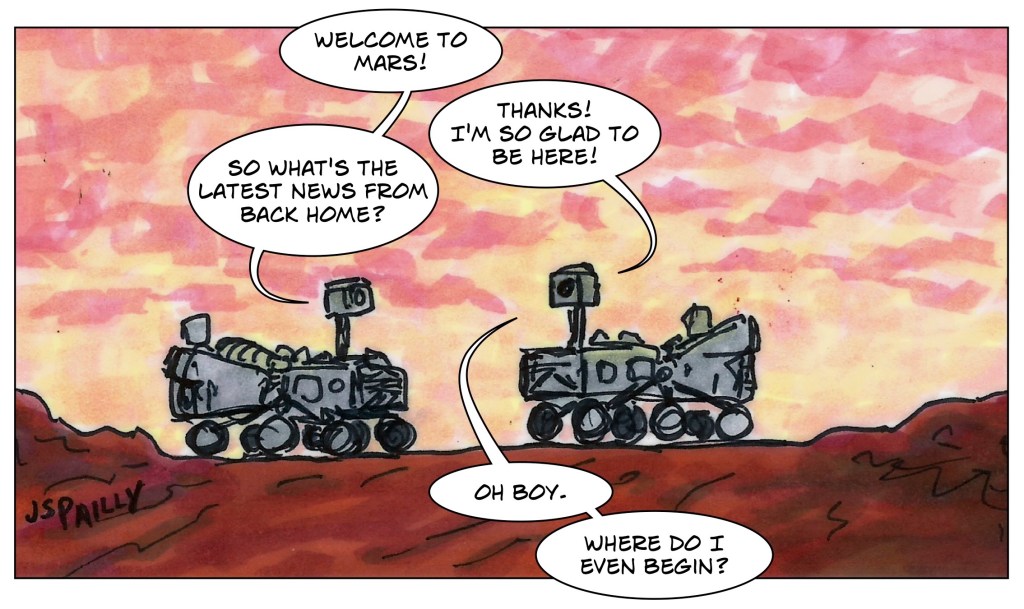
Last week, I watched NASA’s live coverage of the Perseverance rover landing on Mars.  Naturally, I had a notepad ready, and I picked up quite a few new scientific terms.  My absolute favorite—the one that brought the biggest smile to my face—was “heartbeat tone.”  I love the idea that Perseverance (a.k.a. Percy, the Mars Rover) has a heartbeat.

As this article from Planetary News describes it, Percy’s heartbeat tone is “similar to a telephone dial tone.”  It’s an ongoing signal just telling us that everything’s okay.  Nothing’s gone wrong, and everything’s still working the way it’s supposed to.

Of course, other NASA spacecraft use heartbeat tones as well.  According to two separate articles from Popular Mechanics, the Curiosity rover on Mars and the Juno space probe orbiting Jupiter also send heartbeat tones back to Earth.  And that article about Juno offers us a little bit of detail about what Juno’s heartbeat actually sounds like: a series of ten-second-long beeps, sort of like very long dashes in Morse code.

Based on my research, it seems like the earliest NASA spacecraft to use heartbeat tones (or rather, the earliest spacecraft to have this heartbeat terminology applied to it) was the New Horizons mission to Pluto, which launched in 2005.  As this article from Spaceflight 101 explains it, New Horizons’ onboard computers monitor for “heartbeat pulses” that are supposed to occur once per second.  If these pulses stop for three minutes or more, backup systems kick in, take over control of the spacecraft, and send an emergency message back to Earth.

So, I could be wrong about this, but I think this “heartbeat pulse” or “heartbeat tone” terminology started with New Horizons.  To be clear: I’m sure spacecraft were sending “all systems normal” signals back to Earth long before the New Horizons mission.  I just think the idea of using “heartbeat” as a conceptual metaphor started with New Horizons.  But again, I could be wrong about that, and if anyone has an example of the term being used prior to New Horizons, I would love to hear about it in the comments below!

P.S.: I recently wrote a post about whether or not planets have genders.  With that in mind, I was amused to note in NASA’s live coverage that everyone kept referring to Perseverance using she/her pronouns.  However, the rover has stated a preference for they/them on Twitter.  So going forward, I will respect the rover’s preferred pronouns.

Sciency Words: Safety Ellipse

Hello, friends!  Welcome to Sciency Words, a special series here on Planet Pailly where we talk about those wild and crazy words scientists use.  Today’s Sciency Word is:

SAFETY ELLIPSE

I don’t know about you, but when I’m trying to dock my shuttle pod with another spaceship, I like to take a few long, leisurely loops around that other spaceship first.  You know, like this:

Spaceships are pretty!  Who wouldn’t want to get a good look at them from every conceivable angle before completing docking maneuvers?  But it turns out that circling round and round a spaceship like this is not just for admiring the view.  It’s also for safety!  As explained in this paper:

A “safety ellipse” is an out-of-plane elliptical periodic relative motion trajectory around the primary spacecraft such that the trajectory never crosses the velocity of the primary.

That clear things up?  No?  Okay, how about a quote from this paper instead:

This paper defines a safe trajectory as an approach path that guarantees collision avoidance in the presence of a class of anomalous system behaviors.

Still confused?  Here’s a short video demonstrating what a safety ellipse (a.k.a. a safe trajectory) looks like:

Basically, if your shuttle pod experiences engine failure or any other major malfunction, flying in a safety ellipse ensures that you will not collide with the ship you were trying to dock with.  At least not for a good, long while.

I first heard about this term the other day while watching the livestream of the SpaceX Dragon capsule approaching and docking with the International Space Station.  Several times, the livestream commentators mentioned that Dragon was utilizing a “24 hour safety ellipse” or “24 hour safe trajectory,” meaning that if anything went wrong, mission control would have at least 24 hours to fix it before Dragon and the I.S.S. collided.

So remember, friends: the next time you’re going to dock with another spacecraft, do that out-of-plane elliptical periodic relative motion thing.  In other words, circle around the other ship a few times before making your final approach to dock.  It’s for safety reasons.

P.S.: It’s also for enjoying the view.  Spaceships are pretty!

Sciency Words: Orthofabric

Hello, friends!  Welcome to Sciency Words, a special series here on Planet Pailly where we explore the definitions and etymologies of scientific terms.  Today on Sciency Words, we’re talking about:

ORTHOFABRIC

If you’re planning to spend any amount of time floating around in outer space, you need to dress appropriately.  You’ll need protection against solar and cosmic radiation.  You’ll need protection against extreme temperatures, both extreme cold and extreme heat (direct sunlight in the vacuum of space can make things super hot super quick).  Oh, and there are lots of tiny micrometeoroids whizzing about up there.  You’ll need protection against those too.

Around the same time that the space shuttle program got going, NASA started using a new fabric for the outermost layer of their spacesuits.  That fabric is still used today for spacesuits aboard the International Space Station.  It’s called Orthofabric (sometimes spelled with a hyphen: Ortho-fabric).

Orthofabric is made by a company called Fabric Development Inc., based in Quakertown, PA.  Orthofabric is made using three different synthetic fibers: Gore-Tex, Nomex, and Kevlar.  As reported in several research papers (like this one or this one), Orthofabric consistently holds up well against the harsh conditions found in space.  That’s why NASA keeps using it.

For these Sciency Words posts, I think it’s important to say something about the etymology of the word we’re talking about, but I had an extremely hard time finding any sort of etymology for this one.

The prefix “ortho-” comes from a Greek word meaning righteous, virtuous, or pure (hence the word orthodox).  “Ortho-” can also mean upright or straight (hence the word orthopedic).  But what do either of those meanings have to do with Orthofabric?  The prefix “ortho-” also has a specialized meaning in chemistry, but based on my research, the chemistry sense of “ortho-” didn’t seem relevant to Orthofabric either.

So finally, I picked up the phone, called Fabric Development Inc., and asked.  I was told the name Orthofabric was chosen after some back and forth consultation with NASA.  The name doesn’t mean anything in particular.  It’s just a name.  I guess somebody thought it sounded good.  End of story.

P.S.: NASA’s new Perseverance rover will be searching for life on Mars, but as a little side experiment Perseverance is also carrying a small sample of Orthofabric, along with samples of other commonly used spacesuit materials.  NASA wants to see how well these spacesuit materials hold up in the windy and dusty Martian environment.

Sciency Words: Perseverance

Hello, friends!  Welcome back to Sciency Words, an ongoing series here on Planet Pailly where we talk about science or science-related terms.  Today on Sciency Words, we’re talking about:

PERSEVERANCE

Mars rovers are among the most advanced pieces of technology we humans have ever produced.  And by a longstanding tradition dating back to the Sojourner rover in 1997, the official names for NASA’s Mars rovers are chosen by school children.

The Perseverance rover, currently on route to Mars, was named by 7th grader Alex Mather.  He won an essay contest.  Here’s a video of Mather reading his essay, followed by a quick Q and A session with some NASA officials.

You know, after listening to Mather’s essay, I have to agree.  Perseverance is the right name for our newest Mars rover.  It’s even more right of a name now than it was back in March, when the name was announced.

Things are scary here on Earth.  So many people are suffering.  So many people are struggling.  So many lives are being needlessly lost.  But I do believe, as Mather says in his essay, that perseverance is our most important quality as a species.  In the end, humanity will persevere.

Sciency Words: Somaforming

Hello, friends, and welcome once again to Sciency Words.  Each week, we take a closer look at some new and interesting scientific term so we can expand our scientific vocabularies together.  This week’s Sciency Word is:

SOMAFORMING

I’d like to begin this post with a quote.  This comes from the 2019 Sci-Fi novella To Be Taught, If Fortunate by Becky Chambers.  As the protagonist of that book explains, we humans are a remarkably versatile species, able to adapt to pretty much any environment—or at least any environment Earth has to offer.

But take us away from our home planet, and our adaptability vanishes.  Extended spaceflight is hell on the human body.  No longer challenged by gravity, bones and muscles quickly begin to stop spending resources on maintaining mass.  The heart gets lazy in pumping blood.  The eyeball changes shape, causing vision problems and headaches.  Unpleasant as these ailments are, they pale in comparison to the onslaught of radiation that fills the seeming void.

I have rarely seen the dangers of human spaceflight so artfully or so succinctly explained as in this book.

Even before Yuri Gagarin became the first human in space, scientists knew space would be rough on the human body.  They did not know specifically what might go wrong, but they knew there would be trouble.  The obvious solution is to create an environment that is safe and comfortable for human beings.

But as early as 1960, some scientists were considering an alternative solution.  Rather than creating space environments that are suitable for human life, why not modify human life to be suitable for the environment of space?  This was the idea proposed by American research scientists Manfred Clynes and Nathan Kline in their 1960 paper “Cyborgs and Space.”

Clynes and Kline proposed some rather drastic surgical changes to the human body.  They make it sound quite easy.  Just rip out a bunch of internal organs.  Replace those organs with synthetic parts.  Pump the patient/astronaut full of drugs and use hypnosis to suppress any psychological issues that might come up during or after the process.  And now you have a human being who’s ready to go to space!  Or you have a human being who’s dead on the operating room table.  One, or the other!

Clynes and Kline introduced the word “cyborg” to describe the half-human/half-machine person they proposed to create.  What Becky Chambers describes in To Be Taught, If Fortunate sounds a little bit safer and a lot less dehumanizing.  And Chambers introduces a new term to describe the transformation her characters undergo: somaforming.  The word is created by analogy with the word terraforming, with the Greek root word “terra” (Earth) being replaced with the Greek root word “soma” (body).

As the protagonist of To Be Taught, If Fortunate explains it, human space explorers come as guests, not conquerers.  The age of colonialism is long behind us. And being good guests, we don’t want to demand too much of our hosts or cause our hosts too much trouble.  To quote Chambers’ book once more: “I have no interest in changing other worlds to suit me.  I choose the lighter touch: changing myself to suit them.”

And I think that is a wonderful sentiment!

As far as I can tell, the word somaforming has not yet been picked up by the scientific community.  But plenty of words from science fiction have been adopted by scientists.  I have a suspicion that this is going to be one of those words.

Next time on Planet Pailly: Oh no!  I made a mistake in an old blog post, and I need to issue a retraction!