Sciency Words: Stagnant Lid

Sciency Words: (proper noun) a special series here on Planet Pailly focusing on the definitions and etymologies of science or science-related terms.  Today’s Sciency Word is:

STAGNANT LID

Here on Earth, we have earthquakes.  Lots and lots of earthquakes.  And that’s very odd.

Maybe we should be thankful for all those earthquakes.  Our planet’s system of plate tectonics is unique in the Solar System.  Frequent earthquakes are a sign that Earth’s tectonic plates are still moving, that our planet is still geologically healthy.  The alternative would be stagnant lid tectonics, and that’s something we Earthlings probably don’t want.

In this 1996 paper, planetary scientists V.S. Solomatov and L.N. Moresi coined the term “stagnant lid” to describe what was happening on Venus—or rather what was not happening.  Venus doesn’t have active plate tectonics.  Maybe she did once, long ago.  If so, Venus’s plates somehow got stuck together, forming a rigid, inflexible shell.

The term stagnant lid has since been applied to almost every other planetary body in the Solar System, with the obvious exceptions of the four gas giants, and the possible exceptions of two of Jupiter’s moons: Europa and Ganymede.

According to this paper from Geoscience Frontiers, neither Europa nor Ganymede have truly Earth-like plate tectonics, but something similar may be happening.  The authors of that paper refer to the situation on Europa and Ganymede as “fragmented lid tectonics” or “ice floe tectonics.”  The upcoming Europa Clipper and JUICE missions should tell us more about how similar or different this is to Earth’s plate tectonics.

A stagnant lid does not necessarily mean that a planet or moon is geologically dead.  Venus and Io both have active volcanoes, for example, and it was recently confirmed that Mars has marsquakes.  But none of these stagnant lid worlds seem to be as lively as Earth—and I mean that in more ways than one.

If you buy into the Rare Earth Hypothesis, plate tectonics is one of those features that makes Earth so rare. Plate tectonics is something Earth has that other planets don’t, and thus it may be an important factor in why Earth can support life when so many other worlds can’t.

Meet Ariel, a Moon of Uranus

I have a friend who’s obsessed with The Little Mermaid.  So if I’m going to write a post about Ariel, one of the moons of Uranus, it would be a real shame if I couldn’t make some sort of Little Mermaid reference.

Unfortunately, we know precious little about Ariel, or any of Uranus’s moons, for that matter.  Only one spacecraft has ever visited: NASA’s Voyager 2, way back in 1986. And the data Voyager 2 sent back gives us a frustratingly incomplete picture.

What I can tell you is that Ariel’s surface is made of ice, specifically water ice and carbon dioxide ice.  One hemisphere appears to have more carbon dioxide than the other, according to this paper from Icarus.  And according to this profile piece from NASA, Ariel is the shiniest of Uranus’s moons–it reflects more sunlight than the others.  Oh, and Ariel’s surface appears to be younger than the surfaces of those other moons as well.  That might be important!

In fact, according to this article from Scientific American:

[The Voyagers 2] flyby revealed Ariel to be relatively smooth, as if its surface was being continually renewed by activity deep within.  It is currently believed to be the only ocean world in the Uranian system.

A word of caution: that Scientific American article says a lot of highly speculative, highly conjectural stuff. Take it with a grain of sodium chloride.

However, in the absence of better, more detailed information about Uranus and its moons, it sounds like Ariel could maybe possibly be Uranus’s version of Europa or Enceladus.  It could possibly be a moon with an icy crust floating atop an ocean of liquid water.  It might even be the kind of environment that could support life.  There might even be….

But no, I shouldn’t make a claim like that.  It would be irresponsible of me as a science blogger.  Voyager 2’s data was too limited, and subsequent observations by Hubble or other Earth-based telescopes can only tell us so much.  Until our next mission to Uranus (whenever that might be), we really can’t say what might be hiding beneath the icy crust of Ariel.

Sciency Words: The Torino Scale

Sciency Words: (proper noun) a special series here on Planet Pailly focusing on the definitions and etymologies of science or science-related terms.  Today’s Sciency Word is:

THE TORINO SCALE

Are you worried about an asteroid or comet smashing into Earth and annihilating human civilization?  Well, you should be worried about that a little bit.  But only a little bit.  Let me tell you about the Torino Scale, and while that won’t put all your fears to rest, it may help put things in perspective.

In the late 1990’s, M.I.T. Professor Richard Binzel came up with a system which he initially called the Near Earth Object Hazard Index.  In 1999, Binzel presented his system to a conference on Near Earth Objects (N.E.O.s) in Torino, Italy.

People at that conference loved Binzel’s idea and voted that the system should be adopted by the scientific community at large. They also voted to rename Binzel’s system the Torino Scale.

The Torino Scale asks two questions about any given N.E.O.: how likely is it to hit us, and how much destructive energy would be released if it did?  Taking those two factors into consideration, the Torino Scale then produces a score between zero and ten.  Zero means we have nothing to worry about.  Ten means “WE’RE ALL GONNA DIE!!!  AAAHHHHHH!!!” as the experts would say.

According to Wikipedia, the comet that caused the Tunguska Event would have probably scored an eight, and the asteroid that caused the K-T Event (the event widely believed to have killed off the dinosaurs) would have scored a ten.  Wikipedia also tells me that the 2013 Chelyabinsk meteor would have scored a zero, because while that particular N.E.O. was definitely on a collision course with Earth, it’s destructive energy was relatively low (I wonder if the residents of Chelyabinsk, Russia, agree with that assessment).

As of this writing, there are no known N.E.O.s that score higher than zero on the Torino Scale, as least not according to this website from NASA’s Jet Propulsion Laboratory.  It is possible for an N.E.O.’s threat level to change as we learn more about it.  As explained in this article from NASA:

The change will result from improved measurements of the object’s orbit showing, most likely in all cases, that the object will indeed miss the Earth. Thus, the most likely outcome for a newly discovered object is that it will ultimately be re-assigned to category zero.

Sooner or later, another eight, nine, or ten on the Torino Scale will come along.  Fives, sixes, and sevens could also be bad news for us.  But for now, at least within the next one hundred years, it sounds like we probably don’t have too much to worry about.

Probably.

Sciency Words: The Rio Scale

Sciency Words: (proper noun) a special series here on Planet Pailly focusing on the definitions and etymologies of science or science-related terms.  Today’s Sciency Word is:

THE RIO SCALE

The Rio Scale is a classification system used by SETI scientists.  Let’s say someone’s detected possible evidence of an alien intelligence.  How significant is this discovery?  How seriously should we take that news?  The Rio Scale is a tool to help answer those questions.

The Rio Scale was created in the year 2000 at the International Astronomical Congress, which was held that year in Rio de Janerio. Mathematically speaking, the Rio Scale is expressed as:

(Q1 + Q2 + Q3) * ∂

You have to look through a chart in order to plug numbers into those variables.  I’m not going to reproduce that whole chart here, but if you’re interested here’s a Rio Scale calculator where you can learn more.

The quick version is that Q1 is the “what” of what we’ve discovered.  Q2 represents how we discovered it, and Q3 represents how far away from Earth it is.  So as an example, let’s say aliens are transmitting a message straight at Earth.  Let’s say the message was detected by a radio telescope and confirmed by subsequent SETI observations.  And let’s say the message is coming from Proxima Centauri, the star nearest to our own Sun.  This scenario would score very well on the Rio Scale.

As another example, let’s say we find some anomalous infrared radiation, the possible heat signature of an alien megastructure. Let’s say this was found in archival data from the 1970’s.  And let’s say this anomalous radiation came from the Triangulum Galaxy. This scenario would score rather poorly on the Rio Scale.

Lastly, before I forget, let’s talk about ∂.  That variable is a credibility factor. If information about a possible extraterrestrial signal is presented in a peer-reviewed scientific journal, ∂ will be a fairly high number.  If it’s just a press release, ∂ will be lower.  And if the information is coming from some weirdo on the Internet, ∂ equals zero.

Given the chance, I’m sure SETI scientists would like to follow up on every possible detection of extraterrestrial intelligence.  But SETI research does not have infinite resources.

In my opinion, the Rio Scale doesn’t sound like the most scientifically objective system; however, I imagine it does help when comparing and contrasting different possible discoveries.  That way, given the limited resources available to them, SETI scientists can better judge which detections are worth further investigation and which can probably be ignored.

A Mars Meteorite by Any Other Name

You remember that meteorite from Mars?  The one that purportedly had fossilized Martian microorganisms inside it? The controversy over that meteorite has never been fully settled.  And now, it’s not just one meteorite.  Now there are two of them.

That original meteorite was named ALH-84001. Names are important.  You can learn a lot simply by understanding where a name came from.  The name ALH-84001 tells us a bit about this particular meteorite’s history. It was found in the Allan Hills region of Antarctica (ALH) during a 1984 scientific expedition (84), and it was the first meteorite found by that expedition (001).

This new meteorite is named ALH-77005, so right there you know some important things about it.  It was found in the same region of Antarctica, a few years before ALH-84001. And like ALH-84001, ALH-77005 sat in storage for a while before anyone got around to examining it.  In fact, it sounds like ALH-77005 has been sitting in storage for a whole lot longer than ALH-84001 did.

When I first heard about ALH-77005 and the surprises that were found inside it, my initial reaction was enthusiastic.  Surely this would bolster the Martian fossil hypothesis for ALH-84001, I thought.  But after some of the research and having some time to think, I don’t think this new evidence actually changes anything.

It’s still possible that something happened to ALH-84001 once it landed here on Earth.  For example, maybe Earthly microorganisms somehow wormed their way inside the rock.  If so, the exact same thing may have happened to ALH-77005.  So have we found new evidence of life on Mars, or new evidence of life in Allan Hills?  There’s still no way to tell for sure.

But it does make you wonder: how many more meteorites are just sitting in storage, waiting to be opened up?

Sciency Words: Euphotic Zones

Sciency Words: (proper noun) a special series here on Planet Pailly focusing on the definitions and etymologies of science or science-related terms.  Today’s Sciency Word is:

EUPHOTIC ZONES

Based on what Google ngrams has to tell me, it looks like “euphotic” and “euphotic zone” entered the English lexicon right at the start of the 20th Century, then really caught on circa 1940.

The word euphotic is a combination of Greek words and means something like “good lighting” or “well lit.”  In the field of marine biology, the euphotic zone refers to the topmost layer of the ocean, or any body of water, where there’s still enough sunlight for photosynthesis to occur.

My first encounter with this term was in this paper by astrophysicists Carl Sagan and Edwin Salpeter.  Sagan and Salpeter sort of co-opted this term from marine biologists and applied it to the layer of Jupiter’s atmosphere where—hypothetically speaking—Jupiterian life might exist.

I don’t see any reason why the term could not also by used for other planets as well.  There’s a euphotic zone just above the cloud tops of Venus.  The same could be said about Saturn or Uranus.  Or maybe if the ice is thin enough, we may find euphotic zones right beneath the surfaces of Europa or Enceladus.

Of course just because a planet has a euphotic zone, that doesn’t mean photosynthetic organisms are living there.  And also there are plenty of ecosystems here on Earth that do not depend on photosynthesis and that don’t exist anywhere near a euphotic zone.

Still, I’m very glad to have picked up this term.  The concept of euphotic zones can be very helpful in any discussion of where alien life may or may not be hiding.

Meet Miranda, a Moon of Uranus

Miranda has been called the Frankenstein’s monster of the Solar System.  There’s just such a jumbled mismatch of landscapes.  You’d almost believe a mad scientist took pieces of several different moons and stitched them together.

Apparently this is a result of sporadic global resurfacing events.  At least that’s the conclusion of this 2014 paper entitled “Global Resurfacing of Uranus’s Moon Miranda by Convection.”  Due to a paywall, I haven’t been able to read that paper in full, but the research is summarized in articles here, here, and here.

Apparently Miranda used to have a more eccentric (non-circular) orbit than she does today.  Thus, the gravitational pull of Uranus would sometimes be stronger, sometimes weaker, causing Miranda to repeatedly compress and relax.  Imagine Uranus using Miranda like a stress ball and you’ll get a sense of what Miranda must’ve felt like.

All that squeezing and unsqueezing created friction and heat in Miranda’s interior.  Miranda’s internal ices got melty.  Convection cells formed underground, much like they do here on Earth, and some sort of tectonic and/or volcanic activity got started on the surface.

Something similar happens on Europa, a moon of Jupiter. As a result, Europa has the smoothest, youngest-looking surface in the whole Solar System.  So how did Europa turn out looking so beautifully smooth while Miranda turned into Frankenstein’s moon?

Based on what I’ve read, it sounds like Miranda’s orbit changed.  Uranus stopped squeezing Miranda like a stress ball, Miranda’s interior cooled off, and the resurfacing process came to a halt.  What we see today is a moon that is only half transformed by global resurfacing.

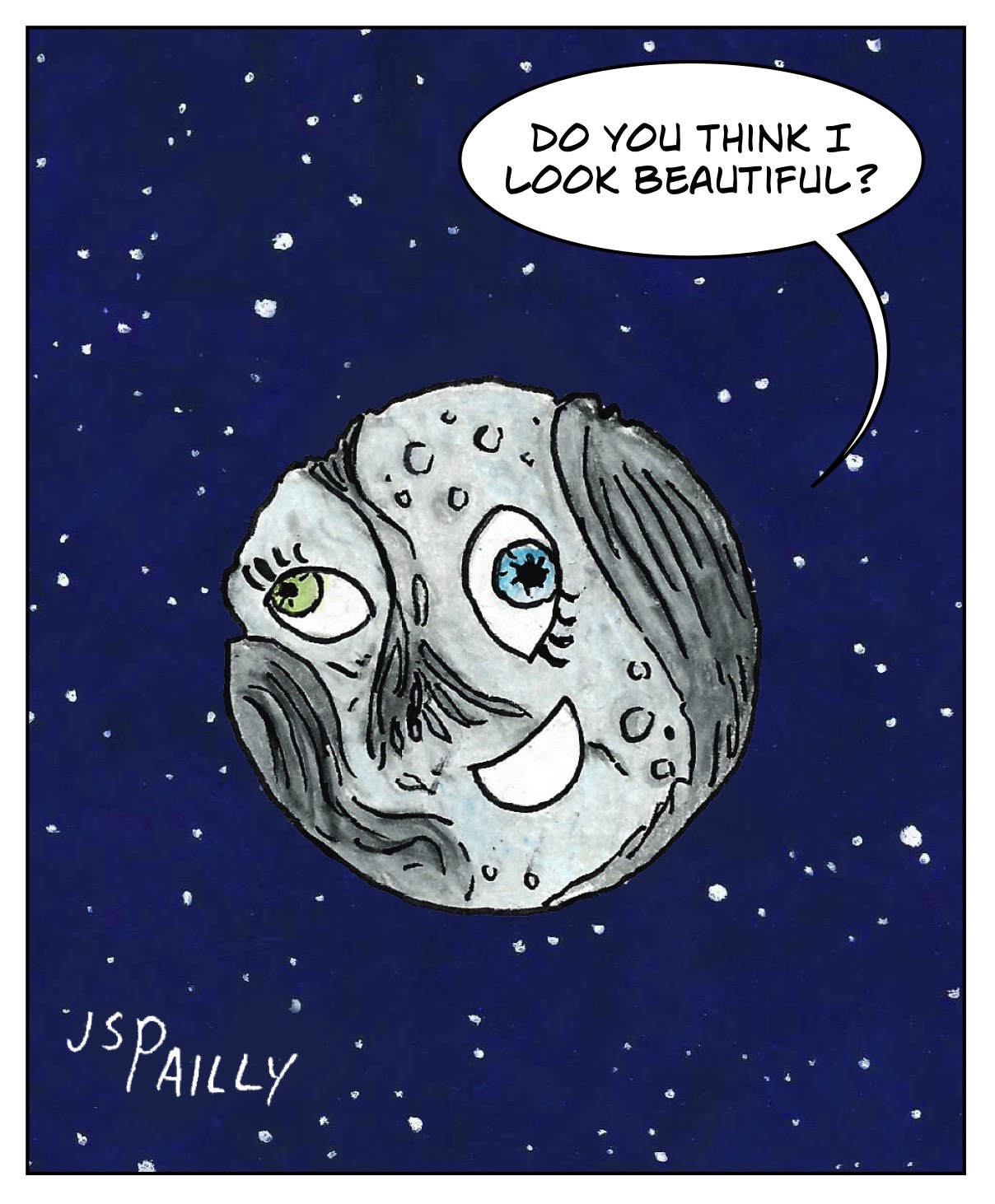
Personally, after studying reference photos of Miranda, learning about what happened to her, and drawing her portrait myself, I no longer feel comfortable with the whole Frankenstein’s monster thing.

I’d like to suggest a new metaphor: Miranda is the Picasso painting of the Solar System. Miranda does have a weird mishmash of surface features that don’t make a lot of sense together (much like a Picasso painting), but that doesn’t make Miranda monstrous.  It gives her her own strange, confusing beauty.

So yes, Miranda, to answer your question: I do think you’re beautiful.

Is This the End of the Great Red Spot?

I have sad news.  Right now, we may be witnessing the final death throes of Jupiter’s Great Red Spot.

For those of you who may not know, the Great Red Spot is an enormous storm that’s been raging on Jupiter for centuries.  It was visible to the telescope as far back as Galileo’s time, and it’s surely been around much longer than that.

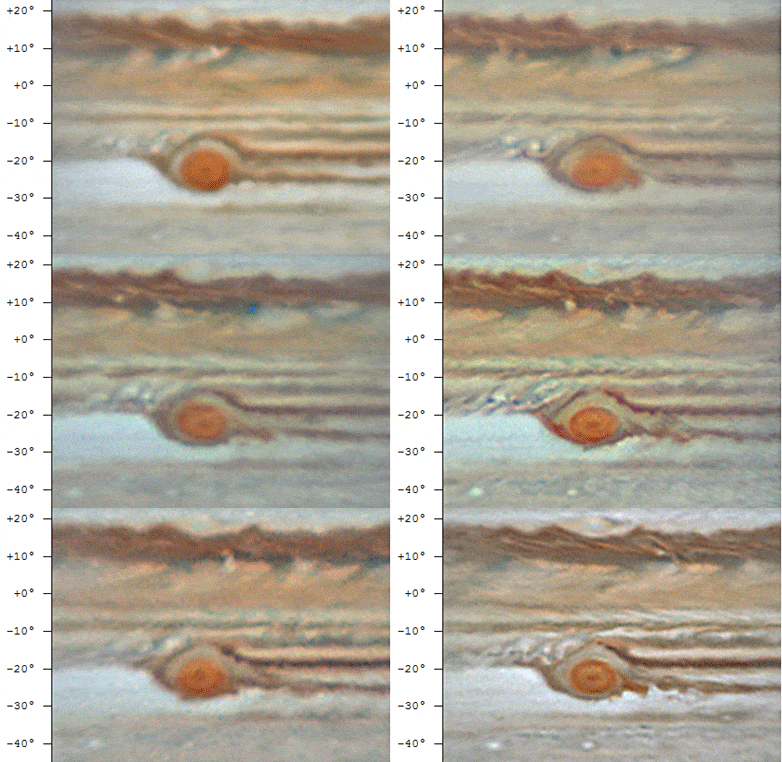
But over the last few decades, the notorious G.R.S. has been slowly shrinking.  Recently, the rate of shrinkage has accelerated.  According to spaceweather.com, the storm is 20% smaller than it was a month ago.  In the time lapse animation below, you can actually see giant blobs of red break free of the Great Red Spot and then disperse into Jupiter’s atmosphere.

Courtesy: spaceweather.com

Has the Great Red Spot suddenly reached a point where it can no longer sustain itself?  Or will the storm resurge and start to grow once more?  I don’t know.  At this point, I don’t think anyone knows.

But I would like to take this opportunity to pontificate a little on the value of space exploration.  Space exploration is expensive, and to many people it seems like a colossal waste of money.  Shouldn’t we be spending all that money trying to solve the problems we have here on Earth?

The thing is space exploration does help us solve our problems here on Earth.  Our ability to compare and contrast Earth with other planets has taught us so much!  Even Jupiter—about as un-Earth-like a planet as there can be—has added to our knowledge of how weather patterns form, sustain themselves, and change over time.

Whatever is happening to the Great Red Spot, this is an opportunity for us to learn.  I have no idea what we’re going to learn, but we’re going to learn something.  We’re going to know a little more about storms in general, which will help us refine our models about storms on Earth in particular.

Weather forecasts will improve.  Maybe we’ll be a little better at predicting hurricanes, and that, in turn, will save lives. All thanks to the space program and the Great Red Spot.

Sciency Words: Sinkers, Floaters, and Hunters

Sciency Words: (proper noun) a special series here on Planet Pailly focusing on the definitions and etymologies of science or science-related terms.  Today’s Sciency Word is:

SINKERS, FLOATERS, and HUNTERS

In the 1970’s, Carl Sagan and fellow astrophysicist Edwin Salpeter were curious about the orangey-red coloration seen on certain parts of Jupiter.  That sort of orangey-red color is frequently associated with organic chemistry (see my post on tholin).

So in this 1976 technical report for NASA, Sagan and Salpeter hypothesize that we really are seeing organic compounds in Jupiter’s atmosphere.  They then go on to imagine what kind of life might develop on a planet like Jupiter.  As a frame of reference, they start by describing one specific example of life here on Earth:

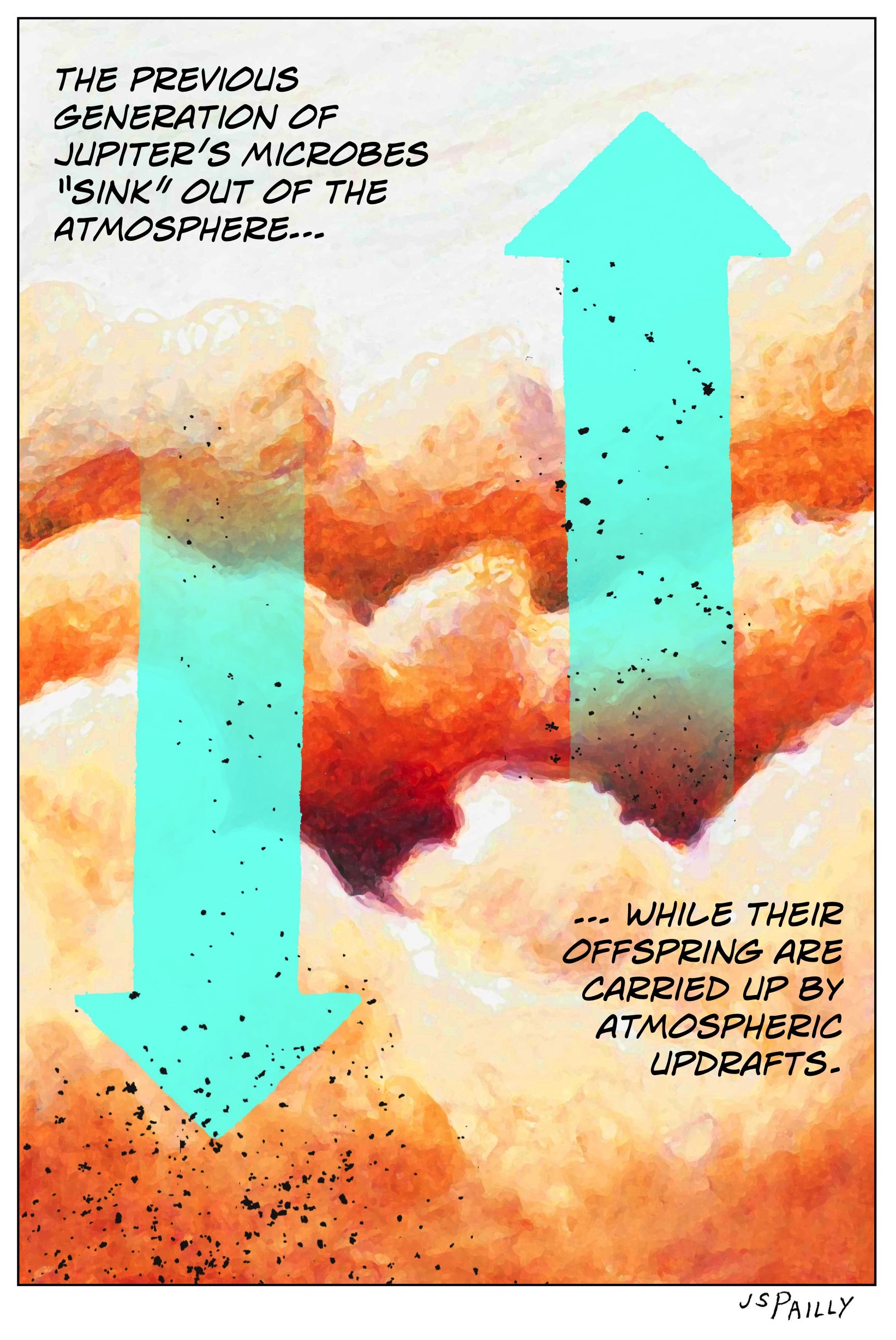
The best analogy seems to be the surface of the sea.  Oceanic phytoplankton inhabit a euphotic zone near the ocean surface where photosynthesis is possible.  They are slightly denser than seawater and passively sink out of the euphotic zone and die.  But such organisms reproduce as they sink, return some daughter cells to the euphotic zone through turbulent mixing, and in this way maintain a steady state population.

So if microorganisms exist on Jupiter, perhaps they follow a similar lifecycle.

Sagan and Salpeter name these hypothetical microorganisms “sinkers,” since sinking is pretty much the defining characteristic of their lifecycles.  But if these sinkers really do exist, then Jupiter may be able to support other, more complex forms of life as well.

Sagan and Salpeter go on to describe “floaters.” Floaters would be giant organisms, perhaps several kilometers in radius.  In order to remain buoyant, they’d have to have very thin skin and be filled with a lifting gas like hydrogen.  Floaters would drift aimlessly through the skies of Jupiter, feeding on the rising and falling swarms of sinkers.

And then there would be “hunters,” as Sagan and Salpeter call them, though that term may be misleading.  Hunters would be able to maneuver deliberately through the air, “hunting” for other organisms.  But these hunters would not eat their prey, at least not in the way we understand eating.  Instead, through a process called “coalescence,” the hunter and the hunted would merge together as one giant super-organism.

Personally, I think Sagan and Salpeter let their imaginations run a little too wild in this paper.  Could life exist on Jupiter?  Sure.  The universe is full of possibilities.  Can we predict with any specificity what life on Jupiter would be like?  I doubt it.

Still, the Jovian ecosystem that Sagan and Salpeter described seems plausible enough.  For the purposes of science fiction, it deserves some attention, and it inspired the short story I posted on Monday.  However, if you haven’t read that story yet, I have to confess (spoiler warning): it turns out the planet in that story is not Jupiter.

Sciency Words: Ice

Sciency Words: (proper noun) a special series here on Planet Pailly focusing on the definitions and etymologies of science or science-related terms.  Today’s Sciency Word is:

ICE

I have a friend who teases me whenever I use the word ice. This is because, depending on what we’re talking about, I can’t just say “ice.”  As soon as the conversation turns to space stuff (as it often does when I’m around, for some reason), I feel the need to say “water ice.” I feel the need—no, the compulsion to specify that I mean the frozen form of water, as opposed to the frozen form of something else.

In more normal, down-to-earth sorts of conversation, I don’t feel that same compulsion.  Water ice is the only kind of ice we’re likely to encounter here on Earth. On rare occasions, if you’re at a science fair, or maybe a Halloween party, you might encounter carbon dioxide ice (a.k.a. dry ice).  But that’s a very rare special case.

However, as soon as we start talking about other planets and moons, or comets and asteroids, the word ice takes on a much broader meaning. In these more cosmic conversations, you really do need to be specific about which ice you’re talking about. To quote from a recent issue of The Planetary Report:

In the strictest definition, ice is the solid form of water.  However, planetary astronomers often use “ice” to refer to the solid form of any condensable molecule.

Beyond Earth, and especially in the outer Solar System, we find all sorts of crazy ices, like ammonia ice, methane ice, or nitrogen ice.  Along with the water ice and CO2 ice we Earthlings are more familiar with, these ices make up the hard crusts of many planetary bodies, like Titan or Pluto.

We also find ice crystals (of various types) forming in the clouds of planets like Uranus and Neptune.  In fact, Uranus and Neptune are often called “ice giants” in large part because of all those weird ices found in their atmospheres.

Starting next week, I’m planning to take a much closer look at those ice giant planets.  I expect my research to turn up plenty of questions, but very few answers.  Uranus and Neptune are, at this point, the least well explored planets in the Solar System.

So stay tuned!

P.S.: I want to start referring to all forms of igneous rock as “magma ice.”  After all, what is igneous rock but frozen magma?  I can’t think of any good reason why the term “magma ice” shouldn’t apply.