Sciency Words: Bunny Hopping

Sciency Words: (proper noun) a special series here on Planet Pailly focusing on the definitions and etymologies of science or science-related terms.  Today’s Sciency Word is:

BUNNY HOPPING

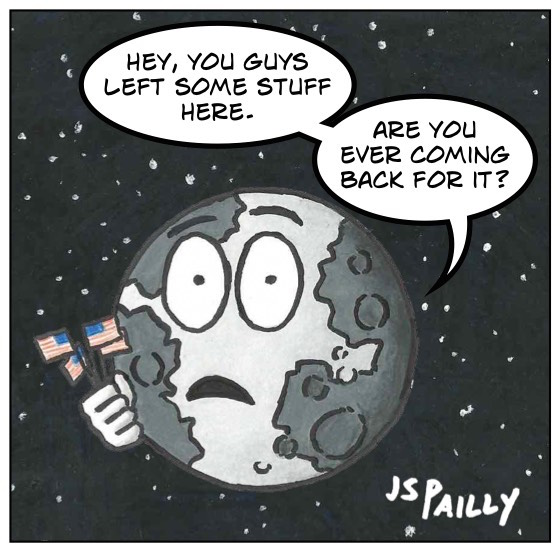
So yesterday I was reading up on the latest spacesuit design from NASA, and I came across a term that I don’t remember ever seeing or hearing before.  In this article from Space Daily, NASA Administrator Jim Bridenstine is quoted as saying: “If we remember the Apollo generation, we remember Neil Armstrong and Buzz Aldrin, they bunny hopped on the surface of the Moon.”

This left me wondering: do people really use the term “bunny hopping” to describe how Apollo astronauts moved about on the Moon?  I tried really hard to trace the etymology of this term.  I didn’t find much, but honestly, when you see clips like this one, it’s easy to figure out where the term came from.

In my previous research on this topic, I’ve seen this method of locomotion referred to as “loping-mode” or “skipping-mode.”  But sure, we can call it “bunny hopping” too.  So why did astronauts do this?

Well, there’s something about walking that most of us, in our daily lives, don’t realize: Earth’s gravity does some of the work for us.  When you take a step, first you lift your foot off the ground, then you extend your leg, and then… well, try to stop yourself at this point.  With your leg extended forward like that, you’ll find that your center of gravity has shifted, and you can feel the force of gravity trying to pull you through the remainder of your walk cycle.

So walking feels like a natural and efficient way for us humans to get around because Earth’s gravity helps us.  Take Earth’s gravity away, and walking suddenly feels awkward and cumbersome.  In lunar gravity, which is approximately ⅙ of Earth’s gravity, the Apollo astronauts found other methods of locomotion to be more comfortable, more natural.  In this clip, we hear audio chatter of astronauts disagreeing about whether “hopping” or “loping” is a better way to get around.

Personal preference seems to be important here, both in how astronauts “walked” on the Moon and in how they described the experience of this new kind of “walking.”

Getting back to the new spacesuits from NASA, the new design features a dramatically improved range of motion.  The next astronauts on the Moon will have a much easier time getting around, and according to Administrator Bridenstine there will be no need for bunny hopping.  “Now we’re going to be able to walk on the surface of the Moon, which is very different from the suits of the past.”

And that’s got me confused.  I’m really not sure what Bridenstine means by that statement because, as I just explained, it was the Moon’s gravity—more so than the spacesuits—that made Apollo era astronauts feel the need to “bunny hop” on the Moon.  The new spacesuits, with their improved range of motion, should help astronauts in the new Artemis program avoid gaffs like these…

But without altering the Moon’s gravity, I don’t see any way to avoid “bunny hopping.”
Sciency Words: Plasma Torus

Sciency Words: (proper noun) a special series here on Planet Pailly focusing on the definitions and etymologies of science or science-related terms.  Today’s Sciency Word is:

PLASMA TORUS

Astronomers have discovered thousands of planets out there.  Exoplanet hunting techniques have gotten so good that astronmers are now moving on to the next great challenge: finding exomoons.  And one possible method for detecting exomoons involves something called a plasma torus.

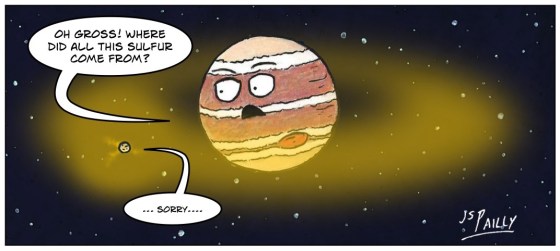
Ever since the 1960’s, we’ve known something weird was happening with Io, one of the moons of Jupiter.  In 1964, an astronomer by the name of E.K. Bigg determined that Io had some strange power over Jupiter’s magnetosphere.  Subsequent research identified clouds of ionized sulfur and sodium in the vicinity of Io’s orbit.  Then in 1979, NASA’s Voyager 1 space probe photographed Io up close, catching Io in the act of spewing a mix of sulfur compounds and other noxious chemicals into space.

We now know that Io is the most volcanically active object in the Solar System and that Io’s volcanic activity directly affects Jupiter’s magnetic field.  As you can see in this totally legit Hubble image, Io has created a nasty mess around Jupiter.

All those nasty chemicals get swept up in Jupiter’s powerful magnetic field, which acts like a supersized particle accelerator, turning those chemicals into a high-energy plasma.

I can’t be sure who coined the term plasma torus, but a multitude of papers from the 1960’s and 70’s (like this one, or this one, or this one) attempt to model the plasma clouds surrounding Jupiter as a torus—torus being the fancy mathematical term for “donut-shape.”

The nifty thing about Io’s plasma torus is that you can detect it even from a great distance.  Even if you’re too far away to observe Io directly, you can still infer that she’s there based on all those ionized chemicals swirling around Jupiter and the effect those chemicals have on Jupiter’s magnetic field.

So could we find volcanically active exomoons by looking for plasma tori?  According to this paper from The Astrophysical Journal, we sure can—and maybe we already have!  The paper identifies the signatures of possible plasma tori encircling several large exoplanets.

One thing I’m not sure about: when we find a plasma torus, can we be 100% certain it’s caused by an exomoon?  Are there any other natural (or unnatural) phenomena that might cause a plasma torus to form?  I don’t know.

P.S.: Safety warning to any space adventurers who might be reading this.  A plasma torus is a high radiation environment.  Keep your distance!

LIGO: The Next Generation

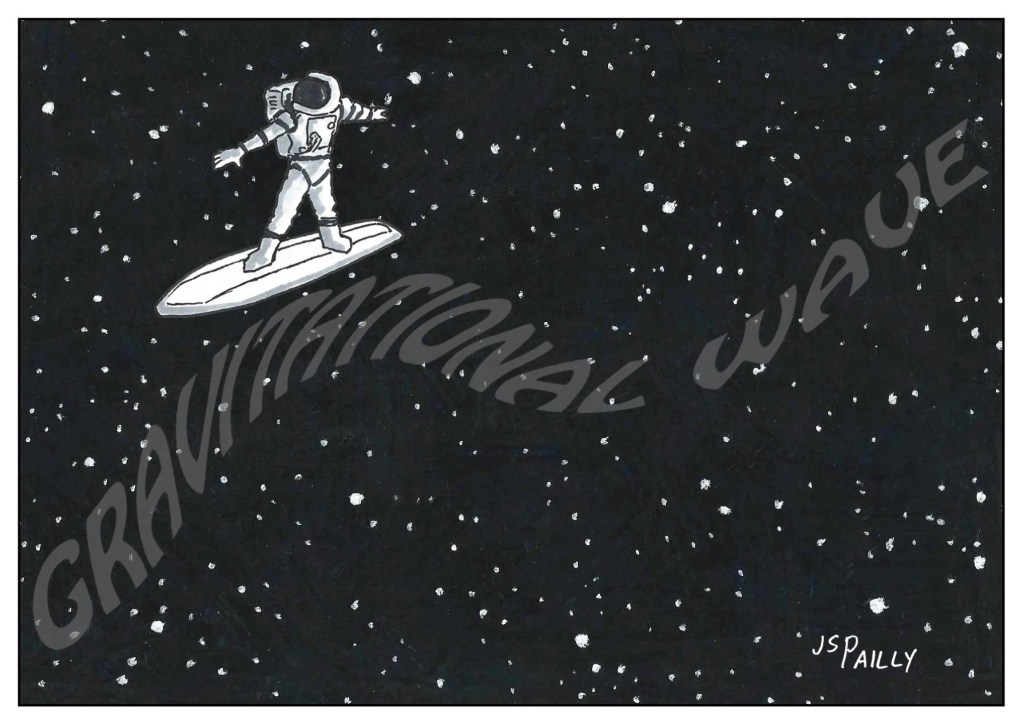
As everyone knows, I’m a total surfer dude.  So after all my recent blog posts about the LIGO project (click here, here, or here), I’ve been wondering: could I “hang ten” on a gravitational wave?

There’s still a lot we don’t know about gravitational waves.  LIGO—the Laser Interferometer Gravitational-wave Observatory—is one of the most delicately sensitive scientific instruments ever built.  But as sensitive as LIGO is, it’s still not sensitive enough.  The next generation of gravitational wave detectors promises to do better.

  • Cosmic Explorer: The United States wants to build a bigger LIGO.  Cosmic Explorer will use the same L-shaped interferometer design as LIGO, only ten times bigger.  This will increase the signal amplitude without adding to the amount of background noise the detector picks up, according to the Cosmic Explorer website.  Click here to learn more.
  • Einstein Telescope: Meanwhile the Europeans are planning to build a gravitational wave detector underground.  The Einstein Telescope, as the project is named, will incorporate not one but two laser interferometers, arranged in a triangular pattern.  One of these interferometers will pick up low frequency gravitational waves; the other will pick up waves of higher frequencies.  Click here to learn more.
  • LISA: And lastly, NASA wants to put a gravitational wave detector in space.  The project is called LISA, which stands for Laser Interferometer Space Antenna.  LISA will consist of three small spacecraft beaming lasers at each other, forming a giant equilateral triangle.  Size really does matter when it comes to gravitational wave detectors, and this space laser triangle will be far, far larger than anything we could have built here on the ground.  Click here to learn more.

Some of the questions these next generation gravitational wave detectors could help us answer: How many black holes are there in the universe?  What’s going on inside neutron stars?  What about pulsars or magnetars?  Are there gravitational waves associated with the cosmic microwave background?  Are there gravitational waves associated with dark matter?  Are any gravitational waves coming from unexpected or unknown sources?

So much science will be gained from these projects!  However, I’m not sure if Cosmic Explorer, the Einstein Telescope, or LISA will be able to answer the question I asked at the beginning of this post.  Total bummer!

Disclaimer: I’m not really a surfer dude.  Actually, I’m terrified of the ocean and I’ve never even learned how to swim.

Sciency Words: Kilonova

Sciency Words: (proper noun) a special series here on Planet Pailly focusing on the definitions and etymologies of science or science-related terms.  Today’s Sciency Word is:

KILONOVA

In a recent presentation at Princeton University, Dr. Beverly Berger—an astrophysicist from LIGO—used a very interesting term.  Imagine a pair of neutron stars orbiting each other, spiraling closer and closer together, until suddenly “they go splat!” as Dr. Berger enthusiastically described it.

The more official-sounding term for this is kilonova, Dr. Berger then explained.  The term kilonova originates from this 2010 paper, which predicted that the merger of either two neutron stars or a neutron star and a black hole would produce a very bright flash of light.

The authors of that paper calculated that, at peek luminosity, this flash of light would be approximately a thousand times brighter than a nova explosion—hence “kilonova.”  (In case you’re wondering, a kilonova is still not as bright as a supernova—a supernova is “as much as 100 times brighter than a kilonova” according to this article from NASA.)

Of course the LIGO project is designed to detect gravitational waves, not bright flashes of light.  But as you can see in the highly technical diagram below, a kilonova is accompanied by subtle ripples in the fabric of space-time—gravitational waves, in other words.

In August of 2017, the LIGO project detected exactly the kinds of ripples that would indicate two neutron stars had “gone splat.”  As this article from the LIGO website explains, alerts were “sent out to the astronomical community, sparking a follow-up campaign that resulted in many detections of the fading light from the event, located near the galaxy NGC 4993.”

One thing I’m still not clear about: what happens after a kilonova?  It seems the scientists at LIGO are wondering about that too.  According to that same article from the LIGO website, the 2017 kilonova produced either the largest neutron star that we’ve ever observed OR the smallest black hole.  “Both possibilities are tantalizing and fascinating,” the article says, “but our data simply isn’t good enough to tell us one way or the other.”

Fortunately there are a few projects in development that might help us understand kilonovae—and similar cosmic cataclysms—a little bit better.  We’ll take a look at some of those upcoming projects in Monday’s post.

That Time the Galaxy Ripped Itself Apart

Do you remember that time back in 1969 when the entire galaxy ripped itself apart?  No?  Me neither.

Last week, I had the opportunity to attend a physics seminar at Princeton University.  The presenter was Dr. Beverly Berger of LIGO.  She was there to tell us all about the discovery of gravitational waves.

Part of Dr. Berger’s presentation was historical.  There were attempts to detect gravitational waves before the LIGO experiment.  The first such attempt was conducted by Joseph Weber of the University of Maryland.  Weber’s idea was that gravitational waves would cause solid objects to expand and contract ever so slightly.  This expansion and contraction would produce friction and thus heat.

In principle, this change in temperature could be measured.  So Weber constructed a giant metal cylinder to serve as a gravitational wave detector (click here to see a picture of it).  And in 1969, Weber detected his first gravitational wave!  Or at least he thought he did. There was a tiny pulse in his data which, as Dr. Berger described it in her presentation, indicated that gravitational waves were emanating from the center of our galaxy!

Except no one was able to confirm Weber’s findings, and the discovery was widely discredited as a result.  But of course we now know, thanks to LIGO, that gravitational waves do exist.  We also know (or at least we strongly suspect) that there is a supermassive black hole in the center of our galaxy, right where Weber’s gravitational waves supposedly came from.

Given all that we now know, I think it’s fair to ask if Joseph Weber might have detected gravitational waves after all.  Someone in the auditorium did, in fact, ask that question.  But no, it’s absolutely impossible.  Weber’s instruments simply weren’t sensitive enough.

According to Dr. Berger, the only way Weber’s gravitational wave detector would have detected gravitational waves is if the entire galaxy had suddenly ripped itself apart.  Obviously that didn’t happen. The galaxy is still here. [citation needed]

P.S.: I’ve had the pleasure of meeting Dr. Beverly Berger several times now.  It’s sort of a friend of a friend situation.  Anyway, Dr. Berger has very kindly introduced me to a new scientific term.  I’ll have that for you in Friday’s episode of Sciency Words!

Sciency Words: Gravity Waves vs. Gravitational Waves

A few years back, I made a bit of a fool of myself in front of a professional physicist from LIGO.  You see, I kind of have a reputation, both online and in real life.  I’m the Sciency Words guy.  I’m the guy who knows stuff about scientific terminology.

So it’s pretty embarrassing when I get my scientific terms mixed up!  For today’s episode of Sciency Words, I’d like to share with you the two terms I got confused about so that the next time you meet a physicist from LIGO, you won’t make my mistake.

GRAVITY WAVES

Gravity waves have to do with fluid dynamics: the movement of liquids and gases.  As an example, imagine an air mass being blown up and over a mountain range. Once over the mountains, that air mass will start to fall downwards again due to the force of gravity.

But of course air masses don’t sink straight down like lead weights.  Air has a lot of buoyancy, so that air mass will bob up and down for a while until it settles into a stable equilibrium.  This bobbing up and down motion will produce ripples in the atmosphere, and those ripples are called gravity waves.

Gravity waves have been observed both in Earth’s atmosphere and Earth’s oceans.  They’ve been observed on other planets as well.  Basically any time part of a liquid or gaseous medium is forced upwards, you can expect gravity to pull it back down again, producing gravity waves.

GRAVITATIONAL WAVES

Gravitational waves have to do with Einstein’s theory of general relativity.  As an example, imagine two black holes spinning rapidly around each other. Even if you’re watching this from a safe distance, you might notice the combined gravitational attraction of those black holes grows stronger and weaker in a regular, oscillating pattern.

Well, actually you probably won’t notice that.  Even in the most extreme circumstances, those oscillations in gravity are barely detectable.  But they do happen.  The LIGO Project confirmed that in 2015 (the news wasn’t announced until 2016).

French theoretical physicist Henri Poincaré gets credit for coining the term gravitational waves (ondes gravifiques in French).  He first wrote about them in 1905, around the same time Einstein was formulating his theory of special relativity.  I’m not sure who coined the term gravity wave, but English mathematician George Biddle Airy was the first to mathematically describe gravity waves in 1841.

My mistake was asking a physicist who studies gravitational waves for LIGO a question about gravity waves in the atmosphere of Titan.  I mean, it’s an understandable mistake, getting these two terms confused—unless you’ve been introduced as an expert on scientific terminology!!!  Then it’s super embarrassing!!!

P.S.: As it so happens, I got the chance to meet up with that same LIGO physicist once again this week.  She was giving a presentation at Princeton University.  Don’t worry.  I didn’t embarrass myself too much this time.  I’ll tell you more in Monday’s post!

Will the Moon Become a Ploonet?

You may have heard that the Moon is slowly moving away from the Earth.  Following up on last week’s episode of Sciency Words, does this mean the Moon will one day become a ploonet: a moon that’s escaped its original orbit and become a planet in its own right?

Currently, the Moon is receding from the Earth at a rate of approximately 4 centimeters per year.  Simultaneously, and not by coincidence, Earth’s rotation rate is slowing down.  The exact reasons for this are, I admit, too math-heavy for my artistic/writerly brain to comprehend, but it has something to do with tidal forces and the exchange of angular momentum.

As explained in this article from Universe Today:

The same tidal forces that cause tides on Earth are slowing down Earth’s rotation bit by bit.  And the Moon is continuing to drift away a few centimeters a year to compensate.

And as further explained in this article from Futurism:

As is true of many rocky relationships, the Earth and Moon only need a bit of time and space to work things out.  Ultimately, we just need to be patient.  In about 50 billion years, the Moon will stop moving away from us and settle into a nice, stable orbit.

So in the very, very, very distant future, assuming the expansion of the Sun doesn’t destroy us first, Earth and the Moon will achieve a new balance.  Earth’s day will be considerably longer, and the Moon will be considerably farther away.  Also, just as the same side of the Moon always faces the Earth, the same side of Earth will always face the Moon.

But the Moon will still be a moon.  It will not become a ploonet.

Sciency Words: Ploonets

Sciency Words: (proper noun) a special series here on Planet Pailly focusing on the definitions and etymologies of science or science-related terms.  Today’s Sciency Word is:

PLOONETS

If you’ve ever played Super Planet Crash (cool game, highly recommended, click here), then you know how difficult it is to maintain a stable orbit.  The planets just keep pulling each other this way and that.  It’s gravitational chaos!  Fortunately, Super Planet Crasher doesn’t include moons.  I imagine the game would be way harder if it did.

Recent research (click here) gives us a better idea of what happens to moons that get yanked out of their proper, moonly orbits.  According to computer simulations, many destabilized moons will crash into their planets.  A few will crash into the sun or be hurled out of the solar system entirely.  But a surprisingly large number—almost half of them—will settle into new orbits around their suns, becoming planets in their own right.

The scientists behind this research have proposed a new term for these runaway moons.  They want to call them “ploonets.”  And furthermore, they describe four different kinds of ploonet we might find out there.

  • Outer ploonet: a ploonet orbiting beyond the orbit of its original planet.
  • Inner ploonet: a ploonet orbiting inside the orbit of its original planet.
  • Crossing ploonet: a ploonet that crossed the orbit of its original planet.
  • Nearby ploonet: a ploonet that shares almost the same orbital path as its original planet.

We may even be able to confirm the existence of ploonets in the near future.  All we have to do it look toward so-called “hot Juipters”—Jupiter-like planets that have migrated dangerously close to their suns.  If those computer simulations are correct, hot Jupiters should have shed small, icy ploonets all over the place during their migratory journeys.

I think we can all agree ploonet is an adorable word, but is this actually a useful term for astronomers and astrophysicists?  I’m not sure.  I guess it depends.  How important is it, do you think, to make a distinction between planets that were always planets and planets that used to be moons?

We Chose to Go to the Moon

We choose to go to the Moon!  We choose to go to the Moon….  We choose to go to the Moon in this decade and do the other things, not because they are easy, but because they are hard; because the goal will serve to organize and measure the best of our energies and skills, because that challenge is one that we are willing to accept, one we are unwilling to postpone, and one we intend to win, and the others, too.

J.F.K., 1962

This weekend, we celebrated the 50th anniversary of the Moon Landing.  Much has already been written about this anniversary: about what the Apollo Program meant to the United States and to the world, about why the space program has struggled in the five decades since, about future missions that may or may not be happening.

I’m going to approach this from a different perspective, because as passionate as I am about space, there’s one thing I’m even more passionate about: writing.

I’ve blogged about this before: being a writer is a lot like running the space program.  For a writer, every small step forward feels like a giant leap.  But much like NASA scientists, writers have a tough time setting realistic budgets and deadlines for themselves.  And most significantly, there will always been doubters and naysayers who want to tell you what you’re doing isn’t pragmatic.  You’re wasting time and money.  Aren’t there other problems you should deal with first?  Writing can wait.

So today, if I may borrow the words of President Kennedy, I’d like to say this:

I choose to write my stories!  I choose to write my stories and do the other things (like marketing, blogging, etc), not because they are easy, but because they are hard; because that goal will serve to organize and measure the best of my energies and skills, because that challenge is one I am willing to accept, one I’m unwilling to postpone, and one I intend to win.

– J.S.P., 2019

Now that I’m thinking about it, you could plug just about any goal you set for yourself into J.F.K.’s Moon speech, and it’ll probably still work.  So in the spirit of President Kennedy and the Apollo Program, what do you choose to do?

P.S.: Oh, and much like the Moon Landing, there are weird conspiracy theories about writers too.

Meet Umbriel, a Moon of Uranus

Lately, I’ve been trying to learn as much as I can about the planet Uranus and its moons.  It’s been a real challenge.  Only one spacecraft has ever visited the Uranian System, and that was back in 1986.

When I do research on most other objects in the Solar System, I usually find plenty of good, highly detailed information to work with.  Geology, chemistry, meteorology (sometimes), seismology (sometimes), astrobiology (more often than you’d think)….  But when it comes to the moons of Uranus… well, we know what color they are!

Today, I’d like to introduce you to Umbriel.  She’s sort of dark grey.  All the moons of Uranus are grey, but Umbriel is the darkest shade of grey out of them all.  In fact, that’s basically what the name Umbriel means: darkness.

According to this paper, Umbriel’s dark grey color might be caused by carbon compounds.  Imagine there’s coal or charcoal dust sprinkled all over Umbriel’s surface.  That’s basically what we think we’re looking at, except unlike coal or charcoal, Umbriel’s carbon compounds probably formed due to the photolysis and/or radiolysis of carbon dioxide, not because of biological activity.

But that dark coloration appears to be only skin-deep. Near the equator, Umbriel has a lighter, icier-looking surface feature.  It’s believed to be the result of a relatively recent asteroid or comet impact.  The color change probably means we’re seeing subsurface material that hasn’t undergone photolysis yet.  Officially, that surface feature is known as Wunda Crater.  Unofficially, it’s called the fluorescent Cheerio. Seriously, I’m not making that up.

Sending a spacecraft to Uranus is a costly and technologically challenging endeavor.  That’s why we’ve only done it once.  But if/when another Uranus mission does get off the ground, investigating that fluorescent Cheerio should be a top priority.  Anything that can tell us what lies beneath the surface of an icy moon like Umbriel is worth a closer look.