If Proxima c Exists, It Must Be Beautiful!

Hello, friends!

For over a week now, I’ve been teasing you with promises of a very pretty picture of a very pretty planet.  Proxima Centauri is already known to have at least one planet, named Proxima b.  Now a second planet, Proxima c, may have also been discovered.

So how do we know Proxima c is there?  Well, we don’t.  I would be an irresponsible science blogger if I didn’t make this 100% clear: astronomers do not know for certain if Proxima c exists.  The evidence, as it currently stands, is highly circumstantial.

  • First off, we have the possible detection of asteroid belts encircling Proxima Centauri.  The presence of asteroid belts would imply the presence of planets, since it would take a planet’s gravity to keep the gaps between those asteroid belts clear.
  • Second, as reported in this paper, we have the possible detection of a “compact source” of thermal emissions.  There could be multiple explanations for this, but one possibility is a planet with a large, Saturn-like ring system.
  • Lastly, according to this paper, Proxima Centauri is wobbling in place.  That sort of wobbling in a star usually means a planet’s gravity is tugging on that star.  Usually.

As I said, all this evidence is highly circumstantial.  Proxima Centauri is known to have extremely violent solar flares, which may also explain why the star is so wobbly.  And that compact source of thermal emissions could be lots of things other than a planetary ring system (it might even be an error in our data).  And as for Proxima’s asteroid belts, we haven’t confirmed those exist yet.  It would be premature to say anything about possible planets based on possible asteroids.

But as this article from Scientific American explains it, all this circumstantial evidence seems to be lining up in such a way that you have to go hmmm.  If Proxima Centauri’s wobbles are caused by a planet, astronomers can make an educated guess about where that planet must be located.  And that location lines up with that compact source of thermal emissions.  And that compact source of thermal emissions is right where a planet would need to be to keep the gap between the asteroid belts clear. Coincidence? Well, maybe.

Again, this is highly circumstantial evidence.  It will take a lot more observation and data analysis to determine whether or not Proxima c is really there.

But for a planet that may not exist, we know an awful lot about what Proxima c should be like.  Based on Proxima Centauri’s wobbliness, we know Proxima c must be more massive than Earth, but less massive than Neptune.  We also know it must be very cold.  It’s a long way away from the habitable zone.  Due to Proxima Centauri’s intense solar flare activity, we’d expect Proxima c to have some crazy bright aurorae.  Oh, and as we already established, Proxima c would have a large, Saturn-like ring system.

In short, Proxima c sounds like it must be a very pretty planet.

If it exists.  Which is still a pretty big if.

Quick programming note: I’m going to take a few days off from blogging.  I’ll be away on a trip to visit family.  My grandmother is turning 100 years old this weekend, so it’s going to be a party!

I’ll be back some time next week with updates about my book and an announcement about this year’s A to Z Challenge.  See you soon!
Sciency Words: Null Hypothesis

Hello, friends!  Welcome to Sciency Words, a special series here on Planet Pailly where we look at the meaning and origins of scientific terms.  Today on Sciency Words, we’re talking about:

THE NULL HYPOTHESIS

Whenever there’s a big scientific discovery in the news, my first question is always: should I take this seriously?  The answer is usually no.  The popular press may say one thing, but when you dig into the actual science, you often find the facts do not support the hype.

So when I started reading about a second possible planet in the Proxima Centauri system, I wanted to know: should I take this seriously?  In this article from Scientific American, the astronomers who discovered this possible planet are quoted as saying:

Since the very first time we saw this [potential planetary] signal, we tried to be its worst enemy.

The astronomers are then quoted saying:

We tried different tools to prove ourselves wrong, but failed.  However, we have to keep the doors open to all possible doubt and skepticism.

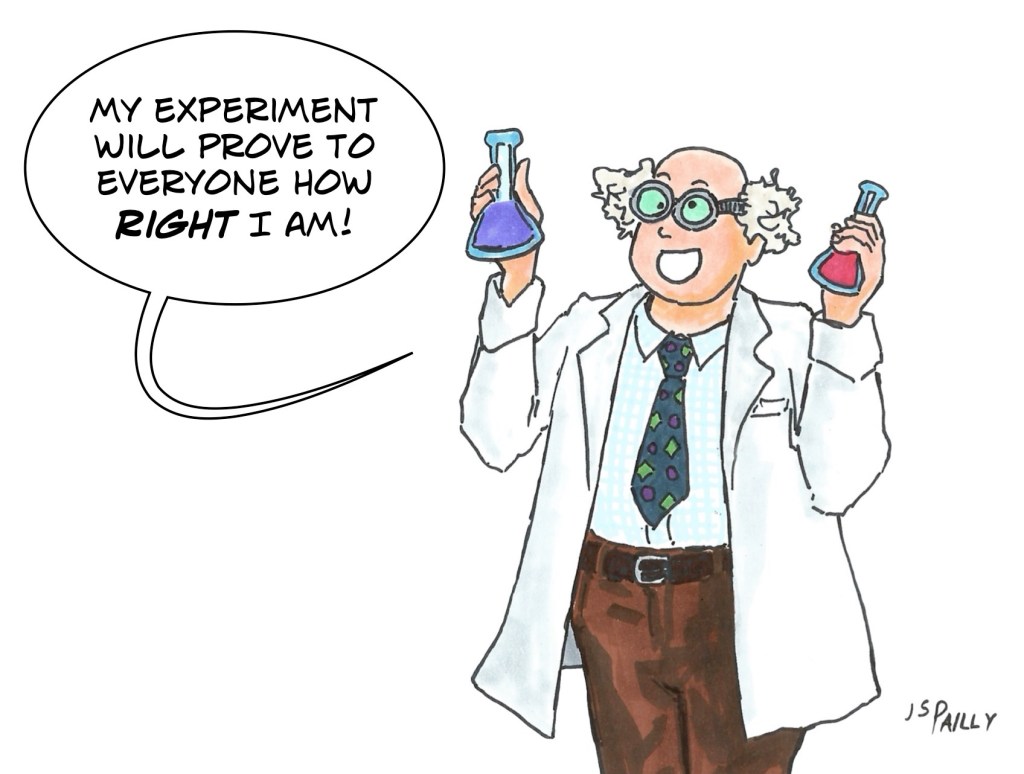
For me, this is the most reassuring thing any scientist could say.  Too often in popular culture, scientists are portrayed a certain way.

For a multitude of reasons, this is not a real scientist.

But no, good scientists are not out to prove to the world that they’re right.  They’re trying as hard as possible to prove to themselves that they’re wrong.  Which brings me to the null hypothesis.

According to the Oxford English Dictionary and other sources (like this one), the term “null hypothesis” can be traced back to British statistician Ronald Fisher.  Fisher first wrote about the null hypothesis in 1935, in a book titled The Design of Experiments.

As a way of introducing the concept, Fisher tells us the story of a woman who claimed to have an oddly specific talent.

A lady declares that by tasting a cup of tea made with milk she can discriminate whether the milk or the tea infusion was first added to the cup.

The Design of Experiments, by Ronald Fisher

Fisher then describes an experiment to test this woman’s claim.  She’s given eight cups of tea, four with the milk added first, and four with the milk added afterward.

In the context of this experiment, the null hypothesis predicts that the woman will not be able to tell which tea is which—she’s only guessing.  Or to put that in sciencier language, the null hypothesis asserts that there will be no statistically significant relationship between the way this woman’s tea was prepared and the way she believes her tea was prepared. As Fisher explains:

[…] it should be noted that the null hypothesis is never proved or established, but is possibly disproved, in the course of experimentation.  Every experiment may be said to exist only in order to give the facts a chance of disproving the null hypothesis.

The Design of Experiments, by Ronald Fisher

A null hypothesis is usually paired with an “alternative hypothesis,” which asserts that a statistically significant relationship does exist.  In Fisher’s tea tasting example, the alternative hypothesis would be that the woman really can tell which tea is which.  You can never really prove that either the null hypothesis or the alternative hypothesis is true, but a well designed experiment should be able to prove that one hypothesis or the other is false.

Going back to that possible planet in the Proxima Centauri system, the article from Scientific American does not explicitly mention the null hypothesis; however, the spirit of the null hypothesis is clearly in play.  Astronomers are trying their best to prove that that planet does not exist, and so far they can’t do it.  And that’s enough to convince me that I should take this new planet seriously (at least for now).

Next time on Planet Pailly, we’ll find out what this not-yet-disproven planet might look like.

Touring Proxima Centauri’s Asteroid Belts

Hello, friends!

As you know, sometimes things don’t go according to plan.  For today’s post, I was planning to draw a really pretty picture of a really planet—a planet that astronomers may (or may not) have found in the Proxima Centauri system.  But as I did my research about this possible planet, I realized I needed to draw something else for you first.

As reported in this 2017 paper, temperature readings indicate that Proxima Centauri may have at least one and as many as three asteroid belts.  Based on what I’ve read, it sounds like the presence of these belts has not been definitively proven yet.  But no one seems to be able to definitively disprove them either.

So here is a map of everything we currently know or suspect exists in the Proxima Centauri system.

As you can see, the planet Proxima b is in an extremely tight orbit around its star.  But since Proxima Centauri is much smaller and cooler than our Sun, Proxima b is technically in the star’s habitable zone.  Click here for my post on whether or not Proxima b could actually support life.

Beyond the orbit of Proxima b, we find our first possible asteroid belt.  In that 2017 paper I cited above, this innermost belt is described as the warm dust belt.  It appears to be located approximately 0.4 AU away from its star (roughly equivalent to the orbit of Mercury in our Solar System).

A little farther out, we find a second possible asteroid belt, which the authors of that 2017 paper describe as the cold dust belt.  Remember: we suspect these dust belts exist because of temperature measurements, hence the names.  The cold dust belt appears to be spread out between 1 AU and 4 AU (roughly equivalent to the space between the orbits of Earth and Jupiter in our Solar System).

And then farther out still, there appears to be a third belt, referred to as the outer dust belt (in my opinion, it should have been named the colder dust belt).  The outer dust belt appears to be located approximately 30 AU away from its star (roughly equivalent to the orbit of Neptune).

I want to emphasize again: as far as I can tell from my own research, no one has definitively proven or disproven these dust belts exist.  All we have are some temperature measurements that suggest something might possibly be there.

But if all those dust belts do exist, that tells us there should be planets orbiting in the gaps between the belts.  It would take a planet’s gravity to keep those gaps empty.  And now that you know that, I think we’re ready to take a closer look at Proxima c.

Except tomorrow is Insecure Writer’s Support Group day, so our trip to Proxima c will have to wait.  But I promise the wait will be worth it.  Science predicts that if Proxima c really exists, it must be the most gorgeous planet you’ve ever seen!

Next time on Planet Pailly, the unexpected benefits of having your manuscript edited.

My Apologies to the Brevard Astronomical Society and to the Planet Orbitar

Hello, friends!

I’ve been blogging for almost ten years now.  In that time, I’ve written and illustrated a lot of posts that I’m really proud of.  But I’ve also made some stupid mistakes, and I’ve posted things that I thought were funny at the time but, in retrospect, I’m not so proud of.

In 2016, I wrote this post about an exoplanet named Orbitar.  Today, I have to issue a retraction.  In that 2016 post, I attributed a quote to the Brevard Astronomical Society, the group that won the I.A.U.’s naming contest for the planet now known as Orbitar.  The quote was about the possibility that Orbitar might have moons and that those moons could possibly support life.

Well, somebody from the Brevard Astronomical Society got in touch to inform me that no one from their organization had made such a statement.  Turns out I did a sloppy job citing my sources for that 2016 post, so I can’t figure out where I got the quote from.  Hence, the need for this retraction.

Given that Orbitar orbits a red giant star at a distance of approximately 1.19 AU, it seems highly unlikely that any Orbitarian moons could support life.  It would be pretty outlandish and unscientific to claim otherwise.  I can understand why an astronomical society would not want to be associated with such a claim.

And another thing: in that 2016 post, I made fun of the name Orbitar.  I thought it was a doofy thing to name a planet.  But I have since gotten used to the name, and I’ve come to like it.  It’s unique.  It’s a name with a lot of personality.  I’m sure lots of planets wish they had such a cool name.

So I’d like to apologize to the planet Orbitar.  Even more so, I’d like to apologize to the Brevard Astronomical Society.  This isn’t the first time I’ve made a mistake on my blog, and it surely won’t be the last.  But using that quote without clearly citing my source was an especially stupid mistake, and I’m very sorry for doing it.

Next time on Planet Pailly, we’ll check out some of the cool stuff other space and science bloggers have been up to lately!

Sciency Words: Somaforming

Hello, friends, and welcome once again to Sciency Words.  Each week, we take a closer look at some new and interesting scientific term so we can expand our scientific vocabularies together.  This week’s Sciency Word is:

SOMAFORMING

I’d like to begin this post with a quote.  This comes from the 2019 Sci-Fi novella To Be Taught, If Fortunate by Becky Chambers.  As the protagonist of that book explains, we humans are a remarkably versatile species, able to adapt to pretty much any environment—or at least any environment Earth has to offer.

But take us away from our home planet, and our adaptability vanishes.  Extended spaceflight is hell on the human body.  No longer challenged by gravity, bones and muscles quickly begin to stop spending resources on maintaining mass.  The heart gets lazy in pumping blood.  The eyeball changes shape, causing vision problems and headaches.  Unpleasant as these ailments are, they pale in comparison to the onslaught of radiation that fills the seeming void.

I have rarely seen the dangers of human spaceflight so artfully or so succinctly explained as in this book.

Even before Yuri Gagarin became the first human in space, scientists knew space would be rough on the human body.  They did not know specifically what might go wrong, but they knew there would be trouble.  The obvious solution is to create an environment that is safe and comfortable for human beings.

But as early as 1960, some scientists were considering an alternative solution.  Rather than creating space environments that are suitable for human life, why not modify human life to be suitable for the environment of space?  This was the idea proposed by American research scientists Manfred Clynes and Nathan Kline in their 1960 paper “Cyborgs and Space.”

Clynes and Kline proposed some rather drastic surgical changes to the human body.  They make it sound quite easy.  Just rip out a bunch of internal organs.  Replace those organs with synthetic parts.  Pump the patient/astronaut full of drugs and use hypnosis to suppress any psychological issues that might come up during or after the process.  And now you have a human being who’s ready to go to space!  Or you have a human being who’s dead on the operating room table.  One, or the other!

Clynes and Kline introduced the word “cyborg” to describe the half-human/half-machine person they proposed to create.  What Becky Chambers describes in To Be Taught, If Fortunate sounds a little bit safer and a lot less dehumanizing.  And Chambers introduces a new term to describe the transformation her characters undergo: somaforming.  The word is created by analogy with the word terraforming, with the Greek root word “terra” (Earth) being replaced with the Greek root word “soma” (body).

As the protagonist of To Be Taught, If Fortunate explains it, human space explorers come as guests, not conquerers.  The age of colonialism is long behind us. And being good guests, we don’t want to demand too much of our hosts or cause our hosts too much trouble.  To quote Chambers’ book once more: “I have no interest in changing other worlds to suit me.  I choose the lighter touch: changing myself to suit them.”

And I think that is a wonderful sentiment!

As far as I can tell, the word somaforming has not yet been picked up by the scientific community.  But plenty of words from science fiction have been adopted by scientists.  I have a suspicion that this is going to be one of those words.

Next time on Planet Pailly: Oh no!  I made a mistake in an old blog post, and I need to issue a retraction!

Dreaming About Pailly Crater

Hello, friends!

So this is kind of a weird time in my life.  A few weeks ago, I handed my manuscript over to my editor.  Now my editor has handed that manuscript back to me.  There’s surprisingly little that needs to be fixed, so I guess I’ll be moving forward with my self-publishing plan soon.

And that’s weird to me.  I’ve been writing for a really long time now.  I’ve come close to being published before, but this time is different.  My writing dreams have never felt so real to me, and yet at the same time nothing about what’s happening feels real to me at all.  I don’t know how to explain it any better than that.

I know a lot of writers fantasize about getting their book on a bestseller list or winning some sort of award.  I honestly don’t care about that.  So long as I make a living writing full time, I’ll be happy.  However, I will confess there is one prestigious honor that I do find myself daydreaming about, from time to time.  Is it premature for me to talk about this?  Yes.  Yes, it is.  Indulge me.

The International Astronomy Union has a longstanding tradition of naming craters on Mercury after artists, writers, and musicians.  To quote from this website, Mercury’s craters are to be named after:

Artists, musicians, painters, and authors who have made outstanding or fundamental contributions to their field and have been recognized as art historically significant figures for more than 50 years.

The most recent Mercury crater naming announcement came in September of 2019.  Among others, poet Maya Angelou and comic book artist Jack Kirby now have craters named in their honor.  Previously, craters have been named after H.P. Lovecraft, J.R.R. Tolkien, and Walt Disney (this is not Disney crater, which seems like a missed opportunity to me).  Click here to see a full list of Mercury’s crater names.

Mercury is the most heavily cratered object in the Solar System, so it seems to me there should be room on the I.A.U.’s list for a Pailly crater.  Maybe someday.  A writer can dream, right?

Next time on Planet Pailly, if you can’t make the planet fit for human life, maybe you should make human life fit for the planet.

Sciency Words: The Yarkovsky Effect

Hello, friends!  Welcome to Sciency Words, a special series here on Planet Pailly where we talk about those weird and wonderful words scientists use.  Today on Sciency Words, we’re talking about:

THE YARKOVSKY EFFECT

Have you ever tried to count all the stars in the night sky?  Well, that might be an easier job than finding and tracking all the asteroids that keep whizzing by our planet.  Part of the problem is due to something called the Yarkovsky Effect.

Ivan Yarkovsky was a Polish engineer working in Russia.  He was also a huge science enthusiast.  If Yarkovsky were alive today, I imagine he’d be writing a blog about all the cool sciency research he was doing in his free time.

But it was the late 19th/early 20th Century.  Blogging wasn’t an option, so instead Yarkovsky wrote pamphlets about science, which he circulated among his science enthusiast friends. And almost fifty years after Yarkovsky’s death, an Estonian astronomer by the name of Ernst Öpik would remember reading one of those pamphlets.

Imagine an asteroid orbiting the Sun.  Sunlight causes this asteroid’s surface to get hot.  Then, as the asteroid rotates, that heat energy radiates off into space.  Would this radiating heat produce any thrust?  Would there be enough thrust to push an asteroid off its orbital trajectory?

Öpik thought so, and in 1951 he wrote this paper introducing the idea to the broader scientific community.  Today’s Sciency Words post would probably have been about the “Öpik Effect,” except Ernst Öpik was kind enough to give credit to the obscure blogger pamphlet writer who originally came up with the concept.  Thus we have the Yarkovsky Effect.

And in 2003, radar observations of the asteroid 6489 Golevka confirmed that the Yarkovsky Effect is real!  The asteroid had wandered 15 km away from its original course!

Around the same time, a copy of Ivan Yarkovsky’s original pamphlet was found in Poland.  As described in this article, it seems Yarkovsky was working on the basis of some faulty premises and a few rather unscientific assumptions.  He more or less stumbled upon the right idea by accident (but let’s not dwell on that part of the story).

Next time on Planet Pailly, no one’s going to name a scientific theory after me, but maybe there’s another sciency honor I can aspire to.

How Proxima b Lost Its Ozone Layer

Hello, friends!

Today we’re visiting Proxima Centauri, one of three stars in the Alpha Centauri system, the star system right next door to our own.  And it turns out Proxima has at least one planet.  Not only that: Proxima’s planet is orbiting within the habitable zone.  That planet may have liquid water on its surface, and perhaps even life!

Proxima’s planet, known officially as Proxima b, orbits about 0.05 AU away from its star.  That puts Proxima b closer to its star than Mercury is to our Sun.  But that’s okay.  Proxima Centauri is much smaller, dimmer, and colder than our own Sun, so everything balances out.

But I have bad news.  The temperature might be right for life, but the radiation environment is all wrong.  Proxima Centauri is a very angry little star.  It’s much angrier than our Sun.  Solar flares, solar wind, and solar radiation are a whole lot worse than anything Earth would normally have to worry about.

In March of 2016, Earth-based astronomers observed a “superflare” on Proxima Centauri.  As you can see in the highly technical diagram below, that superflare would have done serious damage to Proxima b’s ozone layer (assuming Proxima b had an ozone layer in the first place).

According to this 2018 paper on ozone loss, if superflares like that are normal for Proxima Centauri, we should expect Proxima b to lose 90% of its ozone layer in just five years (again, assuming Proxima b had an ozone layer in the first place).  Without an ozone layer, incoming ultraviolet radiation would thoroughly sterilize Proxima b’s surface (much like it does on Mars).

And it gets worse.  Earth’s magnetic field deflects a lot of harmful solar and cosmic radiation away.  But according to this 2016 paper on space weather, Proxima b’s magnetic field (assuming Proxima b has a magnetic field) is taking a real beating.  The magnetic field would be badly weakened and compressed.  As a result, Proxima b’s atmosphere would start eroding away, due to the solar wind, and if those UV rays haven’t already killed everything on the surface, all that solar and cosmic radiation would have a chance to finish the job.

Even the most extreme of extremophiles here on Earth would have a tough time surviving on Proxima b.  But the situation is not hopeless.  That 2016 paper on space weather and that 2018 paper on ozone loss both acknowledge that there are still plausible scenarios where life could evolve and thrive on Proxima b.  But in order to do it, the Proxima b-ians must have done one of two things:

  • Life on Proxima b must be very specifically adapted to that radiation environment, or…
  • Life on Proxima b must have found a good hiding place, perhaps deep underwater or underground, where the radiation can’t reach it.

Next time on Planet Pailly, it’s a bird!  It’s a plane!  It’s… oh no, it’s a killer asteroid!!!

Sciency Words: Solar Wind

Hello, friends, and welcome to another episode of Sciency Words.  Each week, we take a closer look at some science or science-related term so we can expand our scientific vocabularies together!  Today on Sciency Words, we’re talking about:

THE SOLAR WIND

The stars twinkle in our sky because Earth’s atmosphere scatters starlight.  The Sun has an atmosphere too, so it shouldn’t surprise you to learn that when astronomers observe stars that happen to be near the Sun (as viewed from Earth), they can see that the Sun’s atmosphere also scatters starlight.

What might surprise you—and what did surprise astronomers in the 1950’s—is that this scattering effect can extend very, very far into the space around the Sun.  The Sun’s atmosphere must be huge!  As reported in this 1959 article from Scientific American, the Sun’s atmosphere might be so big that it encompasses Earth!

Pursuing this and other lines of evidence (such as the apparent correlation between flare activity on the Sun and aurorae here on Earth, as well as apparent 11 year fluctuations in cosmic radiation levels), American astrophysicist Eugene Parker wrote this paper in 1958, introducing a concept now known as the solar wind.

As you might imagine, the Sun’s atmosphere is hot.  Absurdly hot.  Remember that temperature is really just a measure of the average velocity of atoms, and you’ll soon realize (as Parker did) that atoms in the Sun’s atmosphere must have enough velocity to escape the Sun’s gravity.  And since those atoms would also be ionized, these streams of ionized particles coming from the Sun would serve as extensions of the Sun’s magnetic field.

The term solar wind doesn’t appear in that 1958 paper.  Parker first introduces that term in this 1959 paper, in which he defends his idea and responds to critiques from other astrophysicists.  As Parker explains:

In view of the simple hydrodynamic origin of the expansion, it seems appropriate to term the stream a solar wind.

Also in 1959, the Soviet Union’s Luna 1 space probe gathered the first empirical evidence that the solar wind really does exist, leading to confirmation that Eugene Parker’s solar wind hypothesis was correct.

And today, a NASA spacecraft named in Parker’s honor is spiraling closer and closer to the Sun, gathering more data about the solar wind and other mysterious phenomena associated with the Sun.

Next time on Planet Pailly, now that we’ve talked about the solar wind in our own Solar System, we’ll check out the space weather forecast for the solar system next door.

Sciency Words: Colony

Hello, friends!  Welcome to another episode of Sciency Words.  Normally on Sciency Words, we talk about those strange words scientists use, but today we’re going to talk about a word scientists—or at least some scientists—would prefer to stop using.  And that word is:

COLONY

Mars is so eager for humans to come visit and maybe even stay permanently.  And plenty of humans are eager to do just that!  We’ll bring life to Mars.  Not only that, we’ll bring civilization and culture.  One might say it is humanity’s destiny to colonize Mars.

But is this language of “colonization” and “destiny” too evocative of European imperialism?  Some think so, and they would ask that we stop using such colonialist language when we talk about space exploration.

Now I want to be clear about where I’m coming from on this: I try my best to call people by the names and terms they prefer to be called, and if I find out that the language I use offends somebody, I’ll do may best to change.  Some would accuse me of being too P.C., but I think it’s just good manners.

And I have found that if you make an effort to be respectful and accommodating to others, others will make an effort to be respectful and accommodating to you, and in general they’ll be more willing to forgive you if/when you do slip up and say something unintentionally hurtful.

So a few years back, when I came across this article from National Geographic, I started reading it with an open mind and a willingness to change.  But by the end of the article, even I felt like this was an example of political correctness run amok.  The word “colony” is offensive.  So are the words “settlement” and “frontier.”  Okay.  What words should I use instead?  Even that National Geographic article seems to concede at one point that we don’t have many workable alternatives to these terms.

But this concern does seem to be coming up more and more.  Plenty of people in the scientific community are shying away from words like colony and colonization.  Bill Nye (the Science Guy) says he avoids the word colony, and this official glossary of SETI terminology warns that “settle” and “colonize” may have certain negative connotations for some people.

So at this point, I’m not sure what to think.  What about you?  Do you think this is much ado about nothing, or should we really start looking for alternatives to words like “colony” or “settlement” in our space exploration vocabularies?

Next time on Planet Pailly… I actually don’t have anything planned yet for my next blog post.  We’ll probably just talk about more space stuff.