Our Place in Space: An Immature Technosphere

Hello, friends!  Welcome to Our Place in Space: A to Z!  For this year’s A to Z Challenge, I’ll be taking you on a partly imaginative and highly optimistic tour of humanity’s future in outer space.  If you don’t know what the A to Z Challenge is, click here to learn more.  In today’s post, I is for…

AN IMMATURE TECHNOSPHERE

In a previous post, I told you about the DART Mission, our first real experiment to see if we can defend our planet from incoming asteroids.  I believe humanity has a tremendous responsibility to protect our planet, not only for our own benefit but for the benefit of the entire Earthly biosphere.  Incoming asteroids can do serious harm to Earth’s biosphere (just ask the dinosaurs).  But, of course, there are other threats to the biosphere that should concern us—more immediate and urgent threats, too.

The term “immature technosphere” is mainly associated with SETI research.  Imagine, if you will, a planet that is home to alien life.  Over cosmic timescales, we might expect this hypothetical alien planet to go through several phases of development.

Phase One: The Immature Biosphere
Life has begun!  The first microorganisms are swimming around in the planet’s water (or whatever liquid this planet has instead of water).  But biological activity produces biological waste, in one form or another, so as these early organisms multiply and spread, they may end up poisoning their own environment with their own waste products.

Phase Two: The Mature Biosphere
Life has found a way.  A variety of organism have now evolved, and the waste produced by one organism serves as fertilizer, food, or fuel for others.  A natural balance has been achieved.  Natural cycles have emerged.  Life not only survives but thrives!

Phase Three: The Immature Technosphere
Intelligent life has emerged, by which I mean life capable of creating and using technology.  But as these intelligent life forms begin using technology on a grander and grander scale, they may inadvertently disrupt the natural cycles and the natural balance of their world.  Life is threatened once again, this time by technological waste.

Phase Four: The Mature Technosphere
If intelligent life is truly intelligent, it will recognize the harm it is doing to its own environment and start inventing ways to undo that damage, or at least to keep the damage in check.  In time, perhaps a new balance will be achieved, with nature and technology working together in harmony.

Turning our attention back to Earth, I think it’s fair to say our planet is in the “immature technosphere” phase of development.  But an immature technosphere today implies that a mature technosphere may develop later on, and that gives me hope.

I keep saying that this “Our Place in Space” series is a highly optimistic view of humanity’s future.  Part of what I mean by that is that we will not leave Earth behind.  We will not make a new home for ourselves on the Moon or Mars or elsewhere after destroying our first home here on Earth.  I doubt that that would work anyway; any off-world colony we might establish would still be dependent on Earth for a long, long time to come.

I know a lot of people who see the state of the world and despair.  Things are bad right now, and some of the damage we are doing to our planet and to each other cannot be undone.  But a better future is still possible.  Humanity just needs a bit more time to mature.

Want to Learn More?

Earth in Human Hands by David Grinspoon is one of my all time favorite books.  It’s certainly my #1 favorite non-fiction book.  As an astrobiologist, Grinspoon has more knowledge and authority on scientific matters than I do, but his view of the future is much like the view I’ve been presenting in these A to Z Challenge posts.

So if you’re worried about the state of the world and you want to believe that a better and brighter future is still possible, I highly recommend picking up Grinspoon’s book.

Our Place in Space: HAVOC

Hello, friends!  Welcome to Our Place in Space: A to Z!  For this year’s A to Z Challenge, I’ll be taking you on a partly imaginative and highly optimistic tour of humanity’s future in outer space.  If you don’t know what the A to Z Challenge is, click here to learn more.  In today’s post, H is for…

HAVOC

Venus is my favorite planet.  If you’ve been reading this blog for a while, you probably already know this about me.  The Venusian atmosphere is weird and chemically complex.  The surface is mysteriously smooth, hinting at some pretty extreme geological activity.  And did you know Venus is spinning the wrong way?  She rotates clockwise where every other planet in our Solar System has counterclockwise rotation.  In many ways, I feel like Venus is the planet with the most personality (aside from Earth, of course).  So if there’s a realistic possibility of humans colonizing Venus one day, nothing would please me more!

HAVOC stands for High Altitude Venus Operational Concept.  It’s NASA’s very preliminary plan for exploring Venus, first with robots, then with astronauts, with the eventual goal of establishing a permanent human presence.  Most people scoff at the idea of sending humans to Venus.  Surface conditions are hellish.  The surface temperature is 475 degrees Celsius (900 degrees Fahrenheit).  Atmospheric pressure is 90 times greater than what we experience here on Earth.  Sulfuric acid falls from the sky as rain, and don’t forget about that extreme geological activity I mentioned.  Nobody’s sure what’s happening, but the ground is too smooth, as if it gets regularly “repaved” with fresh lava.

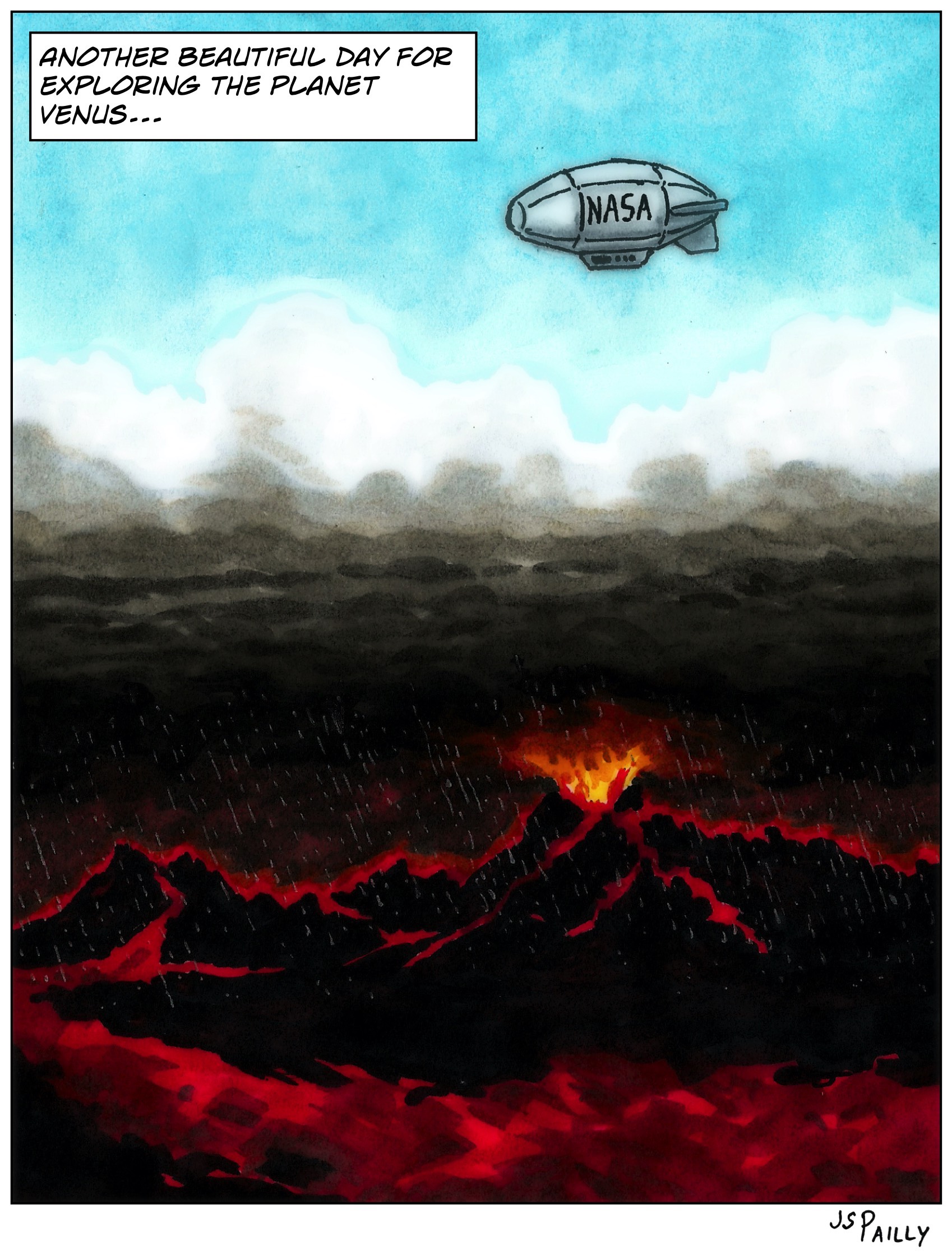
But HAVOC would not involve putting boots on the ground.  Instead, astronauts would explore Venus from the safety of blimps and other airborne habitats.  At an altitude of 55 kilometers above the surface, Venus is quite nice.  You might even call it heavenly.  The temperature and pressure are roughly Earth-normal.  We’d experience Earth-like gravity, too, and Venus would provide almost Earth-like protection from solar and cosmic radiation (a service that the Moon and Mars do not offer).  Also, 55 kilometers up, we wouldn’t have to worry about the sulfuric acid rain; we’d be above the layer of sulfuric acid clouds!

Obviously this is not happening any time soon.  The people at NASA seem to have their hearts set on returning to the Moon in the near future, with a long term goal of getting to Mars.  Still, the idea of exploring Venus with blimps makes sense.  In some ways, Venus might end up being a better second home for humans than Mars—just so long as we stay at that 55 kilometer altitude.

So in the distant future, when humanity is spreading out across the Solar System, don’t be surprised if large numbers of people live in Cloud City-like habitats on Venus.

Want to Learn More?

Check out this paper from the American Institute of Aeronautics and Astronautics, detailing HAVOC as a five phase plan to explore and colonize Venus.

Also, here’s a video from NASA showing what a HAVOC mission might look like, from first arrival in Venusian orbit to safe return back on Earth.

Our Place in Space: The Great Red Spot

Hello, friends!  Welcome to Our Place in Space: A to Z!  For this year’s A to Z Challenge, I’ll be taking you on a partly imaginative and highly optimistic tour of humanity’s future in outer space.  If you don’t know what the A to Z Challenge is, click here to learn more.  In today’s post, G is for…

THE GREAT RED SPOT

Humanity is struggling right now.  There’s war and bigotry.  There’s disease and poverty and climate change.  Despite these problems, I still have tremendous hope for the future.  I still believe that we can work past our current problems and build a better future for ourselves and for our planet.  But when I think of this better and brighter future, there’s still one thing I worry about.  It’s a minor thing, but still… I worry: what’s going to happen to Jupiter’s Great Red Spot?  Will it still be there in the future, or will it slowly fade away and disappear?

In the late 1800’s, the Great Red Spot was observed to be approximately 50,000 kilometers wide.  For comparison, the entire Earth is only 13,000 kilometers in diameter.  But by 1979, when NASA’s Voyager space probes arrived at Jupiter, the Great Red Spot had shrunk to a mere 23,000 kilometers in width.  It was less than half the size it once was!  And today, it’s only 16,000 kilometers wide.  You see now why I’m worried.

I get a bit frustrated with news reports declaring that the Great Red Spot is certain to disappear.  I also get annoyed with news reports saying it’s certain not to disappear.  The popular press goes back and forth on this.  It’s sort of like those news reports you’ll hear about whether or not eggs are good for you.  First they’re good, then they’re bad, then they’re good if you cook them this way, then they’re still bad no matter how you cook them.  In a similar way, first the Great Red Spot is disappearing, then it isn’t, then it is again, and so on.

I think the popular press just doesn’t understand what it means when scientific research gets published.  Published research is best understood as part of an ongoing conversation.  One group of astronomers says they believe the Great Red Spot is disappearing for reasons X, Y, and Z.  Then another group of astronomers say they think it will endure for reasons A, B, and C.  Then maybe another group will contribute reasons J, K, and L to the discussion.  This back and forth discussion continues on and on in the pages of scientific journals, until some sort of scientific consensus is reached (or until the Great Red Spot actually disappears—that would also settle the debate).

But the popular press always seems to latch onto one published paper and present it to the general public as if it is the final word on the matter, as if it is a proclamation of scientifically proven fact.  That is until they latch onto the next published paper and present that as the final word.

So what’s really going to happen to the Great Red Spot?  Well, it’s undeniable that it has shrunk significantly over that last century or so.  Maybe it will keep shrinking until it’s gone, or maybe it’ll pick up steam again and start to expand once more.  Maybe the Great Red Spot goes through century-long phases of shrinking and expanding.  Maybe we just haven’t been observing it long enough to know that. Scientists are still studying this issue, comparing and contrasting their findings, and debating what it all means.  That’s often the way with science (and I hope you’ll keep that in mind the next time you see a news report that begins with the words “According to a new scientific study…”).

Even without the Great Red Spot, Jupiter would be an awe-inspiring sight.  I do hope, though, that it will still be there for all those future colonists on Callisto to see and enjoy.

Want to Learn More?

I found a few relatively recent articles that talk about the Great Red Spot and why it might or might not disappear.  These articles are, in my opinion, more responsible in how they present their information than other articles I’ve seen.

Our Place in Space: The Far Side of the Moon

Hello, friends!  Welcome to Our Place in Space: A to Z!  For this year’s A to Z Challenge, I’ll be taking you on a partly imaginative and highly optimistic tour of humanity’s future in outer space.  If you don’t know what the A to Z Challenge is, click here to learn more.  In today’s post, F is for…

THE FAR SIDE OF THE MOON

The James Webb Space Telescope has been getting a lot of press lately.  It’s the biggest and best telescope we humans have ever put into space.  But today, we’re going to imagine an even bigger and (potentially) an even better telescope.  We’re not going to put this telescope in space, though.  We’re going to build it on the surface of the Moon.

The far side of the Moon is the perfect location to build a radio telescope.  We’ve certainly built radio telescopes here on Earth, but those Earth-based radio telescopes keep running into the same two problems.  First, Earth’s atmosphere (especially the ionosphere) blocks certain cosmic radio wave frequencies from reaching us here on the ground.  And second, there’s a whole lot of terrestrial radio chatter happening here on the ground.  That chatter can interfere with any radio signals that do make it through from outer space.

But on the far side of the Moon, those problems don’t exist.  There’s no atmosphere, and certainly no ionosphere.  And since this is the far side of the Moon we’re talking about—i.e., the side of the Moon that always faces away from the Earth—all that terrestrial radio noise is gone.  The Moon itself would block those signals from ever interfering with our radio telescope.

The telescope itself would be absolutely enormous.  It would be built inside of a crater, with a dish approximately one kilometer wide.  NASA has already approved funding to research this idea; please note, they have not approved funding to build it yet!  Only to research the idea, to see if it’s actually feasible using current technology.  If it turns out that it is feasible, though, building a radio telescope on the far side of the Moon might end up being part of NASA’s new Artemis Program.

What would we do with our new lunar telescope?  Well for one thing, we could “look back in time” to see what the ancient universe was like.  Specifically, we could study a period of time known as the “cosmic Dark Ages.”  This would have been a time after the Big Bang but before the formation of the first stars—literally, the cosmic Dark Ages, like I said.  The hydrogen gas permeating the universe in that era would have emitted some amount of electromagnetic radiation, which we can still detect today in certain radio wave frequencies (or we could detect it, if Earth’s stupid atmosphere would stop getting in the way!).

In addition to looking for these naturally-occurring radio signals, our lunar radio telescope could also watch for radio signals that do not appear to be natural in origin.  Radio transmissions from aliens, in other words.

Searching for aliens would definitely not be the main reason to build a radio telescope on the Moon.  The stuff I said about the cosmic Dark Ages—that’s the main reason to do this.  The aliens thing would just be a side benefit.

For this “Our Place in Space” series, I’ve mostly focused on projects that I think could happen in the distant future.  But this lunar radio telescope project is something that probably needs to happen sooner rather than later.  The far side of the Moon is the perfect location for a radio telescope right now, but as humans start spreading out across the Solar System, things may change.  The far side of the Moon may get a whole lot noisier, in terms of radio chatter.

So in the distant future, rather than building a radio telescope on the Moon, we might prefer to build our radio telescopes farther out.  Places like Pluto, Orcus, Eris, or Quaoar—all those little dwarf planets beyond the orbit of Neptune—may end up being super useful for future radio astronomers.

Want to Learn More?

Check out this article from NASA’s Jet Propulsion Laboratory: “Lunar Crater Radio Telescope: Illuminating the Cosmic Dark Ages.”

Also, here’s an article from Universe Today: “The Moon is the Perfect Spot for SETI.”

Our Place in Space: An Elevator to Space

Hello, friends!  Welcome to Our Place in Space: A to Z!  For this year’s A to Z Challenge, I’ll be taking you on a partly imaginative and highly optimistic tour of humanity’s future in outer space.  If you don’t know what the A to Z Challenge is, click here to learn more.  In today’s post, E is for…

AN ELEVATOR TO SPACE

It takes a lot of fuel to get to space.  We’ve talked about this before, and we’re going to talk about it again (and again and again).  In order for the human race to take our rightful place in space, we’re going to have to dream up some clever and crafty ways to reduce the fuel costs of space travel.  One idea—an idea so crazy it might work—would be to build an elevator to space.

So how would we build a space elevator?  Here’s one method: the first step would be to place a space station in geostationary orbit.  Next, our space station would lower a cable all the way down to Earth’s surface.  For the purposes of gravitational stability, the space station would also have to extend a second cable straight out into space, to serve as a counterweight to the weight of the first cable.

Once both cables are fully extended, an elevator carriage could be attached to the cable here on the ground.  Then just press a button, and the elevator takes you to space!

This whole space elevator system would still require an enormous amount of energy.  Also, a ride on the space elevator would take a really long time.  Some sources I’ve looked at say reaching the “top floor” would take several days; others say it would be more like several weeks.  And safety concerns should not be overlooked, because if that elevator cable ever broke, it could become a big problem all around the world (or at least all the way around Earth’s equator, if you catch my meaning).

Still, compared to launching rockets, this would be a far more cost effective and fuel efficient way to transport people and materials from the ground up into space.  As for the safety concerns, we just have to be sure we make that cable out of some really, really, really, really, really, really, really strong material, to ensure that it never breaks!  One problem: no such material is known to exist yet.  Carbon nanotubes and other experimental nano-materials might be strong enough, or they might fall a bit short of being strong enough.  It’s hard to say at this point.

So this is definitely not a thing we can build right now, but maybe someday in the distant future, going space will be as easy as riding an elevator.  I just hope they come up with better elevator music by then.

Want to Learn More?

I’m going to recommend this short video from Kurzgesagt (In a Nutshell) on space elevators.

I’m also going to recommend this slightly longer and slightly more technical video from Real Engineering.

Our Place in Space: The DART Mission

Hello, friends!  Welcome to Our Place in Space: A to Z!  For this year’s A to Z Challenge, I’ll be taking you on a partly imaginative and highly optimistic tour of humanity’s future in outer space.  If you don’t know what the A to Z Challenge is, click here to learn more.  In today’s post, D is for…

THE DART MISSION

So far this month, I’ve been telling you about things that I think will happen (or plausibly could happen) at some point in the distant future.  But today, I’m going to talk about something that’ll happen in the not-so-distant future.  Something that will happen in the very near future, actually.  Later this year, in fact!  In late September or early October of 2022, a NASA space probe named DART will deliberately crash into an asteroid named Dimorphos.

Dimorphos is a relatively small asteroid orbiting a much larger asteroid named Didymos.  Basically, Dimorphos is Didymos’s moon.  These two asteroids will be passing fairly close to Earth later this year.  Now I want to be 100% clear about this: neither Didymos nor Dimorphos are going to collide with our planet.  We are in no danger.  But these asteroids will be coming close enough that we could do a little experiment—an experiment to see just how well we could defend our planet from a dangerous, mass-extinction-causing asteroid, should such an asteroid ever come our way.

DART stands for Double Asteroid Redirection Test.  As you can see in the highly technical diagram below, the plan is for the DART spacecraft to have a head-on collision with Dimorphos.

This head-on collision should cause Dimorphos to lose some orbital momentum, which should alter Dimorphos’s orbit around Didymos.  How different will Dimorphos’s new orbit be?  Hard to say.  The exact angle of impact… the astroid’s mineral composition… the amount of debris produced by the collision… all of these things may factor into what Dimorphos’s new orbit looks like.

Astronomers can do all the computer simulations they like, but until we throw a real life projectile at a real life asteroid, we won’t really know what will happen.  Not with any kind of precision.  Ergo, we need to do this experiment.

Looking once more into the distant future, I believe that humanity is going to spread out across space.  Large numbers of people will eventually be living on the Moon and Mars, as well as on other planets and moons of our Solar System.  But I also believe these humans in the distant future will take good care of the Earth.  Among other things, they will know how to defend Earth from incoming asteroids and comets, so that what happened to the dinosaurs never has to happen again.  And that capability—the capability to keep Earth safe from killer asteroids and comets—begins with a little NASA experiment scheduled to occur later this year.

Want to Learn More?

Here are a few papers that I’ve been reading about the upcoming DART Mission.  This is where I got most of the information for today’s post:

Our Place in Space: Callisto

Hello, friends!  Welcome to Our Place in Space: A to Z!  For this year’s A to Z Challenge, I’ll be taking you on a partly imaginative and highly optimistic tour of humanity’s future in outer space.  If you don’t know what the A to Z Challenge is, click here to learn more.  In today’s post, C is for…

CALLISTO

The major moons of Jupiter are Io, Europa, Ganymede, and Callisto.  In science fiction, Europa and Ganymede seem to get the most attention.  Sci-Fi writers often end up putting human colonists (or at least a handful of plucky human scientists) on the surfaces of one or both of these icy moons.  But today, I’m going to argue that Callisto would be a far more suitable home for future humans.

First off, and most importantly, there’s the issue of radiation.  The space around Jupiter is one of the most dangerous radiation environments in the entire Solar System.  As you can see in the highly technical diagram below, the radiation is most intense in the vicinity of Io.  The radiation levels get better in the vicinity of Europa and continue to taper off when you reach Ganymede.  You’re still soaking up a lot of radiation, though!  Callisto’s radiation levels, however, are fairly low.  You might even describe the radiation levels on Callisto as “survivable.”

Furthermore, planetary protection laws in the future may mean that both Europa and Ganymede are off limits to human settlers.  Scientists today are 99.99% sure that Europa has a vast ocean of liquid water beneath her surface, and (as you know) wherever there’s water, there may also be life.  There’s evidence suggesting Ganymede may have a subsurface ocean, too.  Europa is often said to be the #1 most likely place where we might find alien life here in the Solar System.  While the odds of finding life on Ganymede are considerably lower, the possibility of Ganymedean life shouldn’t be ignored.

There are already international agreements in place regarding extraterrestrial life.  Space agencies like NASA, the E.S.A., and others are legally obligated to do everything they can to protect suspected alien biospheres from our Earth germs (and also to protect Earth’s biosphere from any germs we might find in outer space).  For obvious reasons, these international agreements haven’t exactly been tested in court, and it’s a little unclear how they would be enforced.

But in a future where human civilization is spreading out across the Solar System, I’d imagine bio-contamination laws would become stronger, not weaker.  Europa would almost certainly be declared off-limits to humans, unless it is proven beyond a shadow of a doubt that no aliens currently live there.  Ganymede may end up being off-limits, too, for the same reason.

Meanwhile, we have Callisto.  Scientists who want to study possible biospheres on Europa and Ganymede could set up a research station on Callisto.  From there, they could keep a close eye on the other moons of Jupiter.  They could operate remote-controlled probes to explore Europa and Ganymede without risking contamination, or they could go on brief excursions to Europa and Ganymede themselves (taking proper safety precautions, of course).  While they’re at it, these scientist could also explore Io.  Io is the most volcanically active object in the Solar System.  There is virtually no chance that we’ll find life there, but studying Io’s volcanoes would still be interesting.

I’d be remiss if I didn’t mention this: Callisto might have liquid water beneath her surface, too.  Not as much liquid water as Ganymede, and nowhere near as much as Europa, but still… it’s possible.  Which means there’s a slim possibility that there could be life on Callisto.  But in Callisto’s case, it is a very slim possibility.  Based on what we currently know about Jupiter’s moons, Callisto still seems like the best place for humans to live.  The radiation levels are much lower, the risk of bio-contamination is negligible…  Yeah, if I were a science fiction writer, I’d put my human colonists on Callisto.

Want to Learn More?

In 2003, NASA published a plan to send astronauts to Callisto, with the intention of using Callisto as a base of operations to explore the other Jovian moons.  Click here to read that plan.  Some of the information is out of date, of course, but it’s still got some interesting ideas.  Maybe someday, something like this plan could work!

I’d also recommend this article on Planetary Protection Policy, covering some of the rules that are already in place to protect planets and moons where we might find alien life.


P.S.: If I were a science fiction writer…?  Wait a minute, I am a science fiction writer!  Click here if you want to buy my first book.  It’s not set on Callisto, unfortunately, but it’s still a fun story.

Our Place in Space: Breakthrough Starshot

Hello, friends!  Welcome to Our Place in Space: A to Z!  For this year’s A to Z Challenge, I’ll be taking you on a partly imaginative and highly optimistic tour of humanity’s future in outer space.  If you don’t know what the A to Z Challenge is, click here to learn more.  In today’s post, B is for…

BREAKTHROUGH STARSHOT

So it’s several hundred years into the future.  Human civilization has spread out across the Solar System.  Large numbers of people are living on the Moon and Mars.  We even have successful colonies on Venus and Mercury (more on that later this month) and a few smaller settlements on the various moons of the outer Solar System.  Does this mean we’re done exploring space?  Heck no!  There’s still plenty more outer space stuff to explore!

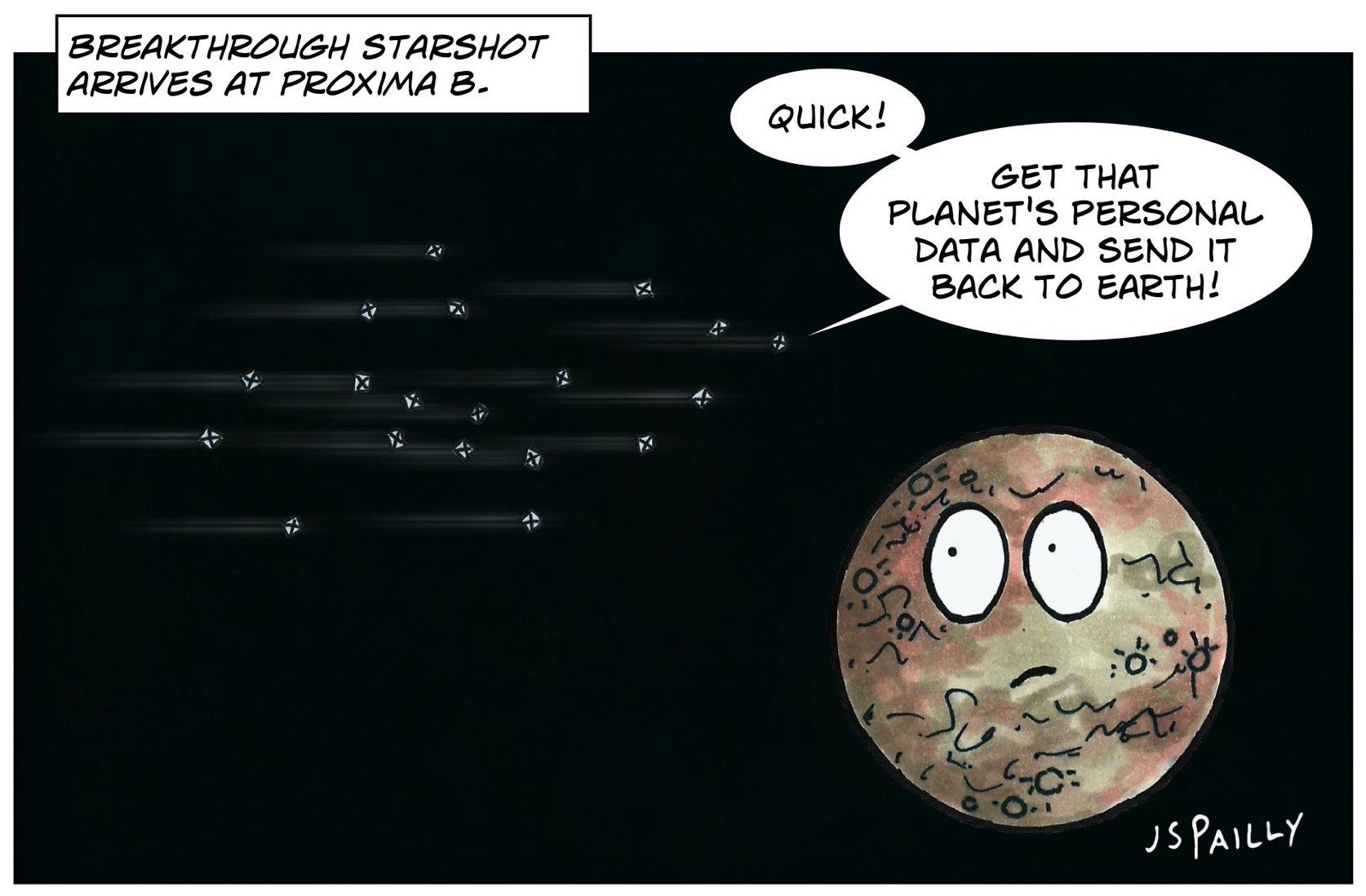
Just as NASA scientists here in the 21st Century send robotic space probes to our neighboring planets, scientists in the future will be keen to send robotic probes out to neighboring star systems.  And the model for a robotic mission to another star system already exists.  In 2016, venture capitalist Yuri Milner, theoretical physicist Stephen Hawking, and Facebook C.E.O. Mark Zuckerberg announced funding for a new research project called Breakthrough Starshot.

The idea is to build a swarm of teeny-tiny space probes, use high energy laser pulses to accelerate these probes straight out of the Solar System, and then sit back and wait for our probe swarm to transmit data back from another star system.  Specifically, Breakthrough Starshot wants to visit Proxima Centauri, the nearest star system to our own.  Proxima Centauri is known to have at least one planet, an Earth-sized world known as Proxima b.

Get it?  Because the C.E.O. of Facebook is involved in this project!

Could we actually build space probes that small?  Well, computer chips are pretty gosh darn small at this point, and they keep getting smaller.  So do cameras and other advanced electronic devices.  So yeah, this part of Breakthrough Starshot’s plan seems plausible enough.

What about that whole high energy laser pulse thing?  That part does seem more speculative to me, but experiments in Earth orbit have shown that light sail technology does work.  Just as the sail on a sailboat catches the wind, a light sail can catch light and use that light-pressure to propel a spacecraft through space.  A high energy laser aimed at a light-sail-equipped space probe… yeah, that sounds plausible to me, too.

Of course, a lot could go wrong with a space probe traveling through interstellar space.  That’s why we’d send a swarm of these things, rather than just one.  Most of the probes probably won’t make it to Proxima b, but the few that do survive the trip will send us some spectacular images and data.

Personally, I don’t like seeing headlines predicting that Breakthrough Starshot will be launching by such and such date (typically, a date in the late 2020’s or early 2030’s).  Breakthrough Starshot does seem to be founded on good science.  It’s the kind of program that really could work, someday.  But is it going to happen in the next ten to fifteen years?  No, I don’t think so.  That seems overoptimistic, in my opinion.

In the more distant future, however, Breakthrough Starshot (or a program very much like it) absolutely could happen.  This sort of thing could definitely work.  And looking ever further into the future, to a time when humans have thoroughly explored our own Solar System, the idea of sending swarms of microchip space probes to neighboring star systems might become routine.

Want to Learn More?

Click here to visit Breakthrough Starshot’s website.  They’ve got lots of information and videos explaining how they intend to get to Proxima b.

I’d also recommend clicking here to see a list of challenges that the Breakthrough Starshot team know they will need to overcome in order to make their plan work.

And for those of you who are looking for some heavier reading, click here to read “A Roadmap to Interstellar Flight,” a scientific paper that essentially serves as Breakthrough Starshot’s founding document.

Our Place in Space: The Aldrin Cycler

Hello, friends!  Welcome to Our Place in Space: A to Z!  For this year’s A to Z Challenge, I’ll be taking you on a partly imaginative and highly optimistic tour of humanity’s future in outer space.  If you don’t know what the A to Z Challenge is, click here to learn more.  In today’s post, A is for…

THE ALDRIN CYCLER

Even in the future, space travel will be expensive.  True, new technologies should make it less expensive than it is today, but there’s one problem that will never go away, no matter how advanced our technology gets: gravity.

Anywhere you want to go in space, you’re going to have to fight against gravity to get there: Earth’s gravity, the Sun’s gravity, the gravity of other planets and moons—at some point on your journey, you’re going to have to fight against any or all of these gravitational forces.  And fighting gravity uses up fuel.  Lots and lots and lots of fuel.

And yet, despite the unforgiving and unrelenting force of gravity, human civilization will eventually spread out across the Solar System.  I’m not going to tell you it will happen in the next twenty years.  I won’t tell you it will happen in the next century, even.  But someday, it will happen.  I’m sure of it!  And so today, I want to talk a little about what the future transportation infrastructure of the Solar System might be like.

American astronaut Buzz Aldrin is, of course, most famous for being the second person to set foot on the Moon.  Aldrin is also a highly accomplished scientist and engineer.  In 1985, he did some math and discovered a very special orbital trajectory that would make traveling from Earth to Mars (and also from Mars back to Earth) far more fuel efficient.

The term “Aldrin cycler” refers to that very special orbital trajectory Aldrin discovered.  The term can also be used to describe a spacecraft traveling along that special orbital trajectory.  The initial investment to build an Aldrin cycler (the spacecraft, I mean) would be really high.  We’d probably want to build a rather large spacecraft for this, and once it’s built, maneuvering the thing into the proper trajectory would require a stupendous amount of fuel.

However, once we’ve done all that, the cycler will cycle back and forth between Earth and Mars, over and over again, pretty much forever.  Traveling to Mars would be a little like catching a train.

I was going to have the Aldrin cycler make a “choo-choo” sound, like I train, but then I realized that would be silly.  Things don’t make sounds in outer space.

Passengers would board the cycler as it flew past Earth; about five months later, they’d disembark and head down to the surface of Mars.  The cycler would then take a long journey (about twenty months) looping around the Sun before flying past Earth once more; then the “cycle” would begin again.

The trip from Earth up to the cycler would still require some amount of fuel.  So would the trip from the cycler down to the surface of Mars.   The cycler itself would also require a little bit of fuel for maneuvering thrusters; otherwise, over time, the ship could start to drift ever so slightly off course.

Obviously this is not a cost-free form of space travel, but I’m sure you can see how this could help keep the cost of space travel down.  And so I imagine in the distant future, the Aldrin cycler (or something very much like it) will be a key part of the Solar System’s infrastructure, just as trains are an important part of our modern day infrastructure here on Earth.

Want to Learn More?

Click here to see a short animation of the Aldrin cycler orbital trajectory, showing several cycles worth of Earth-to-Mars and Mars-to-Earth journeys.

I’d also recommend Buzz Aldrin’s book Mission to Mars: My Vision for Space Exploration, where Aldrin describes the Aldrin cycler (and other cool Mars related things) in more detail. Click here to see the book’s listing on Amazon.

A to Z Theme Reveal: Our Place in Space!

Hello, friends!  April is almost here, which means it’s almost time for the A to Z Challenge!  If you haven’t heard of the A to Z Challenge before, click here to learn more.  It’s a cool thing, with lots of blogs participating, covering all sorts of fun and interesting themes.  Here on Planet Pailly, the theme for this year’s A to Z Challenge will be:

OUR PLACE IN SPACE!!!

This will be a mostly imaginative tour of the future, with a little bit of actual, factual science mixed in.  We’ll see how future human colonists are faring on the Moon and Mars, we’ll visit scientific research stations in the outer Solar System, and perhaps we’ll witness humanity’s first tentative steps toward interstellar travel.  We’ll also check in on Earth and see how our home planet is doing.

I can also promise you that this will be an optimistic view of the future.  I am, and always have been, optimistic about the future of humanity.  People have told me before that my optimism is foolish and naive.  People have told me to “look at the direction things are going” and that I should “get ready for what’s coming.”  Maybe those people have a point, but when I talk about the future, I’m not quite as foolish and naive as I may seem.

I know the world is a scary place right now.  There’s a really nasty war going on.  There’s a pandemic going on (still).  Around the world, liberal democracies are under threat, and climate change is transitioning from being a theoretical concern to a very real and very immediate problem.  The gap between the rich and poor is growing wider, our population growth is unsustainable, et cetera, et cetera… I know.  Believe me, I know.  And yet despite all of that, I still have hope for our planet and our species.

Mother Earth (as pictured above) is right.  We can do better than this.  The first step is to believe in ourselves, to believe that a better and brighter future is still possible.  I admit that hope alone will not guarantee us a better or brighter future, but I also know from personal experience that hopelessness is a self-fulfilling prophecy.  Those who still have hope still have a chance while those who give up hope have doomed themselves.  Let us not, as a species, give up hope in ourselves.

So in the coming month, I invite you to join me in imagining a future where kindness has prevailed, a future where we have not destroyed ourselves or our planet, and where we, as a species united in peace, have gone on to claim our rightful place in space.