Sciency Words: Carcinization

Hello, friends!  Welcome back to Sciency Words, a regular series here on Planet Pailly where we talk about the definitions and etymologies of scientific terms.  Today, we’re talking about:

CARCINIZATION

In time, we will all evolve into crabs.  Crabs are the ultimate life form, evolutionarily speaking.  At least that’s what certain Internet memes would have you believe.  But like most Internet memes, this whole “we will all become crabs” idea is an oversimplification of the truth.  Carcinization is a surprisingly common evolutionary process, but it doesn’t happen to all animals in all situations.

Definition of Carcinization: In evolutionary biology, carcinization is the process of evolving a crab-like body structure, especially a crab-like carapace (shell) with the pleon (tail) folded underneath the belly.  A surprising number of animals have evolved to have this body structure independently of one another.

Etymology of Carcinization: The term was coined in 1916 by English zoologist Lancelot Alexander Barradaile.  It uses a Greek root word meaning “crab.”  Although the term carcinization was coined in 1916, scientists had noticed the unusual prevalence of crab-like animals well before that.  Research on this phenomenon can be traced back to the mid-to-late 1800’s.

Carcinization seems to happen a lot in nature, but it does not happen to all animals equally.  It is far, far, far more likely to happen to an animal that already has a few crab-like characteristics.  For example, if you’re a lobster, a shrimp, or a prawn—in other words, if you’ve already got a bunch of legs and a pair of claws, and if you’re already living on the ocean floor—then there may be some real benefits to evolving even more crab-like characteristics.

It’s hypothesized that the compact body shape of a crab (compared to the more elongated shape of a lobster, for example) may make it easier to defend yourself against predators.  A lobster’s pleon (tail) is very exposed; crabs have their pleons neatly tucked beneath their bellies.  The compact body shape of a crab may also make it easier to scuttle about on the ocean floor, which could help crabs evade predators, and crabs may find it easier to fit into tight spaces as a way to hide from predators.

As a science fiction writer, I’ve long wanted to include some crab-like extraterrestrials in my Sci-Fi stories.  All those memes about crabs being the “ultimate life form” led me to believe this would be a good idea.  The actual science behind carcinization makes me think otherwise.  Carcinization certainly happens a lot with certain animals (i.e., crustaceans) living in certain environments (i.e., the ocean floor).  But it’s not a universal principle of evolution.

All that being said, I’m going to put some crab-like extraterrestrials in a story anyway, because I still think it’s still a fun idea.

WANT TO LEARN MORE?

Here are the research papers I have read or am in the process of reading on the topic of carcinization.  I will have more to say about carcinization later this week.

Sciency Words: Spiritual Bypassing

Hello, friends!  Welcome to Sciency Words, a special series here on Planet Pailly where we talk about the definitions and etymologies of scientific terms, in order to expand our scientific vocabularies together!  In today’s Sciency Words post, we’re talking about:

SPIRITUAL BYPASSING

I am, first and foremost, a science fiction writer.  That’s why most of the research I share on this blog is so heavily focused on outer space: because most of the stories I write are set in outer space.  But I do a fair amount of psychology research, too, because that helps me write more believable characters.

And right now, I am working on a character who has some personal problems.  He’s experiencing a “crisis of faith,” some might say, but in psychology terms, it may be more accurate to say he’s suffering from spiritual bypassing.

Definition of Spiritual Bypassing: Using spirituality to avoid dealing with your problems, rather than using spirituality to help you cope with your problems or overcome them.

Etymology of Spiritual Bypassing: The term was coined in the 1980’s by Buddhist teacher and psychotherapist John Woodward to describe a pattern of behavior he had observed regularly in his line of work.

I’m so spiritual that I don’t have any faults.  I’m so spiritual that I don’t have any weaknesses.  I’m so spiritual that I don’t need to “work on myself.”  I certainly don’t need to see a therapist.  All my pain and all my problems magically go away, by the grace of God or the Buddha or (insert the name of your favorite Higher Power here).  Any trauma in my past?  Through prayer and/or meditation, I’ve transcended that traumatic experience.  It no longer affects me.  I’m too spiritual to have P.T.S.D., depression, anxiety, or anything like that.

That attitude… that is spiritual bypassing.  It’s avoidance behavior.  It’s not about letting religious or spiritual practices help you grow or change; it’s about using religion and spirituality as an excuse to stay the same.  This may be an effective short term coping mechanism for some, but in the long run your problems (whatever they are, wherever they’re coming from) will catch up with you.

In real life, the line between healthy and unhealthy spirituality is not always so clear cut.  I suspect some people may see spiritual exercises and rituals as a quick fix for whatever emotional issues they may be struggling with.  But even people who live happy, long-term spiritual lives may, from time to time, fall into the trap of spiritual bypassing.  As John Woodward (the man who originally coined this term) described it, spiritual bypassing can be an “occupational hazard” for people who follow the spiritual path.

That is certainly the case for a certain character I’m working on—a person who, in the distant future, becomes an accidental and initially reluctant religious leader.

WANT TO LEARN MORE?
These are the articles and papers I read while researching this blog post:

Sciency Words: Volatility

Hello, friends!  Welcome to Sciency Words, a special series here on Planet Pailly where we talk about the definitions and etymologies of science or science-related terms and expand our scientific vocabularies together!  In today’s Sciency Words post, we’re talking about:

VOLATILITY

Wow, it’s been a while since I did a Sciency Words post.  I’ve really missed writing these things.  Once I decided I was ready to bring this series back to life, I knew right away that volatility was the first word I wanted to cover.  I cannot think of any scientific term that is more frequently misused and misunderstood.

Definition of Volatility: In chemistry, volatility refers to the tendency of a chemical substance to switch from a liquid or solid state to a gaseous state.  The faster a chemical will evaporate or sublimate under ordinary environmental conditions, the more volatile that chemical is said to be.  As examples, alcohol is a highly volatile liquid, and dry ice is a highly volatile solid.

Etymology of Volatility: Words like volatile, volatility, and volatilize trace back to a Latin word meaning “to fly away.”  So you could think of it this way: the individual atoms or molecules of a volatile chemical substance are prone to “flying away” as gas.

Rather strangely for a scientific term, there is no precise mathematical definition or formula for volatility.  It’s not something you can measure, per se, but vapor pressure and boiling points are closely related concepts.  You can measure those things.  If a chemical has a high vapor pressure and/or a low boiling point, you can safely call it a volatile chemical.

As a science fiction writer who does a lot of research about science, I come across the words volatile and volatility a lot.  Most science articles—even articles written for a general audience—do not spell out what these words mean in the context of chemistry.  This can lead to some confusion.

A volatile chemical is not necessarily a dangerous chemical.  In some cases, a chemical that is volatile might also be toxic, corrosive, flammable, or explosive—or it might not.  To say a chemical substance is “volatile” or “highly volatile” simply means that chemical is prone to evaporating or sublimating under fairly ordinary environmental conditions.  That’s all.

WANT TO LEARN MORE?
Click here for a short article from Chemicool Dictionary titled “Definition of Volatile.”
Or click here for a video from eHow titled “Volatile vs. Non-Volatile in Chemistry.”

Our Place in Space: The Z-Series Spacesuits

Hello, friends!  Welcome to Our Place in Space: A to Z!  For this year’s A to Z Challenge, I’ll be taking you on a partly imaginative and highly optimistic tour of humanity’s future in outer space.  If you don’t know what the A to Z Challenge is, click here to learn more.  In today’s post, Z is for…

THE Z-SERIES SPACESUITS

Oh my gosh, we actually did it.  This is the final post of this year’s A to Z Challenge!  All month long, we’ve been talking about humanity’s future in outer space.  We’ve talked about the space vehicles that will take us to other worlds, and we’ve talked about the kinds of habitats we could build on other worlds once we get there.  But there’s one thing I’m sure you’ve all been wondering about this whole time: what are people in the future going to wear?

Quite a few years ago, NASA introduced a prototype spacesuit for future missions to the Moon and Mars.  They called it the Z-1 spacesuit.  For some reason, the color scheme looked suspiciously like Buzz Lightyear.  A few years later, NASA introduced an updated design called the Z-2 spacesuit, which had glow-y parts that made it look like something out of Tron.

The Z-1 used mostly “soft” materials in its design, which gave astronauts increased mobility and flexibility; however, these soft materials did not provide much protection.  If you trip and fall on the Moon, you don’t want your spacesuit to rip or tear—not even a little bit!  So the Z-2 used a mix of soft and hard materials, in an attempt to strike a better balance between safety and mobility.

As I understand it, the really important thing is that the Z-series suits have a big, giant hatch in the back.  This hatch-back design makes it much easier to get in and out of your spacesuit, compared to more traditional spacesuit designs.  First, you open the hatch.  Next, you stick your arms in the arm tubes and your legs in the leg tubes.  Your head goes into the fishbowl part.  Then, just close the hatch behind you, and you’re good to go.  Easy!

So will astronauts in the future be wearing Z-3 or Z-4 spacesuits as they explore the Moon, Mars, and so on?  No.  No, they won’t.  I can’t find a source explicitly stating that development of the Z-series spacesuit was canceled, but I’m 99% sure development of the Z-series spacesuit was canceled.  At the very least, there hasn’t been any new news about it for years.  In the meantime, NASA has introduced other spacesuit designs, like the xEMU (eXploration Extravehicular Mobility Unit), intended for use on the Moon, Mars, etc.

It is worth nothing, though, that aspects of the Z-series designs—including the very convenient hatch in the back idea—have been incorporated into the xEMU.  Fans of the Z-1 and Z-2 suits can find some consolation in that.

Predicting the future is hard.  A lot of cool ideas have been proposed for space exploration, and quite a few of those ideas are now in active development at NASA, E.S.A., or elsewhere.  Some of the things we talked about this month may actually happen someday; others may be quietly canceled, like the Z-series spacesuits.  So whenever you see someone (like me) talking about what the future is going to be like, take what they say with a grain of salt (especially if they get hyper specific about what we’re going to do and by what date we’re going to do it).

But even if it turns out I got specific details about the future wrong, I still believe the general ideas expressed in these A to Z posts will be right.  Human civilization is going through a tough time right now, but will come out of this, we will learn from our mistakes, and we will build a better future for ourselves, both here on Earth and out there among the stars.

Want to Learn More?

Here’s an infographic from Space.com about the Z-1 spacesuit, and here’s their infographic about the Z-2.

Also, here’s a short video from NASA about the xEMU spacesuit, which borrows that super convenient hatchback design from the Z-series suits.

Our Place in Space: Yestersol

Hello, friends!  Welcome to Our Place in Space: A to Z!  For this year’s A to Z Challenge, I’ll be taking you on a partly imaginative and highly optimistic tour of humanity’s future in outer space.  If you don’t know what the A to Z Challenge is, click here to learn more.  In today’s post, Y is for…

YESTERSOL

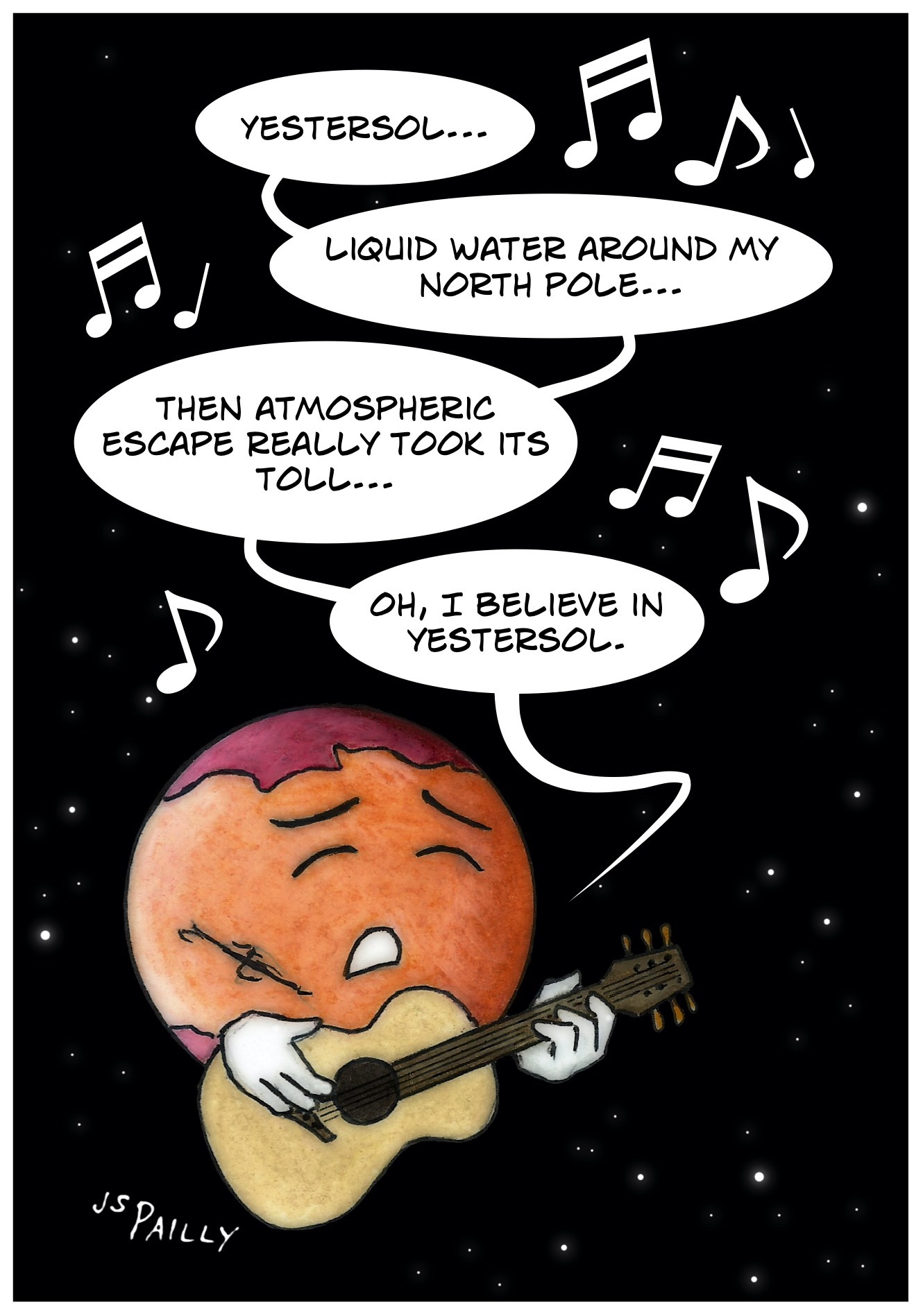
Do you ever feel like there just isn’t enough time in your day?  Like you just cannot get everything you need to do in a day done in a day?  Do you wish your day could be just a little bit longer?  If so, moving to Mars might be a good solution for you!  A day on Mars is nearly 40 minutes longer than a day on Earth!  Scientists call this slightly longer Martian day a “sol,” and several cute and clever new words have been introduced related to Martian timekeeping: words like yestersol, tosol, and solorrow.

As of yet, there are no humans on Mars (citation needed), but there are humans here on Earth who have to live and work and plan their whole schedules according to Mars time.  You see, the Mars rovers can only operate during Martian daylight hours.  Therefore, everyone back at mission control for those rovers needs to be awake, alert, at their desks and ready to go when it’s daytime on Mars (regardless of what time it is here on Earth).

Sometimes the discrepancy between a Martian sol and an Earthly day isn’t so bad.  Sometimes, when it’s daytime at Jezero Crater (current location of the Perseverance rover), it’s also daytime in southern California (where Perseverance mission control is headquartered).  But day after day, sol after sol, that forty minute difference adds up.  At some point, high noon at Jezero crater will be the middle of the night in southern California.

It’s important that the same crew of people always works with the same rover.  Therefore, NASA has had special clocks and watches made to help people keep track of what time it is on Mars.  NASA scientists and engineers associated with various Mars missions set their work schedules, meal schedules, and sleep schedules according to Mars time.  As a result, there is a small community of “Martians” here on Earth, living their lives about forty minutes out of sync from the rest of us.  And quite naturally, certain colloquial terms have developed within this little community of Mars researchers.

Yestersol refers to the sol before the current sol.  Tosol is the current sol.  And solorrow is the next sol, after the current sol.  Making a clear distinction between “yesterday” and “yestersol” is especially important for people who live on Earth and still have to deal with many Earthly concerns, but who also, in a very real way, need to think and act as if they’re living on Mars.

I like to think of the whole “yestersol, tosol, solorrow” phenomenon as a little preview of the future.  It’s one thing to think about big picture futuristic stuff, like space elevators and planetary protection laws; but it’s little bits of culture and daily life (sorry, sol-ly life) that help make the future feel like a real place.

Want to Learn More?

NASA spacecraft engineer Nagin Cox gave a really neat TED Talk about what it’s like living on Mars time.  Click here to watch it.

Our Place in Space: Xanadu

Hello, friends!  Welcome to Our Place in Space: A to Z!  For this year’s A to Z Challenge, I’ll be taking you on a partly imaginative and highly optimistic tour of humanity’s future in outer space.  If you don’t know what the A to Z Challenge is, click here to learn more.  In today’s post, X is for…

XANADU

`Titan is the largest moon of Saturn.  It’s a very cold place.  It’s so cold on Titan that water is basically a kind of rock, and certain chemicals that we typically think of as gases (i.e.: methane and ethane) flow freely as liquids.  As a result, the surface of Titan looks surprisingly similar to some regions on Earth: a rocky landscape eroded by rain and rivers.  Except the “rock” is frozen water, and the rain and rivers are a mix of liquified methane and ethane.  One of the most curiously familiar “rock” formations on Titan lies near the equator.  It’s called Xanadu.

Xanadu is an Australia-sized region of craggy hills and mountains.  Due to Titan’s thick, hazy atmosphere, it’s impossible to see Xanadu (or any other surface feature on Titan) except in certain specific wavelengths, such as certain wavelengths of infrared.  When Xanadu is visible, it appears as a bright splotch on Titan’s surface, surrounded by much darker desert terrain.

It’s unclear how Xanadu came to be.  One hypothesis I read argues that Xanadu could be associated with some sort of giant impact event.  Perhaps a large asteroid or comet smashed into Titan, disrupting the icy crust, which then refroze as this jagged and craggy terrain.  Another hypothesis suggests that Xanadu was created by some sort of tectonic activity—a fascinating possibility.  At this point, Earth is the only world confirmed to have plate tectonics.

In this Our Place in Space series, I’ve tried to emphasize all the cool and exciting things humans could do in the distant future.  I have also mentioned, from time to time, my belief that humans in the distant future will learn to be good stewards of the Earth.  Space exploration can help us do that.  Titan is so curiously familiar, yet also so weirdly different from Earth.  Trying to understand why Titan is so different-yet-similar can teach us much about our own world—which, in turn, will help us figure out how to take better care of our planet.

But there’s a catch.  Just as we have a responsibility to take better care of Earth, we also have a moral responsibility to not mess up Titan.  Remember Titan’s thick, hazy atmosphere?  There are some weird chemicals forming in that atmosphere.  Organic chemicals.  Could those organic chemicals be associated, in one way or another, with biological activity?  Maybe.  Maybe not.  No one can say at this point.

In the next few years, NASA will be sending a robotic helicopter to explore Titan’s Shangri-La region, one of the dark-colored regions directly adjacent to Xanadu.  If we’re lucky, maybe that robo-helicopter will venture into Xanadu at some point.  I have confidence that NASA will thoroughly sterilize all of their equipment before sending it to Titan to ensure that we do not contaminate Titan with our Earth germs.

There will be many more missions to Titan in the future.  Just as Mars is crawling with Mars rovers today, Titan will be covered in Titan rovers, Titan helicopters, and Titan submarines in the future.  The place has too much in common with Earth, and we simply cannot leave it unexplored.  But humans in the distant future will not only be good stewards of the Earth; they’ll be good stewards of the Solar System.  And so, whether we’re exploring Xanadu or Kraken Mare or Shangri-La, or any other region on Titan that has a super cool name, strict safety precautions will always be a must.

Want to Learn More?

I had a really hard time finding information about Xanadu for this post.  I’m guessing that’s because very little information is available at this time.  More exploring needs to be done! What I did find came from these three scientific papers:

Our Place in Space: The Wilderness

Hello, friends!  Welcome to Our Place in Space: A to Z!  For this year’s A to Z Challenge, I’ll be taking you on a partly imaginative and highly optimistic tour of humanity’s future in outer space.  If you don’t know what the A to Z Challenge is, click here to learn more.  In today’s post, W is for…

THE WILDERNESS

All month long, I’ve been telling you about how, in the distant future, human civilization will spread out far and wide across the Solar System.  At the same time, I have rather casually been declaring various places in the Solar System should be off limits to humans.  I feel perfectly justified in doing that after reading a certain research paper titled “How much of the Solar System should we leave as wilderness?”

I’m not going to summarize that paper in its entirety.  If you want to learn more, you can check out the links in the “Want to Learn More?” section below.  The main point I want to talk about, based on what that “wilderness” paper said, is that the Solar System is absolutely ginormous.  You may think you understand how big the Solar System is.  However big you think it is, it’s probably bigger than that.

As a result, we can declare insanely large swaths of territory and resources “protected wilderness” without inconveniencing ourselves.  The paper advocates for establishing a one-eighth principle, meaning that our future space economy should be restricted to using only one-eighth of the resources in our Solar System.  The remaining seven-eighths would be off limits.  To quote from the paper:

We are required, as a point of social ethics, to accept reasonable constraints upon our self-interest in order to meet basic standards of justice between one another and (arguably) between ourselves and future generations.  This is a precondition of having any sort of stable and lasting human society.  However, we will take it that a livable ethic for society at large cannot ask for too much.  More precisely, a reasonable social ethic cannot ask for anything so demanding that it is impossible, inconsistent with what we know about human psychology, or otherwise so demanding that it belongs only in the domain of private sacrificial commitment of a sort associated with political and religious ideals.  The one-eighth restriction may seem to fall foul of this constraint.

Yes, the one-eighth principle sounds very demanding and restrictive at first glance.  But, as the authors of that paper go on to explain, the Solar System is really big.  Even if we make some highly optimistic assumptions about how fast the future space economy might grow, it would still take centuries to use up a full eighth of the Solar System.

This wilderness paper is now one of my all time favorite scientific research papers.  It does make some important warnings for the future, though, and if you’re a fan of the kind of futurism I’ve been touting in this Our Place in Space series, I’d encourage you to check out the links below.

In the meantime, I declare that the rings of Saturn should be off limits to mining operations.  Let’s preserve the natural beauty of those rings.  Parts of Mars should be off limits as well—if we find alien life on Mars, perhaps the whole planet should be off limits.  Same for many of the icy moons of Jupiter, Saturn, Uranus, and Neptune—especially Titan, Enceladus, and Ganymede—and most extra especially, Europa.  Seriously, nobody mess with Europa!

Want to Learn More?

Click here to read “How much of the Solar System should we leave as wilderness?”

Or click here to read an article from Live Science summarizing the paper’s main points in less technical language.

Our Place in Space: VASIMR

Hello, friends!  Welcome to Our Place in Space: A to Z!  For this year’s A to Z Challenge, I’ll be taking you on a partly imaginative and highly optimistic tour of humanity’s future in outer space.  If you don’t know what the A to Z Challenge is, click here to learn more.  In today’s post, V is for…

VASIMR

For space enthusiasts and people directly involved in space exploration, VASIMR can be a highly controversial subject.  In some circles, mentioning VASIMR is almost like bringing up abortion or gun control.  VASIMR supporters will tell you that this technology could radically reduce the fuel costs associated with space travel and also cut down the transit times for interplanetary journeys.  The anti-VASIMR crowd will tell you that this technology has been stuck in the research and development phase for four decades now and that it’s time we cut our losses and spend all that R&D money on something else.

VASIMR stands for VAriable Specific Impulse Magnetoplasma Rocket.  Rather than generating thrust through controlled chemical explosions (as traditional rockets do), a VASIMR engine heats up a neutral gas (typically argon or xenon), ionizes that gas, then accelerates the gas using super powerful magnetic fields.  The magnetically accelerated gas shooting out the back of your spaceship will propel your spaceship forward.

The weight of your argon or xenon fuel would be far less than the weight of the liquid oxygen/liquid hydrogen fuel used in most rockets today.  And in theory, VASIMR powered rockets could travel faster than chemically propelled rockets.  We could get to Mars in a matter of weeks rather than months, or get to Jupiter in a matter of months rather than years!  So why aren’t we already using this technology?

The problem, as I understand it, is that it takes a lot of power to ionize argon or xenon gas.  It takes even more power to generate those super powerful magnetic fields.  All the equipment needed to generate that much power is heavy.  Prohibitively heavy.  Whatever advantage VASIMR might offer in terms fuel weight is thoroughly negated by the weight of all the extra equipment you’d need to make the engine work.

The idea for VASIMR was originally pitched in 1977.  The first laboratory experiment was conducted in 1983.  This technology really has been in development now for four decades, and it’s still not ready to fly.

I’m not going to advocate for cutting funding on this research.  Progress has been made over the last forty years.  It’s slow progress, to be sure, but slow progress is still progress, and if VASIMR ever does work as intended, it would be a huge, huge breakthrough for space exploration.  Many things that are not possible for us right now would suddenly become possible.

If it ever works as intended….

Want to Learn More?

As I said, VASIMR can be pretty controversial.  To give you a better sense of that controversy, I’m going to recommend this article by Robert Zubrin (President of the Mars Society), titled “The VASIMR Hoax.”  I’m also going to recommend this response to Zubrin from Ad Astra Rocket Company (the company currently working on VASIMR), titled “Facts About the VASIMR Engine and Its Development.”

Our Place in Space: Utopia Planitia

Hello, friends!  Welcome to Our Place in Space: A to Z!  For this year’s A to Z Challenge, I’ll be taking you on a partly imaginative and highly optimistic tour of humanity’s future in outer space.  If you don’t know what the A to Z Challenge is, click here to learn more.  In today’s post, U is for…

UTOPIA PLANITIA

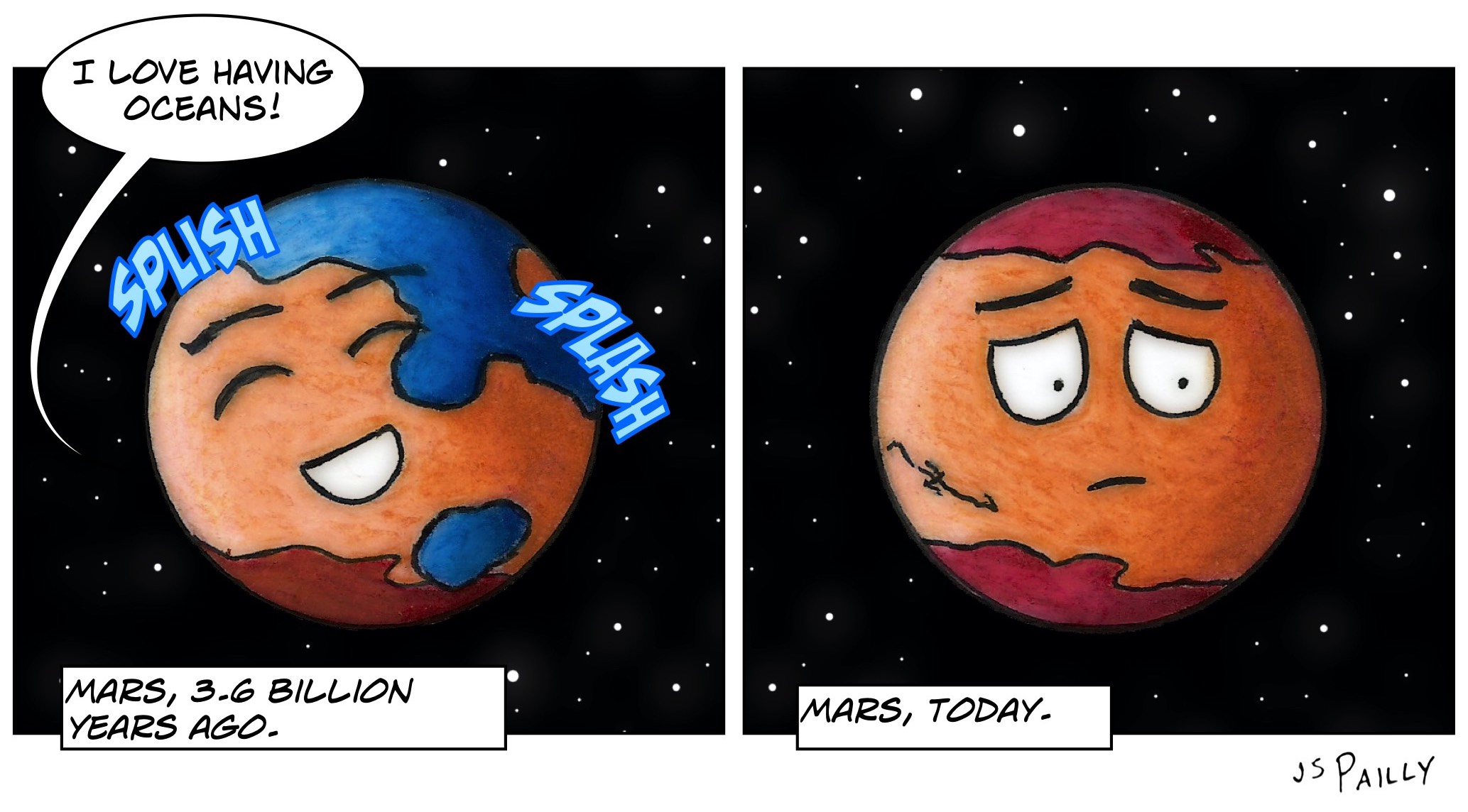
Earlier this month, we talked about Jezero Crater on Mars.  There’s strong and compelling evidence to suggest that Jezero Crater was once filled with liquid water.  In other words, Jezero Crater used to be a lake.  If Jezero Crater used to be a Martian lake, then the nearby region of Utopia Planitia was probably once a Martian ocean.

As you can see in the highly technical diagram above, much of Mars’s northern hemisphere was once covered in water.  Probably.  Okay, as a responsible science blogger who wouldn’t want to make you think there’s scientific consensus about a topic when there is not scientific consensus about a topic, I should make it clear to you that the topic of ancient Martian oceans is somewhat controversial in the scientific community.  Scientists are still arguing over what may or may not be ancient Martian shorelines, among other things.

But let’s assume that ancient Mars did have oceans of liquid water on its surface (that seems like a safe assumption to me, but I’m not a scientist—I’m just a guy with a blog).  If so, those oceans would have covered much of Mars’s northern hemisphere.  Today, Mars is sort of a lopsided planet, with generally low elevation terrain in the north and generally higher elevation terrain in the south.  So if ancient Mars did have large amounts of liquid water on its surface, common sense tells us that that water would have accumulated in the low elevation regions (i.e., the northern hemisphere).

Utopia Planitia is one of those low elevation regions in the northern hemisphere.  The terrain is also relatively flat, making Utopia Planitia a fairly easy place to land a spacecraft.  Several robotic missions to Mars have already landed there, the most recent being China’s Zhurong Rover.  And as if all that weren’t enticing enough, ground penetrating RADAR has detected frozen water underground in the southwestern portion of Utopia Planitia.

In the distant future, Utopia Planitia may end up being the site of a major human colony on Mars.  It’s a safe place to land, there’s a supply of water nearby, and it’s a scientifically interesting region.

On the other hand, if plans to terraform Mars ever come to fruition, Utopia Planitia may end up being part of a Martian ocean once again.  As I said before, it’s a low elevation region.  As we transform Mars into a more Earth-like world, water will start to accumulate in places like Utopia Planitia first, at which point we’d probably have to change the name from Utopia Planitia (plains of Utopia) to Utopia Mare (sea of Utopia).

Want to Learn More?

P.S.: As a Star Trek fanatic, I’d be remiss if I didn’t mention this.  Many of the ships from Star Trek were built at the Utopia Planitia shipyards on Mars, according to Star Trek lore.

Our Place in Space: Tolkien Crater

Hello, friends!  Welcome to Our Place in Space: A to Z!  For this year’s A to Z Challenge, I’ll be taking you on a partly imaginative and highly optimistic tour of humanity’s future in outer space.  If you don’t know what the A to Z Challenge is, click here to learn more.  In today’s post, T is for…

TOLKIEN CRATER

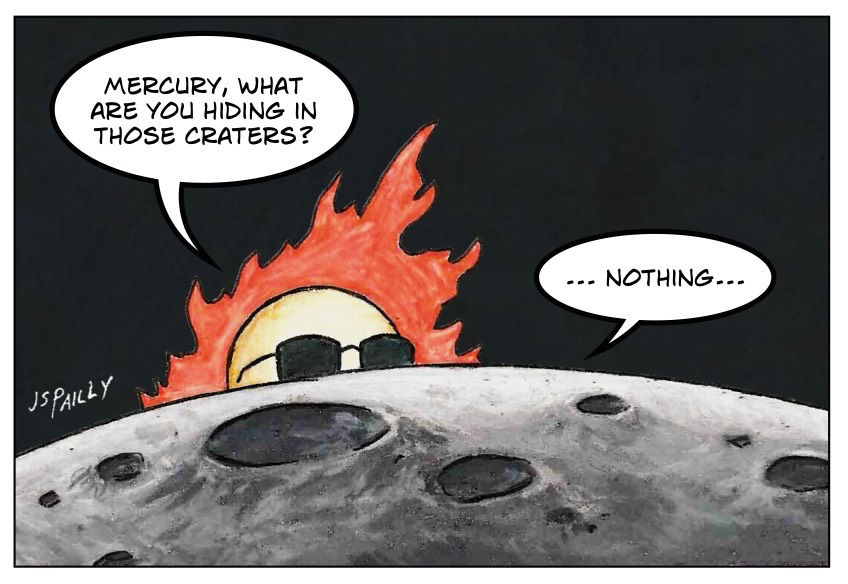
You would not expect to find water on Mercury.  If there ever was water on Mercury, you’d expect it to boil away into space pretty quickly.  I said the exact same thing about water on the Moon yesterday, and yet it turns out there is water on the Moon, trapped in ice form at the bottom of craters near the Moon’s north and south poles.  The same is true for craters near the north and south poles of Mercury.  To my eternal delight, one of those water-filled craters is named after fantasy author J.R.R. Tolkien.

By longstanding tradition, craters on Mercury are named after historically important artists, authors, and musicians.  There are a few exceptions, because a few craters were named before that tradition was established, but the vast majority follow the rule.  And so there’s a crater named after Shakespeare, and a crater named after Van Gogh, and a crater named after Mozart.  John Lennon has a crater named after him.  Walt Disney has a crater.  And so does J.R.R. Tolkien.

Tolkien Crater happens to be located near Mercury’s north pole.  As a result, the bottom of Tolkien Crater is perpetually shielded from sunlight by the crater walls.  It’s extremely dark and extremely cold—cold enough for frozen water to remain stable over cosmic time scales, despite Mercury’s lack of any significant atmosphere or Mercury’s proximity to the Sun.

In the distant future, as humanity spreads out across the Solar System, we may end up deciding to colonize Mercury.  Mercury has resources humans in the future may need: large quantities of metal and perhaps, also, large quantities of helium-3 (necessary for powering nuclear fusion reactors, assuming we ever figure out how to make nuclear fusion reactors work).  If humans do colonize Mercury, places like Tolkien Crater will be valuable real estate.

Most likely, human habitats on Mercury will be built underground.  It’s easier and safer to live underground than to live on Mercury’s surface.  As a result, I like to imagine that people living in and around Tolkien Crater will refer to their subsurface dwellings as “Hobbit holes.”  However, considering how important mining operations would be for a successful Mercury Colony, some sort of reference to the Mines of Moria might be more appropriate.

Let’s just hope those Mercury colonists do not delve too greedily or too deep, lest they awaken something slumbering in the darkness.

Want to Learn More?

Universe Today has an article on how and why we might colonize Mercury.  And here’s an article from Wired.com about the naming of Tolkien Crater.

Lastly, I feel that I have to mention this: if you haven’t seen a picture of Disney Crater, you really need to click here and see a picture of Disney Crater.