Sciency Words: Weird Phobias

Sciency Words Logo

Today’s post is part of a special series here on Planet Pailly called Sciency Words.  Every Friday, I bring you a new and interesting scientific word to help us all expand our scientific vocabularies.  Today’s word is:

PHOBIA

I think we all have our own little, irrational fears.  I’m terrified of blood.  I once fainted in a biology class because we were talking about blood.  I think it was something about blood cells squeezing through capillaries in single file that set me off.

I recently spent some time researching various phobias for a writing project and learned that the technical term for my irrational fear is hemophobia.  Here are a few other interesting phobias.

  • Pupaphobia: the fear of puppets.
  • Aibohphobia: the fear of palindromes (it’s funny because aibohphobia is itself a palindrome).
  • Omphalophobia: the fear of belly buttons.
  • Hellenologophobia: fear of the ancient Latin and Greek languages, or fear of scientific terminology (if you are hellenologophobic, you probably shouldn’t be reading this blog).
  • Sesquipedalophobia: fear of long words.
  • Hexakosioihexekontahexaphobia: fear of the number 666.

So what’s your biggest phobia?  Do they have a technical term for it?  Have you ever managed to overcome your fear?  Please share in the comments below.

Sciency Words: Xylophone

Sciency Words Logo

Today’s post is part of a special series here on Planet Pailly called Sciency Words.  Every Friday, I bring you a new and interesting scientific word to help us all expand our scientific vocabularies.  Today’s word is:

XYLOPHONE

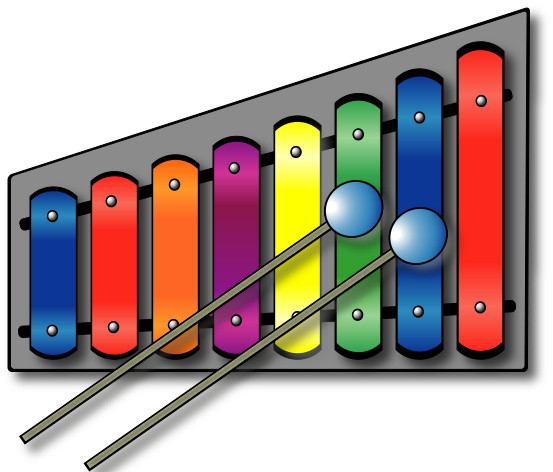
Okay, xylophone isn’t really a sciency word, but it has a sciency word contained within it.  “Phone,” of course, means sound, but what about the “xylo-” part?  That comes from the Greek word “xylon,” which means wood, and there are lots of scientific terms that use “xylon” as a root, especially in the study of plants.

You might remember the words “xylem and phloem” from your 5th grade science class.  They’re sort of like the arteries and veins of plant biology, helping to transport water and other nutrients from the ground up to the treetops.

There’s also the term “xylophagous,” an adjective describing something that eats wood.  Termites, for example, are xylophagous insects.  “Xylitol” is a kind of sugar mainly found in birch tree sap, and it has the unusual property of being a sugar that is good for your teeth.  We also have the term “xylophobia,” the fear of forests or of objects made of wood.

“Xylene” is a category of petrochemicals originally discovered in wood tar, hence its name.  We now use it in solvents, paint thinners, and gasoline.  Some car enthusiasts add extra xylene to regular gas to create a higher octane.  I’ve read enough articles about how this can go horribly wrong, since xylene is a toxic and flammable chemical, so please don’t try this at home.

Picture courtesy of wpclipart.com

So the next time you hear a word with the prefix “xylo-” you’ll know what it means.  It’s fairly easy to remember too, given that we’re all familiar with the humble xylophone.  The only sad part is that the xylophone I had as a kid was made entirely out of plastic and therefore was not a xylophone at all.

P.S.: “Xylon” would make a great name for a race of wooden robots.  They could be the low-tech counterparts to Battlestar Galactica’s Cylons.

Sciency Words: What Comes After Yottabyte?

I recently saw an old Sci-Fi movie where one character uses the word “terabyte” as though this is some enormously large quantity of data.  And, of course, it is, at least here in 2013.  But the movie was set several centuries from now.  By that time, I doubt a whole terabyte would impress anyone.

Terabyte comes from a Greek word meaning “monster,” as in a terabyte is a monstrous amount of information.  It’s equal to one trillion bytes.  After terabyte comes petabyte, exabyte, zettabyte, and finally yottabyte.  The prefix “yotta-” comes from the Italian word for eight and means 1,0008, so a yottabyte equals one septillion or 1,000,000,000,000,000,000,000,000 bytes.

And yet centuries from now, even a yottabyte might not seem like a lot.  It’s rumored that the NSA has already collected several yottabytes of data for its surveillance programs.  I suspect this is a slight exaggeration (emphasis on slight) but it does prove that the term yottabyte is already becoming part of our vocabularies.

So what comes after a yottabyte?  According to my research, yottabyte is currently the largest amount of data that we have an official term for, but some people have already proposed the word brontobyte for the next level.  I presume a brontobyte is so much data that it’s as big as a brontosaurus.


IMG_1097

Sciency Words: Mathematical Theorem

Sciency Words Logo

Sometimes stuff happens, and so I missed yesterday’s Sciency Words post.  Sciency Words is a series here on Planet Pailly where we take a look at some interesting scientific term and try to expand our sciency vocabularies together.  I usually post this series on Fridays, but this week I fell behind schedule, so I’m a day off.

So for the first ever Saturday edition of Sciency Words, our word today is:

MATHEMATICAL THEOREM

Last week, we talked about the difference between a scientific theory and a scientific law, or rather the lack of any real difference between them.  Neither one can ever be taken as 100% certain, but that doesn’t mean that one day a theory (like say evolution) will be discarded completely.  New theories seek to refine the old ones, not replace them outright.

Some degree of uncertainty is inherent in science, but that’s not true of mathematics.  Two plus two equals four.  The sum of the angles of an equilateral triangle equals 180 degrees.  Two parallel lines on a flat surface will never intersect.  These are incontrovertible facts.  Where scientists struggle with their imprecise theories and laws, mathematicians enjoy full confidence in what they call “theorems.”

You’re probably familiar with the Pythagorean Theorem, which states that a2 +b2 = c2 when we’re dealing with the sides of a right triangle.  This theorem was first discovered by an ancient Greek philosopher named Pythagoras and has remained unchanged and unchallenged for over 2,500 years.  There are literally hundreds of ways to prove the Pythagorean Theorem (click here to see 99 of them), but that’s not really necessary.  Where in science we must perform the same experiment hundreds or even thousands of times and still have doubts, mathematics only requires us to prove something once.

So mathematical theorems are 100% certain in a way no scientific theory or law can ever be; however, we must keep in mind that these theorems apply only to our abstract concept of geometry and numbers.  Here in the real world, there are no perfect circles, no angles that are exactly 90 degrees, and no two lines that are perfectly parallel.  The real world is messy and imprecise, and so science remains our best tool for the study of the universe we actually live in.

Scientific Theory vs Scientific Law

Sciency Words Logo

Today’s post is part of a special series here on Planet Pailly called Sciency Words.  Every Friday, I bring you a new and interesting scientific word to help us all expand our scientific vocabularies.  Today, I want to do something a little different and take a look at two terms that we all probably know but are too often misunderstood.

SCIENTIFIC THEORY vs. SCIENTIFIC LAW

You may hear someone say, “Well, evolution is just a theory,” as though that means it’s a trivial thing, little more than guesswork.  A common misconception is that, if we really knew for sure, if there truly were no doubts, we’d call it a scientific law.  So since there is no “Law of Evolution,” that must mean the matter is still suspect.  Perhaps the whole evolution idea may one day turn out to be wrong.

I was taught in school that there are three levels of scientific certainty.  First comes the hypothesis, an untested idea based on scientific observations alone.  Next comes the theory, a hypothesis that has survived all the experiments we’ve tried thus far but is still “just a theory.”  Lastly, we have scientific laws, which are theories that have been proven beyond all possible doubt, that cannot be challenged or overturned, that are absolute, scientific Facts (with a capital F).

That’s a convenient hierarchy, one that was easy for my twelve-year-old self to understand, but it’s not actually the way things work.  There are several different definitions for scientific theories and scientific laws.  The distinction sometimes involves whether or not the theory/law uses mathematics.  Sometimes it’s a question of whether or not the theory/law describes some specific phenomenon or a more generalized view of nature.  And some experts will tell you there is no difference between them whatsoever.

The view I have come to accept is that the difference has more to do with the fashion of the time than anything else.  In the 17th and 18th Centuries, scientists generally called their discoveries laws (for example, Newton’s Law of Gravity or Kepler’s Laws of Planetary Motion).  Scientists in more modern times, such as Darwin (19th Century) or Einstein (20th Century), prefer to call their discoveries theories.  This may reflect a changing attitude among scientists who had come to realize that nothing in science is ever 100% certain.

So what happens when a law or theory is “disproven,” and what would happen if a new discovery seriously challenged the Theory of Evolution?  Well, when Einstein’s Theory of Relativity “disproved” Newton’s Law of Gravity, that did not mean that gravity suddenly went away.  We still use Newton’s law today because it’s a close approximation of the truth, at least until you approach a black hole or try accelerating to the speed of light.  Under those conditions, Newton can’t help you, mainly because he had no idea such things were even possible.

One day, we may learn that Darwin’s Theory of Evolution is only an approximation of the truth.  In fact, that’s already happened thanks in part to the discovery of DNA, something that Darwin didn’t know existed.  The result was not the end of evolution but the development of a new, more sophisticated theory, one that adds greater precision and detail to its predecessor.  We might call this the Theory of Genetic Evolution in order to distinguish it from Darwin’s original idea, but the basic concept remains the intact.

In science, nothing is proven beyond all possible doubt, but that doesn’t mean new theories completely replace the old ones.  One theory builds upon another and upon another.  Einstein built upon the work of Newton, Newton upon the work of Galileo, and so forth all the way back to the natural philosophers of Ancient Greece.  Science continuously makes new discoveries and refines its understanding of nature.  Whether we call these discoveries theories or laws doesn’t matter.  What matters is that science keeps evolving.

P.S.: Special thanks to Mark Ball for suggesting scientific theory as the subject for today’s post.  Please check out Mark’s website, Sci-Fi Ideas.  It’s a great place for both science fiction fans and science enthusiasts to muse over the many possibilities of our universe.

P.P.S.: The great science fiction writer Isaac Asimov once wrote an essay entitled “The Relativity of Wrong.”  Click here to read it.  It’s one of my favorite pieces on science, and it was a real eye-opener for me back when I still believed in that silly hierarchy of scientific certainty I’d learned in school.
Sciency Words: Local Fluff

Sciency Words Logo

Science fiction uses scientific language as a form of artistic expression.  With that in mind, today’s post is part of a series here on Planet Pailly called Sciency Words.  Every Friday, I’ll bring you a new and interesting scientific word to help us all expand our scientific vocabularies together.  Today’s word is:

LOCAL FLUFF

Yes, this is a real science term.  No, it has nothing to do with porn.

As you’re probably aware, you live on the planet Earth.  Earth is located in the Solar System, and the Solar System is located inside a region of space known as the Local Fluff.  Scientists currently estimate this region is roughly 30 light-years across. What’s fluffy about it?  Well, it’s a cloud of hydrogen gas slightly denser than the interstellar medium surrounding it.

In a high tech, Science Fiction future, the Local Fluff might become very important.  Just as rivers and mountain ranges helped determine the political boundaries of nations here on Earth, gas clouds like the Local Fluff might one day be used to draw the borders between intergalactic space empires.

Our Solar System is located close to the outer edge of the Local Fluff.  Alpha Centauri, our nearest neighbor, is just over the border, inside another hydrogen cloud called the G-Cloud (which also has nothing to do with porn).  To find out more about the Local Fluff, click here.

Sciency Words: Recency Bias

Sciency Words Logo

Science fiction uses scientific language as a form of artistic expression.  With that in mind, today’s post is part of a series here on Planet Pailly called Sciency Words.  Every Friday, I’ll bring you a new and interesting scientific word to help us all expand our scientific vocabularies together.  Today’s word is:

RECENCY BIAS

Recency bias: (noun) the human tendency to place greater emphasis and importance on recent events rather than events farther back in time.  Whenever a piece of good news or bad news seems to overshadow everything that ever happened before, that’s recency bias at work.

You might notice the effects of recency bias on the stock market, where the slight change in the value of a stock today is perceived as more significant than the greater, gradual changes that occurred over the course of a year.  You’ll also catch it in political commentaries whenever you hear someone claim that the current President, Congress, etc is the best/worst in history.  It can also come up in sports, art, literature… pretty much anything.

You might even encounter recency bias in your own life.  I often experience it whenever I have writer’s block.  My difficulty composing one stupid sentence for a current writing project somehow convinces me that I suck at writing and at life, despite the fact that I’ve had writer’s block before and despite the fact that I always find a way to get through it.

Of course it is always possible that, when the stock market starts slipping, that it really does mean the economy is about the collapse.  It’s also possible that our current political leaders are the best or worst ever, or that the newest rookie player for your favorite sports team really will change the game forever.  These things are possible… but kind of unlikely.

So before you jump to conclusions, check yourself for recency bias.  Make sure you’re not just thinking about the latest headlines or your most current headache.  Just remember to keep things in the context of history.

* * *

Did you already know this word?  If so, please share another sciency word in the comments below.  That way, we can all keep expanding our sciency vocabularies together!

Sciency Words: Qubit

Sciency Words Logo

Science fiction uses scientific language as a form of artistic expression.  With that in mind, today’s post is part of a series here on Planet Pailly called Sciency Words.  Every Friday, I’ll bring you a new and interesting scientific word to help us all expand our scientific vocabularies together.  Today’s word is:

QUBIT

The spelling of this word drives me bonkers.  It’s pronounced “Q-bit.”  There’s no need for that “u.”  Just replace it with a hyphen, and no one would be confused about the pronunciation.  Unfortunately, the spelling “qubit” has been around long enough already that it’s unlikely to change.

Anyway… qubits are the bits of quantum computers.  Where a bit in a regular computer stores information as either a 0 or a 1, a qubit takes advantage of the weird and wacky laws of quantum mechanics to store information as a 0, a 1, or as a 0 and 1 at the same time.

To put it another way, regular computers think in terms of yes or no.  A quantum computer can think in terms of yes, no, or maybe.  This allows quantum computers to do multiple simultaneous calculations, making them much faster than those simple minded, binary code machines we already know and love.

At the moment, quantum computers are still in development, and they’re only useful for specific, highly complex calculations.  But sooner or later, these things with all their strange, little qubits will be coming to a desktop near you, and then you’ll all get to share my frustration with this awkwardly spelled word.  Presumably by then we’ll also have to learn how to say qubytes, kiloqubytes, megaqubytes, and so on.

* * *

Did you already know this word?  If so, please share another sciency word in the comments below.  That way, we can all keep expanding our sciency vocabularies together!

Sciency Words: Compulsator

Sciency Words Logo

Science fiction uses scientific language as a form of artistic expression.  With that in mind, today’s post is part of a series here on Planet Pailly called Sciency Words.  Every Friday, I’ll bring you a new and interesting scientific word to help us all expand our scientific vocabularies together.  Today’s word is:

COMPULSATOR

Compulsator: (noun) a device used to collect energy from a low-powered source then release it as a high-powered pulse.  The term is short for compensated pulsed alternator.

Think of it like a savings account at a bank.  If you deposit a small amount of money each day, at some future point in time you’ll be able to withdraw a large sum of cash for a major purchase.  In a similar way, by accumulating small amounts of energy in a compulsator, you’ll be able to generate a huge burst of power later on when you need it.

The most common use for compulsators is in a weapon called a rail gun.  The compulsators store energy as inertia in a spinning rotor then release it all at once to fire a projectile.  At the moment, rail guns are still experimental, but they—and the compulsators that make them work—will probably be common terms for soldiers fighting in futuristic, Sci-Fi wars.

* * *

Did you already know this word?  If so, please share another sciency word in the comments below.  That way, we can all keep expanding our sciency vocabularies together!

P.S.: I decided to focus on the term compulsator rather than rail gun today because a) I think the word compulsator is less well known and b) in the future, I suspect engineers will integrate the compulsator into other new weapon technologies besides the rail gun.

P.P.S.: At the moment, I have yet to find an example of a compulsator being used for a peaceful purpose.  If anyone knows of one, please share it in the comments below.

Sciency Words: Synodic Month

Sciency Words Logo

Science fiction uses scientific language as a form of artistic expression.  With that in mind, today’s post is part of a series here on Planet Pailly called Sciency Words.  Every Friday, I’ll bring you a new and interesting scientific word to help us all expand our scientific vocabularies.  Today’s word is:

SYNODIC MONTH

You’re probably aware of the fact that a month is approximately the amount of time it takes for the Moon to complete one full orbit around the Earth.  But if we’re talking about science, “approximately” doesn’t cut it.  That’s why we have the synodic month.

Image courtesy of wpclipart.com

A synodic month is exactly the amount of time it takes the Moon to complete one full orbit around the Earth (keeping in mind that the Earth is also orbiting the Sun).  It’s a bit easier to remember than the regular month.  There’s nothing about February being shorter than June or June being shorter than July.  Unfortunately, twelve synodic months don’t add up to a solar year, so we still have to keep using the calendars we already have.

The length of a synodic month is a little more than twenty-nine and a half days, give or take a fraction of a second.  Over time, however, the synodic month will grow longer and longer.  This is because the Moon is slowly moving away from the Earth.  One day, the gravitational pull between the Earth and the Moon might balance out, and the synodic month will stabilize at roughly 47 days.  Or perhaps, billions of years from now, the Moon might escape Earth’s gravity all together and fly off into space by itself.

So the next time you see the Moon glowing pale white in the sky, be sure to take a moment and appreciate it because it might not be there forever.

* * *

Did you already know this word?  If so, please share another sciency word in the comments below.  That way, we can all keep expanding our sciency vocabularies together!