Sciency Words: Verona Rupes

Sciency Words PHYS copy

Sciency Words is a special series here on Planet Pailly celebrating the rich and colorful world of science and science-related vocabulary. Today, we’re looking at the term:

VERONA RUPES

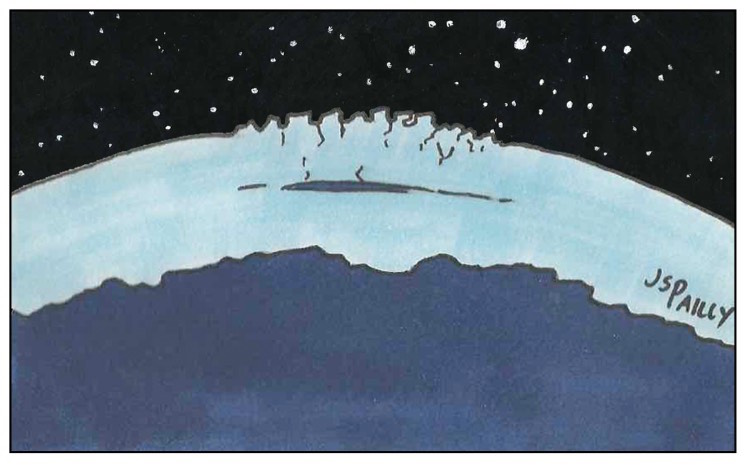
In Wanderers, a short film by Erik Wernquist, we see ordinary humans of the future living, working, and having fun all across the Solar System. One of the fun parts is a cliff-jumping scene on Uranus’s moon Miranda, in a place called Verona Rupes.

The moons of Uranus are generally named after Shakespearean characters, or at least characters from classic literature. The Shakespeare theme also applies to features on those moons, so Verona Rupes is named after Verona, Italy, the setting of Romeo and Juliet. “Rupes” is the Latin word for cliff.

Estimated to be somewhere between 5 and 20 kilometers high (sources disagree wildly about the exact height), Verona Rupes is the tallest cliff in the Solar System, as far as we currently know. For comparison, commercial airliners here on Earth normally fly at an altitude of 9 kilometers.

That extreme height may sound crazy, but it makes sense in the context of Miranda’s landscape. Miranda is sometimes called the Frankenstein’s monster of moons because it has a bizarre, patchwork-like appearance. It looks as though someone took bits and pieces of different planets and moons and haphazardly stitched them together.

Only the southern hemisphere of Miranda has been photographed, so it’s entirely possible more Verona Rupes-like cliffs may be discovered one day in the northern hemisphere.

Jumping off Verona Rupes might not be as terrifying as it seems. Yes, it’s a long drop, but Miranda only has 0.8% of Earth’s surface gravity. So rather than plummeting to your death, you’d drift lazily to… actually, you’d still plummet to your death, or at least serious injury.

Acceleration due to gravity may be low, but after falling 5 to 20 kilometers, you’ll still smack the ground at a velocity of several hundred kilometers per hour. Fortunately, according to Erik Wernquist’s website, those thrill-seekers on Miranda have small rockets to brake their falls.

Links

Miranda High Resolution of Large Fault from JPL Photojournal.

Verona Rupes: Tallest Known Cliff in the Solar System from Astronomy Picture of the Day.

Bizarre Shape of Uranus’ “Frankenstein” Moon Explained from Space.com.

Sciency Words: Ice Giant

Sciency Words BIO copy

Sciency Words is a special series here on Planet Pailly celebrating the rich and colorful world of science and science-related vocabulary. Today, we’re looking at the term:

ICE GIANT

Depending on whom you ask, our Solar System has either four gas giants or only two. Uranus and Neptune are sometimes classified as ice giants instead.

Oc04 Vanilla Ice Giant

Why do we have to make this distinction? Because in the 1990’s (around the time that annoying Vanilla Ice song came out), astronomers began to realize that Uranus and Neptune are fundamentally different from Jupiter and Saturn.

While Jupiter and Saturn are composed of over 90% hydrogen, Uranus and Neptune have a more interesting mix of chemicals: methane, ammonia, water… They have hydrogen too, but the ratio of hydrogen to other stuff is much lower.

It’s believed that during the formation of the Solar System, Uranus and Neptune accumulated vast quantities of ice (hence the name ice giant). By ice, I mean any volatile substance in a solid state, not just water ice.

In describing modern Uranus and Neptune, astronomers continue to call substances like methane, ammonia, and water “ice” even though these substances aren’t necessarily in a solid form anymore. Also, don’t let any of this terminology mislead you into thinking these planets are cold. Their interiors are extremely hot, regardless of their so-called “icy” composition.

Perhaps the biggest difference between gas and ice giants relates to us humans. We don’t honestly know much about the gas giants, but we know even less about their icy cousins. Jupiter and Saturn have been visited by a handful of space probes. Uranus and Neptune have only been visited once each, and that was back in the 80’s.

Oc04 Uranus Spins Right Round

NASA is currently considering a flyby mission to Uranus or Neptune (or both) similar to the recent flyby of Pluto by New Horizons. Approval for that may come in the next year or so.

Of course, if we really want to understand what ice giants are like and why they’re so different, we should send an orbiter, not just a flyby mission. Unfortunately, entering orbit around Uranus or Neptune is much easier said than done. More on that next week.

Links

NASA’s Next Big Spacecraft Could Visit an Ice Giant from Astronomy Magazine.

The Atmospheres of the Ice Giants, Uranus and Neptune from NASA’s Jet Propulsion Laboratory.

Are There Oceans on Neptune? from Universe Today.

Sciencey Words: Uranus

As we continue our voyage through the Solar System, we now reach a planet that has become the butt of far too many childish jokes.

Oc01 Presenting Uranus

I’ve sort of been dreading this. Uranus is the first planet discovered in modern times. It’s only been visited by a spacecraft once. It’s colder than it should be, the atmosphere is oddly featureless (at least in visible light), and some of its moons are pretty strange. Also, Uranus is spinning sideways for some reason.

But it’s hard to take any of that seriously because… well… you know why.

In fact, I rarely if ever hear about new discoveries on or concerning Uranus. Part of the reason is that Uranus is so far away and so difficult to observe; however, Neptune is even farther, and I do occasionally hear about new discoveries there.

I sometimes wonder if astronomers are deliberately avoiding this area of research. I mean, nobody wants to be the guy who probes Uranus for a living.

So how did the seventh planet from the Sun get this embarrassing name? The story, as it turns out, is really interesting.


So what do you think of Uranus’s name? Would you have preferred Herschel or Georgium Sidus or some other possibility?

Sciency Words: Specular Reflection

Sciency Words BIO copy

Sciency Words is a special series here on Planet Pailly celebrating the rich and colorful world of science and science-related terminology. Today, we’re looking at the term:

SPECULAR REFLECTION

A specular reflection is a reflection off a smooth, mirror-like surface, such as glass, polished metal, or a tranquil body of water. The opposite of a specular reflection is called a diffuse reflection, where light strikes a surface and scatters in multiple directions.

Specular reflections are rare in nature. Few surfaces have the perfect, mirror-smooth finish that makes this phenomenon possible. Pools of liquid water are really the best example. Well, pools of liquid—it doesn’t necessarily have to be water.

In the field of planetary science, specular reflections have become extremely important in relation to Titan, Saturn’s largest moon. For a long time, scientists thought Titan might have liquid on its surface. Not liquid water—Titan’s too cold for that—but perhaps liquid hydrocarbons, specifically a mixture of liquid methane and ethane.

And so when the Cassini spacecraft entered orbit of Saturn in 2004, the search was on for Titan’s liquids. Titan’s hazy atmosphere makes it almost impossible to view the moon’s surface in visible light, so Cassini made its observations in other wavelengths, from infrared to radio frequencies.

Dark regions were soon identified on Titan’s surface. Were they lakes of hydrocarbons? No one could be sure until 2008, when Cassini bounced radiowaves off a suspected lake in the southern hemisphere; the radiowaves bounced back, just like a specular reflection.

In 2009, Cassini was again observing Titan in infrared when a glint of sunlight bounced off another suspected lake, this time in the northern hemisphere. Again, it was just like a specular reflection.

Sp10 Titan Sparkles
Cassini continues to investigate Titan’s other… peculiarities.

In fact, these specular reflections turned out to be surprisingly bright. Titan’s lakes must be extremely smooth and still, with hardly any waves at all. This suggests that either Titan’s weather is oddly tranquil or that the methane/ethane mix in these lakes is more viscous than we expected, more like honey than water.

Earth and Titan are the only places in the Solar System where liquid anything flows on the surface. As a result, these two worlds have a surprising amount of stuff in common, from erosion to weather patterns, and maybe even life. More on that next week.

In the meantime, who’s up for a swim?

Links

Smoothness of Titan’s Ontario Lacus: Constraints from Cassini RADAR Specular Reflection Data from Geophysical Research Letters.

Sunlight Glint Confirms Liquid in Titan Lake Zone from NASA.

Saturn Moon’s Mirror-Smooth Lake “Good for Skipping Rocks” from New Scientist.

Sciency Words: Trojans

Sciency Words MATH

Sciency Words is a special series here on Planet Pailly celebrating the rich and colorful world of science and science-related terminology. Today, we’re looking at the term:

TROJANS

Trojan asteroids are asteroids that share their orbits with a planet. This may not seem like a particularly safe arrangement for the asteroids (or the planet), but so long as the asteroids are positioned just right, their orbits will remain stable.

The asteroid must be located near something called a Lagrange point, specifically the L4 or L5 points. These are points in the orbital plane where the distance to the planet equals the distance to its host star. The combined gravitational pulls of the planet and star will cause the asteroid to circle round and round the Lagrange point in a bizarre, corkscrew-like orbital path.

The first known Trojans were discovered near Jupiter very early in the 20th Century. The initial plan was to name them all after characters from the Trojan War, as told in Homer’s Iliad; however, it turned out that there were way, way more Trojan asteroids than named characters in that particular story.

We now know that Jupiter has over 6,000 Trojans, about 4,000 orbiting ahead of it and another 2,000 orbiting behind. Most of the other planets in the Solar System have Trojans too.

Neptune has a dozen confirmed Trojans, according to the IAU’s Minor Planet Center. Mars has four, which were probably captured from the asteroid belt. Earth and Uranus each have one. And Saturn… Saturn has none. No Trojans. Probably because Jupiter stole them all.

Sp07 Sad Saturn

Aww, cheer up, Saturn! You have something way cooler than Trojan asteroids: Trojan moons!

Saturn is the only planet where moons are known to share orbits with each other. Tethys, Telesto, and Calypso orbit together, with Telesto near Tethys’s L4 point and Calypso near the L5 point. Dione, Helene, and Polydeuces make a similar set, with Helene and Polydeuces near Dione’s L4 and L5 points, respectively.

Trojan asteroids are interesting; Trojan moons moreso. But what would be really fascinating, should we ever discover them, are Trojan planets. Somewhere out there, could there be terrestrial worlds hovering near the L4 or L5 points of gas giants? Could these worlds support life? What sort of civilization might develop there, and what strange sights would they see in the night sky?

These are questions best answered by science fiction writers. At least for now.

Sciency Words: Cryovolcano

Sciency Words PHYS copy

Sciency Words is a special series here on Planet Pailly celebrating the rich and colorful world of science and science-related terminology. Today, we’re looking at the term:

VOLCANO

Okay, I guess this is a scientific term. It’s certainly an important concept in geology, but how about we do something a little more exotic for today’s Sciency Words post:

CRYOVOLCANO

Much better! Instead of a volcano spewing fire and lava and ash, picture a volcano that erupts with a mix of icy cold fluids and/or vapors which scientists call “cryomagma.”

How Do Cryovolcanoes Work?

When cryovolcanoes erupt, their cryomagma tends to include lots of liquid water, but at temperatures well below zero degrees Celsius. We all know that salt lowers the freezing point of water. Other substances, including ammonia and methane, can have the same effect.

Cold as they are, cryovolcanoes still require a heat source. This heat can be generated in several ways, including tidal forces, radioactive decay, or perhaps even a subsurface greenhouse effect whereby translucent surface ice allows light energy from the Sun to be trapped as heat energy deep underground.

Where Can We Find Cryovolcanoes?

Cryovolcanoes were first discovered on Triton, one of Neptune’s moons, in 1989. In 2005, the Cassini spacecraft observed cryovolcanic activity on Enceladus, a moon of Saturn, leading to rampant speculation about Enceladus’s possible subsurface oceans and possible organisms swimming in those oceans.

Enceladus remains on the shortlist of places astrobiologists want to check for alien life. And since cryovolcanoes often vent materials into space, we could easily go collect a sample.

Much of what we now know about cryovolcanoes is thanks to our ongoing observation and study of Enceladus.

How Rare are Cryovolcanoes?

So which are more common: volcanoes or cryovolcanoes? Thus far, regular volcanoes have been found on Earth and Io (one of Jupiter’s moons), and strong evidence of volcanic eruptions was just recently observed on Venus. Meanwhile, cryovolcanoes have only been confirmed on two worlds: Triton and Enceladus.

Based on that, it might seem like regular volcanoes are ahead, but hints of cryovolcanism have been found on a long, long list of moons in the outer Solar System (also Pluto).

At the beginning of this post, I insinuated that cryovolcanoes are “exotic,” but I’d guess that Earth-like or Io-like volcanic activity is far less common. Small, icy objects with their weird (to us) cryovolcanoes are probably scattered all across the cosmos.

Links

Active Volcanoes in Our Solar System from Geology.com.

Learning about Volcanic Activity on Triton from Bright Hub.

Ocean on Saturn Moon Enceladus May Have Potential Energy Source to Support Life from Space.com.

Sciency Words: Roche Limit

Sciency Words BIO copy

Sciency Words is a special series here on Planet Pailly celebrating the rich and colorful world of science and science-related terminology. Today, we’re looking at the term:

ROCHE LIMIT

Our yearlong voyage through the Solar System now brings us to Saturn, arguably the Solar System’s most beautiful planet.

Sp02 Put a Ring on It

Where did Saturn’s rings come from? That’s a subject of ongoing scientific debate, but whatever the explanation, it probably has something to do with the Roche limit.

First calculated in 1848 by French astronomer and mathematician Edouard Roche, the Roche limit describes the distance at which an object orbiting a larger object will be torn apart by the larger object’s gravity.

Gravity becomes exponentially weaker the farther you get from the source of that gravity. This is known as the inverse square law. What it means for a moon, especially a large moon, is that the gravitational pull on one side of the moon is stronger than on the other. Move that moon closer to its planet, and the discrepancy gets worse. Exponentially worse.

If our hypothetical moon strayed too close, the planet’s gravity could start pulling one side of the moon away from the other, causing the moon to crumble. The resulting debris field would tend to spread out, eventually creating planetary rings.

Calculating Roche limits can get complicated. The relative densities of the planet and moon matter a lot, since lower density objects (remember the rubble pile asteroids?) will fall apart much more easily. Molecular composition can also be a factor, as some molecular bonds are stronger than others and can do a better job holding a moon together.

But for a planet and moon of roughly the same density, the Roche limit equals about 2.5 times the planet’s radius (measured from the planet’s center). And it just so happens that Saturn’s rings extend to about that distance.

So thanks to the Roche limit, we can predict where planetary rings are likely to form, but not necessarily how. On Monday, we’ll look at four different ways that Saturn might have gotten its glorious rings.

Links

The Roche Limit from Teach Astronomy.

Roche Limit Visualization from YouTube.


Sciency Words: Hot Jupiter

Sciency Words MATH

Sciency Words is a special series here on Planet Pailly celebrating the rich and colorful world of science and science-related terminology. Today, we’re looking at the term:

HOT JUPITER

Hot Jupiters are defined as large gas giants, roughly Jupiter-sized, in orbits less than 0.5 AU from their host stars (half the distance between Earth and the Sun). Many hot Jupiters orbit much closer than that.

Ag12 Hot Jupiter

Since the 1990’s, astronomers have catalogued hundreds of hot Jupiters. Current models of planet formation indicate that gas giants cannot form so close to stars, so hot Jupiters must begin life father away and migrate inwards.

These planetary migrations can have dramatic effects on the rest of a star system.

The Creator of Worlds

As star systems coalesce, gas giants like Jupiter are among the first objects to appear. In some cases, a young gas giant might migrate inward while the other planets are still forming. The denser the protoplanetary disk, the more likely it is that a gas giant will migrate.

In computer simulations, researchers found that an inward migrating giant is actually good for a developing star system. Its passage stirs things up, encouraging planet formation.

Terrestrial planets that form in this way would benefit from the mixing of material from different regions of the protoplanetary disk. In the simulations, some ended up with way more water than Earth could ever dream of!

The Destroyer of Worlds

Of course if a giant planet migrates inward after the inner planets form, all bets are off. These smaller planets would either be gobbled up by the giant or hurled out of orbit by the giant’s gravity.

This scenario could happen if a Jupiter-sized planet were nudged by gravitational interactions with other large planets or by interactions with nearby stars. Gas giants in binary star systems would be at especially high risk.

The Destabilizer of Stars

Hot Jupiters are often found in high inclination (tilted) or retrograde (backward) orbits when compared to the orbits of their host stars. For a long time, astronomers wondered what happened to the orbits of these planets. A better question might be what happened to the rotations of these stars?

The presence of such a large object so close to a star could have a destabilizing effect on the star. New research suggests that hot Jupiters cause their stars to tilt sideways or tip upside down. This would explain the highly inclined and retrograde orbits we’ve observed.

Is This Normal?

Astronomers have discovered a whole lot of hot Jupiters, but that doesn’t mean they’re common. It’s just that with our current detection techniques, hot Jupiters are among the easiest planets to spot.

Rare or not, hot Jupiters would be worth closer inspection by futuristic space explorers. What sorts of adventures might these explorers have? Please share in the comments below.

Links

Why Doesn’t Our Solar System Have a Hot Jupiter? from Space Answers.

Build Your Own Orbit (Hot Jupiters) from Artifexian.

“Hot Jupiter” Systems May Harbor Earth-like Planets from Physics.org.

Mystery of “Hot Jupiter” Planets’ Crazy Orbits May Be Solved from Space.com.

Sciency Words: Chaos Terrain

Sciency Words PHYS copy

Sciency Words is a special series here on Planet Pailly celebrating the rich and colorful world of science and science-related terminology. Today, we’re looking at the term:

CHAOS TERRAIN

Chaos terrain is a weird concept, so I’ve decided to let a master of chaos terrain formation explain.

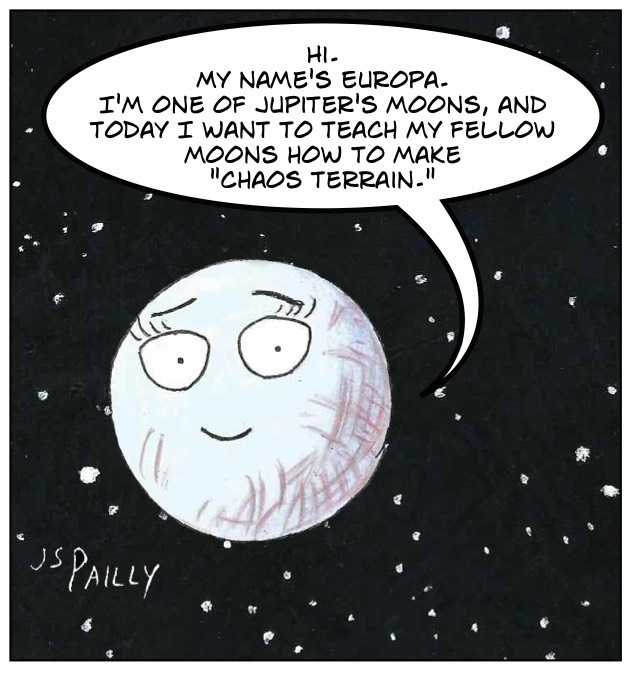
Ag09 Europa Intro

First, you’ll need an ocean of liquid water with a layer of water ice on top. For best results, I recommend using pure or nearly pure ice and really salty ocean water, so that they’ll have dramatically different melting/freezing points.

Ag09 Chaos Terrain Diagram 1

Next, set up some volcanoes or hydrothermal vents on your ocean floor. A little volcanic activity will cause the sporadic melting and refreezing of your ice, allowing ice water and saltwater to mix. If you do this right, you’ll end up with a salty “lake” trapped between layers of ice.

Ag09 Chaos Terrain Diagram 2

As we all know, liquid water is denser than water ice, so your lake will cause the ice above to sag and eventually cave in.

Ag09 Chaos Terrain Diagram 3

Cracks and fissures will form. Chuncks of ice will break apart, and that salty liquid water will get the chance to seep into the gaps, causing more melting and refreezing mayhem.

Finally, when your lake refreezes, it will expand (remember: ice is less dense than water) pushing all that cracked and broken material upward.

Ag09 Chaos Terrain Diagram 4

The resulting terrain will look truly bizarre—chaotic, you might say!—with huge ice blocks jutting up above an otherwise perfectly smooth landscape.

Ag09 Europa Final Thoughts

So, fellow planets and moons, what else can we do to confuse the humans? Share your ideas in the comments below!

Links

Active Formation of “Chaos Terrain” over Shallow Subsurface Water on Europa from Nature (beware of paywall).

Europa’s Chaos Terrains from NASA Visualization Explorer.

Sciency Words: Belts and Zones

Sciency Words BIO copy

Sciency Words is a special series here on Planet Pailly celebrating the rich and colorful world of science and science-related terminology. Today, we’re looking at two closely related terms:

BELTS and ZONES

Jupiter: it’s a big ball of hydrogen. Well, mostly hydrogen. The topmost layer of clouds—the part we can see in visible light—is primarily composed of ammonia, hydrogen sulfide, and water. A dash of other as-yet-unidentified chemicals are also mixed in for color.

If you’ve ever looked at Jupiter, you’ve noticed that it has stripes. The stripes are so pronounced that you can see them even with a cheap backyard telescope, and astronomers have been observing these stripes for centuries.

PIA02863 - Jupiter surface motion animation.gifBy a long-standing convention, the two different kinds of stripes seen on Jupiter are called belts and zones.

  • Zones: Zones are characterized by their lightly colored clouds. Winds in zones generally blow west to east, and the cloud tops rise above the clouds in the neighboring belts.
  • Belts: Belts are darker-colored, with winds blowing east to west. You may notice that Jupiter’s famous storms, such as the Great Red Spot, tend to appear where belts and zones border each other. The clouds in belts are known to sink to lower altitudes than the clouds in zones.

Jupiter isn’t the only planet with belts and zones. The Solar System’s other three gas giants show similar, though less visually distinctive, stripiness, and it’s a safe bet gas giants orbiting other stars will too.

This all seems straightforward enough, but while researching zones and belts for today’s post, I learned something that struck me as very odd. Zones, the clouds of which rise upwards, are often described as cold while belts, with their lower altitude clouds, are described as warm. Does this mean that on Jupiter, warm air sinks and cold air rises? Have the laws of thermodynamics been reversed?

Next Wednesday, I will attempt to solve this peculiar riddle.