Sciency Words: Dark Side of the Moon

Sciency Words PHYS copy

Today’s post is part of a special series here on Planet Pailly called Sciency Words. Each week, we take a closer look at an interesting science or science-related term to help us all expand our scientific vocabularies together. Today’s term is:

THE DARK SIDE OF THE MOON

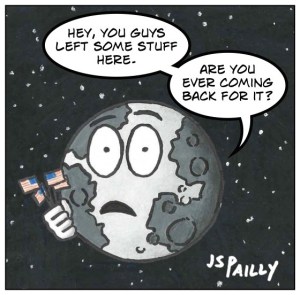
As the Moon orbits the Earth, the same side of the Moon is always facing toward us. It’s like the Moon is staring at us, unblinking, perhaps with some awkward question it’s been meaning to ask.
My06 Stuff on the Moon

But what’s on the other side? What’s on the side facing away from us? Scientists call that the “dark side” of the Moon. Scientists love making Star Wars references, and this one really fits. The dark side of the Moon is cloaked in perpetual darkness, because it is not only turned away from Earth but also away from the Sun.

As a result, we don’t really know much about the dark side of the Moon. There have been rumors that the Apollo Missions, while in lunar orbit, observed secret alien bases in the Moon’s dark region. This is obvious nonsense. The dark side of the Moon is too dark to observe anything!

Maybe some day when humanity finally chooses to return to the Moon, we’ll get some answers. Just so long as we remember to bring a flashlight.

P.S.: Happy April 1st! No, there is no such thing as a “dark side of the Moon.” The side of the Moon facing away from Earth is properly called the “far side of the Moon,” and it gets just as much sunlight as the side facing us.

Sciency Words: Space Adaptation Syndrome

Sciency Words MATH

Today’s post is part of a special series here on Planet Pailly called Sciency Words. Each week, we take a closer look at an interesting science or science-related term to help us all expand our scientific vocabularies together. Today’s term is:

SPACE ADAPTATION SYNDROME

Yeah, we could just call it “space sickness,” but this is Sciency Words, so we have to call it “space adaptation syndrome.” Because NASA has a rule that all space related terms must be turned into acronyms, we can also call it “S.A.S.”

Most astronauts experience space adaptation syndrome at some point, usually during training or during their first few days in space. Relapses are also known to happen. As you can imagine, NASA really wants to figure out what causes S.A.S. and how to prevent it. This is one of the reasons they recently left an astronaut in space for almost a full year.

Mr11 Year in Space
This is totally how the year in space mission happened.

At present, S.A.S. seems to be similar to motion sickness. It is also sort of the exact opposite of motion sickness. Think of it this way:

  • Motion sickness: your inner ear senses motion, but your eyes do not (because you’re playing with your phone in a moving car, for example). In this case, your eyes are feeding your brain false information.
  • Space adaptation syndrome: your eyes see that you’re moving (or not moving), but in the absence of gravity, your inner ear hasn’t got a clue what’s going on. So in this case, your eyes are trustworthy; it’s your inner ear feeding false information to your brain.

The good news is that we humans can adapt. Our brains learn to rely less on our inner ears, allowing the business of human space exploration to continue.

The bad news is that once we humans adapt to space, returning to Earth becomes a problem. I’m not talking about bone loss or muscle atrophy. I’m talking about balance. All of a sudden, your inner ear is working again, and your brain has to relearn how to do this balancing and walking stuff.

There is also a concern—and I’m not sure how seriously to take this concern—that the human body might adapt too well to space. You might spend so much time up there, becoming so acclimated to zero-G, that your brain and inner ear will never function properly together again. You’ll never walk again. You’ll never be able to come home. You’ll be stuck in space for the rest of your life.

That would suck.

Or maybe it wouldn’t. To be honest, if I ever get to go to space, I probably won’t want to come back anyway.

P.S.: Here’s a bonus Sciency Word: lead-head. Lead-head is what astronauts call immunity from space adaptation syndrome.

Sciency Words: Chirality

Sciency Words BIO copy

Today’s post is part of a special series here on Planet Pailly called Sciency Words. Each week, we take a closer look at an interesting science or science-related term to help us all expand our scientific vocabularies together. Today’s term is:

CHIRALITY

Imagine that we’ve finally placed a lander on the surface of Europa. The lander takes samples and detects amino acids, an essential ingredient for life. That raises a few eyebrows, but amino acids are not exactly uncommon in space. Then scientists realize that Europa’s amino acids all share the same chirality.

That’s the part where everybody freaks out.

Chirality, which is a noun, and chiral, which is an adjective, come from a Greek word meaning hand. You’ll see why in a moment.

Amino acids are made of several parts. By definition, they must include an amino group (one nitrogen atom and two hydrogens).

Mr08 Amino Group

By definition, they must also include a carboxyl group (two oxygens, a carbon, and a hydrogen).

Mr08 Carboxyl Group

They also need to have at least one carbon atom positioned between them, for structural purposes.

Mr08 Alpha Carbon

An amino acid with only one carbon separating the amino and carboxyl groups is called an alpha amino acid. If there were two carbons, it would be a beta amino acid, and so on.

But notice: that central carbon atom still has two available bonding sites.

Mr08 Missing Side Chain 1

So amino acids have one more crucial component called a side chain. It’s these side chains that give each type of amino acid its unique flavor (literally—amino acids taste different from one another, or so I’m told).

But which side do we attach the side chain to?

Mr08 Missing Side Chain 2

Left side it is! And we’ll attach a single hydrogen atom to the right.

Very early in the development of life on Earth, organisms started manufacturing amino acids out of simpler chemicals, and they always made the “left-handed” kind. Why? Coin toss. It could just have easily gone the other way, as far as we know.

To this day, our DNA continues to code for left-handed amino-acids only. As a result, there are more left-handed than right-handed amino acids present on Earth. If we ever find a similar disparity elsewhere in the universe—whether left or right-handed—that would be compelling evidence for the existence of alien life.

By the way: there’s a common misconception about chirality that you sometimes find in science fiction. Supposedly, humans cannot eat foods made from right-handed amino acids, and aliens with right-handed biochemistries cannot eat our left-handed foods. This is not necessarily true. In fact, humans do consume right-handed amino acids. Some of them are useful to our bodies, just not in the construction of proteins, and they’re not coded for by our DNA.

Of course, there are plenty of other reasons humans and aliens probably shouldn’t share food.

Mr08 Alien Food

So the chirality of amino acids might not be your top concern.

Sciency Words: Agentic State

Sciency Words PHYS copy

Today’s post is part of a special series here on Planet Pailly called Sciency Words. Each week, we take a closer look at an interesting science or science-related term to help us all expand our scientific vocabularies together. Today’s term is:

AGENTIC STATE

Hey, do you want to write a Sci-Fi/Fantasy story about mind control powers?

Mr05 Autonomous Writer

Yes, you do.

Mr05 Agentic Writer

Well, here’s a term—a real life psychology term—that you might want to incorporate into your story. Though I must warn you: this term has a disturbing history.

The agentic state is a state of mind. A person in the agentic state essentially surrenders their free will and acts as an “agent” of another person who is perceived to be in a position of authority.

A series of experiments in the 1960’s demonstrated how easily we humans will do as we’re told. I won’t describe these experiments in full (you can click here to find out more, if you want). The basic idea can be summed up with these questions:

  • Would you inflict pain on another human being because someone in a position of authority told you to?
  • Would you continue inflicting pain, even as your victim screams for you to stop, because an authority figure insisted it was necessary?
  • Would you torture a person to death because you believed that this authority figure would take responsibility if anything went wrong?

According to the experimental results, the answer to all three questions—for the majority of us, at least—is yes.

Why were these experiments conducted? Because of some very famous words. Words that come to us from a dark period in modern history. Words that I’m sure you’ve heard before: “I was just following orders.” It seems that those words and the mode of thinking they represent are deeply engrained in us all. Telepathic mind control powers hardly seem necessary.

Fortunately, this is not all there is to say concerning this line of psychological research. To quote Frank Herbert, “One cannot have a single thing without its opposite.” The opposite of the agentic state is called the autonomous state. Without delving too deeply into philosophical questions concerning free will, I think we can define the autonomous state as a state of mind where you are making your own decisions rather than allowing authority figures to make them for you. At the very least, you’re not blindly following orders that violate your own conscience.

I don’t know about you, but I find it somewhat reassuring to think that while we may be capable of entering one of these mental states, we are also capable of entering the other—provided we’re aware of what is happening to us.

Sciency Words: Bacterial Conjugation

Sciency Words BIO copy

Today’s post is part of a special series here on Planet Pailly called Sciency Words. Each week, we take a closer look at an interesting science or science-related term to help us all expand our scientific vocabularies together. Today’s term is:

BACTERIAL CONJUGATION

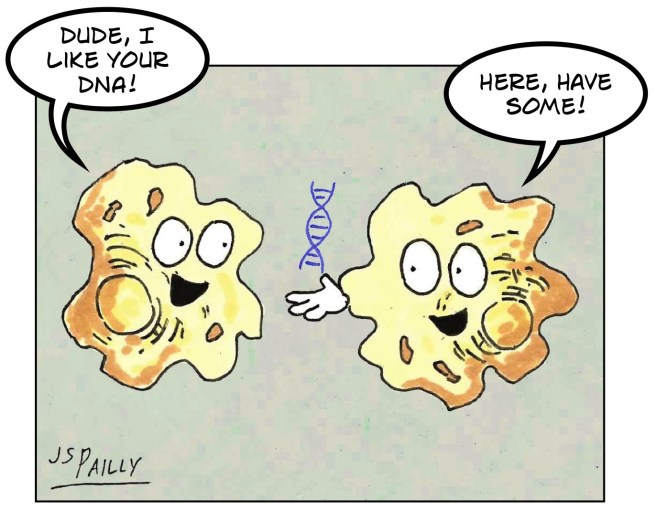
Bacteria aren’t like us. They’re not stuck with the DNA they’re born with.

Mr02 Bacterial Conjugation

Through a process called bacterial conjugation, one bacterium can donate some of its genes to another. In some cases, this even works between bacteria of different species.

The process begins with something called an “F plasmoid” or “F factor.” Bacterial conjugation has a few things in common with sexual reproduction, so I’m sure you can guess what the F stands for. It stands for fertility. Obviously.

This F plasmoid is actually a strand of DNA looped into a circle. A bacterium that has an F plasmoid is called an F+ cell. A bacterium that doesn’t have it is an F- cell. And when an F+ cell and an F- cell meet, the real fun begins.

  • Step One: The F+ cell grows a hair-like protrusion called a pilus (plural pili).
  • Step Two: The pilus attaches to the F- cell, and a connection is formed. You could think of the pilus as a tiny straw linking one bacterial cell to the other.
  • Step Three: Within the F+ cell, the F plasmoid splits apart right down the center of its double helix structure, like a zipper unzipping. One half is fed through the pilus, and the other half stays put.
  • Step Four: Using the half-strand of DNA as a guide, the F- cell creates a complimentary strand of DNA and zips the two back together. The F+ cell does the same thing with the half-strand that it kept. Now both bacteria have a full copy of the F plasmoid, meaning both are F+ cells, and both can go spread the F plasmoid to other bacteria.

This ability has proven to be really useful for bacteria. It is, for example, one of the mechanisms that spreads immunity to our anti-bacterial drugs.

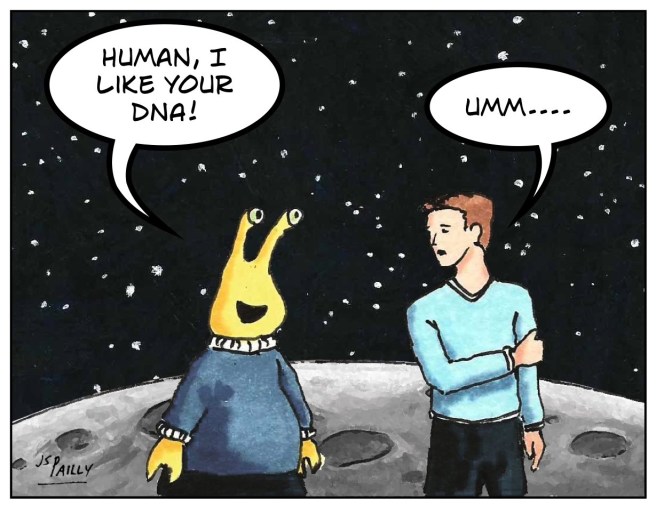
It’s too bad humans can’t do this, but transferring DNA between multicellular organisms would be a far more complicated matter (though come to think of it, sperm and egg cells do an okay job). But perhaps on some distant alien world, multicellular conjugation is possible. Perhaps it is common even between different species. Maybe some day we’ll meet these conjugating life forms, and awkward conversations will ensue.

Mr02 Multicellular Conjugation

Sciency Words: Descope

Sciency Words MATH

Today’s post is part of a special series here on Planet Pailly called Sciency Words. Each week, we take a closer look at an interesting science or science-related term to help us all expand our scientific vocabularies together. Today’s term is:

DESCOPE

What do you call it when a space mission that’s supposed to look like this…

Fb10 Epic Huge Space Probe

… turns out looking more like this?

Fb10 Teeny Tiny Space Probe

It’s called descoping.

Descoping is a term, apparently used at NASA and other space agencies, for when the “scope” of a mission is reduced, usually due to budgetary concerns. At least being descoped is better than being canceled outright, although I can easily imagine missions being descoped to the point that they may as well be canceled.

It seems the term can also apply to military hardware that, once again for budgetary reasons, had to be scaled down. So the verb “to descope” could be doubly useful for science fiction writers.

P.S.: I’d planned to write more for today, but due to budgetary concerns, this blog post has been descoped.

Sciency Words: Gravity Waves vs. Gravitational Waves

Sciency Words MATH

Today’s post is part of a special series here on Planet Pailly called Sciency Words. Each week, we take a closer look at an interesting science or science-related term to help us all expand our scientific vocabularies together. Today, we’re looking at two terms that have almost nothing to do with each other:

GRAVITY WAVES

and

GRAVITATIONAL WAVES

What happens when you combine a 29 solar mass black hole with a 36 solar mass back hole?

Fb08 Black Hole

In this not-so-hypothetical scenario, 29 solar masses plus 36 solar masses equals 62 solar masses. The remaining 3 solar masses are converted into energy in the form of gravity waves. I mean gravitational waves.

I’ve been making this mistake a lot lately, ever since LIGO announced that it had detected gravitational waves for the first time. It’s just easier to say gravity waves. It’s two syllables shorter. Unfortunately, gravity waves and gravitational waves are completely different concepts.

What are Gravitational Waves?

Gravitational waves are part of relativistic physics. According to Einstein’s general theory of relativity, gravity bends space-time. Among other things, this bending causes everything from spaceships to planets to even light itself to follow curved trajectories in the presence of a gravitational field.

Extremely massive objects moving rapidly together, such as a pair of co-orbiting neutron stars or, in the case of the recent LIGO discovery, a pair of merging black holes, bend space one way then the other so violently that they produce a rippling effect in the fabric of space-time. We call these ripples gravitational waves.

What are Gravity Waves?

Gravity waves are part of a different field of physics called fluid dynamics. A few years ago, gravity waves were observed in the atmosphere of Venus, most likely due to air masses rising over mountainous terrain and falling down the other side. After these air masses return to their original altitude (return to a “state of equilibrium,” to use the technical lingo), they tend to bob up and down a bit, producing characteristic ripples in the atmosphere around them. We call these ripples gravity waves (specifically, they’re atmospheric gravity waves).

While this phenomenon has been observed on Venus and Titan, it is best understood here on Earth. Gravity waves are known to appear in Earth’s atmosphere, in lakes and oceans, at the interface between the atmosphere and the ocean… basically anywhere you find a fluid or fluid-like medium. Whenever a fluid returns to a state of equilibrium, either due to gravity or buoyancy, you can expect to see gravity waves.

One Wave is Not Like the Other…

Of course if you’re having a casual conversation about the LIGO experiment (who doesn’t have casual conversations about experiments in relativistic physics?) and you mistakenly say gravity wave instead of gravitational wave, I doubt anyone will be confused. Nine times out of ten, context will make it clear which kind of wave you meant. Just so long as somewhere in the back of your mind, you know there is a difference.

Sciency Words: Alienist

Sciency Words MATH

Today’s post is part of a special series here on Planet Pailly called Sciency Words. Each week, we take a closer look at an interesting science or science-related term to help us all expand our scientific vocabularies together. Today’s term is:

ALIENIST

Not every word that gets added to the scientific lexicon stays in the scientific lexicon. We’ve previously studied the now defunct terms sciential and jiffy. So now let’s talk about alienist.

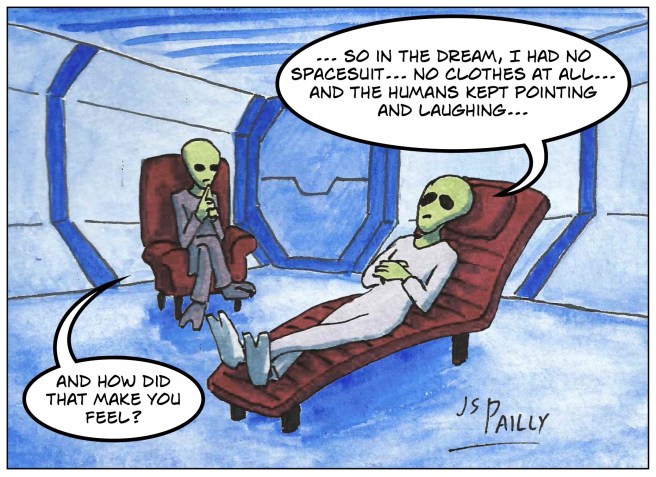
This word is not, as you may suppose, related to our modern understanding of extraterrestrial aliens, nor is it related to the “people from foreign countries” definition. At least not directly. Instead, alienist is traced back to a French word, aliéné, which is an adjective meaning insane.

Both English’s alien and French’s aliéné ultimately originate with the Latin word aliēnus, and both share a certain flavor of meaning: that of “otherness.”

In a sense, you could think of insanity as a state of the mind being “alienated” from the body. Or in a more pejorative sense, the mentally ill could be seen as being “alienated” from normal society.

So an alienist (or aliéniste in French) was a physician who treated the mentally ill, and alienism was the study of mental illness. It seems these terms remained in use until the mid-20th Century, by which point this entire field of science had rebranded itself as psychology.

Fb06 The Alien Alienist

At the beginning of today’s post, I said (or rather implied) that the word alienist has become defunct. That’s not entirely true. There’s a process called semantic narrowing whereby a word with a general meaning transforms into a word with a more specific meaning. Examples include:

  • Meat: originally meant food in general but now only means a specific kind of food.
  • Vest: originally meant clothing in general but now only describes one specific type of garment.
  • Wife: originally meant any female person but now refers only to female persons who are married.

The word alienist has undergone this process as well. Today, an alienist is a specific kind of psychologist who works in the criminal justice system. An alienist evaluates the mental competency of a defendant in a trial. (I guess you could say criminals are “alienated” from the law.)

Semantic narrowing is just one mechanism of linguistic change. In a distant Sci-Fi future, it might be interesting to see how a word like alienist continues to change and what new shades of meaning it might take on.

Sciency Words: Detached Object

Sciency Words PHYS copy

Today’s post is part of a special series here on Planet Pailly called Sciency Words. Each week, we take a closer look at an interesting science or science-related term to help us all expand our scientific vocabularies together. Today’s term is:

DETACHED OBJECT

The defining characteristic of detached objects is that they are, in a sense, “detached” from the rest of the Solar System.

They do orbit the Sun. They are part of the Solar System, but they keep their distance. Their orbits are so far away that they have no significant gravitational interactions with the eight known planets. As far as the detached objects are concerned, there may as well be no planets in the Solar System at all.

Fb03 Confused Sednoids

Hmm… Sedna and 2012 VP113 bring up a good point. While researching last week’s edition of Sciency Words, I initially thought “sednoid” and “detached object” were synonyms. But the list of known detached objects is a bit longer than the list of known sednoids.

The definition of sednoid is clear and specific: sednoids never come closer to the Sun than 75 AU. So if an object’s perihelion (point of closest approach to the Sun) were at 74.999999999 AU, that object would be disqualified from the sednoid club.

Detached objects don’t have to live with this kind of arbitrary restriction. If they stray within about 40 AU, they run the risk of gravitationally interacting with the planets. But it is that gravitational interaction that would change a detached object into some other kind of object; not the crossing of an imaginary 40 AU line in space.

Sednoids and detached objects are so new to our knowledge of the Solar System that the terminology is still evolving. You could choose to think of sednoids and detached objects as distinctly different groups, or you could think of sednoids as a subset within the larger population of detached objects.

It’s also possible that as we learn more about the Oort cloud (the existence of which has not yet been observationally confirmed) and the Ninth Planet (the existence of which has not yet been observationally confirmed), we may abandon this terminology in favor of new names that make more sense.

So in a distant Sci-Fi future when humanity ventures out beyond the orbit of Neptune to explore these strange objects and harvest their resources, perhaps we’ll invent some new sciency words that better describe them.

Sciency Words: Sednoid

Sciency Words BIO copy

Today’s post is part of a special series here on Planet Pailly called Sciency Words. Each week, we take a closer look at an interesting science or science-related term to help us all expand our scientific vocabularies together. Today’s word is:

SEDNOID

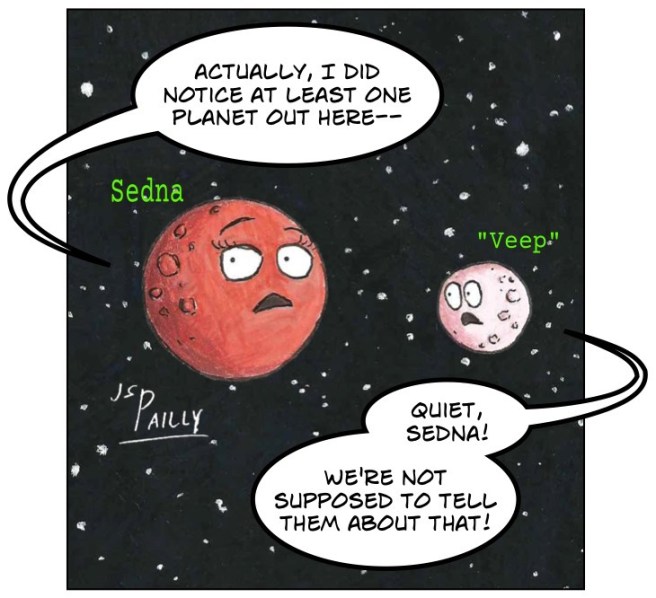
There are currently only two known sednoids. The first is Sedna (from which the word sednoid is derived). The other is named 2012 VP113 (or “Veep,” as I like to call it).

A possible third sednoid was discovered in late 2015. It has the fun, easy-to-remember name V774104. It may take a while for astronomers to determine V774104’s orbital path. It will take a bit longer for them to think up better names.

There’s a lot of ongoing debate over what exactly these two (or three) objects are. They might be former Kuiper belt objects, or they might be part of the Oort cloud, or they may even be objects captured from other star systems.

For our purposes, the defining characteristic of sednoids is that they keep their distance from the rest of the Solar System, coming no closer to the Sun than 75 AU. For the sake of comparison, Neptune orbits the Sun at a distance of approximately 30 AU, and the Kuiper belt terminates at a distance of about 50 AU.

This means sednoids are so distant that they don’t have any significant gravitational interactions with the eight known planets. As far as Sedna and Veep are aware, there may as well be no planets in the Solar System at all.

Ja10 Sednoid Secrets

Okay, the orbits of both Sedna and Veep are a little too strange. They’re too eccentric. Way too eccentric.

At perihelion (closest approach to the Sun), Veep is approximately 80 AU away; at aphelion (farthest distance from the Sun), Veep is over 400 AU away. Sedna’s orbit is even crazier, with perihelion at 75 AU and aphelion at a distance of over 900 AU!

It’s hard to believe the sednoids ended up in these bizarre orbits on their own, so they must have had gravitational interactions with something. If the eight known planets couldn’t have influenced the sednoids, does that mean there’s another planet out there? Could the elusive and controversial Planet X be responsible for these weird orbits?

Assuming Planet X exists at all.

P.S.: I’ve been highly skeptical of the whole Planet X thing, or as it is now being called the Ninth Planet hypothesis. However, after yesterday’s post on the clustering of scattered disk objects and today’s post on sednoids, I have to admit that something odd seems to be going on beyond Neptune’s orbit.