Sciency Words: Macula

Sciency Words PHYS copy

When Voyager 1 trained its camera on the moons of Jupiter, scientists back on Earth had no idea what to expect. Turned out they were right. Voyager was snapping photos of geological features unlike anything anyone had ever seen before. Which meant it was time to make up some new sciency words!

MACULA

Last week, we talked about Europa’s lineae: the reddish-brown cracks and fissures crisscrossing this small moon’s surface. But those weren’t the only surprises Voyager 1 observed. Let’s zoom in for a closer look.
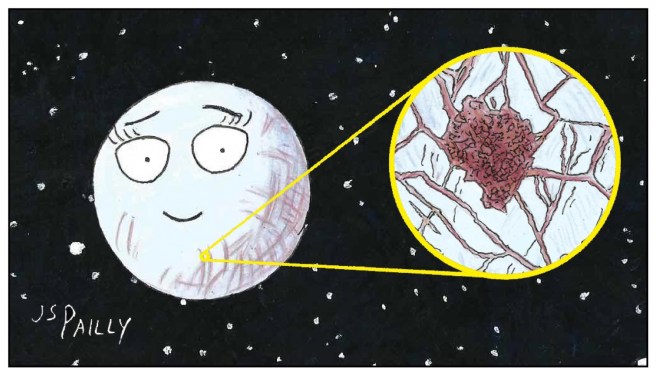
Sp09 Macula on Europa

Europa has these peculiar dark splotches on its surface, similar in coloration to the lineae. Scientists came up with the term macula (plural maculae) to describe them. It comes from the Latin word for “spot” or “blemish.” It’s related indirectly to the word immaculate, which literally means “without blemish.”

Although Europa’s maculae were discovered in 1979, it wasn’t until 2011 that anyone could adequately explain them. It seems that Europa’s thick ice shell has a complex relationship with the ocean of liquid water deep beneath the surface, resulting in frequent patterns of melting and refreezing.

Sometimes “lakes” of liquid water become embedded between layers of ice. This causes surface ice to sag and cave in, breaking up into chunky, tightly packed icebergs. Some sort of material (possibly organic material) seeps up with the meltwater, causing the dark discoloration.

Eventually, the lake beneath a macula will freeze. Since ice is less dense than water, this forces the now cracked and broken surface ice to rise above the surrounding landscape. In the process, the already strange-looking maculae transform into even stranger-looking chaos terrain.

The term macula can be used to describe almost any dark, spotty or splotchy feature on a planetary body. That doesn’t mean they have anything in common beyond superficial appearances. For example, while maculae on Europa seem to be caused by melting and refreezing ice, maculae on Titan may be related to some sort of volcanic activity.

For next week’s edition of Sciency Words, we’ll move on to Ganymede. Europa wasn’t the only Jovian moon showing off strange, never-before-seen geological features when Voyager arrived.


Sciency Words: Linea

Sciency Words MATH

When Voyager 1 trained its camera on the moons of Jupiter, scientists back on Earth had no idea what to expect. Turned out they were right. Voyager was snapping photos of geological features unlike anything anyone had ever seen before. Which meant it was time to make up some new sciency words!

LINEA

Europa has the youngest, smoothest-looking surface of any object in the Solar System.

Ag04 Europa Blush

But as you can see in the totally legit Voyager 1 image above, Europa’s icy blue surface is not without blemish.

It’s crisscrossed with cracks and fissures that appear to be filled with some sort of reddish-brown substance. Astronomers adopted the term linea (plural lineae) to describe these features. This was not astronomers at their most creative or imaginative; linea is just the Latin word for line.

Europa has a subsurface ocean of liquid water. There might be alien sea creatures swimming around in that subsurface ocean. Or there might not. If we want to find out, Europa’s lineae may be a good place to start looking.

The reddish-brown substance is believed to seep up through the cracking, fissuring ice. Does it include organic material? Amino acids? Maybe some sort of alien DNA? Hopefully NASA’s Europa Clipper mission will be able to find out (pending Congressional approval and so forth).

Lineae are most commonly associated with Europa, but the term has also been used to describe line-like features on a handful of other worlds, including Mars (although Mars’s recurring slope lineae are very different from lineae on Europa).

In next week’s edition of Sciency Words, we’ll continue exploring the moons of Jupiter. There are plenty of other terms that had to be invented following Voyager 1’s visit.

P.S.: I once ate at a seafood restaurant named Nova Europa. I know it was supposed to be Mediterranean-themed, but that is not what I was thinking about when they served my calamari.

Sciency Words: Flare Star

Sciency Words BIO copy

Today’s post is part of a special series here on Planet Pailly called Sciency Words. Each week, we take a closer look at an interesting science or science-related term to help us all expand our scientific vocabularies together. Today’s term is:

FLARE STAR

Good Star Trek fans will remember the Battle of Wolf 359, when the Borg came to assimilate us all. Thirty-nine Federation starships were lost. Nearly 11,000 people were killed. #NeverForget

Good Trekkies may also be aware of the fact that Wolf 359 is a real place. It’s a red dwarf star in the constellation Leo, located within a mere eight light-years from Earth.

Also, Wolf 359 is a UV Ceti variable star, or what is more commonly called a flare star. Flare stars experience dramatic, unpredictable increases in brightness across the EM spectrum, including increases in highly destructive X-ray and gamma ray emissions.

And when a flare star starts to flare up, it can happen quickly. In 1952, the star UV Ceti (for which the UV Ceti variable star category is named) became about 75 times brighter in a period of only twenty seconds.

It’s believed that the flare activity of flare stars is similar to the kind of solar flares we’ve observed on our own Sun. Except the Sun’s solar flares are usually not so intense. And when it comes those X-rays and gamma rays, our Sun doesn’t even come close to what spews out of flare stars.

So perhaps parking thirty-nine starships next to a flare star wasn’t the smartest thing Starfleet could have done. Maybe… just maybe… what happened at Wolf 359 wasn’t the Borg Collective’s fault.

Ag26 Battle of Wolf 359

P.S.: Another flare star has been in the news a lot lately: Proxima Centauri. We now know, thanks to the European Southern Observatory, that Proxima does have an Earth-like planet in orbit. So the next question is just how thoroughly that planet has been cooked by Proxima’s violent flare-ups.

Sciency Words: In Situ

Sciency Words PHYS copy

Today’s post is part of a special series here on Planet Pailly called Sciency Words. Each week, we take a closer look at an interesting science or science-related term to help us all expand our scientific vocabularies together. Today’s term is:

IN SITU

Today I’m continuing to blog from the surface of Titan, Saturn’s largest and most mysterious moon. No more reading about Titan in books and journals or on the Internet. Right now, I can do my Titan research “in situ,” as the real scientists would say.

Ag19 Life on Titan

“In situ” basically means “on location.” It comes from the Latin words for “on” and “location.” Alternative translations include “in the place” or “situated in,” but I think “on location” works best for our purposes.

Just about any time you find the phrase “in situ” in a scientific text, you can mentally substitute the words “on location” without changing the meaning of the sentence one bit.

  • The Mars rovers conduct in situ experiments to identify Martian geological features.
  • In the future, colonists cannot depend on supply missions from Earth for all their needs. They’ll have to make use of in situ resources.
  • Triton (Neptune’s largest moon) probably didn’t form in situ, but was captured by Neptune’s gravity after forming elsewhere.

Regarding in situ planetary science, contrast it with the observational science done using telescopes or laboratory experiments that attempt to recreate conditions on other worlds. Or you could contrast in situ research against something like a sample return mission, where material is brought back to Earth rather than analyzed on location (I mean, in situ).

Meanwhile on Titan

While in situ research has its advantages, it’s still only as good as the human doing the research. If life exists on Titan, it’s bound to be very different from life on Earth, with biochemistry totally unlike our own.

I can’t just look into a methane lake and see if any alien microbes are swimming around. I have to know what to look for before I look. I have to know which experiments to do before I do them. Which is why I still have to read books and journals and Internet articles about Titan. Otherwise, I might miss something important.

P.S.: Ah! It’s got my leg! Send help!

Sciency Words: Futurism

Sciency Words MATH

Today’s post is part of a special series here on Planet Pailly called Sciency Words. Each week, we take a closer look at an interesting science or science-related term to help us all expand our scientific vocabularies together. Today’s term is:

FUTURISM

Sometimes I think I know what a word means, only to discover that it has a second definition. Such is the case with futurism.

Previously, I only know about futurism the art style, which dates back to the early 20th Century. It was an art movement obsessed with the latest cutting edge technology. You know, cutting edge technology like aeroplanes and automobiles. That version of futurism is now, ironically, just another part of art history.

Whenever I’ve seen or heard the word futurism, I’ve mistakenly assumed that it harkens back to that early, avant-garde art movement. And when you think you already know what a word means, you don’t feel much need to grab a dictionary and investigate further.

But it turns out that there’s a different kind of futurism (sometimes called futurology) which straddles the line between art and science. I only found out about this other futurism from a recent episode of Writing Excuses (the best podcast for writers… ever!)

The Writing Excuses crew interviewed Trina Marie Phillips, a professional futurist. Her job is to look at the current trends in science and technology and try to extrapolate what might happen over the next 10, 20, or 30-plus years. Fortune 500 companies pay her to help them prepare for the technological advancements that are coming in the near future.

My favorite part of this: professional futurists like Phillips use storytelling—as in science fiction stories—to illustrate to their clients how new technology might affect their customers, or their business models, or the global economy in general. Truly, this is where science meets fiction.

P.S.: I get the sense that futurism is a deep, deep rabbit hole. I have not researched this subject as thoroughly as I probably should have for today’s post, but I was so excited about this that I had to share.

Sciency Words: Tholin

Sciency Words BIO copy

Today’s post is part of a special series here on Planet Pailly called Sciency Words. Each week, we take a closer look at an interesting science or science-related term to help us all expand our scientific vocabularies together. Today’s term is:

THOLIN

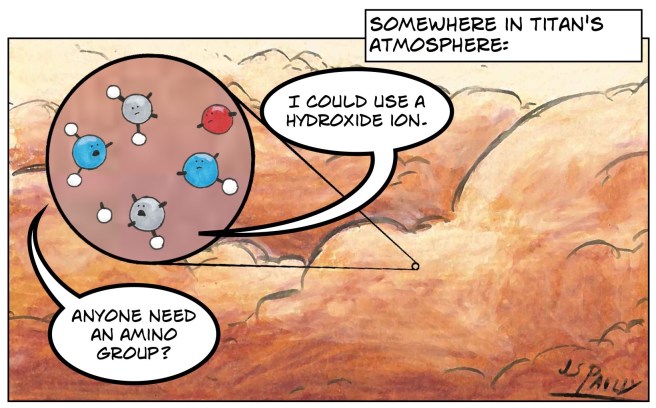
My travels through the Solar System have once again brought me to Titan, Saturn’s largest moon. My spacecraft has commenced landing procedures, and I am currently descending through a haze of aerosol particles called tholins.

The term tholin was coined in a 1979 paper co-authored by Carl Sagan. The word comes from two similar sounding Greek words, one meaning vault (as in the great vault of the heavens) and the other meaning mud. Apparently Sagan toyed with the idea of naming this stuff “star-tar.”

Back on Earth, tholins can be created in the lab. Just take some simple organic compounds like methane and ethane and zap them with UV light or an electric current. You’ll end up with this yucky, orange gunk all over the bottom of your test chamber.

Here on Titan, the same thing is happening due to photolysis. When chemicals like methane (CH4), ethane (C2H6), ammonia (NH3), and formaldehyde (CH2O) get irradiated by sunlight, they break apart and recombine as new, more complex structures.

Ag05 Tholins on Titan

Tholins fill the air as a dense, orange haze. They cover the ground below as orange sludge. They’re also starting to coat the viewport of my spaceship with an orangey film that, I suspect, will be a real pain to scrub off.

While tholins have been notoriously difficult to analyze in the lab, they seem to be a mishmash of organic molecules. It’s hard to say which organic molecules are present, but some of them appear to be extremely large, extremely complicated organic compounds.

It’s easy to imagine amino acids, peptide chains, or even some sort of proto-DNA emerging from tholins, provided the tholins are allowed to dissolve in some sort of aqueous solution (note to self: double check Titan’s liquid methane lakes for dissolved tholins).

I can’t say for certain if there’s life on Titan, but I have to admit with all these tholins lying around, conditions are ripe for some sort of biochemistry to get started.

Links

What in the World(s) are Tholins? from the Planetary Society.

How Titan’s Haze Help Us Understand Life’s Origins from Astrobiology Magazine.

Sciency Words: Photolysis

Sciency Words PHYS copy

Things have been a bit hectic lately, so welcome to a rare Saturday edition of Sciency Words.

Every Friday (normally), we take a closer look at an interesting science or science-related term to help us all expand our scientific vocabularies together. Today’s term is:

PHOTOLYSIS

Last year, when I did my special Mission to the Solar System, I fell in love with one planet in particular: Venus. I guess I’ve always had a soft spot for sciency girls, and Venus is about as sciency as they get. She’s really, really into chemistry.

Jy30 Venus Does Chemistry

Photolysis (also known as photo-dissociation) is one of Venus’s favorite chemistry tools. Photolysis occurs when high-energy photons ram into chemical bonds, causing those bonds to break.

By high-energy photons, of course, I mean light. Specifically ultraviolet light, X-rays, and gamma rays. On Venus, UV rays from the Sun cause the photolysis of sulfur compounds, contributing to the sulfur cycle that causes Venus’s infamous sulfuric acid rain.

Jy30 Photolysis on Venus

The same process breaks apart oxygen molecules in Earth’s stratosphere, allowing them to recombine as ozone, thus generating the ozone layer. Photolysis is also probably responsible for the chemical changes on Jupiter that make the Great Red Spot look red (or sometimes other colors).

And speaking as an artist, photolysis is something I have to guard against. Paints are just a mix of chemicals, and the photolytic break down of those chemicals can, over time, cause paints and other pigments to fade or change color.

Photolysis by any other name…

The term photolysis is sometimes used as a blanket term for similar kinds of chemical bond breaking. For example, very little sunlight reaches the surface of Venus, but sulfur compounds still vigorously break apart and recombine due to the intense heat.

Some academic sources I’ve read still call that photolysis, though I prefer the term thermal dissociation. Calling a chemical reaction that occurs in a near pitch-black environment “photolysis” feels awkward.

Just my opinion.

Photolysis here, photolysis there, photolysis everywhere…

When I first learned about photolysis, I didn’t fully appreciate its significance. I understood only that it (and also thermal dissociation) played key roles in Venus’s extra special chemistry projects.

Then I encountered the word again while researching other planets. And then it popped up in an art textbook I was reading. I’ve gradually come to understand that it is a fundamental concept in science, or at least in chemistry.

Next week, I’ll be revisiting Saturn’s largest and orangest moon: Titan. I have a sneaking suspicion that we will once again see photolysis in action.

Links

Photolysis of Sulphuric Acid as the Source of Sulphur Oxides in the Mesosphere of Venus from Nature Geoscience.

The Sulfur Cycle on Venus: New Insights from Venus Express from the 2009 Lunar and Planetary Science Conference.

Sciency Words: Hot Spots of Jupiter

Sciency Words MATH

Today’s post is part of a special series here on Planet Pailly called Sciency Words. Each week, we take a closer look at an interesting science or science-related term to help us all expand our scientific vocabularies together. Today’s term is:

HOT SPOT

This is Jupiter.

Ag05 Great Red Spot

And this is Jupiter in infrared.

Jy22 Infrared Jupiter

In 1995, the Galileo spacecraft dropped a small probe into Jupiter’s atmosphere. It was supposed to sample the chemicals in Jupiter’s clouds, but in a case of extraordinary bad luck, the probe fell into an empty gap between cloudbanks and collected virtually no data.

I like to imagine the clouds separating before the probe, like Moses parting the Red Sea, but I’m sure that’s not how it actually happened.

These gaps in the Jovian clouds are called hot spots. The thin atmospheric gases in these regions are actually quite cold, but when viewed in infrared, they appear hot due to the intense heat of Jupiter’s interior shining through.

The hot spots form—they always form—about seven degrees north of the equator. Eight to ten of them will appear at a time, evenly spaced along that seven degrees north longitude line, wrapping all the way around the planet.

This has led scientists to conclude that Jupiter’s hot spots are caused by a standing wave (more technically, a Rossby wave) in Jupiter’s atmosphere. The peaks and troughs of the wave correspond to the thickening and thinning of the surface clouds.

The Juno spacecraft’s JIRAM instrument (Jovian InfraRed Auroral Mapper) is specifically designed to study Jupiter’s aurorae (as the name implies) and also the hot spots. By staring straight down into a hot spot with an infrared spectrometer, scientists hope to identify the chemical composition of the deeper atmospheric layers. Among other things, they believe they’ll find a layer of water clouds.

Of course the Great Red Spot is a weird and mysterious phenomenon too. It deserves the high level of scrutiny it gets. But of all the spots on Jupiter, the hot spots may turn out to be the most interesting and revealing of the planet’s features.

Links

Jupiter’s Atmosphere Has Weird Hot Flashes from Space.com.

“Hot Spots” Ride a Merry-Go-Round on Jupiter from NASA.gov.

Sciency Words: Recovery Experience

Sciency Words BIO copy

Today’s post is part of a special series here on Planet Pailly called Sciency Words. Each week, we take a closer look at an interesting science or science-related term to help us all expand our scientific vocabularies together. Today’s term is:

RECOVERY EXPERIENCE

You’re feeling stressed. Weary. Burned out. You have too much work piled on top of you.

It might be tempting, whenever you can take a break, to just stop and do nothing. Nothing at all. You only have so much energy. You feel like your mental resources are running low. It makes sense to try to conserve what little you have left, but is that really your best option?

Have a Recovery Experience Instead

Some psychologists recommend that when you feel like your mental resources are running low, don’t just shut down. Don’t try to conserve what’s left.

Instead, do something fun. Even better, do something creative. Like coloring. Or writing poetry. Or playing with Legos (my new favorite). Even something like redecorating your workspace can engage your creative mind.

This is called a recovery experience, because rather than trying to conserve your mental resources by doing nothing, you recover your resources by being creative.

My Experience with Recovery Experiences

I first encountered this term over a year ago. I was writing a blog post about the whole adult coloring book trend and the science allegedly behind it.

As a workaholic (or perhaps I should call myself a write-aholic), I often feel guilty about doing anything other than writing. Having a sciency word like “recovery experience” has helped me get past my guilt.

  • I’m not wasting time playing video games; I’m having a recovery experience.
  • I’m not wasting time building Lego models; this is a recovery experience.
  • I’m not wasting time antiquing; I’m enjoying a recovery… no, actually this isn’t fun for me. This is wasting my time.

Typically, recovery experiences leave me feeling energized and ready for more writing.

And this summer, I’m planning a nice, long recovery experience, with no writing on the agenda at all. This despite the fact that I have a huge writing project to worry about. This despite the fact that I’m getting super stressed about said project and about writing in general (in fact, that’s the very reason I need a recovery experience so badly right now).

Basically, today’s post is a roundabout way of saying I’m going on vacation. I’ll be back in two or three weeks.

Sciency Words: Endosymbiosis

Sciency Words MATH

Today’s post is part of a special series here on Planet Pailly called Sciency Words. Each week, we take a closer look at an interesting science or science-related term to help us all expand our scientific vocabularies together. Today’s term is:

ENDOSYMBIOSIS

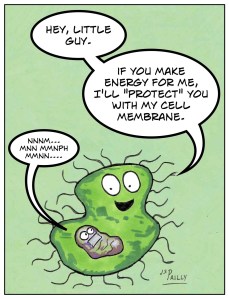
The story goes like this: long ago (roughly 1.5 to 2 billion years ago), two single-celled organisms reached a mutually beneficial arrangement.

Jn17 Endosymbiosis 1

Or perhaps one single-celled organism imposed a mutually beneficial arrangement on another.

Jn17 Endosymbiosis 2

Whichever way it happened, the result is what we now call endosymbiosis. It’s a term which comes from a bunch of Greek words meaning “living together” and “inside.”

The word endosymbiosis can be used to describe any mutually beneficial (non-parasitic) relationship where one organism lives inside another. Think of the bacteria living in your stomach helping you digest your food.

But typically, the term seems to be reserved for such relationships between single-celled organisms. One cell is called the host. The other—the one living inside the host—is called the endosymbiont.

Each individual cell in your body contains tiny internal structures called organelles. This is true not only for humans but all animals and plants, and many microorganisms, such as the amoeba or the paramecium. The presence of organelles is one defining characteristic for all eukaryotic life forms on Earth (as opposed to prokaryotic life forms like bacteria or archaea).

It is believed that, at some point in evolutionary history, all these organelles started out as endosymbionts. Some organelles, like mitochondria and chloroplasts, still have their own DNA separate from the DNA of the cell nucleus.

But at what point did the transition occur? At what point should we stop calling something an endosymbiont and start calling it an organelle? That question gets into some murky territory for biology. The distinction between organelles and endosymbionts is rather too poorly defined at the moment for a Sciency Words post.