Sciency Words: Alien

Welcome to another episode of Sciency Words, a special series here on Planet Pailly where we take a closer look at the defintions and etymologies of science or science-related terms so we can expand our scientific vocabularies together.  Today’s term is:

ALIEN

I recently added a new book to my personal reference library. It’s called Brave New Words: The Oxford Dictionary of Science Fiction.  Flipping through this book has been an absolute joy, and I’ve learned that many of the words we commonly see in both science and science fiction have far more complicated origins than you might expect.

The First Planet Had the First Aliens

The notion that life might exist on other worlds has been around for a surprisingly long time.  The ancient Greek philosophers were philosophizing about it as far back as the 7th Century B.C.E.  The idea really came to the forefront, though, thanks to Galileo.

Once Galileo looked through his telescope and found that the Moon was covered in mountains and “seas,” and once he turned his attention to the planets and realized they too were worlds in their own right, it wasn’t such a huge leap of logic to supposed that people might be living on those other worlds.  But if we’re going to talk about these hypothetical people, what should we call them?

According to Brave New Words, the planet Mercury was the first to have its possible inhabitants named.  Dutch astronomer Christiaan Huygens was writing about the Mercurians as early as 1698.  The term Lunarians, referring to the inhabitants of the Moon, is first noted in 1708.  Other terms like this kept cropping up throughout the 18th and 19th Centuries: Saturnians in 1738, Neptunians in 1870, Martians in 1874….  But what about a generic term for any life-form that’s not from Earth?

An Alien by Any Other Name

The word alien is almost as old as the concept of extraterrestrial life, but that’s not what the word originally meant at all. “Alien” traces back to an ancient Latin word that meant something like “belonging to someone else,” according to Wiktionary.org.
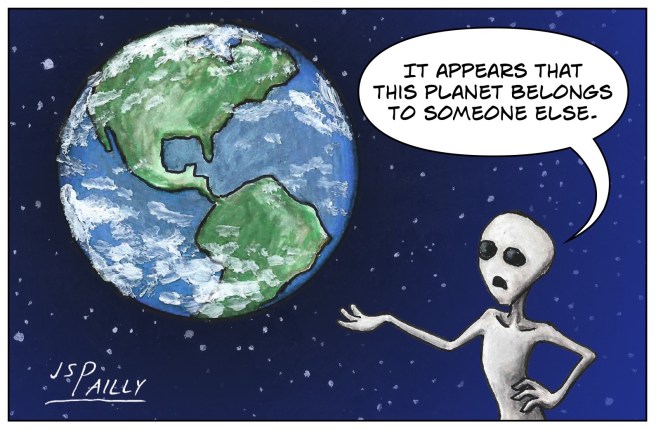
The word came to English by way of French, with its meaning changing and expanding quite a bit along the way.  Alien can mean strange or exotic.  It can mean new and unexpected.  It can mean “from a foreign land.”  It can also mean out of place or unwelcome, and it can have other pejorative connotations as well.

But for our purposes, we’re primarily interested in the “creature from another planet” definition.  The oldest citation given in Brave New Words comes from British essayist Thomas Carlyle, who wrote in 1820: “I am like a being from another planet on this terrestrial ball, an alien, a pilgrim among its possessors.”

But this quotation is marked as being of historical interest, not as a proper example of the word’s sciency/science fictiony usage.  Mr. Carlyle is sort of fumbling for words here, I think, and the word alien still seems to have more to do with being foreign in general rather than extraterrestrial in particular.

Attack of the Bug-Eyed Monsters

So it’s not until the 1930’s, thanks in large part to the pulp Sci-Fi magazines of that era, that the word alien truly comes to mean a creature from some other world.  As Brave New Words shows us, it’s in the 30’s that we start reading about “intelligent aliens” who perform experiments using “many forms of apparatus,” or we hear about how “disgusting” it would be to “traffic with an alien form of life,” or how infuriating it is to think that a human being has become “a captive of the aliens.”

I don’t know about you, but to me that seems like a surprisingly recent development in the language.
Sciency Words: Tau Level

Today’s post is part of a special series here on Planet Pailly called Sciency Words.  Each week, we take a closer look at an interesting science or science-related term to help us expand our scientific vocabularies together. Today’s term is:

TAU LEVEL

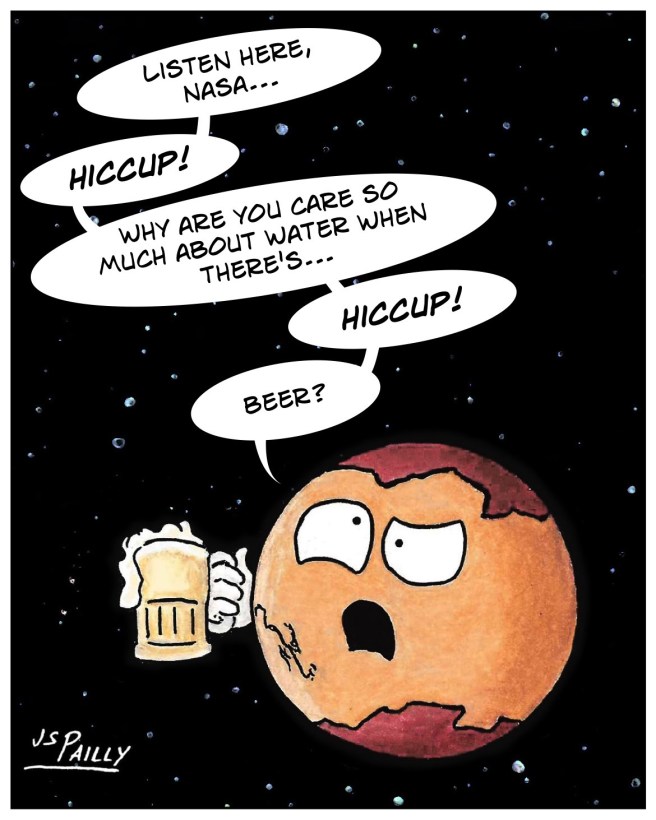
I first came across this term in a press release from NASA’s Jet Propulsion Laboratory.  It has to do with Mars, and the global dust storm that’s been happening there these last few months, and that Mars rover that we may have lost.  But most of all, this tau level thing has to do with Beer.

No, not that kind of beer.

I’m talking about Dr. August Beer, a 19th Century German physicist who studied how light passes through and/or gets absorbed by various substances.  Dr. Beer is best remembered for Beer’s law, which (according to several papers I looked at… click here or here or here) is used to calculate how much sunlight makes it through the Martian atmosphere to reach the planet’s surface.

In those calculations, the Greek letter tau (τ) represents the amount of dust or other particulate matter that’s floating around in the atmosphere.  The more dust in the air, the higher the tau level.  And the higher the tau level, the less sunlight reaches the ground.

As you can imagine, you need to measure the tau level on Mars each day (or rather, each sol) and predict what the tau level will be tomorrow (I mean, solmorrow) if you’re trying to run any sort of surface mission on Mars that depends on solar power.  And in the future, when we have a well-established colony on Mars, don’t be surprised if the term tau level features prominently in the local weather reports.

P.S.: I had an idea that got too convoluted, but I really wanted to make a “don’t drink and drive” joke involving Beer’s law and our possibly wrecked Mars rover.

Sciency Words: Garn Scale

Today’s post is part of a special series here on Planet Pailly called Sciency Words.  Each week, we take a closer look at an interesting science or science-related term to help us expand our scientific vocabularies together. Today’s term is:

THE GARN SCALE

In 1985, Senator Jake Garn of Utah became the first sitting member of Congress to fly in space.  Florida Congressman Bill Nelson followed a year later.  I guess NASA felt it would be good for somebody in Congress to see firsthand how the money for the space shuttle program was being spent.

Senator Garn’s Wikipedia page quotes several astronauts. Apparently not everyone was thrilled about Garn’s mission, but some of them had nice things to say. Astronaut Charles Bolden, who would later go on to become NASA Administrator, said:

Jake Garn was the ideal candidate to do it, because he was a veteran Navy combat pilot who had more flight time than anybody in the Astronaut Office.

And Charles Walker, one of the astronauts who flew with Senator Garn, had this to say:

[…] I think the U.S. space program, NASA, has benefited a lot from both his experience and his firsthand relation of NASA and the program back on Capitol Hill. As a firsthand participant in the program, he brought tremendous credibility back to Capitol Hill, and that’s helped a lot.

Jake Garn may have had a lot of piloting experience before his mission, and afterwards he may have had a lot of positive things to tell his colleagues in Congress, but the mission itself… well, let’s just say weightlessness did not agree with the senator’s stomach.

As a result, Garn’s name has become something of a slang term at NASA.  The Garn scale is an informal, off-the-cuff system to quantify how space sick someone becomes while in space.  Apparently it’s not unusual, even for the most experienced astronauts, to get a little space sick.

A zero on the Garn scale represents not getting space sick at all.  If you do get sick, you’ll probably score a tenth of a Garn, or a quarter of a Garn—some fractional amount of a Garn.  It’s said that no one has ever reached one full Garn’s worth of space sickness, except of course, Senator Garn himself.

Hopefully the senator has a sense of humor about all this.

Sciency Words: Space Adaptation Syndrome

While doing my recent research on hypogravity and its effects on the human body, I’ve seen the term space adaptation syndrome come up a few times. I figured it would make a good Sciency Words post. Then I discovered, to my surprise, that I’d already done this one!

So today I’d like to present to you, apparently for the second time:

SPACE ADAPTATION SYNDROME

Yeah, we could just call it “space sickness,” but this is Sciency Words, so we have to call it “space adaptation syndrome.” Because NASA has a rule that all space related terms must be turned into acronyms, we can also call it “S.A.S.”

Most astronauts experience space adaptation syndrome at some point, usually during training or during their first few days in space. Relapses are also known to happen. As you can imagine, NASA really wants to figure out what causes S.A.S. and how to prevent it. This is one of the reasons they recently left an astronaut in space for almost a full year.

Mr11 Year in Space
This is totally how the year in space mission happened.

At present, S.A.S. seems to be similar to motion sickness. It is also sort of the exact opposite of motion sickness. Think of it this way:

  • Motion sickness: your inner ear senses motion, but your eyes do not (because you’re playing with your phone in a moving car, for example). In this case, your eyes are feeding your brain false information.
  • Space adaptation syndrome: your eyes see that you’re moving (or not moving), but in the absence of gravity, your inner ear hasn’t got a clue what’s going on. So in this case, your eyes are trustworthy; it’s your inner ear feeding false information to your brain.

The good news is that we humans can adapt. Our brains learn to rely less on our inner ears, allowing the business of human space exploration to continue.

The bad news is that once we humans adapt to space, returning to Earth becomes a problem. I’m not talking about bone loss or muscle atrophy. I’m talking about balance. All of a sudden, your inner ear is working again, and your brain has to relearn how to do this balancing and walking stuff.

There is also a concern—and I’m not sure how seriously to take this concern—that the human body might adapt too well to space. You might spend so much time up there, becoming so acclimated to zero-G, that your brain and inner ear will never function properly together again. You’ll never walk again. You’ll never be able to come home. You’ll be stuck in space for the rest of your life.

That would suck.

Or maybe it wouldn’t. To be honest, if I ever get to go to space, I probably won’t want to come back anyway.

P.S.: Here’s a bonus Sciency Word: lead-head. Lead-head is what astronauts call immunity from space adaptation syndrome.

Sciency Words: G-Shortage Illusion

Today’s post is part of a special series here on Planet Pailly called Sciency Words.  Each week, we take a closer look at an interesting science or science-related term to help us expand our scientific vocabularies together. Today’s term is:

G-SHORTAGE ILLUSION

I guess this isn’t a real scientific term, at least not yet. The authors of this paper are proposing this term to describe a problem people living on the Moon or Mars may have to deal with in the future.  For colonists, many a sprained ankle or broken bone (or punctured spacesuit) will probably be blamed on the G-shortage illusion.

The human inner ear, which regulates our sense of balance, is sort of hardwired for Earth’s gravity.  The inner ear expects you to feel 1 g of force—no more, no less—due to the planet’s gravity, and it uses that 1 g of force to figure out which way is down.

But imagine you’re a fighter pilot doing all kinds of crazy maneuvers in midair.  Your inner ear has to do some math to keep track of where you are, and which was is the ground, so you don’t crash.  Now if you happen to turn your head while simultaneously pulling a hard turn with your aircraft, your inner ear could make a serious miscalculation.

This is a form of spatial disorientation known as the G-excess illusion, because it happens when you’re experiencing excess G-forces. It’s a well documented and well understood phenomenon, and pilots who aren’t adequately prepared for it can end up making fatal errors while flying.

The G-shortage illusion is sort of the same thing, but it’s caused by the opposite reason.  Imagine this time you’re an astronaut on the Moon or Mars or some other world with hypogravity.  You take your first step.  At the same moment, you happen to turn your head.  Your inner ear gets confused, and as a result…

Until I started learning about hypogravity, I didn’t realize how often Apollo astronauts lost their balance and fell over while trying to explore the Moon’s surface.  The G-shortage illusion in action, it seems.  Fortunately no one was injured, and no one damaged their spacesuit… but they could have.

So dear readers, if any of your are planning to move to the Moon or Mars, tread carefully!

P.S.: While researching for this post, I found this article from Naval Aviation Newsvery interesting.  It’s written by an artist who was hired by the Navy to do caricature drawings about various forms of spatial disorientation, like the G-excess illusion.  Those drawings were then used as visual aids in flight safety training.  If you’re interested in how art contributes to STEM, this article is worth a look.

Sciency Words: Hypogravity

Today’s post is part of a special series here on Planet Pailly called Sciency Words.  Each week, we take a closer look at an interesting science or science-related term to help us expand our scientific vocabularies together. Today’s term is:

HYPOGRAVITY

We have a pretty good idea how the human body operates in Earth-normal gravity (1 g).  We also know a lot about how weightlessness (0 g) affects our bodies. But what about values of gravity between 0 and 1 g?  According to this review from the journal Frontiers in Physiology, our knowledge about the human body in so-called hypogravity is shockingly limited.

The word hypogravity combines the word gravity with the prefix hypo-, which comes from a Greek word meaning “under” or “below.”  It’s defined as an actual or perceived gravitational force greater than 0 g but less than 1 g.  The term hypergravity (from a Greek word meaning “over” or “above”) is also used for gravitational forces greater than 1 g.

According to Google ngrams, the term started appearing in print during the 1950’s, which would coincide with the early days of the space program.  My first encounter with this term was in an article titled “Medical Skills for an Interplanetary Trip: The Hostile Environment of Space and the Planet Mars,” which appears in this book about the Mars One program.

I can’t remember ever seeing this term prior to that article, which kind of surprised me at first.  But based on my subsequent research, I think this term is used almost exclusively in the medical field, an area which I’m not well versed in.

According to that paper from Frontiers in Physiology, we know very little about what hypogravity does to us, medically speaking.  Of course we do have the first hand accounts of those few astronauts who’ve walked on the Moon, as well as other records and archival footage from the Apollo program.  Frontiers in Physiology also describes several ingenious ways scientists have learned to simulate hypogravity in the laboratory.  And we have mathematical models to help us predict what hypogravity might do to us long term.

But still, our knowledge and experience with hypogravity “remains fragmentary,” as Frontiers in Physiology puts it.  “Fragmentary” seems like just the right word, because old records, laboratory simulations, and computer models can only tell us so much.  We have very little to go on here.  Just bits and pieces. A few scattered data points.

The human body evolved in a 1 g environment.  Prolonged weightlessness seems to do our bodies a lot of harm, from bone loss and muscle atrophy, to disrupting the balance of our internal fluids, to messing up our equilibrioception (a “sixth sense” most of us don’t realize we have until it’s taken away).  I’d assume hypogravity does less harm than weightlessness.  The question is: how much less?

I guess we won’t really know the answer until we start sending people to live on the Moon or Mars long term, and start finding out which health problems they do or do not develop.

Sciency Words: How to Name Your Dinosaur

I got a little bit behind on my research this week, so I don’t have anything prepared for this week’s episode of Sciency Words.  However, I recently stumbled upon this video which seems thematically appropriate in relation to the Sciency Words series.

It’s a TED Talk with Jack Horner, the world famous paleontologist who discovered Maiasaura and demonstrated that some dinosaur species did, in fact, take care for their young.  If you remember Alan Grant from the original Jurassic Park, Jack Horner served as the real life inspiration for that character.

The TED Talk is about how dinosaurs get their names and how that naming process has led to some pretty glaring scientific mistakes.

Sciency Words is mainly a series about science, but it’s also about linguistics and the philosophy of language.  Words have power.  They shape our thoughts, and they can change the way we understand and experience the world.  And as Jack Horner’s TED Talk illustrates, if we’re careless about the words we choose to use, then our words can mislead us, and we can end up blinding ourselves to things that should be obvious.

Harry Potter and the Sciency Words of Molecular Dissociation

Okay, I’m going to try something a little different for this week’s episode of Sciency Words.

I’ve been a huge fan of the Harry Potter novels for a long time now.  Learning new and interesting scientific terms, as we do here on Sciency Words, can feel a little like learning new magical spells.  Sometimes scientific terms even sound a little like the kinds of spells they might teach at Hogwarts.

So today, we’re going to discuss the magical art of molecular dissociation, and we’re going to learn three spells which can cause the dissociation of molecules to occur.  In other words, we’re going to learn three ways to break molecules apart.  Ready?

Photolysis is one of the very first “magical spells” I leanred, and I think it’s a really good one to know about.  “Photo” comes from the Greek word for light, so photolysis is the breaking of chemical bonds using light.

Typically this is done using higher energy wavelengths of light, like the Sun’s ultraviolet rays.  As an artist, it’s important for me to know how to cast shield charms against photolysis, because photolysis can (and will) destroy the chemical pigments in my art work, causing the colors to fade.

As you might have guessed, electrolysis is when you break chemical bonds with electricity.  You may have assumed astronauts are muggles.  You can be forgiven for that assumption, but astronauts definitely know how to perform at least this much magic.

And in the not-so-distant future, space explorers on the Moon and Mars and out in the asteroid belt will probably use electrolysis to split water molecules into hydrogen (useful as rocket fuel) and oxygen (useful for breathing and also as rocket fuel).

“Pyro” means fire, so pyrolysis is the breaking of chemical bonds using heat.  This is probably the most common and most obvious of these molecular dissociation spells—what do you think Bunsen burners are for?—but for some reason I don’t see this term being used very often.

In fact the first time I ever saw the word in print was in this paper about the Curiosity rover on Mars.  I guess Mars rovers have magical powers too, because Curiosity cast pyrolysis on a weird sample it had collected in order to figure out what the sample was made of.  Turned out it was made of complex organic compounds, the kind of compounds that may (or may not) be associated with Martian life.

* * *

Of course there are still so many more scientific terms… I mean magical spells to learn.  I’m hoping I’ll find another of these molecular dissociation spells that fits the photolysis, electrolysis, pyrolysis pattern.  If I do, I promise to draw someone in Slytherin colors performing the spell.

Sciency Words: Macromolecule

Today’s post is part of a special series here on Planet Pailly called Sciency Words.  Each week, we take a closer look at an interesting science or science-related term to help us expand our scientific vocabularies together.  Today’s term is:

MACROMOLECULE

After all the years I’ve been writing Sciency Words, I’ve noticed something.  A lot of times it might seem pretty obvious what a scientific term means, but then you dig a little deeper and find that the term is not so clearly or precisely defined as you’d expect.

Defining macromolecule should be easy.  Macro means big, molecule means molecule; ergo, a macromolecule is a big molecule.  But after I read this paper about the discovery of organic macromolecules on Mars, I had a question: just how big does a molecule need to be to get that macro- prefix?

German chemist Herman Staudinger is credited with coining the term macromolecule.  It was a highly controversial concept at the time.  Another German chemist, Nobel laureate Heinrich Wieland, wrote to Staudinger in the 1920’s saying: “My dear colleague, drop the idea of large molecules; organic molecules with a molecular weight higher than 5000 do not exist.”  But Staudinger would later become a Nobel laureate himself for proving that they do.

I take that Wieland quote to mean that the word macromolecule was defined as any molecule with a molecular weight in excess of 5000, but I’ve seen other sources claiming it was defined as any molecule containing one thousand or more atoms, and still other sources saying it’s ten thousand or more atoms.

But those were the kinds of definitions being used in the early 20th Century.  Modern usage gets far more complicated and confusing.  As Wikipedia explains, the definition of macromolecule “varies among the disciplines.”

  • In biology, there are four kinds of macromolecule: lipids, proteins, nucleic acids, and carbohydrates. If it’s not one of those four things, it’s not a macromolecule, according to a biologist.
  • Polymer scientists go by a definition set by the International Union of Pure and Applied Chemistry (IUPAC), which states that a macromolecule is a “molecule of high relative mass, the structure of which essentially comprises the multiple repetition of units derived, actually or conceptually, from molecules of low relative molecular mass.”
  • Wikipedia also mentions a definition that involves aggregates of molecules sticking securely together due to intermolecular forces rather than covalent or ionic bonds.

It’s not unusual for one word to be defined in different ways by different fields (see my post on metallicity).  This is a big reason why some scientific terms end up being so difficult to define.

As for those organic macromolecules Curiosity found on Mars… in the context of that research, I think macromolecule simply means “very big molecule.”  Like I said on Wednesday, we don’t really know what, specifically, Curiosity found, and maybe we never will.  We just know that it must’ve had a lot of very big molecules in it.

Sciency Words: Aromatic

Today’s post is part of a special series here on Planet Pailly called Sciency Words.  Each week, we take a closer look at an interesting science or science-related term to help us expand our scientific vocabularies together. Today’s term is:

AROMATIC

At some point when I was a little kid, I discovered that gasoline doesn’t smell terrible.  In fact, it has an almost sweet aroma to it.  I got in a lot of trouble for this because, for obvious reasons, my parents didn’t want me sniffing gas fumes.  But still, that subtly sweet smell is there, and it’s caused by a chemical known as benzene.

Apparently I’m not the only person to take note of benzene’s smell.  German chemist Augustus Wilhelm Hofmann is credited with the first usage of the word “aromatic” to describe benzene, along with a whole host of other sweet-smelling chemicals.

Hofmann seems to have realized not only that these chemicals smelled similar but also that they had similar chemical compositions.  “Of this series,” Hofmann wrote in 1855, “few members are at present known, but the group of aromatic acids is itself very imperfect and limited.”  In other words, Hofmann predicted the existence of more “aromatic” chemicals that should fit the pattern.

And more chemicals of this series were later discovered, and we now know what they really have in common: a flattened, ring-like chemical structure, as pictured below:

As an adult, I know better than to sniff gasoline, and as an artist I know better than to sniff my art supplies.  But the xylene used as a solvent in some pens and markers does have that same vaguely sweet aroma as benzene. However, not all of the chemicals we call “aromatic” smell so nice, or smell at all.  It’s the flattened, ring-like structure that defines aromaticity today.  The odor is no longer considered relevant.

You might be wondering then why we still call these chemicals aromatic, if their aromas aren’t important.  This seems to be another case of scientists naming something before they really understood it.  The same thing happened with the word organic.  The term was used so often in scientific literature and became so deeply ingrained in the scientific lexicon that we’re now unable to change it.

The ring-like structures in aromatic chemicals are incredibly strong and unlikely to break apart during chemical reactions. That makes them really good structural components for the large, complex molecules that make life possible here on Earth—and may have once made life possible on Mars.  But we’ll talk more about that next week!