Sciency Words: Kilonova

Sciency Words: (proper noun) a special series here on Planet Pailly focusing on the definitions and etymologies of science or science-related terms.  Today’s Sciency Word is:

KILONOVA

In a recent presentation at Princeton University, Dr. Beverly Berger—an astrophysicist from LIGO—used a very interesting term.  Imagine a pair of neutron stars orbiting each other, spiraling closer and closer together, until suddenly “they go splat!” as Dr. Berger enthusiastically described it.

The more official-sounding term for this is kilonova, Dr. Berger then explained.  The term kilonova originates from this 2010 paper, which predicted that the merger of either two neutron stars or a neutron star and a black hole would produce a very bright flash of light.

The authors of that paper calculated that, at peek luminosity, this flash of light would be approximately a thousand times brighter than a nova explosion—hence “kilonova.”  (In case you’re wondering, a kilonova is still not as bright as a supernova—a supernova is “as much as 100 times brighter than a kilonova” according to this article from NASA.)

Of course the LIGO project is designed to detect gravitational waves, not bright flashes of light.  But as you can see in the highly technical diagram below, a kilonova is accompanied by subtle ripples in the fabric of space-time—gravitational waves, in other words.

In August of 2017, the LIGO project detected exactly the kinds of ripples that would indicate two neutron stars had “gone splat.”  As this article from the LIGO website explains, alerts were “sent out to the astronomical community, sparking a follow-up campaign that resulted in many detections of the fading light from the event, located near the galaxy NGC 4993.”

One thing I’m still not clear about: what happens after a kilonova?  It seems the scientists at LIGO are wondering about that too.  According to that same article from the LIGO website, the 2017 kilonova produced either the largest neutron star that we’ve ever observed OR the smallest black hole.  “Both possibilities are tantalizing and fascinating,” the article says, “but our data simply isn’t good enough to tell us one way or the other.”

Fortunately there are a few projects in development that might help us understand kilonovae—and similar cosmic cataclysms—a little bit better.  We’ll take a look at some of those upcoming projects in Monday’s post.

Sciency Words: Gravity Waves vs. Gravitational Waves

A few years back, I made a bit of a fool of myself in front of a professional physicist from LIGO.  You see, I kind of have a reputation, both online and in real life.  I’m the Sciency Words guy.  I’m the guy who knows stuff about scientific terminology.

So it’s pretty embarrassing when I get my scientific terms mixed up!  For today’s episode of Sciency Words, I’d like to share with you the two terms I got confused about so that the next time you meet a physicist from LIGO, you won’t make my mistake.

GRAVITY WAVES

Gravity waves have to do with fluid dynamics: the movement of liquids and gases.  As an example, imagine an air mass being blown up and over a mountain range. Once over the mountains, that air mass will start to fall downwards again due to the force of gravity.

But of course air masses don’t sink straight down like lead weights.  Air has a lot of buoyancy, so that air mass will bob up and down for a while until it settles into a stable equilibrium.  This bobbing up and down motion will produce ripples in the atmosphere, and those ripples are called gravity waves.

Gravity waves have been observed both in Earth’s atmosphere and Earth’s oceans.  They’ve been observed on other planets as well.  Basically any time part of a liquid or gaseous medium is forced upwards, you can expect gravity to pull it back down again, producing gravity waves.

GRAVITATIONAL WAVES

Gravitational waves have to do with Einstein’s theory of general relativity.  As an example, imagine two black holes spinning rapidly around each other. Even if you’re watching this from a safe distance, you might notice the combined gravitational attraction of those black holes grows stronger and weaker in a regular, oscillating pattern.

Well, actually you probably won’t notice that.  Even in the most extreme circumstances, those oscillations in gravity are barely detectable.  But they do happen.  The LIGO Project confirmed that in 2015 (the news wasn’t announced until 2016).

French theoretical physicist Henri Poincaré gets credit for coining the term gravitational waves (ondes gravifiques in French).  He first wrote about them in 1905, around the same time Einstein was formulating his theory of special relativity.  I’m not sure who coined the term gravity wave, but English mathematician George Biddle Airy was the first to mathematically describe gravity waves in 1841.

My mistake was asking a physicist who studies gravitational waves for LIGO a question about gravity waves in the atmosphere of Titan.  I mean, it’s an understandable mistake, getting these two terms confused—unless you’ve been introduced as an expert on scientific terminology!!!  Then it’s super embarrassing!!!

P.S.: As it so happens, I got the chance to meet up with that same LIGO physicist once again this week.  She was giving a presentation at Princeton University.  Don’t worry.  I didn’t embarrass myself too much this time.  I’ll tell you more in Monday’s post!

Sciency Words: Entomopters

Sciency Words: (proper noun) a special series here on Planet Pailly focusing on the definitions and etymologies of science or science-related terms.  Today’s Sciency Word is:

ENTOMOPTERS

It is aerodynamically impossible for insects to fly, or so French entomologist Antoine Magnan famously claimed in 1934.  And it’s true.  If aerodynamics means the scientific principles governing the flight of airplanes, then you will have a very hard time explaining how insects fly using aerodynamics alone.

Do you know what else is aerodynamically impossible, or at least aerodynamically very, very difficult?  Flying on Mars.  The atmosphere is too thin for fixed-wing aircraft.  But perhaps where traditional aerodynamics fails, insect aerodynamics might succeed!

At least that was the thought behind the entomopter, a project proposed by Robert Michelson and colleagues at the Georgia Tech Research Institute back in the early 2000’s.  The term entomopter comes from two Greek words—entoma, meaning insect, and pteron, meaning wing.  So an entomopter is a flying machine that mimics the “aerodynamically impossibly” flight of insects.

As Michelson explains in this article:

Aerodynamic analyses of [insect] flight consistently revealed that their wings must produce 2-3 times more lift than conventional wings, and in some cases up to 6-7 times.  The extra load-lifting capacity this would offer Entomopters is highly significant, and indicates that a novel design based on flapping insect flight would outperform a more traditional aerodynamic approach.

The prototype entomopter built by Michelson and his research team was modeled after the hawk moth (scientific name Manduca sexta).  With a ten-centimeter wingspan, the hawk moth is an unusually large insect, which makes it easier to observe and study the movements of its wings. And I have to admit in this concept video from NASA, there is something distinctly moth-y about the way the entomopter flies.

I first learned about the entomopter while researching last week’s post on NASA’s NIAC program.  The entomopter was one of those so-crazy-it-might-work proposals that won grant money through NIAC.

You may have heard about the Mars Helicopter Scout (a.k.a. Marscopter), which will be accompanying NASA’s next Mars rover.  You may have also heard about Dragonfly, the robotic quadcopter that NASA plans to send to Titan sometime in the 2030’s. Neither of these spacecraft qualify as entomopters, and I’m really not sure how much thanks either Marscopter or Dragonfly owe to the entomopter project.  But I strongly suspect there is some sort of connection there.

Sciency Words: NIAC

Sciency Words: (proper noun) a special series here on Planet Pailly focusing on the definitions and etymologies of science or science-related terms.  Today’s Sciency Word is:

NIAC

Every once in a while, you’ll hear that NASA is working on some crazy Sci-Fi technology.  Space elevators, warp drive… stuff like that.  How seriously should you take this?  Well, I’m not sure, but NASA does have this special program called NIAC.

When NIAC was first created in 1998, the acronym stood for “NASA Institute for Advanced Concepts.”  The program was canceled for budgetary reasons in 2007, but then it was revived in 2011.  The acronym now stands for “NASA Innovative Advanced Concepts.”

As explained in a recent article from Scientific American, “The program functions as NASA’a venture capital arm, in that it supports technologies that might pan out, big-time.”  Basically, if you have a proposal for some highly speculative new space technology—something that sounds a little bit crazy, but not too crazy—NASA might give you grant money for your research.

NIAC funding has gone toward space elevators and robotic space bees.  A mission to Proxima Centauri using tiny “chip” sized space probes?  That got NIAC funding.  The almost magical sounding Mach effect thruster—a propulsion system that uses zero propellant?  That got NIAC funding.

Some of these ideas have been ridiculed by the scientific community and in the popular press.  And I have to agree: this stuff really does sound crazy.  But remember, The New York Times once ridiculed Robert Goddard for his crazy idea that rockets could get us to the Moon.  The New York Times was really harsh in their criticism.

But as we now know, Goddard was right, and The New York Times famously published an apology in 1969, just days before Apollo 11 landed on the Moon.

Most NIAC-funded projects probably won’t work out; but imagine what would happen if a few of them did!  So the next time you hear that NASA is working on some crazy sounding Sci-Fi tech, that probably just means somebody won a NIAC grant. I’m still not sure how seriously you or I should take these NIAC-funded projects, but maybe it’s okay to take them just a little bit seriously.

Sciency Words: Ploonets

Sciency Words: (proper noun) a special series here on Planet Pailly focusing on the definitions and etymologies of science or science-related terms.  Today’s Sciency Word is:

PLOONETS

If you’ve ever played Super Planet Crash (cool game, highly recommended, click here), then you know how difficult it is to maintain a stable orbit.  The planets just keep pulling each other this way and that.  It’s gravitational chaos!  Fortunately, Super Planet Crasher doesn’t include moons.  I imagine the game would be way harder if it did.

Recent research (click here) gives us a better idea of what happens to moons that get yanked out of their proper, moonly orbits.  According to computer simulations, many destabilized moons will crash into their planets.  A few will crash into the sun or be hurled out of the solar system entirely.  But a surprisingly large number—almost half of them—will settle into new orbits around their suns, becoming planets in their own right.

The scientists behind this research have proposed a new term for these runaway moons.  They want to call them “ploonets.”  And furthermore, they describe four different kinds of ploonet we might find out there.

  • Outer ploonet: a ploonet orbiting beyond the orbit of its original planet.
  • Inner ploonet: a ploonet orbiting inside the orbit of its original planet.
  • Crossing ploonet: a ploonet that crossed the orbit of its original planet.
  • Nearby ploonet: a ploonet that shares almost the same orbital path as its original planet.

We may even be able to confirm the existence of ploonets in the near future.  All we have to do it look toward so-called “hot Juipters”—Jupiter-like planets that have migrated dangerously close to their suns.  If those computer simulations are correct, hot Jupiters should have shed small, icy ploonets all over the place during their migratory journeys.

I think we can all agree ploonet is an adorable word, but is this actually a useful term for astronomers and astrophysicists?  I’m not sure.  I guess it depends.  How important is it, do you think, to make a distinction between planets that were always planets and planets that used to be moons?

Sciency Words: Artemis

Sciency Words: (proper noun) a special series here on Planet Pailly focusing on the definitions and etymologies of science or science-related terms.  Today’s Sciency Word is:

ARTEMIS

By 2024, America will return to the Moon.  That is the promise of NASA’s new Artemis Program. As far as I’m concerned, NASA could not have picked a better name for their next Moon mission.

In ancient mythology, Artemis was Apollo’s twin sister. So as a follow-up to the Apollo Program, Artemis is the logical choice.

And where Apollo (named for a Greek god) put the first man on the Moon, Artemis (named for a Greek goddess) promises to put the first woman on the Moon.  And furthermore, Artemis has a stronger claim to the Moon anyway; she was the goddess of the Moon, after all! Apollo was the god of the Sun.

But will the Artemis mission actually happen? Honestly, I doubt it. Why?  Well, I’m really, really sorry for this, but we’re going to have to talk about American politics.

Artemis is expected to cost $20 billion, minimum.  That’s roughly equivalent to NASA’s entire annual budget.  While that $20 billion price tag is not an immediate deal breaker (like the 90-Day Report was), it’s still an awful lot of money.

It’s up to the current administration to persuade Congress to pay for Artemis.  Why is Artemis a good idea?  Why does it have to happen by 2024?  Based on articles like this one, it sounds like Congress is skeptical yet persuadable.

Unfortunately, the current administration seems to be sending a lot of mixed messages about Artemis.  Most notably, at an event celebrating the 50th Anniversary of the original Moon Landing, the current President very publically chastised his own NASA administrator for wanting to return to the Moon.  It’s enough to make one wonder if Artemis is a real priority for this administration.

So I’m pretty pessimistic about the Artemis Program. I don’t think it will happen, at least not as it’s currently envisioned, and certain not on the current timetable. Don’t agree?  Please tell me why I’m wrong in the comments.  I would love to be wrong about this.

But whenever the United States does get around to returning to the Moon, I hope NASA keeps the Artemis name.  That really is the perfect name for the next Moon mission.

Sciency Words: The 90-Day Report

Sciency Words: (proper noun) a special series here on Planet Pailly focusing on the definitions and etymologies of science or science-related terms.  Today’s Sciency Word is:

THE 90-DAY REPORT

We recently celebrated the 50th anniversary of the Moon Landing. There’s been a lot of talk lately about the old Apollo Program, and also a lot of talk about the new Artemis Program, NASA’s next manned (and womanned) mission to the Moon.

But this is not a Sciency Words post about Artemis (I’m saving that for next week).  Instead, this is a post about the 90-Day Report and how it effectively killed NASA’s plans to return to the Moon in the 1990’s.  I think the story of the 90-Day Report provides some context for what may or may not happen with Artemis.

It was July 20, 1989—the 20th anniversary of the Moon Landing—when President George H.W. Bush announced America’s intention to return to the Moon and establish a permanent presence there.  This would be part of a strategy for America to push onward to Mars.  Following the President’s announcement, a special committee was formed to figure out how to make it all happen.  The committee’s findings were released in a document titled “Report on the 90-Day Study on Human Exploration of the Moon and Mars,” a.k.a. the 90-Day Report.

According to the 90-Day Report, NASA would need to build a huge amount of infrastructure in space.  If you’ve seen Stanley Kubrick’s 2001: A Space Odyssey, that’s basically what the 90-Day Report described: giant space stations, a multitude of space shuttles taxiing equipment and personnel to Earth orbit, and enormous interplanetary space cruisers to transport astronauts to the Moon or Mars.

And how much would this cost?  The 90-Day Report conspicuously didn’t say, but the most commonly cited estimate was $450 billion.  To put that in some context, NASA’s budget at the time was just over $11 billion (according to Wikipedia, numbers not adjusted for inflation).  As Robert Zubrin explains in his book The Case for Mars:

It is doubtful that any kind of program could have survived that price tag. Given its long timelines and limited set of advertised accomplishments on the road to colonizing space, which did little to arouse the enthusiasm of the space-interested public, the 90-Day Report proposal certainly could not.  Unless that $450 billion number could be radically reduced, the [Space Exploration Initiative] was as good as dead, a fact made clear in the ensuing months and years as Congress proceeded to zero out every SEI appropriation bill that crossed its desks.

A lot of people ask why we haven’t returned to the Moon since the days of the Apollo Program.  The 90-Day Report is a prime example of why.  “Too many cooks in the kitchen,” as a dear friend of mine likes to say.  Where President Kennedy set a singular, clearly defined goal for the American space program, President Bush handed the space program over to a committee, which came up with a very complicated, very costly list of ideas, which Congress was unsurprisingly unwilling in paying for.

To be fair, at least one idea from the 90-Day Report did come to fruition.  We did get a giant space station.  But that only happened as a result of an international partnership, which is (in my opinion) a model for how all future space missions should be done.

So with the memory of the 90-Day report in mind, next week we’ll talk about the Artemis Program.

Sciency Words: The Silurian Hypothesis

Sciency Words: (proper noun) a special series here on Planet Pailly focusing on the definitions and etymologies of science or science-related terms.  Today’s Sciency Word is:

THE SILURIAN HYPOTHESIS

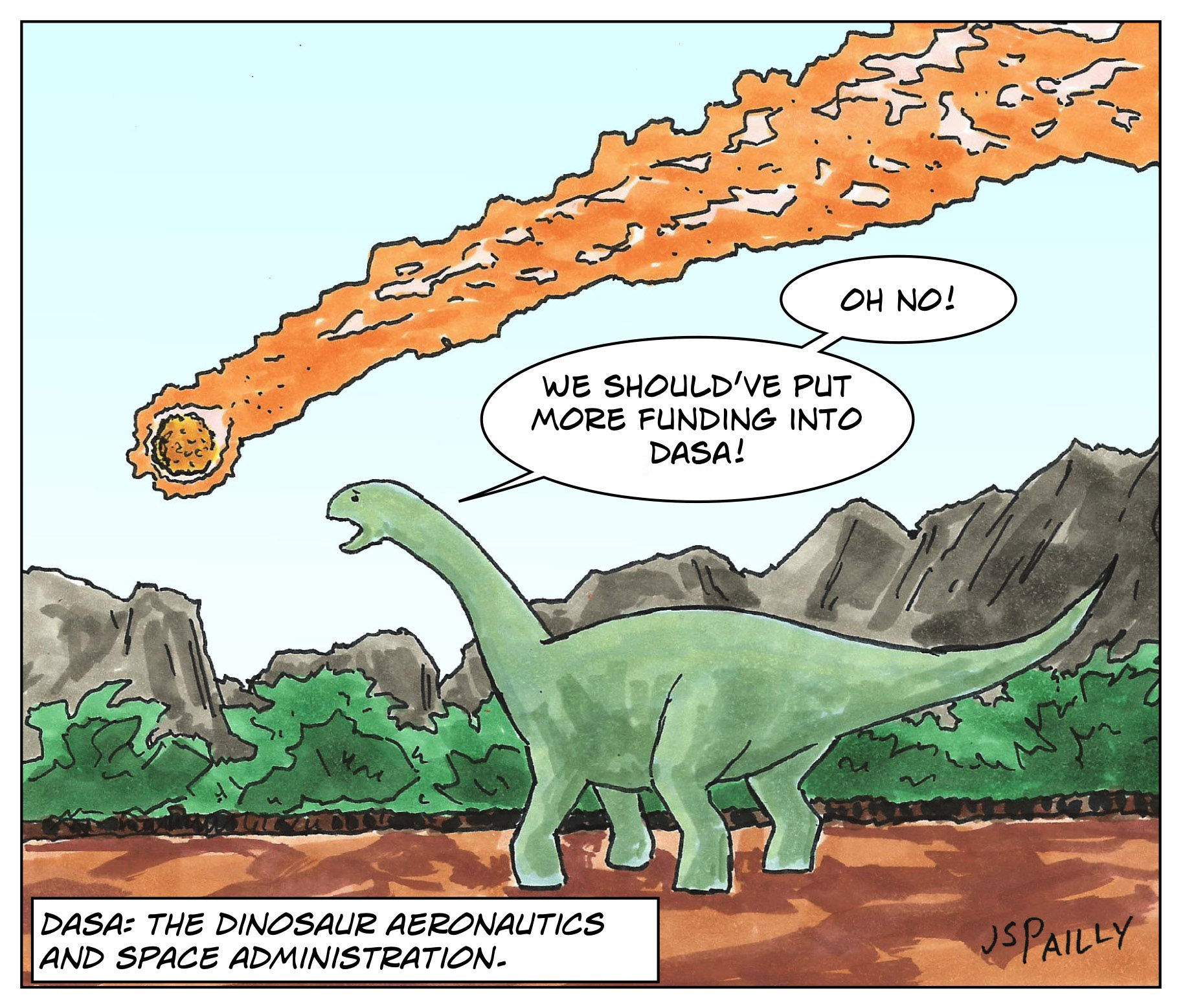
I’ve heard several variations on this joke.  Why did the dinosaurs go extinct?  Because they didn’t put enough money into their space program.

But what if that isn’t a joke?  What if the dinosaurs (or some other prehistoric creatures) did establish an advanced civilization right here on Earth millions of years before we came along?  Could such a civilization come and go without leaving any trace for us modern humans to find?  Or could the traces be there for us to see, and we just haven’t recognized them yet?

In 2018, NASA astrobiologists Gavin Schmidt and Adam Frank presented this idea in a formal scientific paper titled “The Silurian Hypothesis: Would it be possible to detect an industrial civilization in the geological record?”  As Schmidt and Frank explain in a footnote:

We name the hypothesis after a 1970 episode of the British science fiction TV series Doctor Who where a long buried race of intelligent reptiles “Silurians” are awakened by an experimental nuclear reactor.  We are not however suggesting that intelligent reptiles actually existed in the Silurian age, nor that experimental nuclear physics is liable to wake them from hibernation.

Schmidt and Frank go on to examine some of the ways human industrial activities have changed this planet, and how those changes are being recorded geologically.  They also examine a few of the oddities and anomalies in the geological record as we currently know it.

To be clear, there is absolutely no definitive evidence that another advanced civilization existed on Earth before our own.  Schmidt and Frank go to great pains to emphasize that they don’t actually believe their own hypothesis to be true.

The Silurian Hypothesis is intended to be more of a thought experiment than anything else.  It’s meant to help us better understand how human civilization is changing this planet, and also (remember Schmidt and Frank are NASA astrobiologists) how alien civilizations might be changing their own worlds.

P.S.: The Silurian Hypothesis is also a wonderful example of how science fiction can inspire real life science.

Sciency Words: Stagnant Lid

Sciency Words: (proper noun) a special series here on Planet Pailly focusing on the definitions and etymologies of science or science-related terms.  Today’s Sciency Word is:

STAGNANT LID

Here on Earth, we have earthquakes.  Lots and lots of earthquakes.  And that’s very odd.

Maybe we should be thankful for all those earthquakes.  Our planet’s system of plate tectonics is unique in the Solar System.  Frequent earthquakes are a sign that Earth’s tectonic plates are still moving, that our planet is still geologically healthy.  The alternative would be stagnant lid tectonics, and that’s something we Earthlings probably don’t want.

In this 1996 paper, planetary scientists V.S. Solomatov and L.N. Moresi coined the term “stagnant lid” to describe what was happening on Venus—or rather what was not happening.  Venus doesn’t have active plate tectonics.  Maybe she did once, long ago.  If so, Venus’s plates somehow got stuck together, forming a rigid, inflexible shell.

The term stagnant lid has since been applied to almost every other planetary body in the Solar System, with the obvious exceptions of the four gas giants, and the possible exceptions of two of Jupiter’s moons: Europa and Ganymede.

According to this paper from Geoscience Frontiers, neither Europa nor Ganymede have truly Earth-like plate tectonics, but something similar may be happening.  The authors of that paper refer to the situation on Europa and Ganymede as “fragmented lid tectonics” or “ice floe tectonics.”  The upcoming Europa Clipper and JUICE missions should tell us more about how similar or different this is to Earth’s plate tectonics.

A stagnant lid does not necessarily mean that a planet or moon is geologically dead.  Venus and Io both have active volcanoes, for example, and it was recently confirmed that Mars has marsquakes.  But none of these stagnant lid worlds seem to be as lively as Earth—and I mean that in more ways than one.

If you buy into the Rare Earth Hypothesis, plate tectonics is one of those features that makes Earth so rare. Plate tectonics is something Earth has that other planets don’t, and thus it may be an important factor in why Earth can support life when so many other worlds can’t.

Sciency Words: Dreadnought

Sciency Words: (proper noun) a special series here on Planet Pailly focusing on the definitions and etymologies of science or science-related terms.  Today’s Sciency Word is:

DREADNOUGHT

Okay, this isn’t really a scientific term.  It’s more of a science fiction thing.  This week, I ended up watching a video on YouTube about how science fiction borrows and sometimes misuses terminology from the navy.  If you’re a Sci-Fi fan, and especially if you’re a Sci-Fi creator, I think this video is worth your time.

For me, the most interesting of these terms was dreadnought, a word that literally means “I fear nothing.”  In Sci-Fi, dreadnoughts tend to be the biggest, scariest, most overpowered spaceships out there.  If you’re going into battle against a dreadnought, well… I guess it was nice knowing you.

In real life, the term dreadnought comes from the H.M.S. Dreadnought, a massively oversized, massively over-armed battleship that first went out to sea in 1906.  The idea for this ship was championed by Admiral Sir John Fisher, later known as Baron Fisher.

I couldn’t resist showing you Baron Fisher’s coat of arms. Note the family motto on the bottom. Image courtesy of Burke’s Peerage.

Admiral Fisher wanted an all-big-guns ship. No small guns.  No middling-sized guns.  Only the largest guns available at the time would be large enough for the H.M.S. Dreadnaught.  According to this article, the Dreadnought triggered something of an arms race between Britain and Germany, with each country trying to out-dreadnought the Dreadnought, so to speak.

Thus we have a case of what linguists call semantic generalization.  The specific name of one vessel became a generalized term for all the ships that followed a similar design philosophy.  And now the term has been adopted by the Star Trek and Star Wars universes, and many other Sci-Fi universes besides.

Personally, I think dreadnoughts in science fiction have become a bit cliché.  They’re the biggest, baddest ships in the galaxy, and yet somehow the good guys always find a way to blow them up.  But now that I know the history of the term, I kind of want to fit some dreadnoughts into my own Sci-Fi universe—probably in some clever, punny way that honors Admiral Fisher and the original H.M.S. Dreadnought.