Sciency Words: Meme

Sciency Words: (proper noun) a special series here on Planet Pailly focusing on the definitions and etymologies of science or science-related terms.  Today’s Sciency Word is:

MEME

I don’t know about you, but when people talk about memes, I’m not always 100% sure what they mean.  However, it turns out that meme is, in fact, a scientific term, or at least it started out as one.  And you know how I am about scientific terms!

British evolutionary biologist Richard Dawkins gets credit for coining the word meme.  In his 1976 book The Selfish Gene, Dawkins posits that culture develops, changes, and spreads when humans beings imitate the behavior of other human beings.  Explaining the origin of his new word, Dawkins writes that he wanted:

[…] a noun that conveys the idea of a unit of cultural transmission, or a unit of imitation.  “Mimeme” comes from a suitable Greek root, but I want a monosyllable that sounds a bit like “gene.”  I hope my classicist friends will forgive me if I abbreviate mimeme to meme.  If it is any consolation, it could alternatively be thought of as being related to “memory,” or to the French word même.  It should be pronounced to rhyme with “cream.”

In the decades that followed Dawkins’ book, a whole new field of research began to emerge.  The science of memetics would take the analogy between genes and memes to an extreme by applying the core concepts of Darwinian evolution.  To quote from this 2015 article:

Memes are naturally selected and adapted by human beings based on “competition” within our consciousness.  The fittest and best adapted memes will have a better diffusion than the ones which do not fit into the cultural systems they are competing within.

Now if you’re like me and you’re still not 100% sure what, exactly, a meme is, don’t worry.  We’re not alone.  As that same article goes on to explain, the field of memetics seems to have fallen into decline in the late 1990’s/early 2000’s.  The problem: no one, not even the memeticists, could agree on what the word meme means, specifically.

Personally, I think this is a case of an analogy being taken one step too far.  Memes are supposed to be like genes.  Okay.  But genes are tangible things.  They exist within your cells.  It is possible to test for the presence of a gene in an organism’s D.N.A., and you can link genes to the traits that organisms do or do not have.  But memes?  This “unit of imitation” thing is intriguing, but it’s also a rather abstract concept.  How do you study, in a scientific manner, an abstract concept?  How do you test for the presence of an abstract concept?

If we’re talking about the survival of the fittest, perhaps meme is not fit enough for the ecosystem of scientific terms.  However, through the process of linguistic evolution, the word seems to have found a different ecological niche to fill.  According to the Oxford English Dictionary, the first recorded reference to an Internet meme (or rather a “net meme”) was in 1998, around the same time that the science of memetics was in its heyday.  The term was used in a news report about this video clip:

Sciency Words: The X17 Particle

Sciency Words: (proper noun) a special series here on Planet Pailly focusing on the definitions and etymologies of science or science-related terms.  Today’s Sciency Word is:

THE X17 PARTICLE

If you want to know everything there is to know about particle physics, there are only four things you need to understand:

  • Gravity
  • Electromagnetism
  • The weak nuclear force
  • The strong nuclear force

See?  Particle physics is easy!

Okay, maybe particle physics is not so easy.  Even the professionals will tell you they don’t understand those four fundamental forces nearly well enough.  And now, to make matters worse, we may have to add a fifth fundamental force to the list, thanks to the newly discovered X17 particle.

The story of the X17 particle begins with this 2015 paper published in Physical Review Letters.  A team of researchers in Hungary were studying a radioactive isotope of beryllium when they noticed something odd.  Click here if you’re interested in more details about what the Hungarians noticed and what was so odd about it; but for our purposes here on Sciency Words, I think it’s enough to say that this odd thing implied the existence of a previously unknown subatomic particle.

After doing some calculations, the Hungarians determined that this unknown particle (or X particle) must have a mass just shy of 17 megaelectronvolts (hence the name X17 particle).  Follow up research at the University of California, Irvine, strengthened the case that this new particle is real, and furthermore the Irvine team argued that X17 might even be a force carrying particle—meaning we might have discovered a fifth fundamental force of nature!

The latest update is that the same team of Hungarian researchers have noticed something odd happening with another radioactive isotope, this time an isotope of helium.  And according to this prerelease paper, we are once again dealing with an unknown particle with a mass just shy of 17 megaelectronvolts.

This could be a huge breakthrough in the field of particle physics, and according to the Irvine team the X17 particle might even shed some light on the mystery of dark matter.  However, as reported in this article from Quanta Magazine, this particular team of researchers in Hungary have a history of discovering “new” particles that turn out to be errors in their data.  Furthermore, there’s some suspicion that the Hungarians are withholding some of their experimental data regarding X17.  As I’ve written before, withholding data is a huge red flag.

That being said, both professional physicists and the popular press seem to be abuzz with rumors about X17, and I can’t tell you how many people have been asking me about this whole “fifth force” thing.  So I definitely think it is worth knowing about the X17 particle (and now you can impress your friends at parties by explaining what the name means!).

However, do not be surprised if, in another few years, the X17 particle gets thoroughly discredited and debunked.

Sciency Words: Artificial Intelligence

Sciency Words: (proper noun) a special series here on Planet Pailly focusing on the definitions and etymologies of science or science-related terms.  Today’s Sciency Word is:

ARTIFICIAL INTELLIGENCE

In 1955, American cognitive scientists John McCarthy and Marvin Minsky sent out an extraordinary proposal:

We propose that a 2 month, 10 man study of artificial intelligence be carried out during the summer of 1956 at Dartmouth College in Hanover, New Hampshire.  The study is to proceed on the basis of the conjecture that every aspect of learning or any other feature of intelligence can in principle be so precisely described that a machine can be made to simulate it.

McCarthy and Minsky go on to write that that machines can be made to learn, solve problems for themselves, and “improve themselves.”  They also claim that “significant advancement” can be made toward these goals if a group of experts were to “work on it together for a summer.”

Ah, such optimism!

That 1955 proposal is the first documented usage of the term “artificial intelligence.”  Apparently McCarthy initially wanted to use the term “automata studies,” but even among scientists and engineers, “automata studies” didn’t sound sexy enough.  So McCarthy coined the term “artificial intelligence” and ran with that instead.

According to this article from the Science History Institute: “The name implied that human consciousness could be defined and replicated in a computer program […].”  Whether of not that’s true—whether or not computers really can reproduce human-style consciousness—is a topic of ongoing debate.  Regardless, McCarthy’s new term got the attention he wanted, and the 1956 conference at Dartmouth was a success.

However, it turns out it would take more than “a summer” to trigger the robot apocalypse.  Still, the 1956 Dartmouth Conference started something important, and today, we are living with the consequences!

Sciency Words: Love Numbers

Sciency Words: (proper noun) a special series here on Planet Pailly focusing on the definitions and etymologies of science or science-related terms.  Today’s Sciency Word is:

LOVE NUMBERS

My friends, I was recently doing research about the planet Neptune.  Astronomers have a new model for the Neptune system, a model that seems to do a better job predicting the orbits of all those unruly and rambunctious Neptunian moons.  While reading about this new model, I came across the following statement: “We also investigated sensitivity of the fit to Neptune’s Love number […].”  And that gave me a delightful mental picture:

“Love numbers” are named after English mathematician Augustus Edward Hough Love.  They’re also sometimes referred to as “Love and Shida numbers” to recognize the contribution of Japanese scientist T. Shida.

In the early 20th Century, Love introduced two ratios—traditionally represented by the variables h and kh has to do with the elasticity (stretchiness) of a planetary body, and k is related to the redistribution of mass within a planetary body as it stretches.  Shortly thereafter, Shida introduced a third ratio—represented by the variable l—involving the horizontal displacement of a planetary crust.

Taken together, h, k, and l tell you how much a planet, moon, or other celestial body can flex due to tidal forces.  As explained in this paper on Earth’s Love numbers:

If the Earth would be a completely rigid body, [its Love numbers] would be equal to zero, and there would be no tidal deformation of the surface.

But of course Earth is not a completely rigid body.  Tidal forces caused by the Sun and Moon cause Earth to flex “up to tens of centimeters,” according to that same paper.  Tens of centimeters doesn’t sound like much, but as we all know, it’s enough to keep the ocean tides going!

In conclusion, I guess you might say that what’s true for planets is also true for people.  Being completely rigid produces Love numbers equal to zero.  So be flexible.  Allow yourself to stretch a little, and your Love numbers will go up.

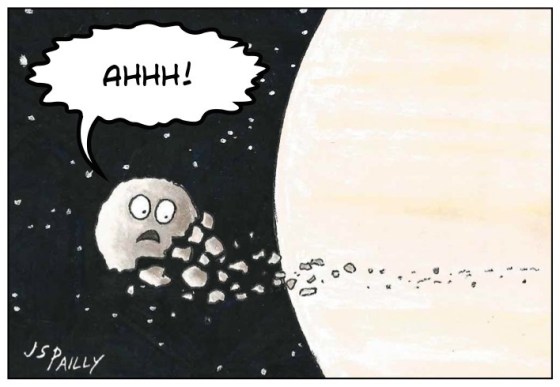
P.S.: Being flexible is healthy in any relationship, but at the same time don’t let others tug on you too hard.  Know your limits—your Roche limit, I mean—because you don’t want to end up like this:

Sciency Words: Dial Tone

Sciency Words: (proper noun) a special series here on Planet Pailly focusing on the definitions and etymologies of science or science-related terms.  Today’s Sciency Word is:

DIAL TONE

Some of you may be too young to know what a dial tone is, so here’s an instructional video explaining the concept.

According to this article from Teletech Services, it was German engineer August Kruckow who invented the dial tone back in 1908.  A dial tone is a buzzing or humming sound that landline telephones make to let you know they’re connected and working.

It’s hard to say when “dial tone” became a SETI term, but the earliest usage I was able to find is this 1995 paper by Steven Dick entitled “Consequences of Success in SETI: Lessons from the History of Science.”

In that paper, Dick draws a distinction between extraterrestrial signals that communicate information vs. extraterrestrial signals that serve essentially the same function as a dial tone.  The general public, Dick argues, would react quite differently if we picked up some sort of intergalactic dial tone instead of a “Greetings, Earthlings, would you like to learn more about calculus?” type of message.

Later papers (like this one or this one) continue to use this dial tone metaphor, and in 2018 a special committee on SETI nomenclature adopted the following as the official definition for the term: “A content-free beacon, i.e. one that communicates only the existence of technological life.”

That same committee goes on to note some concern that the conventional meaning of “dial tone” may soon become obsolete; if so, the committee worries, then the continued use of “dial tone” as a SETI term might become problematic.  I’m not sure I agree with that concern, though.  Lots of terms and phrases have stuck around even after their original meanings have faded into history.

In the near future, maybe it won’t be obvious to everyone that “dial tone” originally had something to do with telephones, but if SETI scientists keep using the term, I don’t think it’s that hard for people to understand what the term means… is it?

Sciency Words: Time

Sciency Words: (proper noun) a special series here on Planet Pailly focusing on the definitions and etymologies of science or science-related terms.  Today’s Sciency Word is:

TIME

How would you define the word time?

I recently read a book called Time Travel: A History by James Gleick.  This is one of the big questions raised by that book, and it’s a question that’s kept nagging at me.  What is time?  We all know what time is, don’t we?  We use the word all the… well, all the time.

But if you had to write a dictionary definition, what would you say?  Keep in mind the first rule of dictionaries: don’t use the word your defining in the definition of that word.  Gleick offers several interesting suggestions.  Time is the experience of duration.  Time is what keeps everything from happening all at once.  Time is the thing that clocks measure.

These are fun definitions, but I don’t find them fully satisfying.  Maybe we could turn to this classic explanation of time given in Doctor Who:

People assume time is a strict progression of cause to effect, but actually, from a non-linear, non-subjective viewpoint, it’s more like a big ball of wibbly-wobbly, timey-wimey… stuff.

In my own science fiction writing, time is often described as “a living thing,” something that’s constantly shifting, constantly changing.  History keeps rewriting itself, and time travelers speak of time in almost adversarial terms.  But while that might work for the kinds of Sci-Fi stories I want to tell, I don’t think this “living thing” notion is an actual, practical way to define what time is.

The closest I’ve come to finding a satisfying definition of time is an idea that goes back to Aristotle: time is a measure of change.  The sun changes its position in the sky.  So do the moon and all the stars.  The seasons change, one into the next into the next, until the cycle repeats.  All these cyclical changes set the standard by which we measure non-cyclical changes.  That’s what time is!

Or is it?  I said this is the closest I’ve come to finding a satisfying definition, but it still feels incomplete.  Thanks to Einstein and the theory of general relativity, we now know that time itself changes relative to acceleration and/or gravity.  So how can the measure of change be changeable?  There must be more to it than that, right?

Sciency Words: Facies

Sciency Words: (proper noun) a special series here on Planet Pailly focusing on the definitions and etymologies of science or science-related terms.  Today’s Sciency Word is:

FACIES

So I’m currently reading a paper entitled “A Field Guide to Finding Fossils on Mars.”  Basically, if you’re hoping to dig up some fossils on Mars, you need to know where to look.  This paper is all about which “facies” are the most likely to have well preserved Martian organisms inside them.

I have to admit I’m having a tough time with the paper.  My first question, and perhaps your first question as well: what the heck is a facies?

The word facies comes straight from Latin, where it meant (believe it or not) face.  It could also mean facial expression or the generalized appearance of a thing.  According to this article from the Encyclopedia Britannica, Danish scientist Nicholas Steno was the first to use facies as a geology term in 1669, but it was Swiss geologist Amanz Gressly who reintroduced the term in 1838, leading to its modern usage.

Gressly was conducting geological research in the Jura Mountains, which lie along the border between France and Switzerland.  It was already known that there were different layers of rock stacked on top of each other.  We call these strata, and it’s now widely recognized that different strata correspond to different time periods in Earth’s past.

But Gressly noticed that, in addition to the strata stacked vertically on top of each other, there were also different “stratigraphic units” arranged horizontally beside each other—the facies, as Gressly decided to call them.  Gressly is quoted in this book as having written:

I think that the petrographic or paleontological changes of a stratigraphic unit in the horizontal are caused by the changes in environment and other circumstances, which still so powerfully influence today the different genera and species which inhabit the ocean and the seas.

In other words, if you find different facies within the same strata, then you’re looking at different environments or ecosystems that existed at the same time, side by side: a lakebed next to a forest, for example.

Or at least that’s what Gressly originally intended the word facies to mean.  But according to that same Encyclopedia Brittanica article, the term has since been generalized “[…] to encompass other types of variation that may be encountered as one moves laterally (e.g., along outcroppings of rock strata exposed in stream valleys or mountain ridges) in a given rock succession.”

So if you’re going fossil hunting on Mars, you want to look for rocks formations dating back to Mars’s Noachian Period—that’s when Mars had lakes and rivers and oceans of liquid water on its surface.  Rock formations from the very early Hesperian Period would also be good.  There was still some liquid water sloshing around at that time.

But within Noachian or Hesperian-aged strata, which facies should you look for?  Well, I’ll have to get back to you on that one.  As I said, I’m having a tough time with this paper, but I am determined to get through it!

P.S.: Bonus Sciency Word!  Those same Jura Mountains where Amanz Gressly did his geological research also gave us the name for Earth’s Jurassic Period.

Quick, Name Those Moons!

I haven’t done enough research this week to put together a Sciency Words post.  I’ve been too busy with other writing.  However, I do have some name-related news to share with you today.

As you may have already heard, astronomers recently discovered twenty new moons orbiting the planet Saturn.  This brings Saturn’s total moon count up to 82, surpassing Jupiter’s total of 79.

These newly discovered moons are each about five kilometers in diameter, according to this press release from Carnegie Science.  That’s really small for moons.  These objects are more like asteroids that happen to be caught in Saturn’s gravity.  Or they might be rubble left over from the destruction of older Saturnian moons.  Saturn may (or may not) have a long history of destroying her own moons.

Now astronomers are asking for you (yes, you!) to help name these newly discovered moons.  Due to established naming conventions, these particular Saturnian moons must be named after giants from Inuit, Norse, or Gallic mythology.  Tweet your suggestions to @SaturnLegacy using the hashtag #NameSaturnsMoons.  Name submissions are due by December 6, 2019.

So go crack open some books on Inuit, Norse, and Gallic mythology, and may the best names win!

Sciency Words: Bunny Hopping

Sciency Words: (proper noun) a special series here on Planet Pailly focusing on the definitions and etymologies of science or science-related terms.  Today’s Sciency Word is:

BUNNY HOPPING

So yesterday I was reading up on the latest spacesuit design from NASA, and I came across a term that I don’t remember ever seeing or hearing before.  In this article from Space Daily, NASA Administrator Jim Bridenstine is quoted as saying: “If we remember the Apollo generation, we remember Neil Armstrong and Buzz Aldrin, they bunny hopped on the surface of the Moon.”

This left me wondering: do people really use the term “bunny hopping” to describe how Apollo astronauts moved about on the Moon?  I tried really hard to trace the etymology of this term.  I didn’t find much, but honestly, when you see clips like this one, it’s easy to figure out where the term came from.

In my previous research on this topic, I’ve seen this method of locomotion referred to as “loping-mode” or “skipping-mode.”  But sure, we can call it “bunny hopping” too.  So why did astronauts do this?

Well, there’s something about walking that most of us, in our daily lives, don’t realize: Earth’s gravity does some of the work for us.  When you take a step, first you lift your foot off the ground, then you extend your leg, and then… well, try to stop yourself at this point.  With your leg extended forward like that, you’ll find that your center of gravity has shifted, and you can feel the force of gravity trying to pull you through the remainder of your walk cycle.

So walking feels like a natural and efficient way for us humans to get around because Earth’s gravity helps us.  Take Earth’s gravity away, and walking suddenly feels awkward and cumbersome.  In lunar gravity, which is approximately ⅙ of Earth’s gravity, the Apollo astronauts found other methods of locomotion to be more comfortable, more natural.  In this clip, we hear audio chatter of astronauts disagreeing about whether “hopping” or “loping” is a better way to get around.

Personal preference seems to be important here, both in how astronauts “walked” on the Moon and in how they described the experience of this new kind of “walking.”

Getting back to the new spacesuits from NASA, the new design features a dramatically improved range of motion.  The next astronauts on the Moon will have a much easier time getting around, and according to Administrator Bridenstine there will be no need for bunny hopping.  “Now we’re going to be able to walk on the surface of the Moon, which is very different from the suits of the past.”

And that’s got me confused.  I’m really not sure what Bridenstine means by that statement because, as I just explained, it was the Moon’s gravity—more so than the spacesuits—that made Apollo era astronauts feel the need to “bunny hop” on the Moon.  The new spacesuits, with their improved range of motion, should help astronauts in the new Artemis program avoid gaffs like these…

But without altering the Moon’s gravity, I don’t see any way to avoid “bunny hopping.”

Sciency Words: Plasma Torus

Sciency Words: (proper noun) a special series here on Planet Pailly focusing on the definitions and etymologies of science or science-related terms.  Today’s Sciency Word is:

PLASMA TORUS

Astronomers have discovered thousands of planets out there.  Exoplanet hunting techniques have gotten so good that astronmers are now moving on to the next great challenge: finding exomoons.  And one possible method for detecting exomoons involves something called a plasma torus.

Ever since the 1960’s, we’ve known something weird was happening with Io, one of the moons of Jupiter.  In 1964, an astronomer by the name of E.K. Bigg determined that Io had some strange power over Jupiter’s magnetosphere.  Subsequent research identified clouds of ionized sulfur and sodium in the vicinity of Io’s orbit.  Then in 1979, NASA’s Voyager 1 space probe photographed Io up close, catching Io in the act of spewing a mix of sulfur compounds and other noxious chemicals into space.

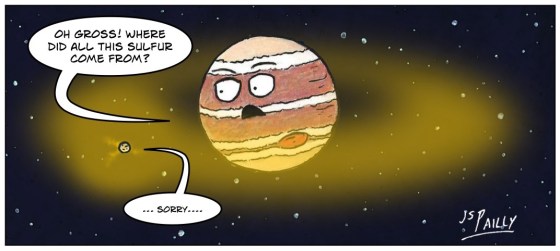
We now know that Io is the most volcanically active object in the Solar System and that Io’s volcanic activity directly affects Jupiter’s magnetic field.  As you can see in this totally legit Hubble image, Io has created a nasty mess around Jupiter.

All those nasty chemicals get swept up in Jupiter’s powerful magnetic field, which acts like a supersized particle accelerator, turning those chemicals into a high-energy plasma.

I can’t be sure who coined the term plasma torus, but a multitude of papers from the 1960’s and 70’s (like this one, or this one, or this one) attempt to model the plasma clouds surrounding Jupiter as a torus—torus being the fancy mathematical term for “donut-shape.”

The nifty thing about Io’s plasma torus is that you can detect it even from a great distance.  Even if you’re too far away to observe Io directly, you can still infer that she’s there based on all those ionized chemicals swirling around Jupiter and the effect those chemicals have on Jupiter’s magnetic field.

So could we find volcanically active exomoons by looking for plasma tori?  According to this paper from The Astrophysical Journal, we sure can—and maybe we already have!  The paper identifies the signatures of possible plasma tori encircling several large exoplanets.

One thing I’m not sure about: when we find a plasma torus, can we be 100% certain it’s caused by an exomoon?  Are there any other natural (or unnatural) phenomena that might cause a plasma torus to form?  I don’t know.

P.S.: Safety warning to any space adventurers who might be reading this.  A plasma torus is a high radiation environment.  Keep your distance!