Our Place in Space: The Wilderness

Hello, friends!  Welcome to Our Place in Space: A to Z!  For this year’s A to Z Challenge, I’ll be taking you on a partly imaginative and highly optimistic tour of humanity’s future in outer space.  If you don’t know what the A to Z Challenge is, click here to learn more.  In today’s post, W is for…

THE WILDERNESS

All month long, I’ve been telling you about how, in the distant future, human civilization will spread out far and wide across the Solar System.  At the same time, I have rather casually been declaring various places in the Solar System should be off limits to humans.  I feel perfectly justified in doing that after reading a certain research paper titled “How much of the Solar System should we leave as wilderness?”

I’m not going to summarize that paper in its entirety.  If you want to learn more, you can check out the links in the “Want to Learn More?” section below.  The main point I want to talk about, based on what that “wilderness” paper said, is that the Solar System is absolutely ginormous.  You may think you understand how big the Solar System is.  However big you think it is, it’s probably bigger than that.

As a result, we can declare insanely large swaths of territory and resources “protected wilderness” without inconveniencing ourselves.  The paper advocates for establishing a one-eighth principle, meaning that our future space economy should be restricted to using only one-eighth of the resources in our Solar System.  The remaining seven-eighths would be off limits.  To quote from the paper:

We are required, as a point of social ethics, to accept reasonable constraints upon our self-interest in order to meet basic standards of justice between one another and (arguably) between ourselves and future generations.  This is a precondition of having any sort of stable and lasting human society.  However, we will take it that a livable ethic for society at large cannot ask for too much.  More precisely, a reasonable social ethic cannot ask for anything so demanding that it is impossible, inconsistent with what we know about human psychology, or otherwise so demanding that it belongs only in the domain of private sacrificial commitment of a sort associated with political and religious ideals.  The one-eighth restriction may seem to fall foul of this constraint.

Yes, the one-eighth principle sounds very demanding and restrictive at first glance.  But, as the authors of that paper go on to explain, the Solar System is really big.  Even if we make some highly optimistic assumptions about how fast the future space economy might grow, it would still take centuries to use up a full eighth of the Solar System.

This wilderness paper is now one of my all time favorite scientific research papers.  It does make some important warnings for the future, though, and if you’re a fan of the kind of futurism I’ve been touting in this Our Place in Space series, I’d encourage you to check out the links below.

In the meantime, I declare that the rings of Saturn should be off limits to mining operations.  Let’s preserve the natural beauty of those rings.  Parts of Mars should be off limits as well—if we find alien life on Mars, perhaps the whole planet should be off limits.  Same for many of the icy moons of Jupiter, Saturn, Uranus, and Neptune—especially Titan, Enceladus, and Ganymede—and most extra especially, Europa.  Seriously, nobody mess with Europa!

Want to Learn More?

Click here to read “How much of the Solar System should we leave as wilderness?”

Or click here to read an article from Live Science summarizing the paper’s main points in less technical language.

Our Place in Space: VASIMR

Hello, friends!  Welcome to Our Place in Space: A to Z!  For this year’s A to Z Challenge, I’ll be taking you on a partly imaginative and highly optimistic tour of humanity’s future in outer space.  If you don’t know what the A to Z Challenge is, click here to learn more.  In today’s post, V is for…

VASIMR

For space enthusiasts and people directly involved in space exploration, VASIMR can be a highly controversial subject.  In some circles, mentioning VASIMR is almost like bringing up abortion or gun control.  VASIMR supporters will tell you that this technology could radically reduce the fuel costs associated with space travel and also cut down the transit times for interplanetary journeys.  The anti-VASIMR crowd will tell you that this technology has been stuck in the research and development phase for four decades now and that it’s time we cut our losses and spend all that R&D money on something else.

VASIMR stands for VAriable Specific Impulse Magnetoplasma Rocket.  Rather than generating thrust through controlled chemical explosions (as traditional rockets do), a VASIMR engine heats up a neutral gas (typically argon or xenon), ionizes that gas, then accelerates the gas using super powerful magnetic fields.  The magnetically accelerated gas shooting out the back of your spaceship will propel your spaceship forward.

The weight of your argon or xenon fuel would be far less than the weight of the liquid oxygen/liquid hydrogen fuel used in most rockets today.  And in theory, VASIMR powered rockets could travel faster than chemically propelled rockets.  We could get to Mars in a matter of weeks rather than months, or get to Jupiter in a matter of months rather than years!  So why aren’t we already using this technology?

The problem, as I understand it, is that it takes a lot of power to ionize argon or xenon gas.  It takes even more power to generate those super powerful magnetic fields.  All the equipment needed to generate that much power is heavy.  Prohibitively heavy.  Whatever advantage VASIMR might offer in terms fuel weight is thoroughly negated by the weight of all the extra equipment you’d need to make the engine work.

The idea for VASIMR was originally pitched in 1977.  The first laboratory experiment was conducted in 1983.  This technology really has been in development now for four decades, and it’s still not ready to fly.

I’m not going to advocate for cutting funding on this research.  Progress has been made over the last forty years.  It’s slow progress, to be sure, but slow progress is still progress, and if VASIMR ever does work as intended, it would be a huge, huge breakthrough for space exploration.  Many things that are not possible for us right now would suddenly become possible.

If it ever works as intended….

Want to Learn More?

As I said, VASIMR can be pretty controversial.  To give you a better sense of that controversy, I’m going to recommend this article by Robert Zubrin (President of the Mars Society), titled “The VASIMR Hoax.”  I’m also going to recommend this response to Zubrin from Ad Astra Rocket Company (the company currently working on VASIMR), titled “Facts About the VASIMR Engine and Its Development.”

Our Place in Space: Utopia Planitia

Hello, friends!  Welcome to Our Place in Space: A to Z!  For this year’s A to Z Challenge, I’ll be taking you on a partly imaginative and highly optimistic tour of humanity’s future in outer space.  If you don’t know what the A to Z Challenge is, click here to learn more.  In today’s post, U is for…

UTOPIA PLANITIA

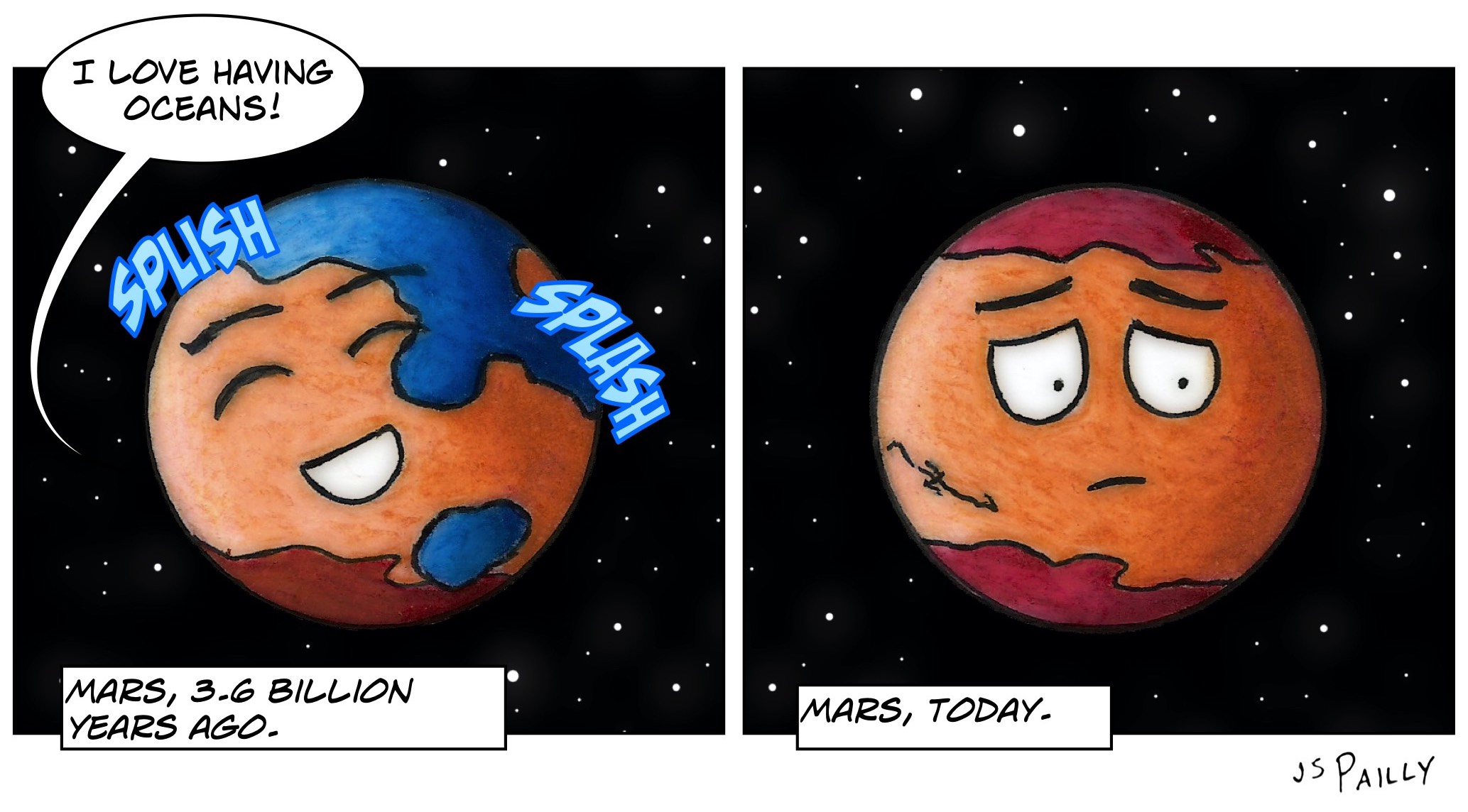
Earlier this month, we talked about Jezero Crater on Mars.  There’s strong and compelling evidence to suggest that Jezero Crater was once filled with liquid water.  In other words, Jezero Crater used to be a lake.  If Jezero Crater used to be a Martian lake, then the nearby region of Utopia Planitia was probably once a Martian ocean.

As you can see in the highly technical diagram above, much of Mars’s northern hemisphere was once covered in water.  Probably.  Okay, as a responsible science blogger who wouldn’t want to make you think there’s scientific consensus about a topic when there is not scientific consensus about a topic, I should make it clear to you that the topic of ancient Martian oceans is somewhat controversial in the scientific community.  Scientists are still arguing over what may or may not be ancient Martian shorelines, among other things.

But let’s assume that ancient Mars did have oceans of liquid water on its surface (that seems like a safe assumption to me, but I’m not a scientist—I’m just a guy with a blog).  If so, those oceans would have covered much of Mars’s northern hemisphere.  Today, Mars is sort of a lopsided planet, with generally low elevation terrain in the north and generally higher elevation terrain in the south.  So if ancient Mars did have large amounts of liquid water on its surface, common sense tells us that that water would have accumulated in the low elevation regions (i.e., the northern hemisphere).

Utopia Planitia is one of those low elevation regions in the northern hemisphere.  The terrain is also relatively flat, making Utopia Planitia a fairly easy place to land a spacecraft.  Several robotic missions to Mars have already landed there, the most recent being China’s Zhurong Rover.  And as if all that weren’t enticing enough, ground penetrating RADAR has detected frozen water underground in the southwestern portion of Utopia Planitia.

In the distant future, Utopia Planitia may end up being the site of a major human colony on Mars.  It’s a safe place to land, there’s a supply of water nearby, and it’s a scientifically interesting region.

On the other hand, if plans to terraform Mars ever come to fruition, Utopia Planitia may end up being part of a Martian ocean once again.  As I said before, it’s a low elevation region.  As we transform Mars into a more Earth-like world, water will start to accumulate in places like Utopia Planitia first, at which point we’d probably have to change the name from Utopia Planitia (plains of Utopia) to Utopia Mare (sea of Utopia).

Want to Learn More?

P.S.: As a Star Trek fanatic, I’d be remiss if I didn’t mention this.  Many of the ships from Star Trek were built at the Utopia Planitia shipyards on Mars, according to Star Trek lore.

Our Place in Space: Tolkien Crater

Hello, friends!  Welcome to Our Place in Space: A to Z!  For this year’s A to Z Challenge, I’ll be taking you on a partly imaginative and highly optimistic tour of humanity’s future in outer space.  If you don’t know what the A to Z Challenge is, click here to learn more.  In today’s post, T is for…

TOLKIEN CRATER

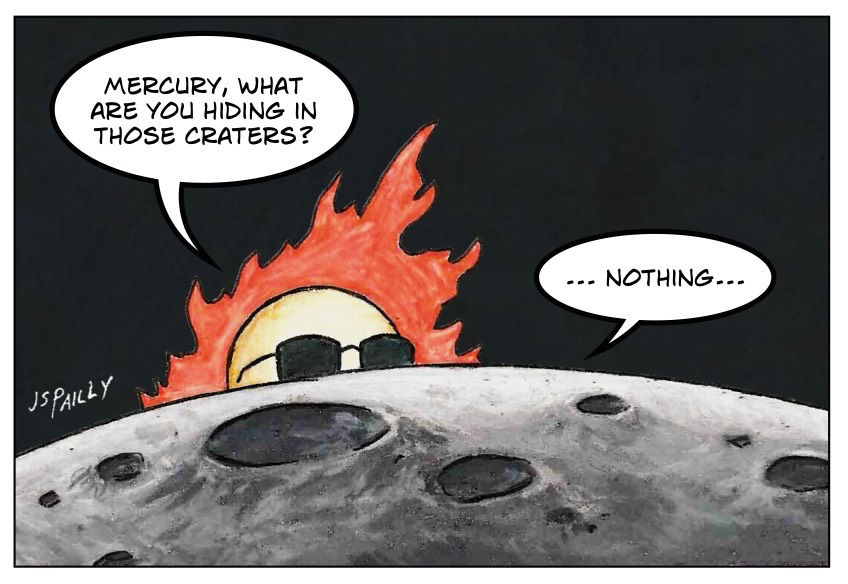
You would not expect to find water on Mercury.  If there ever was water on Mercury, you’d expect it to boil away into space pretty quickly.  I said the exact same thing about water on the Moon yesterday, and yet it turns out there is water on the Moon, trapped in ice form at the bottom of craters near the Moon’s north and south poles.  The same is true for craters near the north and south poles of Mercury.  To my eternal delight, one of those water-filled craters is named after fantasy author J.R.R. Tolkien.

By longstanding tradition, craters on Mercury are named after historically important artists, authors, and musicians.  There are a few exceptions, because a few craters were named before that tradition was established, but the vast majority follow the rule.  And so there’s a crater named after Shakespeare, and a crater named after Van Gogh, and a crater named after Mozart.  John Lennon has a crater named after him.  Walt Disney has a crater.  And so does J.R.R. Tolkien.

Tolkien Crater happens to be located near Mercury’s north pole.  As a result, the bottom of Tolkien Crater is perpetually shielded from sunlight by the crater walls.  It’s extremely dark and extremely cold—cold enough for frozen water to remain stable over cosmic time scales, despite Mercury’s lack of any significant atmosphere or Mercury’s proximity to the Sun.

In the distant future, as humanity spreads out across the Solar System, we may end up deciding to colonize Mercury.  Mercury has resources humans in the future may need: large quantities of metal and perhaps, also, large quantities of helium-3 (necessary for powering nuclear fusion reactors, assuming we ever figure out how to make nuclear fusion reactors work).  If humans do colonize Mercury, places like Tolkien Crater will be valuable real estate.

Most likely, human habitats on Mercury will be built underground.  It’s easier and safer to live underground than to live on Mercury’s surface.  As a result, I like to imagine that people living in and around Tolkien Crater will refer to their subsurface dwellings as “Hobbit holes.”  However, considering how important mining operations would be for a successful Mercury Colony, some sort of reference to the Mines of Moria might be more appropriate.

Let’s just hope those Mercury colonists do not delve too greedily or too deep, lest they awaken something slumbering in the darkness.

Want to Learn More?

Universe Today has an article on how and why we might colonize Mercury.  And here’s an article from Wired.com about the naming of Tolkien Crater.

Lastly, I feel that I have to mention this: if you haven’t seen a picture of Disney Crater, you really need to click here and see a picture of Disney Crater.

Our Place in Space: Shackleton Crater

Hello, friends!  Welcome to Our Place in Space: A to Z!  For this year’s A to Z Challenge, I’ll be taking you on a partly imaginative and highly optimistic tour of humanity’s future in outer space.  If you don’t know what the A to Z Challenge is, click here to learn more.  In today’s post, S is for…

SHACKLETON CRATER

You would not expect to find water on the Moon.  If there ever was water on the Moon, you’d expect it to boil away into the vacuum of space pretty quickly.  And yet there is growing scientific evidence suggesting that craters near the Moon’s north and south poles are full of frozen water.  In the distant future, the most important and famous of these water-filled craters will be Shackleton Crater.

Shackleton Crater is about 21 kilometers across and 4 kilometers deep.  For the sake of comparison, the Grand Canyon is just shy of 2 kilometers deep.  What’s really important, though, is that Shackleton Crater is located almost perfectly at the Moon’s south pole.  As a result, it doesn’t matter what time it is—it doesn’t matter what part of the lunar day/night cycle it it—the bottom of Shackleton Crater is always shielded from sunlight by those 4 kilometer tall crater walls.  Always.

That makes the bottom of Shackleton Crater extremely dark.  More importantly, it makes the bottom of the crater extremely cold—cold enough to overcome water’s natural tendency to boil (or sublimate) in a vacuum.

Shackleton Crater is not unique in that respect.  There are over three hundred craters around the Moon’s north and south poles that are in a state of perpetual darkness.  Any or all of these eternally dark craters could have frozen water inside them.  So what makes Shackleton Crater so extra special?  Well, once again, the crater is located almost perfectly at the Moon’s south pole.  As a result, while the bottom of the crater is always in darkness, sections of the crater rim are always in sunlight.

This combination of perpetual sunlight up here and perpetual darkness down there makes Shackleton Crater the #1 most valuable piece of real estate on the Moon.  If you built a moon base at Shackleton Crater, you could set up solar panels along the crater rim while also having easy access to all that frozen water at the bottom of the crater.

I don’t generally like making “in the next twenty years” predictions, but in the next twenty years, there’s a good chance that somebody will land at Shackleton Crater and build some sort of scientific research station.  Perhaps there will be several research stations, clustered together, almost village-like.

In time, that village on the Moon will grow.  And it will keep growing.  In the distant future, it would not surprise me if Shackleton Crater eventually became one of humanity’s first off-world metropolises.

Want to Learn More?

Check out these links:

Our Place in Space: The Rocket Equation

Hello, friends!  Welcome to Our Place in Space: A to Z!  For this year’s A to Z Challenge, I’ll be taking you on a partly imaginative and highly optimistic tour of humanity’s future in outer space.  If you don’t know what the A to Z Challenge is, click here to learn more.  In today’s post, R is for…

THE ROCKET EQUATION

Are you bad at math?  That’s okay.  I’m bad at math too.  I try to avoid talking about math on this blog because I know a lot of my readers are still traumatized by high school math classes, but also because I don’t feel I’m qualified to explain math anyway.  So in today’s post, we’re going to talk about what the rocket equation means and why it’s so important without talking about what the rocket equation actually is or how it works.

As you know, you need fuel to go to space.  If you’re a rocket scientist, the rocket equation tells you how much fuel you need to reach any specific destination in space.  You want to travel from Earth to the Moon?  Plug some numbers into the rocket equation, and the equation will tell you how much fuel you need.  Want to go from the Moon to Jupiter?  Plug new numbers into the equation, and it’ll tell you how much fuel you need for that trip.  It always ends up being an absolutely ridiculous amount of fuel.

When you see space vehicles sitting on the launch pad, something like 85% to 90% of the mass of that space vehicle is fuel.  The rocket equation demands that it be so.  For the sake of comparison, fuel makes up about 30% to 40% of the mass of an airplane, or about 4% of the mass of a car.  NASA famously refers to this as “the tyranny of the rocket equation,” because NASA is the American space agency, and whenever Americans don’t like something that call it tyranny.

With a little creative engineering, rocket scientists can make marginal improvements to a rocket’s fuel efficiency—a 1% or 2% improvement, perhaps!  But that’s about it.  The rocket equation is unforgiving, and it offers very little wiggle room.  In other words, the rocket equation means that space exploration is super expensive, and it always will be, unless and until we invent some totally new Sci-Fi propulsion system that no longer requires rocket engines.

As a science fiction writer, I’m perfectly happy to dream up propulsion systems that ignore the rocket equation.  But for the purposes of this “Our Place in Space” series, I’m trying to stick to more realistic science, which means that the distant future we’ve been exploring in these blog posts is still very much constrained by the rocket equation.

We humans can still do a lot under those constraints.  We can get to the Moon (we’ve done it before!), and we can get to Mars and the asteroid belt as well.  Most of the outer Solar System is within our reach—in time, perhaps the entire outer Solar System could be ours.  But there are limits.  So long as we’re still using rockets for space travel, there will always be limits on how far humans can go.

Want to Learn More?

Check out NASA’s “The Tyranny of the Rocket Equation” article, which goes into more detail about why the rocket equation matters.  There’s also some colorful language in there about “revolting against tyranny.”

And for those of you who do want to see the math, here you go.  Enjoy!

Our Place in Space: Quaoar

Hello, friends!  Welcome to Our Place in Space: A to Z!  For this year’s A to Z Challenge, I’ll be taking you on a partly imaginative and highly optimistic tour of humanity’s future in outer space.  If you don’t know what the A to Z Challenge is, click here to learn more.  In today’s post, Q is for…

QUAOAR

Ceres is a dwarf planet located in the asteroid belt.  In early 2015, Ceres became the first dwarf planet ever visited by a space probe from Earth.  Later that same year, New Horizons conducted its now famous flyby of Pluto, making Pluto the second dwarf planet we’ve visited.  So that leads to an obvious question: which dwarf planet do we want to explore next?  Well, there’s a chance it might end up being Quaoar.

Quaoar (pronounced either as kwa-war or kwa-o-ar) was discovered in 2002 by astronomers at the Palomar Observatory in southern California.  It’s named after the Tongva god of creation, the Tongva being an indigenous people native to southern California.  At the moment, we know that Quaoar is a Kuiper Belt Object, just like Pluto.  We also know that it’s about half the size of Pluto, that there’s signs of water ice and methane ice on its surface, and that it has at least one moon, named Weywot (the son of Quaoar, according to Tongva mythology).

So what makes Quaoar so special?  Why would we visit Quaoar next, rather than Orcus, Sedna, Eris, or the many other strange and mysterious dwarf planets we now know are out there?  The answer is simple: location, location, location.

Just as the Moon orbits the Earth, and just as the Earth orbits the Sun, the Sun orbits the central mass of our galaxy.  That means the Sun—and our whole Solar System, in fact—is moving through space.  Right now, there are at least two mission proposals to explore the interstellar space that lies directly ahead of our Solar System.  Coincidentally, Quaoar happens to be located near the “front” of our Solar System.  So if we’re launching space probes to explore the space directly ahead of our Solar System, it just makes sense to visit Quaoar on the way.

One of those mission proposals is American.  The other is Chinese.  I have no idea if or when either of these missions will get to fly.  It would be nice if both happen.  It would create an opportunity for American and Chinese scientists to coordinate their efforts and compare notes on what they learn about Quaoar, and later about the interstellar medium that lies ahead of our Solar System.  Such cooperation often occurred, even at the height of the Cold War, whenever American and Soviet space probes happened to visit the same planet at about the same time.  Space exploration has a way of bringing countries together.

Want to Learn More?

Here’s the proposal for the U.S. mission that would visit Quaoar, and here’s an article from Space News about the mission China is considering.

Our Place in Space: Phobos

Hello, friends!  Welcome to Our Place in Space: A to Z!  For this year’s A to Z Challenge, I’ll be taking you on a partly imaginative and highly optimistic tour of humanity’s future in outer space.  If you don’t know what the A to Z Challenge is, click here to learn more.  In today’s post, P is for…

PHOBOS

Buzz Aldrin.  He walked on the Moon.  He also has ideas about how to get humans to Mars.  We talked about one of those ideas earlier this month, and now we’re going to talk about another.  What if, rather than going straight down to the surface of Mars, we first set up a little base for ourselves on Phobos, one of Mars’s two moons.

Whenever you want to land on a planet (or a moon), you’ll have to fight against gravity to do so.  That is assuming, of course, that you want to land safely.  Crashing into a planetary body is fairly easy.  Landing safely—that’s the hard part!  You need to control your descent.  If you’re controlling your descent using rocket engines, you’re going to use up a whole lot of fuel in the process.

But as you can see in this highly technical diagram, Phobos is very small.

Okay, maybe not that small.  But still, Phobos is much smaller than Mars, and Phobos’s surface gravity is significantly less than the surface gravity on Mars.  That means a rocket controlled descent onto the surface of Phobos will use up less fuel than a rocket controlled descent all the way down to the surface of Mars.

In his book Mission to Mars: My Vision for Space Exploration, Aldrin argues that we should set up a way station on Phobos before attempting to land humans on Mars.  From this Phobos way station, astronauts could get an up close and personal view of Mars.  They could get the lay of the land without actually landing.  Using remote controlled robots, they could explore the Martian surface and prepare the way for future missions.  And on the off chance that we discover alien life on Mars (current life, I mean, not fossils), then our astronauts on Phobos could study that life from afar without risking any sort of biological contamination.

Personally, I’m not 100% sold on this idea.  I kind of feel like if we’re going to go to Mars, let’s just go to Mars.  But Buzz Aldrin is Buzz Aldrin, and I’m just some guy with a blog.  The thing about the fuel costs for landing on Phobos vs. landing on Mars makes sense to me.  And if it does turn out that there’s life on Mars, contaminating the Martian ecosystem with our Earth germs (or having Mars germs contaminate us) does become a serious concern.

But otherwise, do we really need a way station on Phobos?  Is that a necessary prerequisite to landing humans on Mars?  I don’t know.  Maybe it would be helpful.  When the time comes, maybe we really will go to Phobos first and land on Mars later.  It’s possible.

Want to Learn More?

Once again, I’m going to recommend Mission to Mars: My Vision for Space Exploration by Buzz Aldrin.  Lots and lots of ideas in that book about how we might one day travel to Mars and what we might do once we get there.

Our Place in Space: The Outer Space Treaty

Hello, friends!  Welcome to Our Place in Space: A to Z!  For this year’s A to Z Challenge, I’ll be taking you on a partly imaginative and highly optimistic tour of humanity’s future in outer space.  If you don’t know what the A to Z Challenge is, click here to learn more.  In today’s post, O is for…

THE OUTER SPACE TREATY

Believe it or not, human law does extend to outer space.  There are international agreements in place saying what is and is not legal in space.  And these agreements go back decades.  It all started with the Outer Space Treaty of 1967.  Every nation with a space program has signed on to the Outer Space Treaty, and many nations that do not currently have space programs have signed on as well.  Today, the Outer Space Treaty is regarded as the founding document—the Magna Carta, of sorts—for all of space law.

According to the treaty, any human who goes to space shall be considered an “envoy of mankind,” and all space agencies around the world shall have a responsibility to avoid the “harmful contamination” of any alien environments they wish to explore.  Provisions like that reflect the idealism of the 1960’s, I feel, but there are also provisions that reflect the deeper fears and anxieties of that time.  Most notably:

  • No nuclear weapons in space.
  • Seriously, no nation may put nuclear weapons in space.  Ever!
  • No nation may use the Moon or any other celestial body for military purposes.
  • No nation may claim ownership of the Moon or any other celestial body.
  • Did I mention this already?  I may have mentioned this already, but it’s really important: NO NUCLEAR WEAPONS IN SPACE!!!

The good news is there are no nuclear weapons in space.  By all accounts, every nation involved in space exploration has followed the rules the Outer Space Treaty established (or at least no one has ever blatantly violated the treaty).  But will that continue to be the case going forward?

Of late, some concerns have been raised.  You see, when the treaty was written, it was assumed by everyone that governments would be in charge of space exploration, not private companies.  It was assumed that the people who go to space would be highly trained astronauts, not private citizens engaged in space tourism.  So should space tourists be considered “envoys of mankind”?  Are private companies allowed to claim ownership of celestial bodies?  And do private companies have any legal obligation to avoid “harmful contamination” of alien environments?  The Outer Space Treaty is a little unclear about those issues.

As I said, the Outer Space Treaty reflects the idealism of the 1960’s and also the fears and anxieties of that time.  I imagine that, sooner or later, there will be new treaties and new agreements to address the concerns of today.  The Outer Space Treaty of 1967 may be considered the founding document for space law, but it is not the final word on space law.

We live in an ever changing world.  Laws need to be updated to keep up with the times.  That’s been true for all of recorded history.  It’s still true today, and it will continue to be true even in the distant future when humanity is spreading out across the Solar System.

Want to Learn More?

Here’s an article from The Conversation on the Outer Space Treaty and some of the concerns that have been raised in recent years about it.

Our Place in Space: NIAC

Hello, friends!  Welcome to Our Place in Space: A to Z!  For this year’s A to Z Challenge, I’ll be taking you on a partly imaginative and highly optimistic tour of humanity’s future in outer space.  If you don’t know what the A to Z Challenge is, click here to learn more.  In today’s post, N is for…

NIAC

So far this month, we’ve talked about some pretty wild ideas for future missions in space.  We’ve talked about building an elevator to space.  We’ve talked about putting a radio telescope on the far side of the Moon.  We’ve talked about sending astronauts to Callisto, one of the moons of Jupiter, and exploring the hydrocarbon lakes on Titan (a moon of Saturn) using a robotic submarine.  As crazy as these ideas may seem, they’ve all received some amount of funding from NASA through a program called NIAC.

NIAC stands for NASA Innovative Advanced Concepts (yes, it’s an acronym that contains another acronym inside it).  NIAC is basically a program that awards grant money to researchers who are testing the limits of what we can do in space using current technology or who are developing new technologies that might one day revolutionize space exploration.  If you ever hear on the news that NASA is funding some project that sounds a little too Sci-Fi to be true, it probably just means that NASA gave somebody some NIAC funding for their research.

I once heard NIAC described as a high-risk/high-reward program.  Many NIAC projects probably won’t work out.  Some of these things really are too Sci-Fi to be true.  But what if a few NIAC projects do work?  What if some crazy idea that sounds like pure science fiction actually works!?!  Even if only a few NIAC funded projects do come to fruition, they could change everything for NASA.  More than that, they could change everything for human civilization.

I’m no expert on finances.  I’m certainly no expert on how the U.S. federal budget works.  I do know that space exploration is expensive.  Very expensive.

I also know that NASA does what it does within a very strict and rather inflexible budget.  I’m actually really impressed that NASA manages to do so much cool science stuff on such a tight budget.  This may seem weird, but I often ask myself “What would NASA do?” when I have to make difficult spending decisions.

Most NIAC projects are definitely not ready to fly and probably won’t be ready to fly for quite a few years to come.  But it makes sense to start planning for the future now.  It makes sense to do some of the research now that could help make a more Sci-Fi future become a reality.  That’s really what NIAC is all about.

Want to Learn More?

Wikipedia has a pretty thorough list of all the research projects that have received NIAC funding over the years, up to 2020.

Additionally, here’s a listing of NIAC funded projects from 2021, and here’s the listing for 2022.