Sunlight Can Kill You!

We all know the Sun produces U.V. rays and that if you spend too much time sunbathing, you’ll probably get skin cancer. Well, the Sun spews a lot of other stuff into space too. Ultraviolet radiation may be the least of your worries if you happen to live in space.

In addition to U.V. rays, the Sun also produces:

  • X-rays: sort of like U.V. rays, only with more energy and, therefore, more harmful.
  • Gamma rays: even more energetic and harmful than X-rays.
  • Solar ejecta: solar flares and other nasty explosions on the Sun can accelerate protons, electrons, and other little bits and pieces of atoms to ludicrous speeds. Do not stand in their way!

Fortunately, Earth’s atmosphere and magnetic field protect us from most of the Sun’s deadly radiation. Even the crew of the International Space Station are in a low enough orbit that Earth still keeps them safe. Well, safe-ish.

But all this radiation makes human space exploration beyond low Earth orbit extremely hazardous. Before sending astronauts to the Moon, NASA had to wrestle with their collective conscience over how much radiation exposure should be considered acceptable. Now, NASA is wrestling with its conscience again as it plans to send astronauts to Mars.

Current technology cannot protect humans from solar radiation. The problem gets worse with increased solar flare activity. One of the things science fiction writers (like myself) have to figure out is how to keep our characters from dying of radiation sickness within the first few chapters of our books.

P.S.: Starlight can kill you too. In addition to solar radiation, astronauts have to worry about cosmic radiation: radiation from other stars, quasars, and God knows what else.

Sciency Words: Ejecta

Sciency Words MATH

Today’s post is part of a special series here on Planet Pailly called Sciency Words. Every Friday, we take a look at a new and interesting scientific term to help us all expand our scientific vocabularies together. Today’s word is:

EJECTA

This is the fancy, technical term for stuff that gets thrown around whenever violent things happen. For example:

  • All the stuff that spews out of volcanoes… that’s ejecta.
  • When a meteor hits, the debris that gets thrown into the air is ejecta.
  • Whenever I get writer’s block, all the crumpled papers strewn around my office are ejecta.

Ja03 Ejecta

Since we’ll be spending most of January talking about the Sun, I figured this is a term we should all know. The Sun gets pretty violent and produces lots of solar ejecta, which is bad news for anyone who lives in space (it’s not exactly good news if you live on Earth either).

The Sun’s Gone Wibbly

Ja01 Mr Sun

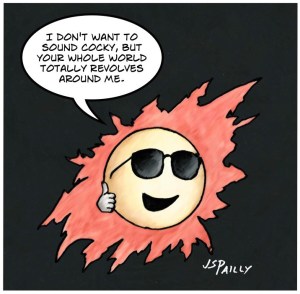
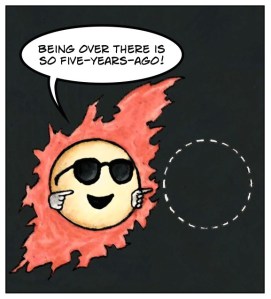
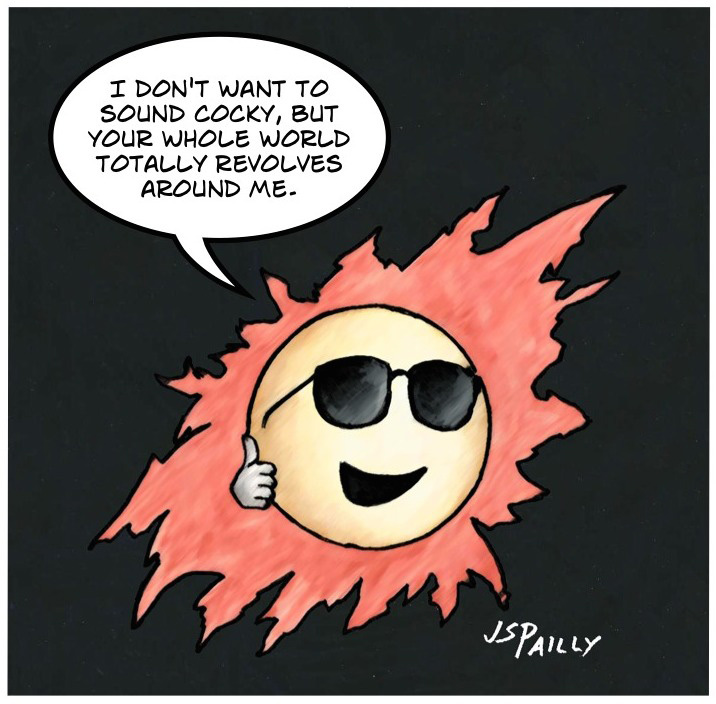
The Sun as pictured above isn’t exactly lying, but what he’s saying is misleading. The nine eight planets of the Solar System do orbit the Sun, which may give you the impression that the Sun is stationary with respect to the planets. It is not. The Sun wobbles.

This is due to the combined gravitational forces of all the planets, comets, asteroids (and even Pluto) tugging the Sun in multiple directions at once. The effect is small but not insignificant. Over the course of just a few years, the Sun can completely change its position relative to the rest of the Solar System.

Ja01 Being Over There

The true center of the Solar System is a point in space called the barycenter. The barycenter happens to be located near (and sometimes inside) the Sun. You could say the Sun, planets, and everything else in the Solar System orbit the barycenter, but keep in mind that the barycenter is not stationary either.

If you want to get a better feel for how planets and stars tug on each other through gravity, I suggest checking out the game Super Planet Crash. It’s free. Just click here to start playing.

Sources

One Way to Find a Planet from NASA’s “The Space Place.”

Barycentric Coordinates (Astronomy) from Wikipedia.

The Wobbling Sun from Innumerable Worlds.

Welcome to the Solar System!

People of the Internet, I’ve been away for a while due to an unpleasant combination of personal and professional reasons. It led to a lot of pain and a lot of soul searching. But that’s behind me now, and I have a renewed enthusiasm for writing, blogging, and science. Today, I have a special announcement:

The 2015 Mission to the Solar System

In 2015, Planet Pailly is launching a yearlong mission to explore the Solar System. Blog posts over the coming year will visit all nine eight planets as well as several of the Solar System’s other areas of interest. Here is our mission itinerary:

  • January, 2015: The Sun
  • February, 2015: Mercury
  • March, 2015: Venus
  • April, 2015: Earth
  • May, 2015: The Moon
  • June, 2015: Mars
  • July, 2015: The Asteroid Belt
  • August, 2015: Jupiter
  • September, 2015: Saturn
  • October, 2015: Uranus
  • November, 2015: Neptune
  • December, 2015: Pluto/The Kuiper Belt

Be advised that the “Mission to the Solar System” series will include numerous highly technical diagrams like the one pictured below.

Ja01 Mr Sun

So I hope you’ll join me for this sciency adventure. Also, please check out Planet Pailly’s new mission statement as well as the new page for ongoing series, and stay tuned for updates regarding my other major projects (especially Tomorrow News Network).

Our Mission to the Solar System officially begins on Monday with a post entitled “The Sun’s Gone Wibbly.”