Artsy Science: Craters of Mercury

Artsy Science

Today’s post is part of a collection of posts on the artistic side of science. Through both art and science, we humans try to make sense of the world around us, and the two fields have a lot more in common than you might expect.

* * *

The International Astronomy Union has the sole power to name things in outer space, and they have a lot of rules and regulations for how the naming process works. This usually results in names like HD 856019b. But for Mercury, specifically the craters of Mercury, the I.A.U.’s process is actually kind of fun.

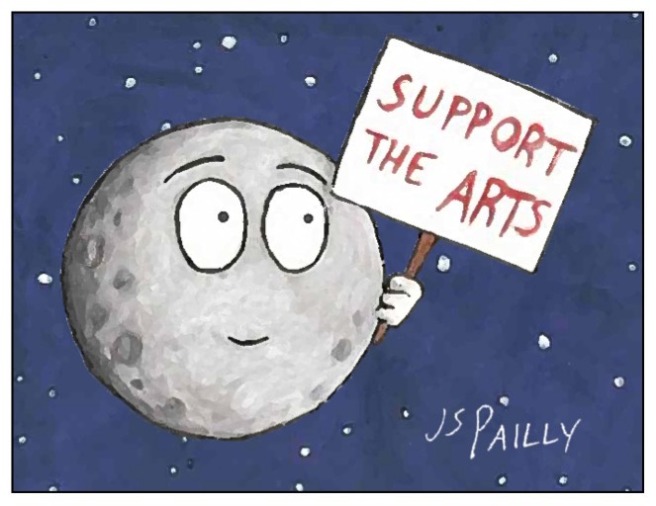
With only a few exceptions, the craters of Mercury are all named after famous authors, artists, or musicians. This means Mercury has a Shakespeare Crater, a Hemmingway Crater, a Van Gogh Crater, and a Beethoven Crater. For you Beetles fans out there, there’s a John Lennon Crater. Edgar Allen Poe has a crater. Mozart and Monet have craters. My personal favorite is, of course, Tolkien Crater.

It’s worth noting that Mercury has more craters than any other planet in the Solar System, and we keep discovering more of them. That means we need more artists and authors and musicians, and we need them fast before we run out of names. So like Neil Gaiman says, go out and make good art. Mercury is counting on you.
Fe05 Support the Arts

P.S.: Special shout out to Spacerguy, who mentioned this fun fact in a comment yesterday.  Please check out his Star Trek themed blog by clicking here.

Into Thin Air: Mercury’s “Atmosphere”

Poor Mercury. Since its formation, Mercury has substantially shrunk. It gets hit by more meteors than any other planet in the Solar System, and its “atmosphere” is so thin it doesn’t even deserve the name. Scientists call it an exosphere instead.

What little air Mercury has comes from several sources. Volatile chemicals seep out of the planet’s crust through a process called outgassing. In addition, those meteor impacts kick up plenty of dust particles. Mercury even gets some spare hydrogen and helium from the Sun.

But the Sun giveth and the Sun taketh away. The constant pressure of solar radiation blows most of Mercury’s gaseous materials away.

Mercury even has a comet-like tail of particles streaming away from it.

Mercury’s gravity and weak magnetic field hold some of the planet’s exosphere in place, but not enough. Just another reason why nobody wants to live on Mercury.

Links

Extreme Effects: Seven Things You Didn’t Know About Mercury from NASA.

Atmosphere of Mercury from Universe Today.

The Planet Mercury Has a Comet Like Tail from Watts Up With That?

Sciency Words: Volatile

Sciency Words PHYS copy

Today’s post is part of a special series here on Planet Pailly called Sciency Words. Every Friday, we take a look at a new and interesting scientific term to help us all expand our scientific vocabularies together. Today’s word is:

VOLATILE

In colloquial English, the word volatile is an adjective used to describe things like the stock market or the Middle East. But as a technical, scientific term, volatile is a noun.

Volatiles are chemicals that tend to turn into gas at relatively low temperatures or when exposed to a vacuum (like the vacuum of space). Examples include:

  • Hydrogen
  • Oxygen
  • Ammonia
  • Methane
  • Water

Many volatiles are so eager to become gases that they’ll sublimate, meaning they’ll transform from solid to gas without bothering to be liquids first.

As we continue our exploration of the Solar System, we’ll be talking about this class of chemicals a lot. They’re especially important if you want to understand why Mercury is the way that it is. More about that on Monday.

Links

Volatiles from Wikipedia

Outgassing from Wikipedia

Mercury: It’s Hot and It’s Cold

Throughout 2015, we’ll be exploring the Solar System. In January, we visited the Sun. Today, we begin our exploration of the planet Mercury.

Let’s start with a few basic facts that pretty much everyone knows. Mercury is the smallest planet in the Solar System (unless you insist on calling Pluto a planet). Mercury is the planet closest to the Sun. Mercury is one of the coldest places in the Solar System.

Wait… coldest?

Fe01 Mercury Singing 1

While it’s true that the dayside of Mercury is scorching hot (800 degrees Fahrenheit), the temperature on the night side can drop as low as -300 degrees Fahrenheit. The reason for this enormous temperature discrepancy is Mercury’s atmosphere, or rather Mercury’s lack of an atmosphere.

Atmospheres enable planets to trap and redistribute heat, maintaining a relatively constant global temperature. So planets without atmospheres (like Mercury) cook on one side and freeze on the other.

This is just one of many reasons why nobody wants to live on Mercury.

Fe01 Mercury Singing 2
Mercury is also the densest planet in the Solar System.


Links

How Hot is Mercury? from Space.com.

What is the Hottest Planet in the Solar System? from Universe Today.

Sciency Words: SOHO

Sciency Words BIO copy

Today’s post is part of a special series here on Planet Pailly called Sciency Words. Every Friday, we take a look at a new and interesting scientific term to help us all expand our scientific vocabularies together. Today’s word is:

SOHO

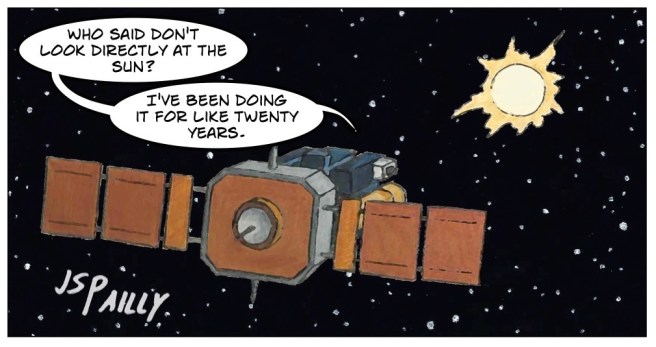
If you want to do any serious research about the Sun, you will soon come across this name: SOHO, short for the Solar and Heliospheric Observatory. It is a project of international cooperation between NASA and ESA (the European Space Agency). The Europeans built it, NASA launched it into space and is now responsible for operating and maintaining it.

SOHO is positioned between the Sun and Earth, and its mission is to monitor and study solar activity. Launched in December of 1995, SOHO was only supposed to be in operation for about two years, yet despite several malfunctions, the thing is still running nearly two decades later.

Much of what we currently know about the Sun is thanks to SOHO (which is why the name came up so often in my research).

  • SOHO observes activity on the Sun’s surface (like Moreton waves), and it has provided us with the first ever images of what’s going on beneath the surface.
  • SOHO is part of our early warning system, helping protect our technologically advanced civilization in case something like the Carrington Event ever happens again.
  • SOHO samples solar ejecta, allowing us to find out what exactly the Sun is spewing into space.
  • Remember that weird thing about the Sun’s temperature? SOHO is helping investigate that too.

Ja12 SOHOSo as we end our month-long adventures with the Sun, let’s give a big round of applause to the SOHO spacecraft, one of the hardest working spacecraft in the Solar System, and let’s hope that it will miraculously keep working for many years to come.
Starting Monday and continuing throughout the month of February, we will turn our attention to the Planet Mercury.

The Corona Mystery

The Sun. It’s right there in the middle of the Solar System. We’ve got spacecraft monitoring it 24 hours a day. You’d think we know just about everything there is to know about it, but the Sun harbors a great scientific mystery.

Before we go into that, let’s define some key terms.

  • The photosphere: the surface layer of the Sun.
  • The convective zone: the layer directly beneath the photosphere.
  • The corona: the Sun’s “atmosphere,” located above the photosphere.

As heat radiates out from the Sun’s core, the temperature gradually decreases. In the convective zone, it’s several million degrees Celsius. In the photosphere, the temperature drops to merely a few thousand degrees Celsius.

That makes sense. As we get farther away from the source of all that heat, we’d expect the temperature to cool off a bit. So the corona should be cooler still, right?

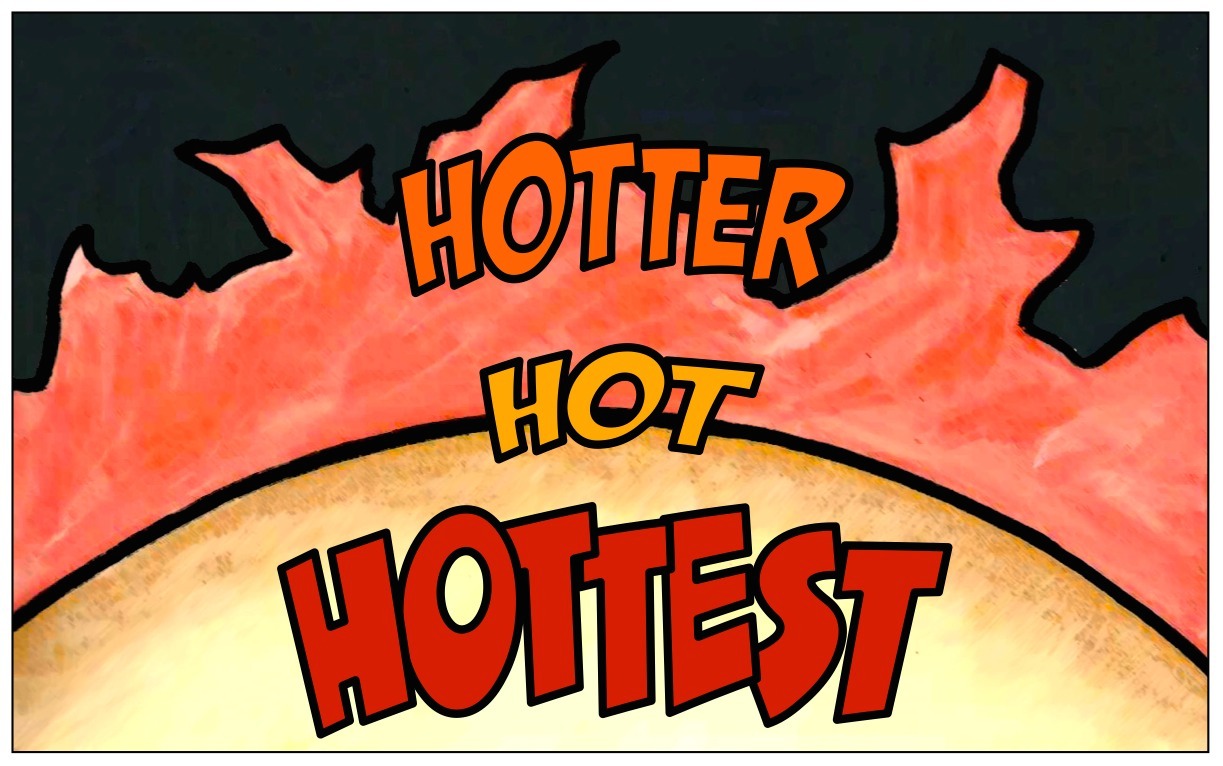
Wrong. The temperature rapidly increases from a few thousand degrees to tens of thousands of degrees, and then peaks back in the range of several million degrees Celsius.

Ja08 Hottest Hot Hotter

Why? I don’t know why. Nobody knows why, though it may have something to do with the Sun’s magnetic field. More recent research suggests “nanoflares” might have something to do with it.

But the truth is we do not know the reason for this temperature discrepancy. It is (at least for now) a scientific mystery.

Sources

The Sun’s Corona from NASA’s Imagine the Universe.

Explain the Coronal Heating Mystery from the Stanford Solar Center.

Layers of the Sun from The Sun Today.

Sun’s Magnetic Secret Revealed from Space.com.

Tiny “Nanoflares” May Solve Sun Mystery from Space.com.

Sun Surfing (Sciency Words: Moreton Waves)

Ja09 Sun Surfing

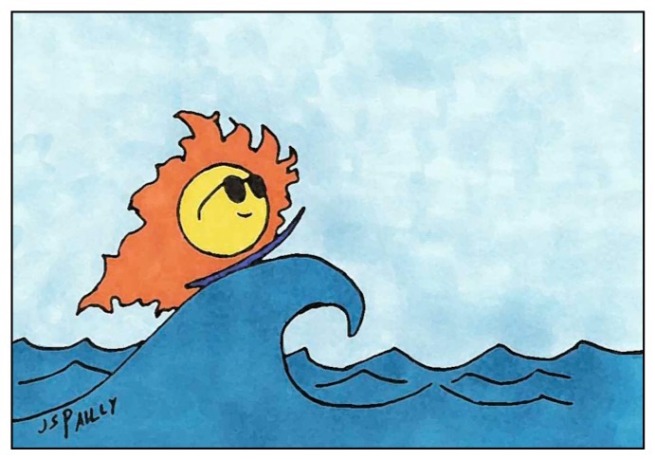
Okay, so the Sun can’t really go surfing, but maybe you could go surfing on the Sun.

Ja09 Surfing on the Sun

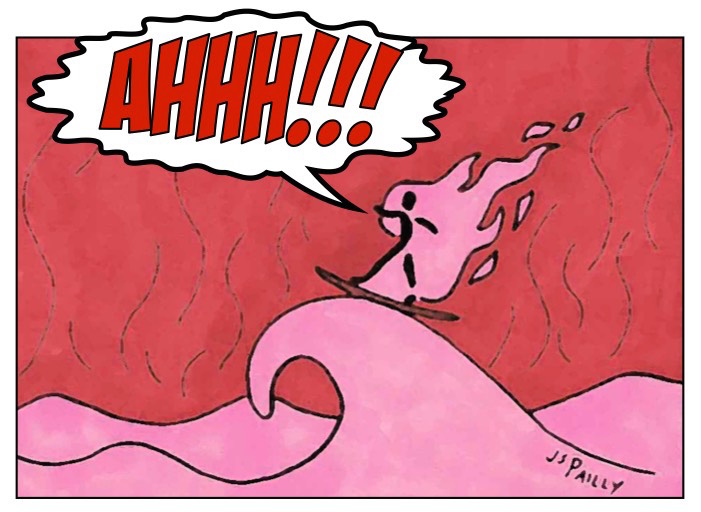
Okay, so you can’t really go surfing on the Sun, but if you could, the Sun’s got some pretty sick waves. It’s time for this week’s edition of Sciency Words, where we take a look at a new and interesting scientific term to help us all expand our scientific vocabularies together. Today’s term is:

MORETON WAVES

Sometimes, a solar flare will be so powerful, so intense, that it will cause the surface of the Sun to ripple. Sometimes it will throw up enormous tidal waves of scalding hot plasma. These waves are called Moreton waves, named after Gail Moreton, the astronomer who first discovered them.

In 2009, NASA astronomers observed a Moreton wave (or “solar tsunami,” as they called it) that was 60,000 miles high (100,000 km) traveling at a speed of 150 miles per second (250 km/s). That observation ended any doubts scientists had about the existence of these waves.

So in conclusion, do not go surfing on the Sun.

What Color is the Sun?

Ja11 Andy Warhol Sun

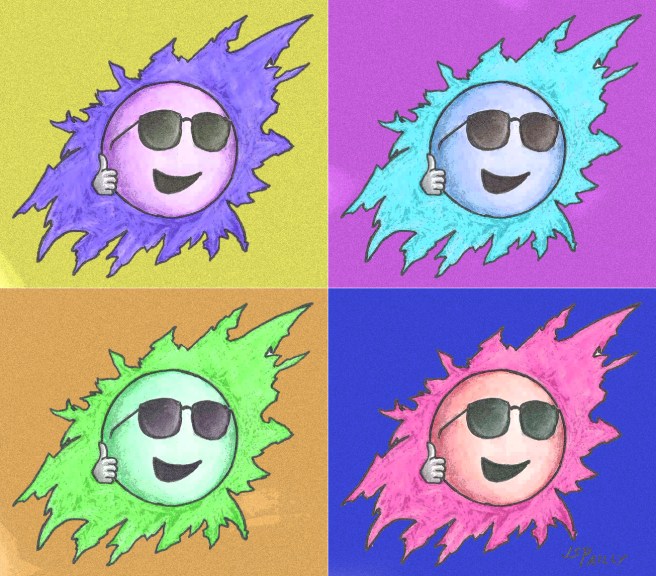
As much as I’d like to give you a straightforward answer to this question, I can’t. I can’t just say the Sun is yellow or white or purple. To really understand the color of the Sun, we need to talk about absorption and emission spectra.

Light from the Photosphere

Atoms absorb light. To be more accurate, different kinds of atoms absorb specific wavelengths of light, letting all the other wavelengths continue on their merry way. The result is what we call an absorption spectrum.

All the colors of the rainbow, except a few are missing.  This is an absorption spectrum.
All the colors of the rainbow, except a few are missing. This is an absorption spectrum.

The light we see coming from the Sun’s surface (a.k.a. the photosphere) has an absorption spectrum. The overall appearance is white or, according to some experts, a slightly greenish white.

But there’s more to the Sun’s color than just the photosphere.

Light from the Chromosphere

Sometimes, when an atom receives energy, it emits light. To be more accurate, different kinds of atoms emit light in specific wavelengths. We call this an emission spectrum.

No rainbow, just a few specific colors.  This is an emission spectrum.
No rainbow, just a few specific colors. This is an emission spectrum.

The glowing plasma that surrounds the Sun is called the chromosphere. The chromosphere appears to be a red or pink color, due mainly to light emitted by hydrogen atoms.

The light of the chromosphere is not nearly as intense as the light from the photosphere, but that doesn’t mean the chromosphere doesn’t contribute to the Sun’s overall color—whatever that color is.

There’s one more factor that influences the Sun’s color, at least as far as our Earthly perception is concerned.

Earth’s Atmosphere

Earth’s atmosphere tends to scatter blue light (which is why the sky is blue). So we see the Sun as a yellow-orange color because most of the blue light has scattered away, while reds, oranges, and yellows follow a more or less direct path straight from the Sun to your eye.

The Color of the Sun

So what color is the Sun? It’s every color, or rather it’s every color except a few that were absorbed in the photosphere, plus a touch of reddish pink from the chromosphere, minus a whole lot of blue if you’re observing the Sun from Earth.

Sources

Lecture 9: The Sun’s Photosphere and Chromosphere from Dmitri Pogosian at the University of Alberta.

Spectra and What Scientists Can Learn from Them from NASA’s “Imagine the Universe.”

Photosphere from Wikipedia

Chromosphere from Wikipedia

What Color is the Sun? from Fraser Cain, publisher of Universe Today (YouTube video).

What Color is the Sun? from the Stanford Solar Center.

Stare Directly at the Sun

On Friday, we talked about the Carrington Event. A massive solar storm triggered a geomagnetic storm that wrecked the technological infrastructure of the time. Fortunately, this happened in 1859, and the infrastructure that was wrecked were telegraph wires and related equipment.

But what if something like the Carrington Event happened today? Several mini-Carringtons have caused blackouts, the most notable happening in Quebec in 1989, and in 2012 a frighteningly large solar storm just barely missed us. Even minor solar flare activity can wreak havoc on our modern technology.

The good news is that the National Oceanic and Atomospheric Administration (N.O.A.A.) has a Space Weather Prediction Center, located in Boulder, Colorado. Their job: to stare directly at the Sun (using satellites, space probes, and special telescopes). With sufficient warning from the N.O.A.A., we can protect our technologically advanced civilization from the Sun’s temper tantrums.

Ja07 Watching the Sun

Thanks to the N.O.A.A., the power stays on, airplanes can navigate safely, and our satellites don’t get fried. In fact, the N.O.A.A.’s Space Weather Prediction Center is so good at what it does that most of us don’t even notice when a solar storm hits, unless it’s to check out the auroras.

P.S.: I said we can protect our technology, and we can; but we haven’t seen anything like the Carrington Event hit Earth since 1859. No one’s entirely sure how well prepared we are for something like that.

Sources

Education and Outreach Videos from the Space Weather Prediction Center.

S.W.P.C. Frequently Asked Questions from the Space Weather Prediction Center.

The Sun’s Wrath: Worst Solar Storms in History from Space.com.

Near Miss: The Solar Superstorm of July 2012 from NASA Science.

Sciency Words: The Carrington Event

Sciency Words PHYS copy

Today’s post is part of a special series here on Planet Pailly called Sciency Words. Every Friday, we take a look at a new and interesting scientific term to help us all expand our scientific vocabularies together. Today’s word is:

THE CARRINGTON EVENT

In 1859, British astronomer Richard Carrington was studying the Sun when he observed two bright flashes of light. This turned out to be a major solar storm. As luck would have it, the brunt of the storm was aimed directly at Earth.

Here’s the good news: the world didn’t end.

The bad news is that when the massive cloud of solar ejecta hit Earth, it triggered what’s called a geomagnetic storm, the worst geomagnetic storm on record.

Solar storms like the Carrington Event, pictured above, don’t hit Earth directly.  Instead, they mess with Earth’s magnetic field, which in turn messes with our technology.
Solar storms like the Carrington Event, pictured above, don’t hit Earth directly. Instead, they mess with Earth’s magnetic field, which in turn messes with our technology.

Telegraph wires picked up and transmitted energy from the geomagnetic storm, causing mayhem for telegraph operators around the globe. Operators received nasty electric shocks. Their equipment melted and/or emitted sparks. In some cases, those sparks ignited fires.

The global economy (such as it was in 1859) was disrupted, as were news services and personal correspondences, but things soon returned to normal. As I said, the Carrington Event was not the end of the world.

But imagine if such a thing happened today, with all our phone lines, Internet connections, power grids, airplanes, and satellites? What would happen to our computers, televisions, and microwave ovens? Fortunately for us, the National Oceanic and Atmospheric Administration is on top of this issue, and their Space Weather Prediction Center will be the subject of Monday’s post.

P.S.: If you love learning new words as much as I do, please check out Michelle Joelle’s blog Stories and Soliloquies.  Today (assuming I got the date right), she’s launching a new series called the Philosopher’s Lexicon, so now we can all expand our philosophical vocabularies together!

Sources

The 1859 Carrington Event from Tempo.

Monster Radiation Burst from the Sun from BBC News.

The Solar Storm of 1859 from Wikipedia.