#IWSG: Ulterior Motives

Hello, friends, and welcome to this month’s meeting of the Insecure Writer’s Support Group.  If you’re a writer, and if you feel in any way insecure about your writing life, click here to learn more about this amazingly supportive group!

I don’t know about you, but my writing productivity crashed and burned toward the end of March.  Right now, I’m feeling insecure because I’ve done virtually nothing to prepare for this year’s A to Z Challenge.  I’m also feeling insecure because the timeline for publishing Tomorrow News Network, book one, has totally fallen apart.

I have no one to blame but myself.  Wait, no, that’s not true.  The coronavirus deserves a lot of the blame too.  Not all of the blame, but a lot of it.

So here’s my plan.  Even though I’m as ill-prepared for the A to Z Challenge as I could possibly be, I’m doing the challenge anyway.  My theme is the story universe I created for Tomorrow News Network.  Obviously, I have an ulterior motive for doing this.  It’s my way of saying: “Buy my book!”

Except the first book of the Tomorrow News Network series isn’t out yet. It won’t be released until (checks timetable, mutters curse at the coronavirus)—okay, I still have to figure out what my new release date will be.  But it’s coming soon!

I have a second ulterior motive as well.  You see, book one is more or less finished, but I still have to write books two, three, four, five (etc, etc, etc).  So as I tell you all about this fictional universe I’ve created, your feedback, dear reader, will be invaluable as I plan out the rest of the Tomorrow News Network series.

And lastly, my third ulterior motive may be the most important of all, given my current mental state during the coronavirus crisis.  As I said at the beginning of this post, my writing productivity crashed and burned near the end of March, and I’m having a tough time getting back into my creative groove.  I’m hoping that by participating in the A to Z Challenge—and by writing, specifically, about my own story universe—I’ll jumpstart my writing brain.  I guess we’ll have to wait until the end of April to know if that works.

In the meantime, please click here to check out the first Tomorrow News Network: A to Z post.  Today, A is for Alkali Extraction Incorporated, a faceless mega-corporation that’s mining alien planets for their resources.

#IWSG: Editing on Valentine’s Day

Hello, friends!  Welcome to March’s meeting of the Insecure Writer’s Support Group.  If you’re a writer and if you feel in any way insecure about your writing life, click here to learn more about this amazing group!

This year, I was fortunate enough to spend Valentine’s Day with my one true love: writing.

Well, actually I spent Valentine’s Day (and many other recent days) reading and reviewing the notes from my editor.  I had to invent an elaborate color coding system to keep track of everything.  I marked changes I agreed with in blue, changes I disagreed with in orange, and changes that I had questions about in pink. Thank goodness I bought all those pens in pretty colors a few months ago!

Having my manuscript professionally edited has turned out to be a slower, more contemplative process than I expected.  My editor has given me a lot to think about.  It’s tough.  But I’m not going to dwell on that today, because if you’re a writer, you already know how tough every aspect of the writing process can be.

But I do want to share something about this process that I wasn’t expecting.  For those of you who feel anxious about turning your manuscript over to an editor, this might help alleviate some of your fears.  There were several sections of my manuscript that I was especially worried about.  I’d agonized over these sections for months and couldn’t find a way to make them any better.  To my surprise, my editor did not flag these sections as problems.

At our last meeting, I asked about this.  My editor read through a few of those sections again, shrugged, and told me I was worried about nothing.

Writing is still tough.  Editing is still tough.  But to have a professional look at my manuscript and tell me to stop worrying about this part or that part or those other things—what a huge relief!

Next time on Planet Pailly, we’ll compare a real scientist to a movie scientist.

#IWSG: The Writing Lesson I Never Learned

Hello, friends!  Welcome to another episode of the Insecure Writer’s Support Group!  If you’re a writer, and if you feel in any way insecure about your writing, click here to learn more about this wonderful group!

This month, my muse and I have reason to celebrate.  I mean, any time writing gets done, my muse and I have reason to celebrate.  But this month in particular, we have an especially good reason to celebrate.  My manuscript is done, and it is now in the hands of my editor.

At some point, obviously, my editor will hand that manuscript back to me along with a big old list of things that need to be fixed.  But in the meantime, I don’t have to worry about it, and that’s a nice feeling.

Except turning my manuscript over to my editor did not feel like the triumphant moment I thought it would.  Why not?  Because my manuscript was late.  Very late.  I’m taking the self-publishing route with this book, so it’s not like I’m in breech of contract or anything like that.  The only deadline I missed was a deadline I imposed on myself.

But still, I’m really shocked by how long it actually took me to finish that manuscript.  And since I have other self-imposed deadlines looming on the horizon, I’m a little concerned.  Am I going to stay on schedule?  Are those self-imposed deadlines not as realistic as they seem?

Which brings me to one of the very first lessons I (supposedly) learned on my writing journey.  This comes from author/blogger Jon Gibbs.  I attended one of his writing seminars back in 2006 or 2007, and he told me—told a whole group of us young, naive writers—that however much time you think you need to write something, double it.  That’s how you set a deadline.

More often than not, that lesson has proven to be true.  Just about everything takes twice as long as I think it should.

So when I set my deadline for my manuscript, did I follow Jon Gibbs’ advice?  No.  And the two deadlines I have coming up in March and May?  Did I follow Gibbs’s advice for those?  Nope.  So my muse and I are going to have to cut the celebration short and get back right back to work.

Next time on Planet Pailly, have you noticed how windy it is in outer space?

#IWSG Judge Not and You Shall Not Be Judged

Hello, friends!  Welcome the first posting of the Insecure Writer’s Support Group for 2020!  If you’re a writer, and if you feel in any way insecure about your writing life, click here.  I.W.S.G. is an awesome organization for insecure writers like us!

For years now, I’ve used these I.W.S.G. posts to tell you about the relationship I have with my muse.  She’s a clever muse.  She can also be really annoying sometimes.  But my muse is also a little bit more than just my muse.  She’s also my conscience.

If you’ll allow me to get religious for a moment, I’d say my muse has a favorite Bible verse.  It’s from the Gospel of Luke.  It’s the “judge not and you shall not be judged” part.

I have to admit I have a tough time with this.  Other people can be so stupid, so crass, so self-centered and inconsiderate.  I can’t help but feel a teeny bit judgmental.  I think it may be part of human nature.  We can’t help but judge each other.

But the muse does not accept my “human nature” excuse.  Every time I start to get judgy, my muse reminds me that I am a writer.

As a writer, I have a responsibility to see how everyone is the hero of their own story (or at least I have a responsibility to try).  No matter what horrible things my gut instinct may tell me about other people, other people have their own reasons for doing what they do or being the way they are.  Other people have backstories.  Other people have motivations.  They have needs and wants, and maybe their needs are in conflict with their wants.  And they have inner monologues that, regardless of what I might think, must make logical sense to them.

This is not meant to be a Bible-themed blog post.  This isn’t about being a better Christian.  It’s not even about being a better human being.  This is simply a matter of becoming a better writer, because if you can learn to sympathize with other people in real life, then, miraculously, your readers will find it easy to sympathize with the characters you put into your stories.

At least that’s what my muse keeps telling me.

Next time on Planet Pailly, the Earth orbits the Sun… right?  Right?

#IWSG: Write, Rest, Repeat

Welcome to the Insecure Writer’s Support Group!  If you’re a writer, and if you feel in any way insecure about your writing life, click here to learn more about this awesome group!

For today’s episode of the Insecure Writer’s Support Group, I’m going to turn things over to my muse.  She has something to say, and maybe it’s something your muse needs to hear.

My fellow muses, I’m sure you all remember what they taught us during muse training: writers are weak-willed and lazy.  They’ll invent all sorts of excuses to avoid writing.  So it’s up to us to use whatever deception, manipulation, or coercion we can in order to force our writers to do their writing!

But after spending so much time out in the real world working with a real life writer, I’ve discovered that what they told us in training isn’t quite true.  Writers want to write.  They really, really do.  The problem is that they set their expectations too high and then feel disappointed and discouraged when they fall short of their goals.

My own writer is obsessed with tracking his daily and weekly word counts.  He’s also started keeping a tally of the total number of words he writes per year.  Word counts can be a great way for writers to measure their own progress.  However…

I know many of you have been dealing with similar problems.  Maybe your writer just “lost” NaNoWriMo, or worse… maybe your writer “won” and is now stuck with a total mess of a manuscript.  Either way, your writer may be feeling a bit frustrated, a bit discouraged—even a little bit (dare I say it?) insecure right now.

Challenges like NaNoWriMo can test your writer’s limits and help them grow.  However—and this is the part I wish they’d teach us in muse training—writers also need recovery time.  This past year, I have allowed my writer to settle into a rhythm of intense writing days followed by periods of slower, more relaxed writing.

My writer didn’t like this new rhythm at first.  He thought I was being too easy on him.  Truth be told, I was a bit nervous about this myself because, as I said, this really isn’t what they taught us in muse training.  But then my writer noticed that, while his daily word counts were all over the place, his weekly word counts were steadily going up.  He stopped complaining, and I stopped worrying.

Write, rest, and repeat!  That’s our writing mantra now.  So if you’re having trouble with your writer, don’t presume they’re being lazy.  Don’t be too hard on your writer, and don’t let your writer be too hard on him/herself.  Let your writer rest.  Give your writer a chance to recover.  Then move on to the next writing challenge!

#IWSG: Contract with a Muse

Welcome to the Insecure Writer’s Support Group!  If you’re a writer, and if you feel in any way insecure about your writing life, click here to learn more about this awesome group!

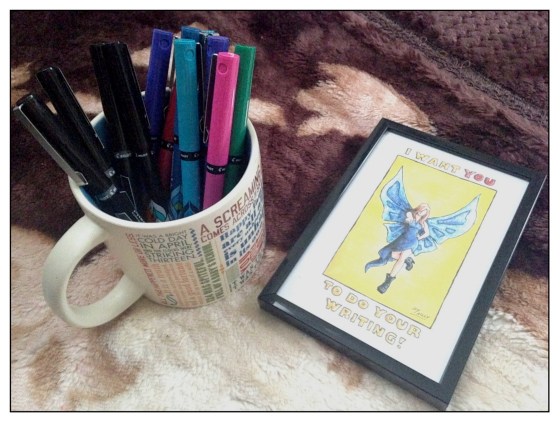
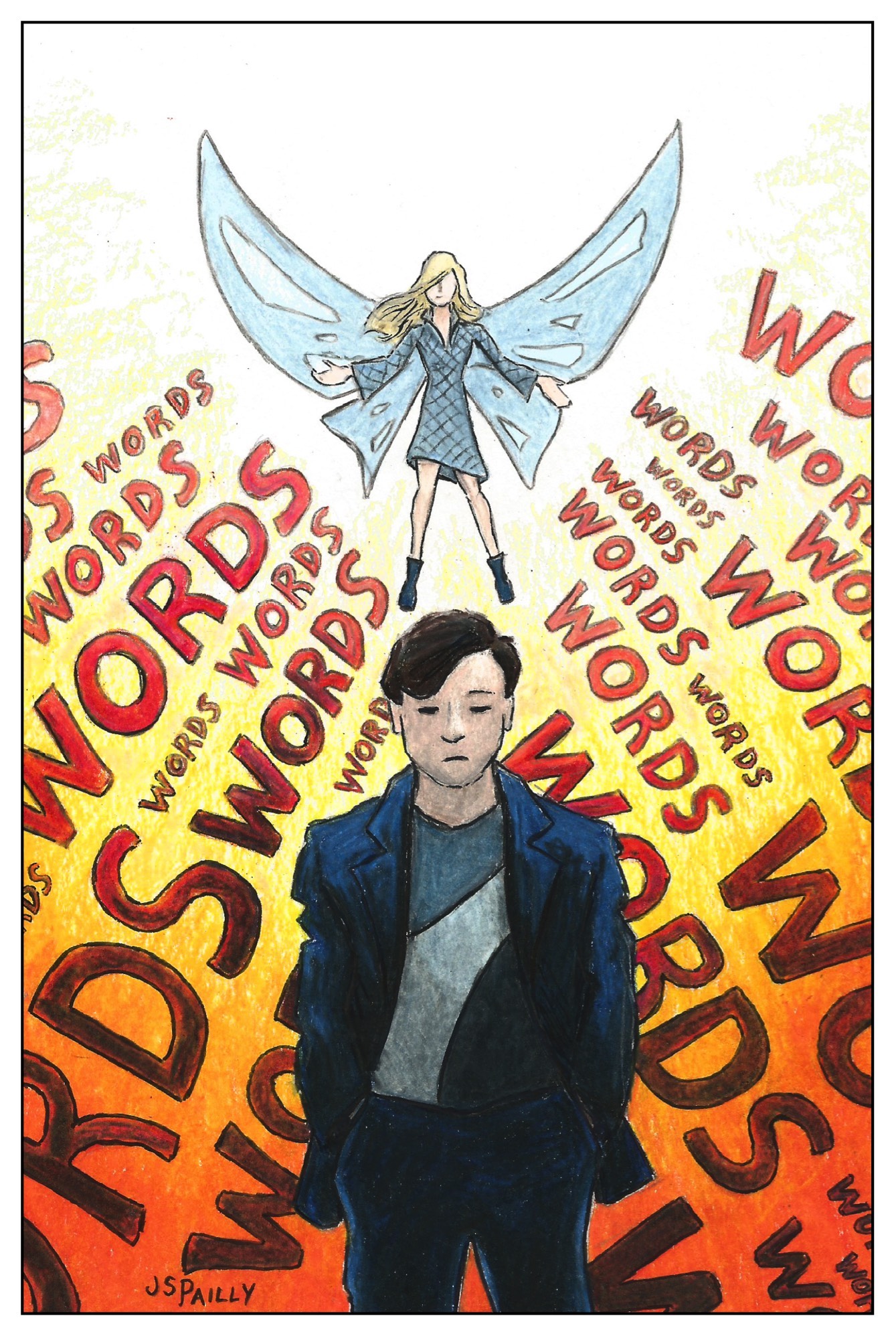
Ladies and gentlemen, I have an imaginary friend.  Those of you who regularly read my Insecure Writer’s Support Group posts have already met her.  She’s my muse.  Here’s her picture:

And here’s her picture sitting in my writing zone, next to my coffee mug full of pens.  I always have a picture of my muse with me when I’m writing.

But not all writers believe in muses.  In fact, not all writers even approve of the belief in muses.  I was recently listening to a writing podcast where the host went off on a tirade against the very concept of muses.

You can’t sit around waiting for your muse, this podcast host said.  You’ll never get any writing done that way.  Writing is work.  You have to do it every day, whether you feel inspired or not!

Of course my muse and I have heard all this before.  Perhaps you have too.  But I think all this anti-muse stuff is based on a fundamental misunderstanding about how muses do their jobs.  You see, my muse and I have something like a contractual relationship.

I do have to do my writing every day.  That’s the promise I made to my muse, and in exchange she has promised to keep bringing me the shiniest of shiny new ideas.  If I don’t fulfill my side of the bargain, why should my muse fulfill hers?

So writers, you can’t sit around being lazy and expect your muse to do all the work for you.  Show some initiative.  Go write.  It might feel like a struggle, but the muse will reward you in the end.

P.S.: And muses, remember you have an obligation to your writer too.  If your writer is making a real effort, do not be stingy with the good ideas!

#IWSG: Stop Acting Like a Little Kid

Welcome to the Insecure Writer’s Support Group!  If you’re a writer, and if you feel in any way insecure about your writing life, click here to learn more about this awesome group!

All in all, last month was a good month for me.  I had a meeting with my editor that I thought went well.  I attended a physics seminar in Princeton, an experience which really fueled my creativity as a science fiction writer.  Oh, and I wrote an article that I’m really proud of for Fiction Can Be Fun (click here to read it!)

But no matter how well things are going for me, there’s always somebody who wants to drag me down.  This time, I’ve been told that I need to stop acting like a little kid.  I’m too old to keep chasing these childish writing dreams.

Except I didn’t find this particular insult to be particularly insulting.  Rather, my thought was: Little kid?  Oh, you have no idea how right you are!  Allow me to give you a tour of my personal “writing zone.”

A few years back, I moved to a new house.  In that process, I ended up getting rid of my writing desk.  I don’t like desks.  Sitting at a desk is such a grownup thing to do, and I didn’t want to do it anymore.  Instead, I bought a thick, heavy blanket, laid it out on the floor, and called that my new writing zone.  It’s a comfy and cozy environment for writing.

As you can see in the highly technical diagram above, I keep several things in my writing zone:

  • A dictionary, specifically the New American Heritage Dictionary, which happens to be my favorite dictionary.
  • Two thesauruses, because if I can’t find the right word in one of them, there’s still a chance I might find it in the other.
  • Two notebooks, one for first drafts and another for rewrites.
  • My computer, so I can stream music.
  • Coffee mug full of pens.  Why?  I think that’s self-explanatory.

So whenever I write, I don’t sit at a desk.  I don’t even own a desk.  Not anymore!  Instead, I lie down on my belly, feet kicked up in the air—just like a little kid.

Oh, and you may have noticed in that highly technical diagram one other thing I keep in my writing zone: a picture of my B.I.F.F.  That’s a picture of my muse.  She’s not just my imaginary friend—she’s my best imaginary friend forever, or my B.I.F.F.

So if you want to insult me, don’t tell me my writing dreams are childish.  Don’t tell me I’m acting like a little kid.  That’s not an insult to me.  That’s a point of pride.

P.S.: Shoot, I always forget to promo this….  If you’d like to help support what I’m doing here on Planet Pailly, click here to “buy me a coffee.”  I don’t actually drink coffee, but your money will help me keep my coffee mug full of pens.

#IWSG: A Letter from Future Me

Welcome to the Insecure Writer’s Support Group!  If you’re a writer, and if you feel in any way insecure about your writing life, click here to learn more about this awesome group!

Last month, I said I needed some time off. I was feeling kind of burned out on writing.  No, it was worse than that.  I was finding all sorts of problems in my manuscript.  Lots of little, annoying problems, and I felt overwhelmed.  I was angry with myself.  I felt deeply disappointed with myself.

So I took a break from my regular writing schedule.  And during that break, I got a surprise in the mail.  It came from… well, I guess you’ll see who it came from:

To J.S. Pailly, my dearest friend,

Hello, past me!  It is I, J.S. Pailly.  I’m you from the future!

I’m writing to let you know that in the future, everything will be okay.  Well, maybe not everything.  You won’t believe who’s President now (oh yes, it can get worse!).  But in your life and in your career, things will work out.

No, you’re not going to be the most famous writer in the world, and you certainly won’t be the wealthiest.  But you’ll do well enough to get by writing full time.  It’s a good life. It’s a good career.  You’ll be happy, which really is the most important thing.

Now I am not going to tell you how, exactly, you made it.  I won’t say what your big break will be.  I won’t tell you which of your books will sell well and which will flop. I don’t want to spoil the surprise!  And honestly, you’ll be better off not knowing in advance.  You’ll learn more that way.

But I do want to let you in on one secret to your future success.  This is perhaps the single most important thing your future self could tell you: stop worrying about the details!!!  You have a tendency to obsess over the little stuff.  Is it okay to end this sentence with an exclamation point?  Should that word be italicized?  Does this line of dialogue really need a dialogue tag?

You agonize over this stuff as if one semicolon will make or break your entire writing career.  It won’t.  Trust me.  I am you from the future, and I’m writing to let you know that none of the stuff you’re worried about right now will matter.  None of it!

Now get back to writing.  Your future depends on it.

Yours truly,
J.S. Pailly
(from the actual future!)

P.S.: Next time you go to that Chinese place (you know the one I mean), get the walnut chicken, not the beef and broccoli.  No, seriously.  This is important!

I’m not sure how seriously I should take this.  Here’s a picture of the actual letter, and, well… that does look like my handwriting.

But this can’t be real, can it?  Someone’s got to be playing a trick on me.  I don’t know. But one thing’s for sure: I will be having the walnut chicken for dinner tonight.

#IWSG: Write Because You Want To

Welcome to the Insecure Writer’s Support Group!  If you’re a writer, and if you feel in any way insecure about your writing life, click here to learn more about this awesome group!

On this blog, I write about science. I’m a big believer in science and in science’s ability to make our lives better.  But I also believe in fairies.  There is, after all, a magical fairy person who flutters around me all the time.  She’s my muse, and it’s her job to put words into my head.

But recently, my muse put some very strange words in my head, words I would not have expected from her.  What did she say?  She told me I don’t have to keep doing this writing stuff if I don’t want to.

Here’s the thing: I’ve been very, very stressed out about writing these last few weeks.  Those of us who want to write professionally are told over and over again to treat writing like a job.  And that’s good advice.  You should treat writing like a job if you expect to ever make money off it.

But I have treated writing so much like a job that it’s stopped being fun.  It’s just part of my daily grind now.  That’s clearly not what my muse intended for me, nor is it what I intended for myself.

This post makes it sound like I’m about to quit writing. Don’t worry.  That’s not what’s happening.  But I do need to remember that writing is supposed to be fun, and I need to reconnect with the reason why I wanted to start writing in the first place.

To that end, I’ve decided to take a little break from blogging.  I’ve given myself an extra special project to work on this month, something that should get me back into the swing of things.  When we meet again for September’s I.S.W.G. post, I will (hopefully) be able to tell you more!

#IWSG: An Open Letter to Anyone Who Ever Talks to a Writer

Welcome to the Insecure Writer’s Support Group!  If you’re a writer, and if you feel in any way insecure about your writing life, click here to learn more about this awesome group!

Since last month’s meeting of the Insecure Writer’s Support Group, I’ve been getting out more, doing new things, meeting new people.  It’s not like I took the “your life is soooo boring” thing seriously.  I didn’t plan this or anything.  It just sort of happened.

Anyway, if I’m going to be meeting new people, having more of a social life, and all that stuff, then I think it’s time to revisit one of my older IWSG posts.  So here, once again, is an open letter to anyone who’s had a conversation with me.

* * *

This is an open letter to anyone who’s ever had a conversation with me.  You may or may not have been aware of this at the time, but I’m a writer. That means there’s something you should know: while we were talking, I was taking mental notes about you.

Okay, there’s no need to panic.  I’m not in the habit of taking people I know or people I’ve met and just dropping them into my stories.  Yes, some writers do that, but that’s not how my process works.

So I promise I will not create a character just like you; however, the things you said—especially the way you said them—may inform my character development process at some point in the future.  Well, maybe not in the future.  To be honest, I’m probably already using you as a source of inspiration.

If you used some particularly interesting turn of phrase of displayed some unique or striking mannerism while we were interacting, I may have actually written that down to ensure I wouldn’t forget.  I wouldn’t have done this in front of you. That would’ve been rude. But be aware that I probably did this behind your back, and I probably added you to a file folder when I got home.

I hope this doesn’t make you feel self-conscious or uncomfortable. It’s important to me that you behave naturally.  Or rather, I want you and need you to behave authentically, because authentic speech and behavior are precisely that I’m trying to replicate in my storytelling.

Thank you for your time.  I just thought you ought to know what you’re getting yourself into when you talk to a writer like me.

Sincerely,

J.S. Pailly.