The Peril of Being Self Educated

Hello, friends!

As many of you already know, I blog about science, but I am first and foremost a science fiction writer (fingers crossed, soon to be a published science fiction writer!).

Back in 2010, I started this blog as a way to force myself to do the kind of research that I, as an aspiring Sci-Fi author, thought that I ought to be doing.  In the beginning, I really didn’t know much about science, except for some stuff I remembered learning in school.  And most of that stuff I remembered from school turned out to be wrong or, at best, only half true.

That’s one of the reasons I love being self educated.  Writing this blog has given me an opportunity to discover and correct many of the misconceptions I once had about science.  And my Sci-Fi writing has improved as a result.  I was recently looking over one of my old manuscripts.  So many silly misconceptions are on full display in that text.  Thank God that story never got published!

Another reason I love being self educated: doing deep dives on topics that I find interesting or that I think could be useful in my stories—topics like lithium mining, Troodon intelligence, or Venus’s unknown absorber.  The kinds of topics that never seem to get covered in school or that rarely get attention from the popular press.

I have, on occasion, surprised professional scientists with just how much I know about some weirdly specific topics.  And then I’ve surprised those same scientists with how much I don’t know about more ordinary, more generalized things.  That’s the peril of being self educated.  Your knowledge is splotchy, inconsistent.  You end up with these weird gaps in your knowledge, gaps that someone with a more traditional science education would not have.

And that’s why I keep blogging: because there’s still a whole lot I don’t know, and I’m sure I still have a lot of misconceptions in my head about science, and about other things too.  One thing I didn’t anticipate when I started this blog was how valuable a resource you, dear reader, would be.  You’ve asked me questions.  You’ve challenged me.  Some of you have pointed out my mistakes and suggested new avenues of research.

For that, I just want to say thank you, and please keep it up!

Next time on Planet Pailly, what if I told you Earth is not the perfect planet for life?

Something Worth Knowing

Hello, friends!

Today I’d like to share a very old video I found on YouTube.  It’s a series of man (and woman) on the street interviews where people are asked if they think we’ll find life on other planets.

According to the video description, this was filmed in 1962.  It’s interesting to me to hear people talk about the possibility of finding “vegetable” and/or “animal” life on Venus.  At that time, the Soviet Union’s Venera 1 spacecraft would have already visited Venus; however, due to a technical glitch, Venera 1 failed to transmit any data about Venus back to Earth.  So surface conditions on Venus were still unknown to us Earthlings.

But setting aside the Venus stuff in particular, in general people’s opinions about space exploration and extraterrestrial life have not changed much since 1962.  Some people are enthusiastically optimistic, others think it’s all nonsense, and a lot of people don’t seem to care one way or the other.

Then, of course, you get the one guy who swears he’s seen a U.F.O.  And then, of course, you get the guy who’s “working off the theory of the Bible,” where it says God only created life on one planet (F.Y.I., I’ve read the Bible too, and I don’t remember it ever saying that).  So again, not much has changed since 1962.

But my favorite is the woman at 1:40 who says she doesn’t expect we’ll find any life on Venus, but then goes on to say we’ll still find “something worth knowing.”  I’d say she was right on both counts!

Personally, I do think there’s life on other planets, and also on other moons (I’m looking at you, Europa).  But regardless of whether or not we find alien life out there, we should absolutely keep searching and keep exploring.  I suspect we will continue to learn all sorts of things that are worth knowing!

Next time on Planet Pailly, we’ll learn how to dance like binary stars.

Wait, What Do You Mean There’s No “Life” on Mars?

Hello, friends!

The other day, someone wanted to pick a fight with me.  This person said to me in a forceful, almost rude tone, that there is absolutely no chance we will ever discover life on Mars.  If you know me at all, you must surely know: them’s fightin’ words!

Except before this conversation could escalate into a full blown argument, it became apparent (to me, at least) that we were not actually talking about the same thing.  You see when I talk about life on Mars, I mean life of any kind, including microorganisms—especially microorganisms.  This other person was using the word “life” to mean, specifically and exclusively, intelligent life.

No, I do not expect we’ll find intelligent life on Mars.  There are no canals, no cities—none of that stuff Percival Lowell once imagined he saw in his telescope.  Nor do I expect to find non-intelligent animals or any kind of plant life.

The best we can hope for is that there might be Martian microorganisms hiding under a glacier, subsisting off a trickle of meltwater.  And to be honest, I’m not overly optimistic about finding even that much life on Mars.  But to say it is absolutely impossible?  No, I cannot agree with that.

And after explaining what I mean when I talk about life on Mars and what my expectations actually are, this person conceded (grudgingly, perhaps) that I might have a point.  Thus what could have been a bitter and fruitless argument turned into an opportunity to educate someone about the science of astrobiology.  Why?  Because I asked the question “Wait, what do you mean by life?”

Language is not as precise a tool as we often imagine.  People sometimes use the same words to mean very different things, leading to misunderstandings, hurt feelings, and unproductive arguments.  I think a lot of those arguments, both big and small, could be avoided if more people would stop and ask: “Wait, what do you mean by (fill in the blank)?”

Next time on Planet Pailly, am I too judgmental?  We’ll find out in this month’s posting of the Insecure Writer’s Support Group.

Beware Wishful Thinking: A Science Lesson

This may seem like a contradiction. Astrobiologists are actively searching for alien life.  It’s their job.  And yet whenever new evidence of alien life is presented, astrobiologists are the first and most vocal skeptics about it.  If your job is to search for alien life, why would you be so quick to doubt any evidence that alien life actually exists?

This goes back to the famous “extraordinary claims require extraordinary evidence” line from Carl Sagan, or the whole proof beyond a reasonable doubt thing I kept saying during my recent A to Z series on the search for alien life.  Astrobiologists very much do want to find alien life.  They’re eager to find it.  Perhaps a little too eager.

And thus, astrobiologists have to be careful.  They have to be extra skeptical, because they have to be on guard against their own wishful thinking.

And really, this is not only true in the field of astrobiology; it’s true of science in general.  And frankly, it’s a valuable lesson for us all, even if you’re not a scientist.

I can’t tell you how many times I’ve really wanted to believe something.  I’ve really wanted to believe that some girl likes me, or that I’ve put my money in sound investments, or that I’ve voted for the right people.  And when you really want to believe something, you’ll latch onto whatever flimsy evidence you can find to prove to yourself that it’s true.

Astrobiologists know this.  Scientists know this (or at least they’re supposed to).  And I think it’s good advice for us all to live by.  The more you want to believe something, the more you should question and doubt it.  Always, always, always be on guard against your own wishful thinking.

Sciency Words: Sciency Words

Sciency Words: (proper noun) a special series here on Planet Pailly focusing on the definitions and etymologies of science or science-related terms.  Today’s Sciency Word is:

SCIENCY WORDS

Yeah, that’s right.  I’m declaring that Sciency Words is itself a Sciency Word.  It is a science-related term, after all!

Seeing as we’re about to embark on a full twenty-six episodes of Sciency Words for this year’s A to Z Challenge, I figured this is a good time to talk about why this series exists and why I think it matters.  You see, I’m a science fiction writer, and I started writing this blog as a way of teaching myself about science.  And the #1 problem I had right from the start was learning the vocabulary.

And it seems I’m not the only one who struggles with that. In fact, according to this paper from the Journal of Research in Science Teaching, understanding the “discursive practices of science” is the biggest obstacle high school science students have to overcome.  One student is quoted in that paper saying, “Science has its own little slang to it.”  And as another student said, “[Scientists] communicate with their own different words and it’s, well to me, it’s hard to like to use their words cause they’re big.”

So why do scientists insist on using such big, confusing words?  Why can’t they use plain English so that everybody can understand what they’re saying?  It is not because scientists want to make themselves sound smart or to make other people feel stupid (at least that’s not always the case).  The problem with plain English (or plain whatever language you prefer) is that it can be a little ambiguous.

Couldn’t you just say random instead of stochastic? Couldn’t you say wobble instead of libration?  Couldn’t you say forward and backward instead of prograde and retrograde?  Well, no, in some contexts those words really aren’t synonymous.  Those Sciency Words mean something a little more precise than their plain language “equivalents,” and that linguistic precision is really important if you’re trying to explain complex scientific concepts.

So for me, in my ongoing research journey, there’s really no way around it.  I have to learn the vocabulary, and thus the vocabulary has become a big part of this blog.  Because using simple words can lead to oversimplified—and woefully inaccurate—science, as I often see in the popular press.  There’s a quote that’s often attributed to Albert Einstein which I think applies here: “Everything should be made as simple as possible, but not simpler.”  Or as one of the students interviewed for that Research in Science Teaching paper said, “It isn’t no slang that can be said about this stuff.”

Sciency Words: The Sagan Effect

Sciency Words: (proper noun) a special series here on Planet Pailly focusing on the definitions and etymologies of science or science-related terms.  Today’s Sciency Word is:

THE SAGAN EFFECT

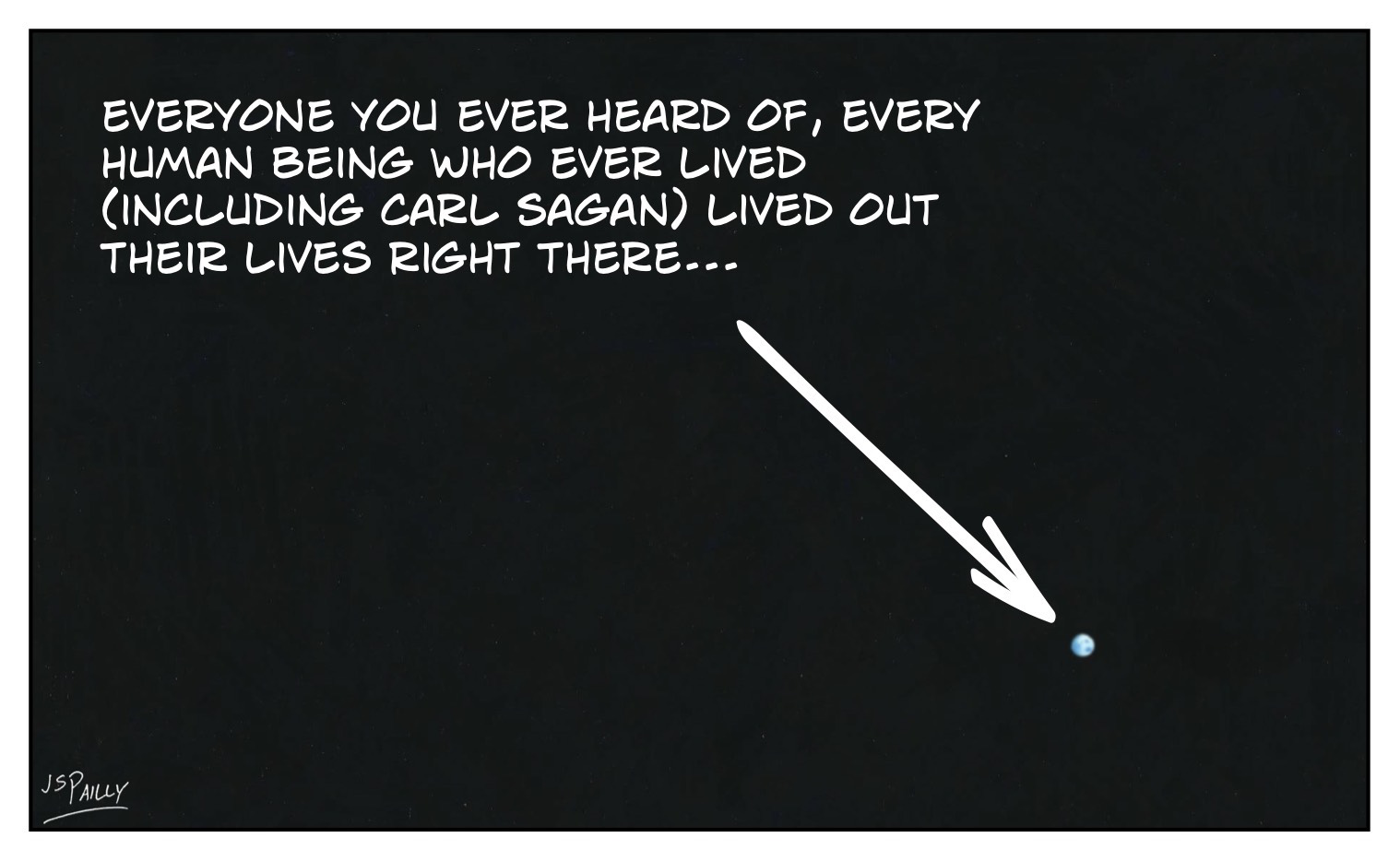
This year’s A to Z Challenge is fast approaching. I’ve already revealed my theme: Sciency Words, specifically scientific terms related to the search for alien life.  And with that theme in mind, there’s one person whom I expect we’ll be talking about a lot: Carl Sagan.

Sagan deserves a lot of credit for making astrobiology a respected branch of modern science, and he invented some of the scientific terms we’ll be talking about next month.  But Sagan himself was not as well respected by his peers as he should have been.

Why not?  Because he wrote too many books.  Because he was on television all the time, giving interviews, hosting his own T.V. show, and waxing poetic about our place in the universe.

Apparently that led to a perception among the scientific community that Sagan must not be spending much time doing actual scientific research.  As a direct consequence of that perception, Sagan was denied membership to the U.S. National Academy of Sciences, and it’s widely believed that this is also why he was denied tenure at Harvard.

And Sagan is not the only working scientist to suffer from what is now known as the Sagan Effect.  As described in this article from the Journal of Neuroscience, quite a few researchers have lost grant money or been reprimanded by their supervisors or faced other career-derailing consequences simply for giving a TED Talk or having too many followers on Twitter or writing a few articles for popular science magazines.

This despite the fact that there is a growing awareness in the scientific community that scientists do need to engage with the public. To quote from that same article from Neuroscience:

Most scientists agree that science communication is important, and some even say that it is a scientist’s duty to interact with the media and the tax-paying public.  Yet, the concern remains that science dissemination may be incompatible with a successful academic career, particularly if the scientist is a junior or pretenture investigator.

So it would seem that if you’re a scientist and you want to engage with the public, you’re damned if you do and damned if you don’t.

The frustrating thing is that Carl Sagan was no slacker when it came to science.  The oft cited statistic is that he produced, on average, one peer-reviewed paper per month.  All that work he did to popularize science was on top of his regular workload as a scientist, not instead of it.

And the same could be said of many “popularizers” today, according to this paper titled “Scientists who engage with society perform better academically.”  Yes, the scientific community has been researching itself, and the evidence shows that scientists who engage with the public do not slack off with their regular work.  Quite the opposite: they outperform their less publically engaged colleagues!

Even so, the Sagan Effect remains in play. Scientists seem to have embraced certain stereotypes about themselves, and, quoting again from this Neuroscience article, “deviating too much from the idealized image of the single-minded, focused academic is still considered problematic.”  But I think it’s time we all let that stereotype go, because if you’re a working scientist today you can do your research AND help inspire the next generation of scientists (and give people like me ideas for cool Sci-Fi stories)—just like Carl Sagan did!

Keeping an Open Mind

I know some people who believe some pretty ridiculous things.  I know people who buy into astrology and tarot cards.  I know people who insist the Earth is only 6,000 years old.  I’m friends with someone who believes the Moon Landing was a hoax, and recently I had a conversation with a 9/11 truther. That conversation got uncomfortable real fast.

The thing is, whenever these people find out I’m a huge science enthusiast, they always end up throwing science back in my face. It’s a basic principle of science, isn’t it?  You have to keep an open mind, don’t you?  Scientific theories have been disproven before, and scientists should be prepared to admit when they’re wrong.

Whenever I get the “keep an open mind” lecture, I respond with a quote that’s often attributed to Carl Sagan: “It pays to keep an open mind, but not so open your brains fall out.”

Because in science, the consensus opinion does change.  Old theories do make way for new ones (though it’s rare for a well established theory to be overturned in its entirety). It does pay to keep an open mind, but that doesn’t mean switching off your critical thinking skills.  And when a hypothesis doesn’t stand up to questioning and scrutiny, when it doesn’t agree with experimental or observational evidence, it’s probably not because my mind isn’t open enough; it’s probably because your hypothesis is wrong.

Just my two cents for today.

Putting STEM into the Arts

I thought I was done talking about the whole STEM vs. STEAM debate, but then it occurred to me that there’s one point that nobody seemed to be talking about.  This debate is often framed in terms of how the arts can benefit STEM.  No one ever seems to mention how STEM can benefit the arts.

About a month ago, SpaceX announced that Japanese billionaire Yusaku Maezawa will be going on a tourist trip around the Moon. Maezawa is an art collector, and he’s decided to take six to eight artists with him on a mission called “Dear Moon.”  According to the Dear Moon website, “A painter, musician, film director, fashion designer… Some of Earth’s greatest talents will board a spacecraft and be inspired in a way they never have been before.”

Art is meant to reflect the world we live in. Therefore artists have a responsibility to understand, as best they can, our increasingly scientific and increasingly technological world.  It sounds to me like Maezawa gets this.  But aside from seeking out new sources of inspiration, there are also craft-related reasons why artists might want to be exposed to sciency stuff.

As an artist, when you’re thinking about how light and shadow play off a three-dimensional form, you’re sort of thinking about physics. When you’re mixing paints, trying to make sure they’ll adhere to your canvass, or trying to make sure the colors won’t fade over time, you’re dabbling in chemistry.  And obviously when you’re drawing a figure study (nude or otherwise), knowing a little about anatomy and biology will help you a lot.

None of the art teachers I had in school, and none of the art tutors my parents hired for me outside of school, really made this clear to me.  As I said in my post on Friday, young me came to understand that the arts and sciences were totally different, unrelated things.  There was a long period of time in my life when I felt artistically stuck. I was unable to improve, and I didn’t understand why.

It wasn’t until I attended a seminar taught by James Gurney, the author and artist behind Dinotopia, that my art began to thrive again.  Why?  Because Mr. Gurney got me to start thinking scientifically about my art. I guess you could say he got me to stop thinking of myself as a left-brain-only kind of guy.

I can’t speak for every artist out there, but I know for me personally a more interdisciplinary approach to education would have done me a world of good.  And with that, I think I’ve said my peace about STEM and STEAM.  In my next post, I’ll move on to some other topic.

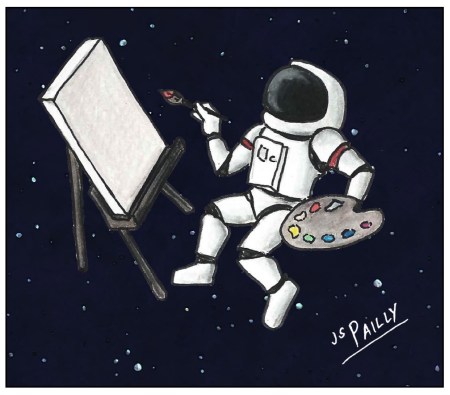
P.S.: While drawing that artist in space cartoon for today’s post, I thought of several reasons why painting in space like that would not work.  For one thing, I imagine those paints would do the whole freezing-and-boiling-at-the-same-time thing that other liquids tend to do in space.  If you can think of other challenges my artist/astronaut would have to deal with, please share in the comments!

Sciency Words: STEM vs. STEAM, Part Two

In last week’s episode of Sciency Words, I told you about STEAM education, a variation of STEM education, but with an A added to represent the arts.  There’s a passionate and sometimes vitriolic fight happening in the education world about this.  If I had to pick sides, I guess I’d be on team STEAM; but I hate picking sides in something like this because this whole STEM vs. STEAM fight amounts to what I like to call a “failure of language.”

What I mean by that is that the whole STEM vs. STEAM thing is all about words.  Words, words, words.  Nothing more.  Every time we invent a new word, we create a sort of mental box.  To define our new word, we put certain things in the box, and we keep other things out.  To some extent, we have to do this; otherwise, language wouldn’t work.

But when we start sorting concepts into different mental boxes, we may inadvertently start erecting mental barriers as well.  As a child growing up in the 80’s and 90’s, I never heard about STEM or STEAM.  Those terms hadn’t been invented yet.  Even so, young me came to understand that the arts and sciences were absolutely different from each other.  There were hard barriers between them.  I worry that an unintended consequence of STEM has been to make those kinds of barriers harder and taller, and I’d like to believe that STEAM might help break those barriers down.

As a matter of education policy and the allocation of grant money, maybe STEM is the more useful word to be using.  When we can take a bunch of big concepts (like science, technology, engineering, and mathematics, along with all the interdisciplinary challenges that come with those subjects) and put them together in the same mental box, we suddenly have the ability to communicate complex ideas in simple ways.  STEM education is important.  The fact that this term exists and we all more-or-less understand what it means is a huge success of language.

But what I’ve seen of this STEM vs. STEAM debate strikes me as a case study of how a success of language can start to look like a failure.  I can think of other examples as well. Any time we start insisting that things (or worse, people) belong in separate boxes, we’re allowing mere words to create real divisions, and we’re making the communication of ideas between the two sides more difficult.

This may not qualify as a scientific term, or even as a linguistics term, but it’s a term I’m using more and more in all the seemingly pointless arguments our society keeps getting into these days:

FAILURE OF LANGUAGE

Okay, I’m going to get off my philosophy of language soapbox.  Now it’s your turn.  What do you think of STEM, STEAM, and the ways language succeeds and/or fails us?

Sciency Words: STEM vs. STEAM, Part One

I don’t think I’ve ever done a two-part episode of Sciency Words before, but this turned out to be a more complicated and controversial topic than I originally expected.  I have some strong feelings about this, but for now I’ll keep those feelings to myself and endeavor to be fair to both sides of the debate over:

STEM vs. STEAM

Our story begins in the early 2000’s.  Studies were being published.  Important meetings were happening at the National Science Foundation.  There was a growing concern about the state of education in the United States.  Children were not learning what they needed to know in certain specific fields.  It seemed that a whole generation of young people would not be prepared for the high-tech job market of the future.

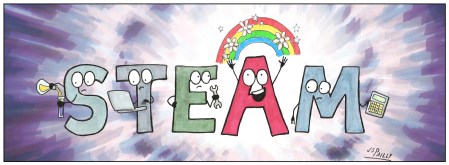
Thus, the concept of STEM education was born.  STEM, of course, is an acronym for science, technology, engineering, and mathematics.  There’s been a strong push in recent years to get children excited about these subjects, to get them interested in pursuing STEM careers, and rightfully so.  Our world is changing, and children should be prepared for that.

But has this emphasis on STEM gotten out of hand? Has STEM led to a deemphasizing or even a devaluing of the arts?  Some worry that it has, and this has led to a new push to turn STEM into STEAM, with the A representing art.

The argument goes that the arts, or at least certain key aspects of the arts, are just as important in the high-tech world of tomorrow as the more traditional STEM fields.  As an example, think of a smartphone.  Think of the design team that figured out what the phone should look like, what it should feel like in your hand.  Think of the people who designed the user interface, with all those little icons that show you what your phone can do, and all those musical dings and beeps and whistles that let your phone tell you you got a text message, or that your download in complete, or that your battery is running low.  All those little niceties of design—it takes artists to do that.

But some people really are not happy about getting the arts mixed up with STEM.  Yes, the arts are important for a well-rounded education.  Yes, there’s a place for artists in the jobs market of the future.  But remember how our story began.  There was a growing concern that children were not getting the education they needed in certain specific fields. This was a crisis in the American education system, and the crisis is not over yet.  STEM education is only now starting to get the attention—and also the grant money—it so desperately needs.  We need to stay focused on the biggest problem areas in our education system.

Now I try to keep these blog posts fairly short.  I hope I did an okay job summarizing both sides of this issue, but if you think I left important points out, please feel free to yell at me in the comments below.  I’d especially love to hear from educators who may be on the front lines of this debate.

As for my own opinion… I guess if I had to choose sides, I’d be on team STEAM.  But I hate choosing sides in something like this.  From my perspective, more than anything else, this fight looks like a failure of language.  I’ll explain what I mean by that in part two.