Never Say Never: Life on Ancient Venus

Hello, friends!  Today’s post is about the planet Venus, but the real lesson today is this: never say never.

Could Venus have supported life at some point in the past?  Yes.  In theory, yes.  Despite being closer to the Sun than Earth, Venus still orbits within the so-called habitable zone of our Solar System (this depends a little on whom you ask; some sources say Venus is inside the habitable zone while others will tell you she’s skirting the habitable zone’s edge).  So it is plausible that, at some point in the distant past, Venus could have had more Earth-like temperatures and more Earth-like surface conditions.

But then something went catastrophically wrong.  Carbon dioxide gas somehow started accumulating in Venus’s atmosphere.  Carbon dioxide is naturally good at trapping heat, so rising CO2 levels caused the temperature to also rise.  Rising temperatures caused more CO2 to outgas from the planet’s crust.  The outgassing of more CO2 caused the temperature to rise further, which caused more outgassing of CO2, which caused temperatures to rise further, which caused more outgassing of CO2, which caused… you get the idea.  This process is known as a runaway greenhouse effect.

Cartoon of Venus, looking eager, and Earth, looking shocked, as Venus says, "Oh, Earth! I used to have 'organisms' crawling on me, too.  But then I filled my atmosphere with CO2, triggering a runaway greenhouse effect.  That killed everything!"

I don’t think anyone knows for certain what started the runaway greenhouse effect on Venus (or at least, I’ve read many different ideas about what the initial cause might have been).  All we know for certain is what Venus is like today: hell.  Insane heat.  Insane atmospheric pressure.  Insane levels of CO2 plus insane weather, most notoriously sulfuric acid rain.  I think it’s safe to say that no planet in the Solar System is more hostile to life as we know it than modern day Venus.

But the runaway greenhouse effect was not the only catastrophe to befall Venus.  Venus also experienced something called a global resurfacing event.  Resurfacing may sound like something you’d do to a parking lot, but when we’re talking about planets, resurfacing means spreading fresh lava over a planet’s surface, essentially paving over whatever surface features might have been there before.

So could Venus have supported life at some point in the past?  Sure.  It’s possible.  But this always seemed like an untestable hypothesis to me.  The runaway greenhouse effect would have killed everything (well, almost everything… see my post script), and the global resurfacing event would have paved over any fossils or other evidence of past Venusian life.  So if there ever was life on Venus, we’d never know about it.  Never.

We now come to the “never say never” part of today’s post.  On Venus, there are patches of rough terrain called tesserae (singular, tessera).  As longtime readers of this blog know, Venus is my favorite planet, so naturally I have heard about the tesserae on Venus before; however, I was previously led to believe tesserae were formed by thrust faults, volcanic eruptions, or some other relatively modern geological activity.  But recently, I read a research paper that mentioned, rather casually, that tesserae might also be the remnants of ancient continental crust jutting up above the otherwise smooth, resurfaced landscape.

So the tesserae we see today could be ancient Venus’s version of the Rocky Mountains, the Alps, or the Himalayas.  They are (or were) the highest of high elevation regions on ancient Venus—regions high enough to survive the global resurfacing event.  If true, then the tesserae of Venus may preserve some hard evidence of what Venus used to be like before the runaway greenhouse effect and the global resurfacing event wrecked the place.

So was there ever life on Venus?  It’s possible, but we don’t know for sure.  I once resigned myself to the belief that we could never know, but you should never say never.  Signs of ancient water and ancient life may be preserved on Venus after all, just waiting for us to discover.

P.S.: Some scientists believe there may be life on Venus today.  There is some very circumstantial evidence of microorganisms floating around in Venus’s upper atmosphere.  I do have some thoughts about that, but I’ll save that for another blog post.

Want to Learn More?

Here is the research paper I mentioned that casually mentions tesserae might be the remnants of ancient continental crust.

And here is a paper I found describing possible signs of water erosion on Venus’s tesserae.  Water erosion could not possibly happen on Venus today, so this would be further evidence that tesserae have preserved something of Venus’s ancient history.

And lastly, just because this “tesserae equals continental crust” idea is new to me, that doesn’t mean it’s new to science.  Here’s a paper from 1990 discussing the possibility.  Even if some of the information in this paper is out of date, I think it’s still worth a look, if only to see how much history this idea has.


#IWSG: To Be a Writer…

Hello, friends!  Welcome to this month’s meeting of the Insecure Writer’s Support Group, a blog hop created by Alex J. Cavanaugh and co-hosted this month by PJ Colando, Jean Davis, Lisa Buie Collard, and Diedre Knight.  If you’re a writer, and if you feel insecure about your writing life, click here to learn more about this amazingly supportive group.

I didn’t do any blogging last month (aside from last month’s IWSG post, of course).  I didn’t work on my current WIP either.  I didn’t make any real writing progress last month, now that I’m thinking about it, but that’s okay.  There’s more to being a writer than writing.

To be a writer, you need to live a rich and fulfilling life.  Experience the joy and beauty of the world, but don’t ignore the ugliness or the cruelty.  As a writer, you need to recognize the ugliness and cruelty of the world even as you celebrate the beauty and the joy.

To be a writer, you need to take risks.  You need to try new things, even if they’re stupid things.  You need to embarrass yourself.  Allow yourself to make mistakes.  Big mistakes, sometimes.  It would be nice if we writers could learn everything we need to know the easy way (by reading about it in our favorite books).  But we can’t.  Some lessons can only be learned the hard way.

And after every success and every failure, you need to take the time to feel your feelings, no matter what those feelings might be.  Laugh at yourself.  Cry.  Start plotting your revenge.  Doesn’t matter if these thoughts and feelings are rational or irrational.  You need to feel them.  To be a writer, you need to understand the human condition, and the only way to do that is to experience it in full for yourself.

Meet new people.  Meet people who are just like you.  Meet people who are totally different (or who seem to be totally different at first).  Get to know them.  Try to understand their goals, their passions, their challenges.  And if these people happen to open up to you, try to understand their fears and regrets.  Don’t judge.  Never be judgmental.  To be a writer, you need to have empathy for everyone.  That is a tall order, I know, but I do mean everyone.  As we writers like to say, each villain is the hero of their own story.  Learn that lesson (and other lessons like it) in real life, by talking to real people, and your writing will improve.

And then, once you’ve done all those things, get back to writing as soon as you can.  The muse will be patient while you’re out there living a rich and fulfilling life, leaning all these things about the world and the human condition.  But the muse can only be patient for so long.

So if you’ll excuse me, I think I better get back to writing.

#IWSG: Take an Interest in Things

Hello, friends.  Welcome to this month’s meeting of the Insecure Writer’s Support Group, a blog hop created by Alex J. Cavanaugh and co-hosted this month by Natalie Aguirre, Kim Lajevardi, Debs Carey, Gwen Gardner, Patricia Josephine, and Rebecca Douglass.  If you’re a writer and if you feel insecure about your writing life, click here to learn more about this amazingly supportive group.

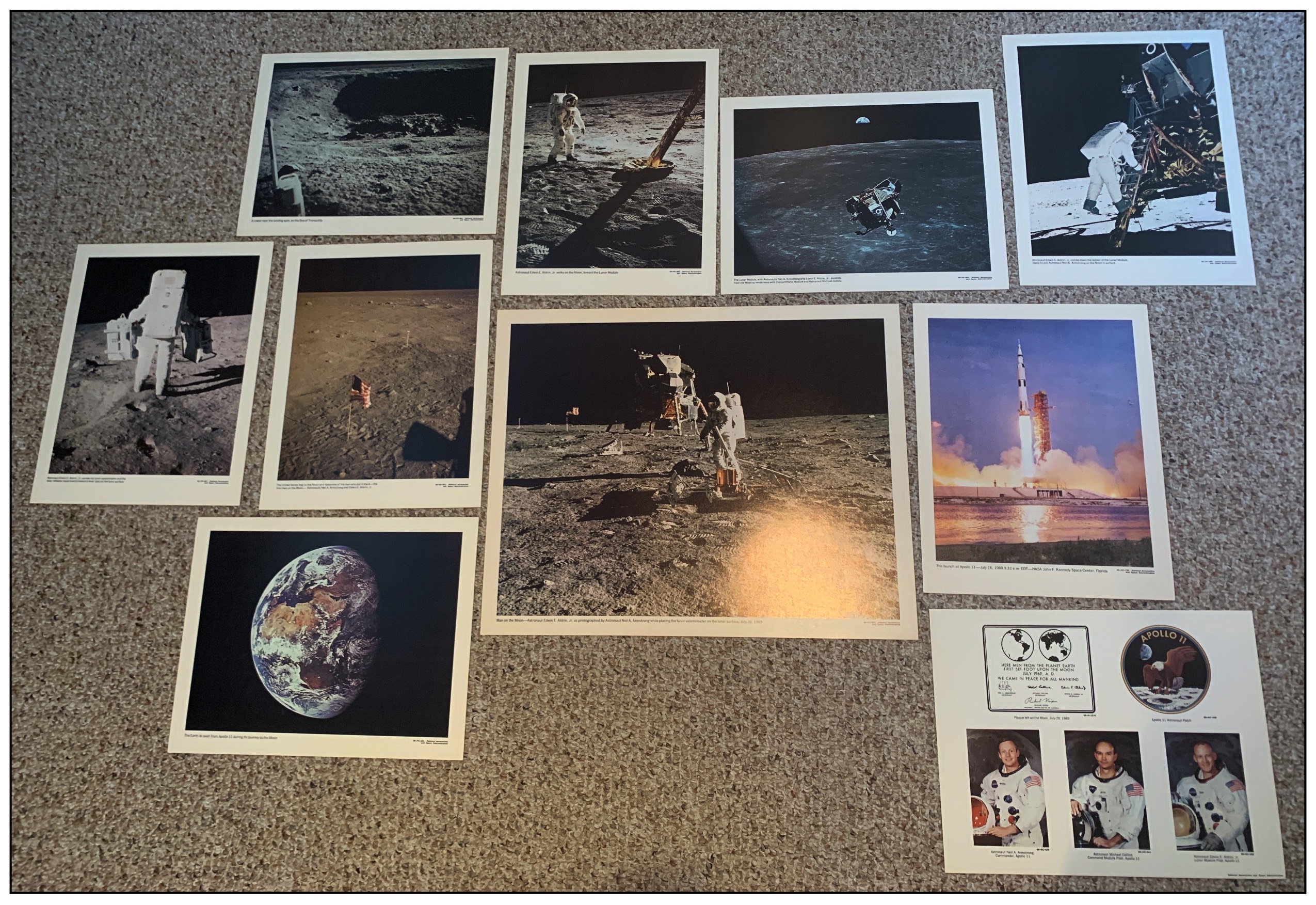
Friends, last month my grandmother passed away.  She was 103 years old.  She spent most of her professional life working for the United States Department of State, and she was peripherally involved in many of the ups and downs of the Cold War.  That is a period of time which includes the Moon Landings, and I am in proud possession of several poster-size photographs of the Apollo 11 Moon Landing which “went missing” during my grandmother’s time working for the government.

My grandmother was also an avid reader, and she encouraged me to be an avid reader, too.  At a time in my life when school really pushed the idea that only certain books counted as “real reading,” my grandmother encouraged me to read anything and everything I wanted.  She promised to buy me any book I asked for, and so, even though she didn’t personally care for science fiction, she bought me many of the Star Trek and Star Wars novels I read as a kid when I was supposed to be reading actual homework.

And in my teenage years, when I started writing my own Sci-Fi stories, my grandmother became my first editor.  She corrected my spelling and grammar, and she asked interesting questions about my characters and the weird Sci-Fi worlds they inhabited (all this, again, despite the fact that she didn’t personally care for science fiction).

My grandmother lived a fascinating life.  I don’t know all the details.  She said something to me once implying that some details of her life might actually be national secrets, and to this day I have no idea whether or not she was joking.  But I do remember, quite vividly, what she would say whenever someone asked her about her incredible life: “Oh, I just take an interest in things.”

Obviously I met other people who worked for the State Department when I was growing up.  You’d think everyone at the State Department would know a lot about the world, but they didn’t.  My grandmother was unique.  She knew more about the world than anyone else I’ve ever met, and it’s all because she just took an interest in things—all sorts of things—even things that may not have seemed like they were worth knowing about, at first glance.

So my writing advice this month is this: take an interest in things, as my grandmother did.  Take an interest in all sorts of things, even things that don’t seem particularly interesting or important, at first.  Whether you are protecting America’s foreign policy interests or writing your next awesome story, you never know what little tidbits of knowledge might end up mattering.

Carbon Dating Alien Life

Hello, friends!

A little over a week ago, the bodies of two dead extraterrestrials were presented to Mexico’s Congress as evidence that Earth has, in fact, been visited by aliens.  My initial reaction, upon first hearing about this, was: Is this it?  Is this the proof we’ve all been waiting for?  I used to believe in U.F.O.s, and there’s a part of me that still wants to believe.  But wanting to believe something doesn’t make it true.

The very first news article I read about this—the very first paragraph of that article, in fact—threw up one of the biggest red flags I’ve ever seen in all my years of researching space and science stuff.  I don’t remember who published that article.  CNN, Reuters, the Associated Press… it was one of those news sources, I think.  Anyway, the article stated in the very first paragraph that scientists used carbon dating to determine the age of these supposed extraterrestrial bodies.  Which… come on, seriously?

For anyone who doesn’t know how carbon dating works, I’ll provide a link in the “want to learn more” section below.  The important thing is this: carbon dating only works because we know how much carbon-14 (a radioisotope of carbon) is present in Earth’s atmosphere.  So if we ever discover a dead organism on Mars, and if we decide to try carbon dating that dead Martian organism, we would first need to know the carbon-14 content of Mars’s atmosphere.

As for these purported extraterrestrials, we don’t even know what planet they (supposedly) came from.  We have no way of knowing how much carbon-14 would be in their home planet’s atmosphere, or how much was in the atmosphere aboard their spaceship, or how much would’ve been in the atmospheres of any other worlds they may have visited before they happened to die here on Earth.  So why would you even bother carbon dating these alien bodies?  What purpose could that possibly serve?

If the people presenting these “extraterrestrials” to Mexico’s Congress were serious scientists doing serious science, they would know all that.  They’d know carbon dating is pointless in this situation.  The only reason carbon dating was mentioned at all (I presume) is because it sounds very sciency to the general public.  It adds an air of scientific legitimacy.  “We carbon dated these things, which means they must be what we say they are.”

After turning to some less gullible science news sources, like Live Science and Smithsonian Magazine, I learned that the people behind these alien corpses have a history of “discovering” alien bodies.  In previous cases, these “discoveries” have turned out to be the disfigured remains of a child and indigenous Peruvian mummies that were mutilated to appear extraterrestrial.  The story gets super gross, and if the allegations are true, then I hope the people who did this are prosecuted to the full extent of the law.

Look, I want to believe in U.F.O.s.  I want to believe that Earth has been visited by extraterrestrials.  That would be—well, it would be terrifying, in one sense, but it would also be kind of a relief.  The notion that we are alone in the universe bothers me on a deep, existential level.  But when you really want to believe something like that, it’s important to be extra skeptical of people telling you exactly what you want to hear (or in this case, showing you exactly what you want to see).

The real lesson here is not that Earth has been visited by aliens.  The real lesson, I think, is that we should all be on guard against our own wishful thinking.  Or maybe the lesson is that if you’re going to talk a big game about carbon dating, make sure you know how carbon dating actually works.

WANT TO LEARN MORE?

As promised, here’s a link to an article from How Stuff Works explaining how carbon dating works.

And here’s an article from Live Science about those extraterrestrial bodies that were shown to Mexico’s Congress and the credibility of the people who showed that.

And here’s a similar article from Smithsonian Magazine.

A Couple Things…

Hello, friends!  I just have a couple things I want to announce today.

First Thing

Last week, one of my drawings appeared in an article on Live Science.  The article in question was about a species of cave-dwelling beetle named Anophthalmus hitleri.  These beetles were first discovered in the 1930’s by German scientists, who decided to name their discovery in honor of German’s illustrious new leader.  Hence the hitleri part of the name.  And here is the drawing that Live Science used (with my permission, of course):

The article is really interesting and I encourage you all to check it out (click here).  Scientists are habitually reluctant to rename things, but it seems there is finally some hope that these poor beetles will be given a new, less fascistic name.

Regarding the use of my art, I am very open and free about letting people use my art for science education and science outreach purposes.  My art has been used in high schools and colleges.  It’s been used at planetariums.  I’ve had researchers associated with both NASA and E.S.A. ask for permission to use my art in their public presentations.  One person even asked if they could include my art in a peer-reviewed research paper.  And now my art has appeared on Live Science!  I could not be happier about this.

So if you’re interested in using my art, please get in touch.  I do require that you ask permission, because I want to make sure that my art is being used for science education, science outreach, or some other sufficiently sciency purpose.  Also, I just really like knowing where my art goes.  It makes me very happy knowing that my art is being used for so many cool sciency things.

Click here to access my contact form, or you can always click the “contact” link at the top bar of my blog.

Second Thing

Long time friend of the blog Kate Rauner has a new book coming out.  Kate has done some really good hard Sci-Fi (or hard-ish Sci-Fi) series in the past, but she tells me her new book blurs the line between science fiction and fantasy.  I’ve been looking forward to reading this one for a while, and right now you can get a copy for free if (and only if) you promise to give the book a fair and honest review on Amazon.

This offer lasts until September 30, 2023.  Click here for the details and to request your free review copy.

#IWSG: Do Your Own Research

Hello, friends!  Welcome to this month’s meeting of the Insecure Writer’s Support Group, a blog hop hosted by Alex J. Cavanaugh and co-hosted this month by Sonia Dogra, J Lenni Dorner, Pat Garcia, Sarah – The Faux Fountain Pen, and Meka James.  To learn more about this amazingly supportive group and to see a list of participating blogs, click here.

I write a blog about outer space, which means I sometimes attract the ire of Flat Earthers, Moon Landing deniers, and other “free thinking” people.  One especially self-righteous commenter once admonished me for believing all of NASA’s lies and then said the classic line: “Do your own research!”  If I had been drinking tea at that moment, I would have spit my tea out laughing.  Do my own research?  That’s my whole shtick!  That’s basically my mission statement on this blog.  I’m a Sci-Fi writer, and I blog about my research.

So for today’s IWSG post, I’d like to share some tips and tricks to help any other writers who want to do their own research.  Some of this may seem to be specific to researching science, but there are general principles that I think you can adapt to any kind of research you might need to do.

First of all, start by learning the vocabulary.  Every field of study (scientific or otherwise) has its own unique jargon.  When I first started doing my science research, someone told me (rather sternly) that just knowing a bunch of science jargon is not the same as actually understanding science.  That’s certainly true; however, if you learn the jargon first, the rest of your research will be considerably easier.  You’ll know what terms to search for on Google (or better yet, Google Scholar).  You won’t have to stop so often during your research to look up words.  And if the opportunity comes up, you’ll be able to ask more intelligent questions and have more productive conversations with people who actually work in whatever field you’re researching.

Next, if you end up reading more technical (i.e., more confusing) books, articles, research papers, etc., then I recommend reading the end first.  Don’t worry about spoilers.  Not when you’re doing research.  So for example, whenever I read a scientific research paper, I’ll skip to the end and read the section titled “Conclusions” first (or sometimes that section is titled “Discussion”); then I’ll go back to the beginning and read the whole paper.  I find it’s a lot easier to follow along, step by step, how a new discovery was made if I already understand, in some detail, what the discovery is.

And lastly, after you learn a new thing, I recommend trying to explain whatever you’ve learned in your own words.  The act of putting something into your own words is a clever brain hack that will increase the odds of you retaining that new knowledge long term.  This process can also help you identify gaps in your knowledge where you still need to do more research.  One option: you could simply talk to a friend about whatever you’re researching.  Or you can write a research diary.  Or you could do what I do and blog about your research (although I recently started keeping a research diary as well, because if I don’t feel confident that I understand something, then I don’t want to spread my own misconceptions to others on the Internet).

All of that may sound like a lot of work.  That’s because it is a lot of work.  Doing your own research is a lot of work.  I wish more people on the Internet understood that.  However, if you’re willing and able to commit the time and energy to doing it right, doing your own research can do you a lot of good—especially if you’re a writer.

So if you’re a writer looking to dive into your own research, I hope something I’ve said here was helpful to you.  And if you’re someone who’s been doing your own research for a while now, I’d love to hear about how your research process works in the comments below.

Uranus and Planet Nine: Exploring Two Planets for the Price of One

Hello, friends!

I don’t like to go out shopping.  My time is valuable.  Traffic is frustrating.  Fuel is expensive.  So if I do need to go out for some reason, I plan my route carefully and try to combine multiple errands into one trip.  Believe it or not, this is a lifeskill that I learned from NASA.  When NASA plans missions into outer space, they too plan carefully and try to double, triple, or quadruple up science objectives for a single mission.

In April of 2022, the U.S. National Academy of Sciences advised NASA to send a mission to the planet Uranus, with a launch date in the early 2030’s.  This mission has not been officially approved yet, nor has it officially been named.  As a placeholder name, it’s often called the Uranus Orbiter and Probe mission, or U.O.P.  As this placeholder name implies, the mission would include two spacecraft: an orbiter, to orbit Uranus, and a probe, which would be dropped into the atmosphere to probe Uranus’s interior.

No spacecraft from Earth has visited Uranus since the 1980’s, so a mission like this is long overdue.  The orbiter will spend four to five years orbiting the planet, studying the planet’s rings, measuring the planet’s weird and wonky magnetic field, and visiting all of the planet’s major moons—several of which may contain subsurface oceans of liquid water.  Oh, and if NASA does launch in the early 2030’s, U.O.P. should arrive in time to observe the changing of seasons on Uranus (something which only happens once ever 42 years).

As for the atmospheric probe, it will spend maybe an hour or so plummeting through the planet’s atmosphere before being crushed by the increasing atmospheric pressure.  Right now, scientists can only make educated guesses about Uranus’s interior structure and chemical composition.  The uppermost layer of the Uranian atmosphere is an opaque haze of hydrocarbons.  Neither ground-based nor space-based telescopes can see through that haze, so an atmospheric probe is the only way to find out what the deeper layers of Uranus’s atmosphere are really like.

But as I said at the beginning of this post, NASA likes to double, triple, and quadruple up science objectives whenever they can, and I just read about a really interesting and exciting side quest U.O.P. may be able to complete while on route to Uranus.  For about a decade now, scientists have suspected that we might have nine planets in our Solar System after all.

According to the Planet Nine hypothesis, something very massive—massive enough to be a large planet or, perhaps, a small black hole—is lurking in the outer reaches of the Solar System, somewhere far beyond the orbit of Neptune.  You see, the orbits of many of trans-Neptunian objects (comets, dwarf planets, etc.) seem to be clustered together in a rather peculiar way.  It’s almost as if a very big, very massive something has been pushing all those trans-Neptunian objects around, corralling them together with the power of its gravity.

As of yet, no one has been able to pinpoint the exact location of the mysterious Planet Nine.  But U.O.P. may be able to help!  Remember that Uranus is very, very far away.  The flight from Earth to Uranus will take a very, very long time.  During that long journey through space, U.O.P. will feel the gravitational influence of all the planets in the Solar System—including the gravitational influence of any planets we don’t currently know about.  So by keeping close tabs on U.O.P.’s exact location in space, astronomers should be able to notice any unexpected gravitational forces that may start tugging on U.O.P.

Even a slight gravitational tug should, over the course of the long journey to Uranus, be enough to point us in the direction of Planet Nine, or at least help us zero in on Planet Nine’s most probable location.

WANT TO LEARN MORE?

Here’s a write-up from the Planetary Society about NASA’s most recent “decadal survey” for planetary science, which includes (among other recommendations) the proposed Uranus Orbiter and Probe Mission.

And here’s the research paper I read pitching the idea of using U.O.P. to help search for Planet Nine.

And lastly, here’s an article from Inverse explaining the above mentioned research paper in layperson’s terms.

How Big are the Mountains on the Moon?

Hello, friends!

So I’ve fallen down a research rabbit hole, or maybe I should say I’ve fallen into a research crater.  I’ve been studying the topography of the Moon: mountains, valleys, craters, cliffs, etc, etc.  Some of these lunar land forms sound like they are stupidly big.  2 or 3 kilometers tall, in a surprising number of cases, or 2 or 3 kilometers deep.  Photos taken from space or by Earth-based telescopes don’t necessarily give you a good sense of just how stupidly large these things are.

Of course we have stupidly large land forms here on Earth, too.  Mt. Everest rises about 8.5 kilometers above sea level, and Mauna Kea (in Hawaii) stands more than 10 kilometers above the ocean floor.  The tallest mountains I’ve seen, personally, would be the Rocky Mountains in the western United States.  According to the Google machine, the tallest of the Rocky Mountains stands about 4 kilometers above sea level; however, if you’re in a place where you can see the Rockies, you’re not standing at sea level.  So I’m guessing that when I saw them, the Rocky Mountains were looming roughly 2 or 3 kilometers over me—comparable to many of the lunar land forms I’ve been reading about.

But here on Earth, mountains like the Rockies or the Alps are exceptional, whereas on the Moon, mountains that big (or cliffs that tall, or craters that deep) seem to be fairly ordinary.  I’m guessing this is due to gravity.  It’s easier to be a big mountain when the pull of gravity is so much less.

So if you and I were standing on the surface of the Moon, is that what the landscape would look like around us?  Rocky Mountain size mountains all around us?  In some regions, yes.  But also no.  Before you try to imagine what the lunar landscape would actually look like, to your human eyes, I need to tell you how your human eyes may play tricks on you when you’re on the Moon.

Here on Earth, when you see a tall mountain in the distance, how can you tell it’s a tall mountain in the distance and not a small hill right in front of you?  Well, certain visual cues help your brain figure that out.  Roads and cars, trees and buildings, birds or other wildlife… you know how big or small these things are, and seeing these things will help you guesstimate how large a nearby hill/far off mountain must be.

The atmosphere also plays a role in this.  Air is not 100% transparent, so even on a clear and sunny day, distant mountains will tend to look a little hazy—noticeably hazier than a nearby hill would look.

But there’s no air on the Moon, so you won’t see any atmospheric haze.  None whatsoever.  There are also no trees on the moon, nor any roads or buildings (yet).  So those visual cues are also missing.  As a result, an optical illusion comes into play which can make nearby hills almost indistinguishable from far off mountains.

Noticing the size of rocks and boulders might help, but the only way to really recognize the sheer scale of some of these lunar land features (as seen from the lunar surface) is to move around, change perspectives, and try to judge size and distance by parallax.

A few weeks ago, I went planet hunting with my telescope.  Mercury, Venus, and Mars were clustered together in the sky, and I didn’t want to miss that.  I also took a look at the Moon that night.  I’ve seen the Moon in my telescope many times, of course.  I always enjoy looking at the shadows cast by mountains, craters, etc.  But thanks to this new “research crater” I’ve fallen into, that night was the first time I fully appreciated the significance of those shadows.  Those are big shadows.  They must be big shadows in order for me and my relatively small telescope to see them so clearly all the way from Earth.  It takes some stupidly tall mountains and stupidly deep craters to cast such stupidly big shadows across the lunar surface.

WANT TO LEARN MORE?

To make landing on the Moon safer and easier, the Apollo missions mostly stuck to flat terrain regions.  Mostly.  The exception is Apollo 15, which landed near a mountain range called Montes Apenninus.  Click here to learn more about Apollo 15 and the terrain around the Apollo 15 landing site.

Additionally, I found this video from Astrum really helpful in understanding the true size and scale of lunar surface features.  The video also talks about how your eyes can deceive you when viewing the lunar landscape.

That Time NASA Discovered Life on Earth

Hello, friends!

As some of you may already know, there is life on Earth.  NASA discovered that fact in 1990.  Let me explain.

In the decades prior to the Space Age, certain astronomers had claimed to observe vegetation growing on the Moon, artificial canals on the face of Mars, and some scientists even speculated that beneath the clouds of Venus (which were surely H2O clouds), we might find a world dense with jungle.  Writers and philosophers had long speculated about how other worlds might be populated by other people, and at least a few theologians argued that there must be life on other planets (for why would God create all these planets and then leave them empty?).

And yet, as both the Soviet and American space programs ventured farther and farther out into space, they found nothing.  No vegetation on the Moon (not even on the far side of the Moon).  No canals on Mars.  Definitely no jungles on Venus (and as for Venus’s clouds, it turns out they’re not made of H2O—they’re not made of H2O at all!!!).

I don’t want to make it sound like everybody expected to find life on the Moon, Mars, or elsewhere, but a lot of people were expecting to find life.  So what happened?  Why couldn’t our space probes find life on any of the other worlds of the Solar System?  There were two possible explanations.  Either there was no life out there to find, OR something was wrong with our space probes.  Maybe they weren’t carrying the right equipment to detect life, or maybe they weren’t performing their experiments properly, or maybe they weren’t sending the correct data back to Earth.

Which brings us to 1990.  NASA’s Galileo spacecraft was heading out to Jupiter, but for navigational reasons it needed to do a quick flyby of Earth first.  A certain scientist named Carl Sagan saw this Earth flyby as an opportunity.  What would happen if Galileo did a thorough scan of our home planet?  Could this fairly standard NASA space probe, equipped with a fairly standard suite of scientific instruments, detect life on a planet where we already knew life existed?

The results were published a few years later in a paper entitled “A search for life on Earth from the Galileo spacecraft.”  This “search for life on Earth” paper is my all time favorite scientific research paper.  First of all, for a scientific paper, it’s a surprisingly easy read.  Turns out Carl Sagan was a good writer with a knack for explaining science in a clear and accessible manner.  Who knew?  Secondly, the experiment itself is really cool.  And third, the results of the experiment are a little more ambiguous than you might expect.

Among other things, Galileo detected both oxygen and methane in Earth’s atmosphere.  If you didn’t already know there was life on Earth, it would be difficult to explain how those two chemicals could both be present.  Oxygen and methane should react with each other.  They should not exist together in the same planet’s atmosphere for very long—not unless something unusual (like biological activity) continuously pumps more oxygen and more methane into the atmosphere.

Additionally, Galileo noticed a strange “red-absorbing” substance widely distributed across Earth’s landmasses.  This mystery substance could not be matched with any known rock or mineral, suggesting a possible biological origin.  This red-absorbing mystery substance was, in fact, chlorophyll—the chemical that allows plants to perform photosynthesis.

And lastly, Galileo picked up radio transmissions.  Galileo couldn’t determine the content of these transmissions, but the transmissions were clearly artificial—an indication that there is not only life but intelligent life on Earth.

I’ve read this “search for life on Earth” paper several times over the years.  Like The Lord of the Rings or Ender’s Game, it’s one of those things I love to read again and again, and each time I feel like I get a little more out of it.  The main take away, I have come to believe, is that if there were anything similar—anything even remotely similar—to Earth’s biosphere on the Moon or Mars or anywhere else in the Solar System, we would know about it.  Our space probes would absolutely be able to detect something like that.

However, there’s still a lot of stuff here on Earth that the Galileo probe missed.  Some little details, for example: chlorophyll absorbs both red and blue light, but Galileo apparently didn’t notice the blue absorption.  Only the red.  And Galileo overlooked some big things, too.  Cities, roadways, the Great Wall of China?  Maybe a follow-up mission to Earth would find those things, but Galileo didn’t see any of that stuff.  And then there’s Earth’s oceans.  Galileo couldn’t detect anything beneath the surface of the water.  Water very effectively blocked all of Galileo’s sensors.

So our space probes are not fundamentally flawed, but they do have a few blind spots.  Today, no one expects to find jungles on Venus or canals on Mars.  Our space probes say those things aren’t there, and we can be confident that our space probes are working properly.  But there are a few niche environments out there were alien life might still be hiding.

WANT TO LEARN MORE?

Science communicators (myself included) dumb things down for their readers, which is why reading actual scientific papers has become an important part of my research process.  Dumbed down science is fine, provided it still says what the actual scientific research says.  But reading these sorts of papers is a skill, and it takes some time and practice to do it.  If you’ve ever wanted to start reading scientific papers for yourself, “A search for life on Earth from the Galileo spacecraft” by Carl Sagan et al. is a good starter paper.

This is a #IWSG Post about U.F.O.s

Hello, friends!  Welcome to this month’s meeting of the Insecure Writer’s Support Group, a blog hop created by Alex J. Cavanaugh and co-hosted this month by Kate Larkindale, Diane Burton, Janet Alcorn, and Shannon Lawrence.  To learn more about this amazingly supportive group, click here.

As you’ve probably heard by now, the U.S. Congress recently held hearings about Unidentified Aerial Phenomena (U.A.P.s), which are more commonly known as Unidentified Flying Objects (U.F.O.s).  There was some… let’s say “interesting” testimony in that hearing.  Now I don’t know if anyone will find this IWSG post relatable, even a little bit, but U.F.O.s make me feel deeply insecure about my writing.

I’ve always been obsessed with space, and there was a time in my life, long ago, when that obsession included an obsession with U.F.O.s.  I believed U.F.O.s were real.  I was convinced that aliens were here, visiting Earth, possibly studying us the way we study dolphins or gorillas.  It was only a matter of time, I thought, before the truth finally came out.  Many times, I’d see something on the news or read something on the Internet that would get my hopes up.  Every single time, my hopes would be disappointed.

Today, I am much more skeptical.  Admittedly, a congressional hearing is a little different than previous U.F.O.-related news stories, but I’m not getting my hopes up.  Not anymore.  Maybe American pilots are seeing strange, hard to explain things in the sky, but lots of strange things happen on this planet without aliens getting involved.  At this point, unless stronger evidence is made public, I’m inclined to believe that that congressional hearing had more to do with Chinese spy balloons than anything like an extraterrestrial intelligence.

However, watching the congressional U.F.O. hearing did trigger this weird insecurity of mine, as a Sci-Fi writer.  What if, at some point in the near future, we do discover alien life?  The moment probably won’t involve a flying saucer landing on the White House lawn.  More likely, it’ll be the detection of weird gases in the atmosphere of some distant exoplanet, or maybe we’ll find a suspicious mix of amino acids on one of Jupiter’s moons, or perhaps (if we’re really lucky) we’ll find fossils buried in the strata of Mars.

As a space enthusiast, I’m eager for the discovery of alien life; but as a Sci-Fi writer, I’m dreading the day a discovery like that is announced.  Why?  Because I’ve done a lot of world building for my Sci-Fi universe.  I’ve invented multiple alien species.  I’ve put a lot of thought into where all these different species come from, how they evolved, what sort of technology they each use.  So if the day comes when we do discovery alien life, in real life, I’m dreading all the rewriting and retconning I’ll probably have to do.

Anyone relate?