Defend Our Planet

Today’s post is for anyone who thinks the space program is a waste of money.

Just so you know, a large asteroid is flying by today.  NASA has been tracking it for years, and they say they’re confident it will not hit the Earth, but it will come closer to us than the Moon.  There are other asteroids whizzing by us all the time, most of them too small to matter, but this one is bigger than an aircraft carrier and could easily destroy a city.

One of NASA’s missions is to track large objects approaching Earth and find ways to deflect them away from our planet.  This costs a lot of money, but it’s worth it, and even in the midst of the federal government’s budget problems, NASA’s funding for planetary defense has increased.

The dinosaurs didn’t have a space program, and a large asteroid (roughly thirty times bigger than the one flying past us today) wiped them out.  Whatever the cost, we don’t want to make their mistake.

This graphic provided by SPACE.com explains today’s near miss in greater detail.  For more on how much money NASA spends to protect us from asteroids, click here.

Learn about the huge asteroid 2005 YU55's close pass by Earth in this SPACE.com infographic.
Source: SPACE.com: All about our solar system, outer space and exploration
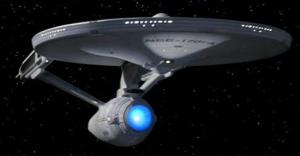
How Star Trek Could Solve the Energy Crisis

In order to travel at warp speed, the starship Enterprise must generate enormous amounts of energy.  It does this using antimatter fuel.  When antimatter touches regular matter, the two explode, releasing 100% of their energy.  By contrast, nuclear fission only releases about 1% of the energy stored in uranium atoms.  To make things even better, antimatter leaves no gas fumes, no nuclear waste, nothing to hurt the environment.

Antimatter could not only propel starships through space, but it could solve our energy crisis.  Unfortunately, any antimatter supplies that may have existed on earth touched some matter long, long ago and exploded.  So we have to make it using particle accelerators, which is an extremely difficult and expensive process.

In recent years, however, scientists have found antimatter in some of the most unlikely places.  Antiprotons, produced by cosmic rays outside our Solar System, are getting caught in Earth’s magnetic field.  Scientists at NASA say they’ve also discovered that positrons, or antielectrons, are sometimes produced by thunderstorms.  These positrons get caught in Earth’s magnetic field too.  They’re just sitting up there, waiting for us to collect them.

Individual particles of antimatter won’t do much by themselves.  When a positron collides with a satellite in orbit, for example, it destroys one electron in that satellite in a microscopic explosion.  It doesn’t damage the satellite, and it doesn’t threaten the safety of astronauts.  But imagine what we could do if we gathered all those particles together, stored them safely, and put them into a power plant.

For more on antiprotons in Earth orbit, click here.  For more on positrons made by thunderstorms, click here.

Sci Friday – Heavenly Palace

Advancements in space tend to take a lot longer than planned, so China’s rapid progress building a new space station (known as the “Heavenly Palace”) is quite a surprise.  About a month ago, they launched the first test segment; this week, they launched the second and connected them together.  Seems they’re well on their way to having it finished on schedule by 2020.  I can’t remember the last time NASA finished anything on schedule.

Anyway, here are this week’s sciency links, starting with China’s space station and NASA’s ongoing problems.

Surfing Gravity Waves

Science is full of long-shot experiments, like SETI’s search for extra-terrestrial life or CERN’s search for the Higg’s Boson (an experiment which should wrap up soon).  There’s also the search for gravity waves, and research instillations all over the world are trying find them even though they’re supposed to be next to impossible to detect.

Albert Einstein first predicted gravity waves as part of his theory of relativity.  If you drop a large stone into still water, the water ripples.  In the same way, when something big happens in the universe, such as the collision of two black holes, it should cause space itself to ripple.  Using sensitive equipment spread across the world, scientists hope to detect these ripples in space.

There are currently three gravity wave detectors in the United States and others scattered all over the world.  Officials recently announced plans for a new one in India.  The more detectors the better because while an earthquake might accidentally set off a few only a gravity wave would trigger them all.

If researchers do detect a gravity wave, it will give them an opportunity to study gravity in a whole new way.  I have no idea what kinds of things they could learn, but as a science fiction writer I can always make stuff up.  They might discover a way to create artificial gravity or maybe even antigravity.  Or perhaps, if it’s possible to generate artificial gravity waves, we could ride them like surfers and travel all over the galaxy.

For more on gravity waves, click here.  For more on the plans for the new gravity wave detector in India, click here.